Buyer Fit Snapshot
| Best fit | Custom Folding Cartons for Cosmetics projects where brand print, material claims, artwork control, MOQ, and repeat-order consistency need to be specified before quoting. |
|---|---|
| Quote inputs | Share finished size, material target, print colors, finish, packing count, annual reorder estimate, ship-to region, and any compliance wording. |
| Proofing check | Approve dieline scale, logo placement, barcode or warning zones, color tolerance, closure strength, and carton packing before bulk production. |
| Main risk | Vague material claims, crowded artwork, missing packing details, or unclear freight terms can make a low unit price expensive after revisions. |
Fast answer: Custom Folding Cartons for Cosmetics: Board, Finish, Dieline, and Unit Cost should be specified like a repeatable production item. The safest quote records material, print method, finish, artwork proof, packing count, and reorder notes in one written spec.
Production checks before approval
Compare the actual filled-product size with the drawing, then confirm tolerance on folds, seals, hang holes, label areas, and retail display edges. Reserve space for logos, QR codes, warning copy, and material claims before decorative graphics fill the panel.
Quote comparison points
Review material grade, print process, finish, sampling route, tooling charges, carton quantity, and freight assumptions side by side. A quote is only useful when the supplier can repeat the same color, closure quality, and packing count on the next order.
Custom Folding Cartons for Cosmetics: A Practical Guide
Good cosmetic packaging earns trust before anyone cracks the seal. Bad packaging does the opposite, usually fast. That is why Custom Folding Cartons for cosmetics matter so much: they protect the product, carry the required copy, and do a lot of brand work in the first few seconds on shelf. If the carton feels flimsy, the product feels cheaper. A mirror-finish lipstick tube does not fix that.
For brands building serums, lip products, eye creams, or compacts, Custom Folding Cartons for cosmetics are often the smartest retail packaging choice. They ship flat, store neatly, and can be printed, coated, embossed, foiled, or kept stripped back depending on the price point. Think of them as part of the product, not as a box someone remembered at the last minute. That is the difference between packaging that supports the sale and packaging that looks improvised.
If you want a broader starting point, our Custom Packaging Products page is a useful place to compare formats before you lock the structure.
What Custom Folding Cartons for Cosmetics Really Are
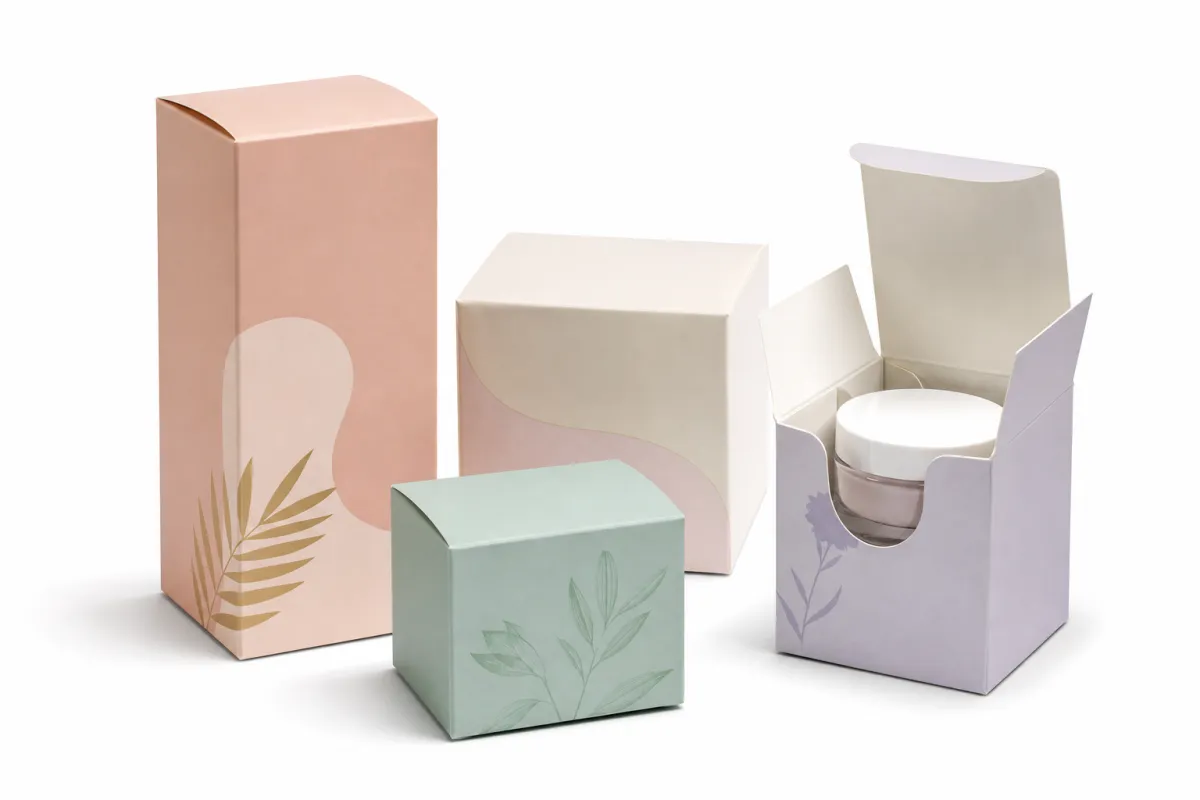
Custom folding cartons for cosmetics are paperboard Boxes That Ship flat, fold into shape, and hold retail beauty products like serums, creams, lip gloss, mascara, fragrance minis, and compacts. That is the basic idea. They are not rigid boxes. They are not mailers. They are the familiar folding carton format you see on shelves every day, built around your exact size, print, and compliance needs.
From a packaging buyer's perspective, custom folding cartons for cosmetics do three jobs at once. They protect the product from scuffing, light handling, and ordinary transit abuse. They carry the copy a customer actually needs to read: ingredients, warnings, net contents, barcode, and usage notes. They sell the brand in a glance. That is why packaging design matters more than people like to admit. A clean carton makes a small product feel more complete and more trustworthy.
Here is the shelf reality: a great cream in a dull carton looks like a bargain-bin item before anyone turns it over. A tidy carton with sharp print, disciplined layout, and one or two smart finishing touches can raise perceived value without turning the box into a circus. That is where custom folding cartons for cosmetics earn their keep. The formula might be excellent, but the carton is the first proof.
They also sit in a very specific lane compared with other formats. Rigid boxes signal premium and cost more. Tubes work for some formulas, but not all. Mailers are for shipping, not shelf presentation. Custom folding cartons for cosmetics make the most sense when you need retail packaging that folds flat, runs efficiently, and still supports branded packaging at scale. For many SKUs, they give the best balance of cost, print freedom, and shelf presence.
"A carton is not decoration. It is the product's first sales call."
That sounds blunt because it is true. In custom printed boxes for beauty products, every millimeter matters. If the carton is too loose, the product rattles. If it is too tight, packing slows down and returns creep up. If the graphics ignore the structure, the final box looks like a design file that never met a die line. Custom folding cartons for cosmetics have to earn their place in the line, not just look pretty in a PDF.
How Custom Folding Cartons for Cosmetics Move from Dieline to Shelf
The production path for custom folding cartons for cosmetics usually follows the same sequence: brief, structure, dieline, artwork, sample, print, finish, die cut, fold, pack, ship. That sounds neat because the process wants to be neat. Real projects are messier. The smooth jobs are the ones where product dimensions are final, legal copy is clean, and nobody changes the closure style after proof approval.
Typical timelines are measured in weeks, not days. A simple run of custom folding cartons for cosmetics can move in about 10 to 15 business days after final proof approval, depending on quantity and factory load. Add foil, embossing, windows, or custom inserts, and the schedule can stretch to 15 to 25 business days or more. Sampling usually adds a few days, especially if you need a physical prototype before you greenlight the run. Try to rush structure, artwork, and compliance at the same time and the schedule gets ugly fast.
The bottlenecks are predictable. Dieline dimensions need to match the actual product. Barcode placement needs enough quiet space to scan. Ingredient copy has to fit without shrinking into unreadable mush. Color expectations should be based on a proof standard, not a fuzzy memory of what the screen looked like at 2 a.m. With custom folding cartons for cosmetics, one late correction can shove the whole job back because print, cutting, and folding all depend on each other.
Smart brands lock the structure first, then the copy, then the artwork. That order saves headaches. Once the carton size changes, the layout changes. Once the layout changes, the proof changes. Once the proof changes, the schedule changes. Somehow that still surprises people. It should not. Custom folding cartons for cosmetics are mechanical as much as visual, and the machine does not care how much the design team loves the concept.
If the carton is for a new formula or a premium launch, ask for a sample. A screen mockup can be kind of persuasive in the way a polished showroom is persuasive. It shows the dream, not the bruises. A physical sample shows whether the carton will pack quickly, open cleanly, and hold up on shelf. That matters more than a presentation deck with pretty shadows.
For transit testing, a useful reference point is ISTA transport testing. Not every cosmetic carton needs full lab validation, but if the product is fragile or moving through distribution, a little testing beats guesswork. For board sourcing and chain-of-custody questions, FSC is worth a look too, especially if sustainability claims will sit on the carton.
One more practical note: if your custom folding cartons for cosmetics need a barcoded retail setup, ask the prepress team to confirm quiet zones and contrast before print. I have seen more than one launch stall because the barcode sat too close to a fold. Small thing. Big annoyance if missed.
Key Factors That Shape Custom Folding Cartons for Cosmetics
Material selection is the first serious decision. Custom folding cartons for cosmetics are usually made from SBS, C1S, C2S, kraft, or recycled board. SBS gives you a bright, smooth surface and excellent print quality, which is why it shows up so often in premium product packaging. C1S and C2S can help if you want different print and interior behavior. Kraft gives a more natural, earthy look, while recycled board supports a lower-impact story if the brand voice actually matches it. Do not pick the board just because it sounds responsible. Pick it because it fits the product, the visual direction, and the retail channel.
Structure matters just as much. Straight tuck, reverse tuck, tuck end, seal end, sleeve, and tuck top styles all have different strengths. A lightweight serum may do well in a standard tuck carton. A heavier jar may need a stronger bottom style. Fragile cosmetics often benefit from inserts, and some formats need a tighter closure to reduce movement. Custom folding cartons for cosmetics are not one-size-fits-all, because the fill method, shelf weight, and opening experience all change the choice.
Finishing is where many brands get carried away. CMYK print is the base. PMS spot color is for tighter brand control. Foil, embossing, debossing, soft-touch lamination, and spot UV can all lift perceived value. They can also add cost and make production less forgiving. One deliberate finish usually looks better than five competing effects fighting for attention. That is packaging design 101, even if some mood boards suggest otherwise. With custom folding cartons for cosmetics, restraint usually reads more premium than noise.
Compliance is not glamorous, but it is non-negotiable. Ingredient panels need to be legible. Warning copy needs room. Net contents need a sensible location. Batch codes, country-of-origin text, and barcode placement should be planned early. If the carton has claims, those claims need to be supportable. Custom folding cartons for cosmetics can handle all of that, but only if the layout respects both regulatory and retail packaging realities. Pretty copy that cannot be read from shelf distance is not helping anyone.
Windows, inserts, and tamper-evident features can also change the build. A window can show the product and reduce uncertainty, but it introduces die-cut complexity and a small cost bump. Inserts improve presentation and protection, especially for glass bottles or delicate applicators. Tamper-evident details may be worth it for higher-value formulas or sensitive markets. The point is not to load the carton with extras. The point is to use the right feature for the product.
If your line includes multiple shades or formulas, think about structure reuse. Custom folding cartons for cosmetics become easier to manage when the base carton stays consistent and only the artwork shifts. That reduces setup time, simplifies packing, and keeps the shelf system cleaner. It also helps with brand consistency, which is the whole job of package branding anyway.
Common board and finish choices
The best-looking carton is not always the most expensive one. Here is a simple way to compare common options for custom folding cartons for cosmetics:
| Option | Typical use | Typical unit cost at 5,000 pcs | Tradeoff |
|---|---|---|---|
| 16pt SBS, CMYK | Mass market or clean clinical look | $0.18-$0.30 | Affordable, but less tactile impact |
| 18pt SBS, CMYK + soft-touch | Mid-premium skincare and beauty | $0.24-$0.42 | Feels nicer, adds coating cost |
| Kraft or recycled board, 1-2 colors | Natural or earth-first branding | $0.22-$0.40 | Looks honest, but limits bright color work |
| Premium board with foil or embossing | Launches, prestige skincare, gift sets | $0.38-$0.85 | Strong shelf impact, higher setup and press time |
The price range above is not a promise. It is a working reference. Size, quantity, print coverage, finishing, and insert choice all shift the numbers. Still, it helps because custom folding cartons for cosmetics are usually priced by a mix of appearance, protection, and run length, not just by the cost of paperboard.
For brands that want a cleaner path, I usually recommend choosing one premium detail and one practical strength. Maybe that is soft-touch plus a strong structural fit. Maybe it is embossing plus a clean matte print field. Maybe it is a recycled board with a well-planned spot color system. The point is to let custom folding cartons for cosmetics do one or two things very well instead of six things badly.
Cost and Pricing for Custom Folding Cartons for Cosmetics
Pricing for custom folding cartons for cosmetics is driven by a short list of variables: quantity, board type, box size, print coverage, finishing complexity, inserts, and the number of SKUs in the run. That is the honest version. Anyone promising a magic low number without seeing the dieline is either guessing or selling trouble later.
Higher volumes usually reduce unit cost because setup gets spread over more pieces. Lower volumes can still work, but the setup and tooling charges matter more. This is where brands sometimes get annoyed: the first box does not cost the same as the thousandth. Packaging is math. Annoying, but useful. If you want custom folding cartons for cosmetics in a small run, expect the unit price to stay higher until the quantity starts absorbing the fixed work.
Oversized cartons are a common waste. If the box is built too large because the team wants it to "feel premium," you pay for more board, more freight, and more shelf dead space. Too many finishes can also backfire. If you pile on foil, UV, embossing, and multiple inks, the carton is gonna look busy. For custom folding cartons for cosmetics, the smart spend is usually on fit, print clarity, and one detail that reinforces the brand.
Here is where brands can save money without making the box look cheap: standardize dimensions, simplify finishing, and reuse a base structure across shades or formulas. That is much better than redesigning every SKU from scratch. It also keeps your custom printed boxes easier to reorder. When a product line grows, consistency is worth more than novelty.
"The cheapest carton is not the one with the lowest quote. It is the one that does not create rework, delay, or a shelf problem."
That line sounds blunt because the damage from a bad spec shows up later in packing labor, damaged units, or markdowns. For custom folding cartons for cosmetics, a low initial quote can still become the expensive option if the carton is hard to assemble or the finish fails on press. I would rather see a clean carton at a fair price than a bargain carton that behaves badly.
Brands often ask where the money really goes. The answer is usually in the production choices they cannot see at first glance: die tooling, color matching, coating pass count, insert assembly, and proofing rounds. Once you understand that, custom folding cartons for cosmetics stop feeling mysterious. They are not cheap or expensive by default. They are designed and specified into a price band.
To keep comparisons clear, use quotes that break out board, print, finishing, and freight separately. If a supplier gives you one lump number and no detail, that is not transparency. It is a guessing game with nicer stationery.
Step-by-Step Ordering Process for Custom Folding Cartons for Cosmetics
Start with the product itself. Measure the finished item, including closure height, cap shape, and any insert or applicator that has to fit inside. Do not size custom folding cartons for cosmetics off the label art or the bottle body alone. That mistake causes crushed corners, loose fit, and packing bottlenecks. The carton should be built around the real product, not the best-case sketch.
Next, choose the structure and confirm the dieline. This is the part that saves people from their own enthusiasm. A design team can make almost anything look good on a screen. The dieline is where the box tells the truth. Once the structural shape is fixed, the artwork can be built around safe zones, folds, and panel behavior. With custom folding cartons for cosmetics, structure first is the boring answer that saves money.
Then comes the artwork and copy. Keep the legal text readable. Keep the barcode in a clean area. Keep brand marks away from folds if they need precision. If the carton carries multiple claims, make sure the hierarchy still works at retail distance. The best cosmetic cartons are not crowded. They are disciplined. Good custom folding cartons for cosmetics make the message feel intentional instead of crammed.
After that, review proofs line by line. Look at color expectations, finish callouts, ingredient text, barcode placement, spellings, and any country-specific requirements. If the product will be sold in more than one market, the copy review matters even more. A careless approval can wreck a whole run, and then everyone acts shocked when the production schedule moves. It moves because the carton has to be correct before it can be printed.
If the SKU is premium, fragile, or structurally unusual, approve a physical sample before the full run. Screen mockups can be kinda persuasive. They show the dream, not the bruises. A sample shows whether custom folding cartons for cosmetics open smoothly, stack properly, and protect the product during packing and transit.
Then confirm logistics. Know the lead time, the carton count, the packing method, and the freight plan. If the cartons are going to a co-packer or fulfillment center, ask how they want them packed. That one detail can save days later. The same is true for pallet height and carton labeling. Custom folding cartons for cosmetics should arrive ready for the line, not ready for another round of sorting.
For convenience, this is the short version of what to send a packaging supplier:
- Finished product dimensions and closure details
- Target quantity and reorder expectations
- Board preference, if you have one
- Artwork files and legal copy
- Finish preferences and must-have effects
- Timeline, shipping destination, and packing requirements
If you are comparing vendors, ask for custom printed boxes that include the dieline, quote breakdown, sample option, and production schedule in writing. That makes the decision easier. It also exposes who is organized and who is just optimistic.
Common Mistakes With Custom Folding Cartons for Cosmetics
The first mistake is designing before the structure is final. Pretty graphics are nice. A box that does not close correctly is not. Custom folding cartons for cosmetics need structural discipline before anyone starts arranging gradients, logos, or foil accents. If the dieline changes after the artwork is built, the team spends time fixing problems that should never have existed.
The second mistake is leaving too much empty space inside the carton. Oversizing wastes board, increases freight, and makes the product feel underpackaged. It also creates movement, which can scuff the product or weaken the shelf impression. A compact, well-fitted carton usually looks more intentional than a larger one with air inside it. That matters in retail packaging, where customers read size and substance fast.
The third mistake is treating compliance copy as a late add-on. Ingredients, warnings, barcode specs, and origin statements are not decoration. They are part of the box. If the layout does not leave room for them, the design becomes cramped and hard to read. Custom folding cartons for cosmetics should make legal copy readable without making the brand look like a medicine cabinet label from hell.
The fourth mistake is stacking too many finishes. I see this all the time. Someone wants foil, embossing, spot UV, matte lamination, and a custom interior. That can work if the brand budget is healthy and the concept is disciplined. More often, it looks busy. One strong finish usually does more for custom folding cartons for cosmetics than a pile of effects fighting for attention.
The fifth mistake is skipping prototype review on a new format or a new fill size. That is where people get surprised by closures that fight back, inserts that do not align, or product shapes that make the carton bulge. If you have never run that SKU before, prototype it. Skipping that step on custom folding cartons for cosmetics is a very expensive way to learn humility.
Another trap is ignoring channel differences. A carton for a boutique shelf is not always the same carton for Amazon, salons, or mass retail. Product packaging should match the real channel, because handling conditions and customer expectations differ. A carton that looks elegant in a display case may need more structure if it is going through a rougher supply chain.
Expert Tips and Next Steps for Custom Folding Cartons for Cosmetics
Build around one proven structure first, then vary graphics across the line. That keeps custom folding cartons for cosmetics easier to reorder and easier to manage when the range expands. A stable base also helps co-packers, because packing a familiar structure is faster and less error-prone. Repetition is not boring here. It is efficient.
Choose a finish hierarchy instead of a finish pile. Spend on the detail customers will notice first. Maybe that is a soft-touch surface. Maybe it is a foil logo. Maybe it is a crisp emboss on the brand mark. Do not spend money on effects that only show up under studio lighting. Custom folding cartons for cosmetics should earn their premium feel on shelf, not just in a presentation deck.
Ask for three things before you approve any run: a sample, a dieline, and a firm timeline. That sounds basic because it is basic. Yet this is where projects still drift. A sample confirms fit. A dieline confirms structure. A clear timeline confirms whether the supplier can actually hit the date. With custom folding cartons for cosmetics, those three items save more stress than any polished mockup ever will.
It also helps to compare options side by side instead of asking for a vague "best quote." The best quote for a prestige serum may be wrong for a clinic line. The best quote for a small run may be wrong for a growing brand that needs steady reorders. I would rather see three options with clear differences in board, finish, and lead time than one mysterious number with a smile attached.
If you want a clean path forward, start here: define the product, gather the must-have copy, choose the structure, request a sample, and compare quotes with the same specs. Then pick the carton that protects the product, supports the brand, and fits the schedule. That is the real job of custom folding cartons for cosmetics. Not vanity. Not fluff. Just packaging that does what it should.
For brands building out retail packaging options, this is usually the point where clarity beats creativity. Good custom folding cartons for cosmetics balance shelf impact, regulatory clarity, and practical production timing. That balance is what keeps a launch from turning into a repair project.
If you are also comparing custom printed boxes across different product lines, reuse the structure where you can and reserve the fancy stuff for the SKUs that really need it. That is how you protect budget without flattening the brand.
Custom folding cartons for cosmetics are most useful when they make the product look trustworthy, keep the compliance team calm, and move through production without drama. The easiest way to Choose the Right one is simple: lock the fit first, keep the copy readable, and spend your finish budget where shoppers will actually notice it.
What size custom folding cartons for cosmetics should I order?
Base the carton on the finished product size, not the jar or bottle label size. Leave enough clearance for inserts, closures, and easy packing without letting the product rattle. Ask for a dieline before artwork so the size is locked before design work starts.
How long do custom folding cartons for cosmetics usually take?
Simple runs can move faster, but sampling, approvals, and finishing choices usually set the real timeline. Expect extra time for foil, embossing, windows, or custom inserts. The fastest way to lose days is changing copy or box size after proof approval.
Are custom folding cartons for cosmetics expensive?
They can be very affordable at scale, but unit price depends heavily on quantity and finish complexity. Setup costs matter more on small runs, while print and material choices matter more on large runs. A clean structure with one strong finish usually beats a box overloaded with extras.
What materials work best for cosmetic folding cartons?
SBS is common for bright, clean print results. Kraft or recycled board works well when the brand wants a more natural look. Heavier board is worth it when the product is premium, fragile, or needs more shelf presence.
What should be printed on custom folding cartons for cosmetics?
Include the product name, net contents, ingredients, warnings, usage instructions, barcode, and brand identity. Keep legal copy readable and place it where it will not fight the design. Check that any claims on the carton are supportable and consistent with the product label.

