Buyer Fit Snapshot
| Best fit | Custom Folding Cartons with Window projects where brand print, material claims, artwork control, MOQ, and repeat-order consistency need to be specified before quoting. |
|---|---|
| Quote inputs | Share finished size, material target, print colors, finish, packing count, annual reorder estimate, ship-to region, and any compliance wording. |
| Proofing check | Approve dieline scale, logo placement, barcode or warning zones, color tolerance, closure strength, and carton packing before bulk production. |
| Main risk | Vague material claims, crowded artwork, missing packing details, or unclear freight terms can make a low unit price expensive after revisions. |
Fast answer: Custom Folding Cartons with Window: Board, Finish, Dieline, and Unit Cost should be specified like a repeatable production item. The safest quote records material, print method, finish, artwork proof, packing count, and reorder notes in one written spec.
Production checks before approval
Compare the actual filled-product size with the drawing, then confirm tolerance on folds, seals, hang holes, label areas, and retail display edges. Reserve space for logos, QR codes, warning copy, and material claims before decorative graphics fill the panel.
Quote comparison points
Review material grade, print process, finish, sampling route, tooling charges, carton quantity, and freight assumptions side by side. A quote is only useful when the supplier can repeat the same color, closure quality, and packing count on the next order.
Custom Folding Cartons With Window: Buyer's Guide for Brands
Shoppers make a judgment in seconds, and often faster than brands like to admit. When they can see the product, that decision gets even quicker. That is the practical reason Custom Folding Cartons with window so often outperform fully enclosed packs in categories where color, texture, freshness, or finish carries real selling power. The opening is not there just to look pretty; it gives the eye a direct read on the item before anyone has time to overthink it.
For brands trying to balance retail packaging, protection, and shelf presence, this format sits in a useful middle ground. It leaves room for branding, legal copy, and package branding details while still letting the product become part of the presentation. That balance matters more than many buyers expect, especially once the box is sitting beside louder competitors and the shelf starts feeling crowded.
If you already use custom printed boxes or other branded packaging formats, a windowed carton deserves a close look. It shifts the conversation from "what does the box say?" to "what does the product look like?" and that small change can move buying behavior in a real way.
A window is not decoration. It is a quiet promise that the product can stand in plain view.
Why custom folding cartons with window stop shoppers
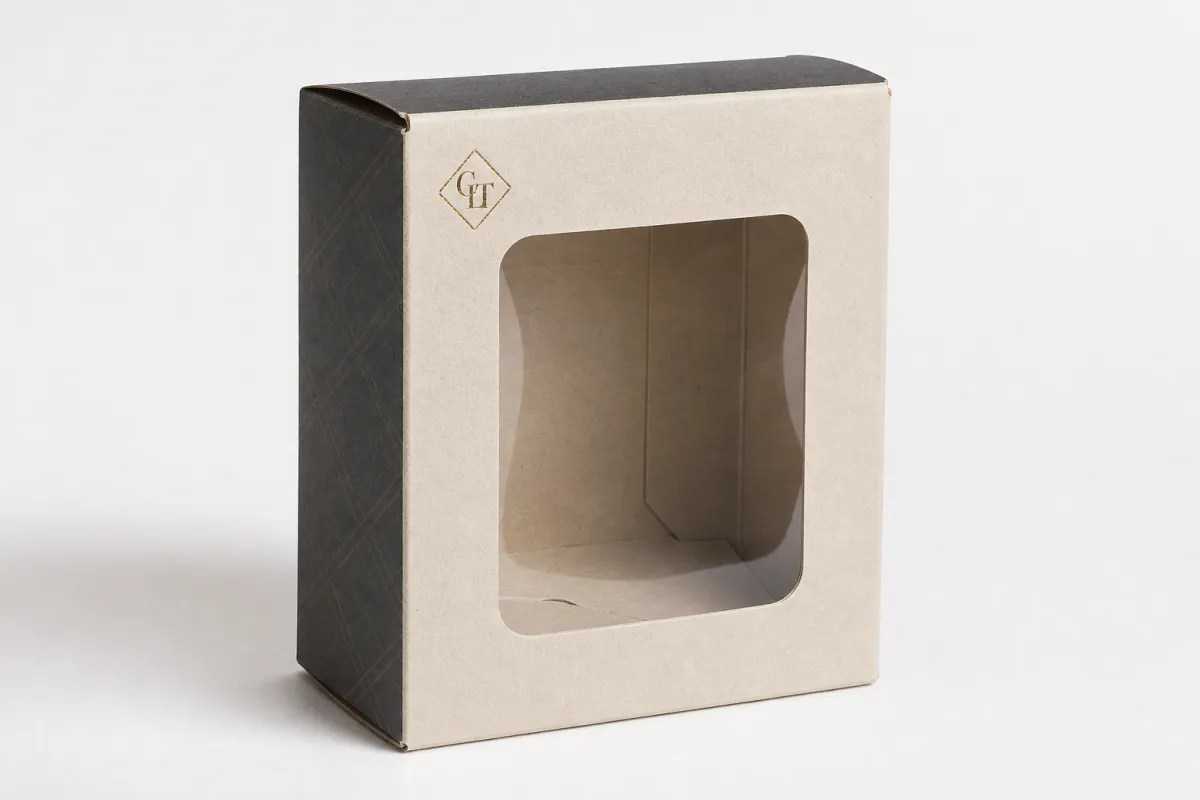
In a crowded aisle, visibility tends to win before decoration does. A shopper scans a clear opening, reads color, freshness, texture, or shape, and makes a rough quality call before reading a single line of copy. That is one reason Custom Folding Cartons with window often feel stronger than opaque cartons in categories where appearance carries real weight.
The eye does not study a carton panel by panel. It looks for contrast, clarity, and a signal that the item matches the price. Once the product is visible, the carton does less explaining and more framing. That shift matters in packaging design, because the package no longer has to carry every selling point on its own.
The format works especially well for cosmetics, baked goods, candles, supplements, tea, small gifts, and premium food items. In those categories, buyers often want to inspect shape, fill level, finish, or freshness cues before they commit. A window answers that need without stripping away the brand's own messaging.
There is also a business case that gets missed. A well-placed window can reduce the need for oversized graphics because the product itself becomes part of the story. Instead of crowding the panel with every promise, the carton can stay cleaner and more focused. That can make Custom Folding Cartons with window feel more premium, not less.
From a packaging buyer's perspective, the format bridges two goals that often pull in different directions: selling on shelf and protecting in transit. The best product packaging does both. The window gives shoppers a preview, while the carton still provides the panel space needed for ingredients, instructions, barcodes, warnings, and branding hierarchy.
The format is not right for every item. It works best when the visible product is part of the purchase decision. If the item is dull, inconsistent, or likely to shift in the box, the window can expose problems instead of solving them. That is why Custom Folding Cartons with window should be treated as a structural choice, not a decorative extra.
- Best use cases: premium bakery items, candles, cosmetics, soaps, teas, giftable retail goods
- Strong buying cues: freshness, color, texture, fill level, shape, or finish
- Less effective when: the product moves around, scratches easily, or needs full opacity for compliance or privacy
Brands that get this right usually understand one simple rule: the window should reveal the most persuasive part of the product, not just any part. That is the difference between a carton that merely shows and a carton that sells.
How custom folding cartons with window are built
The build starts with board selection. That sounds basic, but it influences stiffness, print quality, fold performance, and how well the carton supports itself around the opening. For most folded cartons, 14 pt to 24 pt paperboard is common, with 16 pt, 18 pt, and 20 pt showing up often in mid-range retail work. Heavier board can improve rigidity, yet it also changes scoring, gluing, and cost.
The next step is the dieline. This is where structure becomes concrete: panel sizes, fold lines, tuck flaps, glue areas, and the exact aperture are mapped before printing starts. If the dieline is weak, the finished carton can lose alignment quickly. Experienced suppliers treat the structural drawing as part of the project, not a formality to fill in later.
The window itself can be handled in a few ways. Some cartons use a clear film, usually PET, rPET, or cellulose, to cover the opening and protect against dust or light surface contact. Others use an open cutout when the product is already wrapped, bagged, or nested inside a tray. Each option changes the visual effect, the assembly steps, and the amount of protection the pack can provide.
From a converting standpoint, the sequence is direct: print the board, die-cut the blanks, apply the window film or insert, then fold and glue the carton so it ships flat. The catch is that each step depends on the one before it. A clean print job can still fail if the cutout is off by a few millimeters or the glue pattern overlaps the visible area.
That is why custom folding cartons with window are not just boxes with a hole. They are a structural and visual system. The strongest versions are built so the aperture, graphics, and fold behavior all support the same selling point. If the window sits too close to a score line, the board can weaken. If it is too large, the panel can lose the stiffness needed to keep a crisp face on shelf.
The tradeoff is simple, and it is not forgiving: a larger window improves visibility, but it removes board material. Once material comes out of the design, the rest of the carton has to carry more load. That is where reinforcement, panel placement, and film choice begin to matter.
Two standards deserve attention here. If the cartons will move through demanding supply chains, ask whether the pack should be evaluated under ISTA procedures or related ASTM transport conditioning methods. If you are sourcing fiber responsibly, ask about FSC chain-of-custody documentation. Those details are not flashy, but they matter when the carton has to survive more than a simple hand-off.
One more practical note: if the visible product needs to stay centered, an insert can matter more than the outer carton itself. The window may get the attention, yet the hidden support often decides whether the finished pack looks premium or careless. I have watched more than one strong concept get dragged down by a loose interior, and it is kinda frustrating because the fix is usually straightforward once someone spots it.
Custom folding cartons with window pricing factors
Pricing starts with the board, but it does not end there. The unit cost for custom folding cartons with window depends on board grade, print coverage, coating, window size, and whether the opening needs a film overlay or a more complex insert. A plain white carton with a modest window will price very differently from a carton with full-color graphics, foil, embossing, and a specialty finish.
Quantity matters just as much. Setup, die creation, press preparation, and window application take time no matter how many boxes you order. A 1,000-piece run can look expensive per unit, while a 10,000-piece run often drops sharply because the fixed costs spread across more cartons.
MOQ pressure is real. Some suppliers can run short quantities with digital print, while others need enough volume to justify tooling and make-ready time. If a custom die has to be created for a unique window shape, the project may also carry a one-time tooling charge. Buyers who skip that question early often get surprised later.
Here is the practical comparison most brands need first:
| Build level | Typical quantity | Common specs | Approx. unit cost | Best fit |
|---|---|---|---|---|
| Basic window carton | 5,000+ | 16 pt SBS, standard print, clear film window | $0.18-$0.35 | Entry retail packaging, simple branded packaging |
| Mid-tier retail carton | 3,000-10,000 | 18 pt board, matte or aqueous coating, custom dieline | $0.30-$0.55 | Cosmetics, candles, premium food, custom printed boxes |
| Premium presentation carton | 2,500+ | 20 pt board, foil, embossing, soft-touch, insert or tray | $0.55-$0.95 | Gift sets, luxury product packaging, launch items |
Those ranges are directional, not a promise. Print coverage, ink density, finishing complexity, and the carton style itself can shift the number quickly. A small tuck-end carton is not priced the same way as a rigid-looking fold-and-glue structure with a large display window.
For apples-to-apples quotes, insist on the same quantity, the same board weight, the same window material, and the same finishing. Otherwise, two estimates can look close while actually describing very different products. That is one of the easiest ways to lose visibility on real cost.
If you want to compare multiple suppliers, ask for three price points: test quantity, standard run, and volume break. That gives you a clearer view of where the economics begin to improve. It also helps you decide whether the project should stay in a modest launch phase or move immediately into larger production.
One honest observation: the cheapest carton is not always the best value. If a low-price quote uses weaker board or a flimsy window attachment, the box can crease, bow, or arrive looking tired. That hurts shelf performance, and shelf performance is where the revenue lives.
Process and timeline: custom folding cartons with window
The project usually moves through six stages: discovery, structural design, artwork approval, prototype review, production, and finishing. Delays often appear when one stage starts before the previous one is fully signed off. If the artwork is still changing while the dieline is in motion, the timeline can slip by days or even weeks.
Good packaging teams begin with the product itself. They ask for dimensions, fill weight, fragility, shelf channel, and the visual point the brand wants the window to reveal. That information tells the supplier whether the carton needs more stiffness, a different aperture, or an insert that keeps the item centered. In practice, a carton that fits the product cleanly almost always looks more expensive.
After that comes proofing. A flat proof checks graphics, bleeds, fold lines, and barcode placement. A physical sample or prototype matters even more when the window is involved, because the eye is judging the opening as much as the artwork. Does the opening reveal the best angle? Does the product sit too high or too low? Does the flap close without fighting the insert? Those answers only show up in the sample stage.
Production then follows the standard converting sequence: print the sheets, die-cut the blanks, apply the window, fold and glue, and pack for shipment. A simple run with standard paperboard can move fairly quickly, often around 12-15 business days from proof approval, though specialty finishing or unusual insert work can extend that. If a supplier says every window carton takes the same amount of time, ask them to explain the assumptions.
Timeline risks are usually predictable. Late artwork changes are the biggest one. Specialty finishes such as foil, embossing, or soft-touch coating add another layer of coordination. Material shortages can also slow the job, especially if the board or film spec is unusual. The fastest custom folding cartons with window projects are the ones where the spec is locked before production begins.
One useful planning habit is to treat the pack schedule like a chain. Structural approval, artwork approval, sample sign-off, and production release all need to happen in order. If one link is loose, the rest wobble.
Step-by-step ordering plan for custom folding cartons with window
Start with a product audit. Measure the item accurately, note the weight, and decide what the window should reveal. That could be texture, fill level, color, or a premium finish on the product itself. The opening should frame the selling point, not expose dead space or random packing material.
Then choose the job the carton needs to do. Is it primarily a shelf-selling pack, a shipping container, or a mix of both? The answer controls the board thickness, the closure style, and whether an insert is necessary. A carton that only has to look good for a store shelf is solving a different problem from one that has to survive parcel handling.
At this point, ask for a structural recommendation before final artwork. A good dieline lets the logo, legal copy, barcode, and window sit in a coherent layout. A poor one forces the designer to fight the structure, and that rarely ends well. If you already need other formats, it can help to compare the carton against related Custom Packaging Products so the project stays aligned with the rest of the line.
Once you have a dieline, review a prototype with the real product inside it. This is where many hidden issues surface. Maybe the carton feels too tall on shelf. Maybe the visible area is too narrow. Maybe the insert grips too tightly or not enough. One real sample will usually teach more than several rounds of email notes.
After that, finalize a clean spec sheet. It should include dimensions, quantity, print sides, coating, window material, closure type, insert needs, shipping destination, and any compliance text that must fit on the panel. That one document reduces back-and-forth and gives the supplier enough detail to quote accurately.
For brands that care about sustainability claims, this is also the moment to ask for paper sourcing documentation. FSC-certified board can be a meaningful signal if it fits the brand story. If the pack will go to market with environmental language, the chain of custody should be clear enough that the claim can hold up under scrutiny.
- Measure the product - height, width, depth, and total weight
- Define the visual job - what the window should show and why
- Request a dieline - before artwork is finalized
- Review a sample - with the actual product inside
- Approve the spec sheet - only after dimensions and finishes are locked
A buyer who follows that sequence usually gets fewer surprises, better cost control, and a stronger finished carton. That is the practical path for custom folding cartons with window.
Common mistakes with custom folding cartons with window
The most common mistake is making the window too large. Buyers often assume bigger visibility always helps, but the opposite can happen if the board loses too much support. Corners soften, fold lines weaken, and the face of the carton can start to bow. Once that happens, the pack can look tired before it even reaches shelf.
The opposite mistake shows up just as often: a window that is too small. If shoppers can barely see the product, the carton gives up its main advantage and becomes a standard box with extra labor. That is a poor trade. A window should make the buying decision easier, not more uncertain.
Weak board selection causes another set of problems. Light board may print beautifully, but it can crush during stacking or sag near the cutout. If the product is heavier than average, or if multiple cartons are packed into cases, the board needs enough rigidity to keep its shape through the supply chain.
Product movement is where a lot of good-looking projects fail. If the item slides around inside the box, the visible area can look crooked or messy. That is especially true for candles, jars, tubes, and small gift items. An insert, tray, or snug fit often matters more than the outer graphics. The window reveals whatever is happening inside, including the parts the brand would rather not show.
Then there is the approval trap. A carton can look fine on a screen and still fail in the real world after the dieline, fold areas, and aperture are applied. Every proof should be checked in context. The best teams review the window position, the barcode area, the legal panel, and the product reveal together, not separately.
There is also a brand consistency issue. If your other branded packaging uses a matte, understated look, a loud window carton can feel disconnected. If your package branding is built around luxury cues, an overly plain opening can look underdesigned. The pack has to match the brand system, not fight it.
- Avoid oversized windows unless the structure has been reinforced
- Avoid tiny windows that cannot showcase the product clearly
- Avoid weak board that sags or crushes near the opening
- Avoid loose interiors that let the product drift out of position
- Avoid blind approval without a physical sample
In other words, the window only helps if the rest of the carton is engineered around it. That sounds obvious, but it is one of the most frequent misses in custom folding cartons with window.
Expert tips and next steps for custom folding cartons with window
Use the window as a frame, not just a cutout. Place it where the product texture, color, or shape creates contrast. A pale soap against a deep board, a glossy candle through a matte carton, or a bakery item with visible finish can create instant clarity. Shoppers respond to that kind of visual signal quickly.
Match the finish to the opening. A matte or soft-touch board can make the visible product feel more intentional, while spot gloss or foil can guide the eye toward the window without overwhelming it. The point is not to decorate every panel. The point is to direct attention with restraint.
Ask for three quote scenarios before you commit: a test quantity, a standard run, and a volume break. That will show you where the pricing threshold sits. In many packaging programs, the difference between 2,500 and 10,000 cartons is large enough to affect launch timing, channel strategy, and margin planning.
It also helps to build a short launch checklist before you brief any supplier:
- Exact product dimensions and weight
- Reference photos of the item and current packaging
- Target quantity and replenishment plan
- Required panel copy, warnings, and barcode placement
- Window size preference and product reveal priority
- Coating, insert, and closure requirements
- Shipping destination and carton pack-out expectations
That checklist speeds up quoting, makes structural comparisons easier, and reduces the odds of a late-stage redesign. It also helps you compare custom folding cartons with window against other product packaging options without losing sight of the actual job the carton must do.
One practical insight from the buying side: the strongest packaging programs usually start with the structure, then layer on the graphics. Too many teams do the reverse. They design a beautiful face first, then try to force the structure to fit. The result can be expensive, awkward, or both. A cleaner path is to let the carton geometry support the story from the beginning.
If you are working with an agency or an internal design team, keep everyone focused on the same outcome: sell the product faster, protect it properly, and keep production realistic. That is where custom folding cartons with window earn their keep. They are not the answer to every packaging problem, but for the right product, they are one of the clearest ways to build shelf confidence.
Frequently Asked Questions
What products work best in custom folding cartons with window?
Products that benefit from color, texture, shape, or fill-level visibility tend to perform best, especially cosmetics, bakery items, candles, teas, and giftable retail goods. If the item already looks premium on its own, the window can reduce the need for heavy graphics and let the product do part of the selling. For loose, fragile, or irregular products, add an insert or tray so the visible item stays centered and does not shift during shipping.
How much do custom folding cartons with window cost?
Price depends on board grade, print coverage, coating, window material, quantity, and how complex the die-cut structure is. Larger runs usually reduce the unit cost, while low-volume orders often pay more because setup, tooling, and press preparation are spread across fewer cartons. Ask for quotes at multiple quantities so you can see where the best cost break happens before you lock the order for custom folding cartons with window.
How long does custom folding cartons with window production take?
The timeline usually includes approval of the structure, artwork, sample review, then print, die-cut, window application, gluing, and packing. Late artwork edits, specialty finishes, or material shortages are the most common reasons lead time stretches. A locked spec sheet and fast approvals are the best ways to keep the project moving, especially if custom folding cartons with window need to launch alongside other retail packaging.
Do custom folding cartons with window protect products as well as solid cartons?
Yes, if the board strength, insert design, and window placement are selected correctly for the product weight and shipping method. A film-backed window can still provide dust protection and visual access without weakening the pack too much. If the product is heavy or likely to shift, use internal support so the opening does not compromise safety or appearance in custom folding cartons with window.
What should I send for an accurate custom folding cartons with window quote?
Send exact product dimensions, weight, quantity, and whether the carton needs to ship flat, display on shelf, or both. Include a reference photo, desired window size or location, print finishes, and any insert or closure requirements. The more complete the spec sheet, the faster a supplier can quote accurately and suggest structural changes that may lower cost for custom folding cartons with window.
Start with the product, not the decoration. Decide what the window needs to prove on shelf, size the aperture around that cue, and then lock the structure before artwork goes too far. That sequence keeps custom folding cartons with window practical, cost-aware, and honest about what the pack is supposed to do.

