A plain poly mailer says the order left the building. Custom Frosted Zipper Bags for ecommerce stores say the product was packed with intent, and that difference lands quickly. The bag is not just a container. It can shape the first impression, protect against dust, reduce handling damage, and make an unboxing feel considered instead of accidental.
That is why the format keeps showing up in branded packaging for apparel, beauty, accessories, and small hard goods. It gives a more polished retail look without forcing every SKU into a rigid carton. For teams packing at speed, that matters. So does the fact that a good bag can be standardized across a catalog without creating a dozen special cases.
The appeal is not subtle. Frosted film softens glare, hides fingerprints, and makes the package look controlled even before the logo is seen. A clear bag can show every crease and scratch; a frosted one absorbs a lot of that visual noise. The result is less polished by accident, more polished by design.
Why custom frosted zipper bags for ecommerce stores feel premium fast
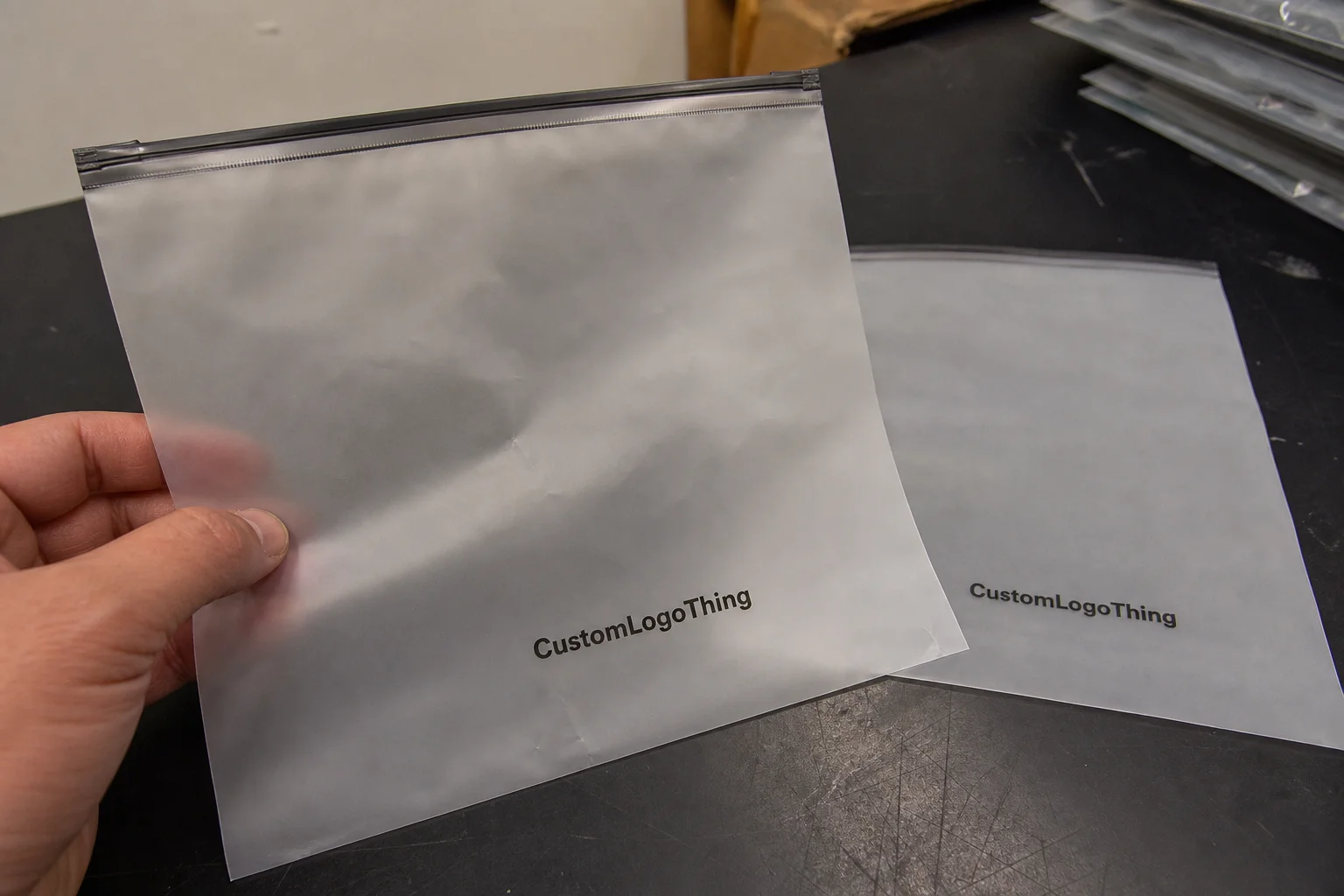
Frosted plastic lands in a useful middle ground. It is translucent enough to hint at the product, but muted enough to keep the package from looking busy. That works especially well for folded tees, socks, skin-care kits, cables, stationery, jewelry sets, and other items where the packaging should frame the product rather than compete with it.
There is a branding advantage here that gets underestimated. A simple logo on a frosted surface often reads cleaner than a dense graphic on a glossy bag. Minimal marks also age better across seasonal changes and product refreshes. If the bag is part of the brand system, restraint usually does more than decoration.
From a buyer’s perspective, the economics are straightforward. A frosted zipper bag usually costs less than a custom printed box and still feels more deliberate than a plain mailer. That gap matters for ecommerce brands that need a retail-ready presentation without turning every order into a packaging project.
Good packaging fails when the spec is wrong, not when it looks simple. Overworked print, undersized film, and sloppy zipper construction cost more in perception than they save in unit price.
If you need a broader packaging vocabulary or want to compare formats before locking a spec, Packaging School and industry resources are useful references. They will not pick the bag for you, but they help keep the discussion grounded in actual packaging terms.
How frosted zipper closures protect products in transit
The zipper is the practical feature that gives this format a broader job. A decent press-to-close seal keeps dust out during storage, keeps loose components from drifting inside the pack, and makes the item easier to reopen if the customer needs to return or repack it. That is why these bags often work both as customer-facing packaging and as an inner layer inside a larger shipping setup.
The frost finish helps in another quiet way: it hides wear. Bags get handled in warehouses, slid into cartons, stacked, shifted, and sometimes rubbed against rough surfaces before they ever reach the customer. Glossy clear plastic broadcasts every scuff. Frosted film masks a lot of that abuse, so the product still looks presentable when the order is opened.
For fulfillment teams, the format fits neatly into common workflows. Some brands use it as the primary retail pack. Others use it as a resealable protective layer inside a poly mailer or box, especially for return-friendly categories. Either way, the bag can reduce the chance that a set arrives separated, dusty, or visually messy.
Transit performance depends on matching the bag to the product’s actual stress load. Light, soft items usually do fine in a standard zipper bag. Products with corners, edges, or noticeable weight need a thicker gauge and sometimes a stronger zipper profile. For anything that will be tossed, stacked, or shipped long distance, it is worth thinking about the abuse profile instead of assuming the bag will handle everything.
If you want a formal way to think about drop, vibration, and compression conditions, the test frameworks at ISTA are useful. They are designed around transport stress, not ideal-case handling.
Sizing, thickness, print, and finish: the specs that change the bag
This is the part where many buyers go wrong. They choose something close enough, then wonder why the finished bag looks off. A bag that is too tight wrinkles hard and stresses the zipper. A bag that is too large makes the product feel underpacked. Neither outcome helps the brand.
Start with the packed product, not the empty item. Measure the item as it ships, including folds, inserts, closures, and any accessory that goes with it. Add a little room so the bag closes without forcing the contents into a compressed shape. Flat apparel needs breathing room at the top seal. Boxed accessories should sit in the bag with enough margin to look deliberate, not swallowed.
Typical sizing guidance looks like this:
- Small accessories: 6 x 8 in. to 8 x 10 in. often fits jewelry cards, cables, and compact beauty tools.
- Apparel basics: 10 x 12 in. to 12 x 14 in. is common for folded tees, socks, and similar items.
- Sets and bundles: 12 x 16 in. or larger is usually better when inserts, labels, or multiple components need room.
Thickness matters just as much as size. A thinner film can work for presentation-only use on light items, but once the product has corners, weight, or repeated handling, the bag needs more structure. Many buyers end up in the 4 to 10 mil range, with 6 to 8 mil often sitting in the practical middle for ecommerce retail packaging. Thinner than that and the bag can feel flimsy. Thicker than necessary and you may pay for structure that does not materially improve performance.
Print choices should stay honest. A one-color logo near the zipper or in a lower corner often looks sharper than crowding the entire surface. Full-coverage graphics can work, but only when the artwork is clean and the bag size justifies it. Otherwise the package starts reading like a promotion instead of branded packaging. Simple marks also reduce the risk of print distortion on curved or folded surfaces.
Finish details change both the hand feel and the perceived quality. A matte frost usually looks softer than a glossy frost. A hang hole helps if the bag will sit on a peg display. A tear notch improves first-open convenience, especially for retail packaging that may be sold in stores as well as online. If you are mapping the bag against other packaging components, our Custom Packaging Products page is a useful reference point for comparing sizes, finishes, and closure options before requesting quotes.
| Option | Typical Use | Approx. Unit Price at 5,000 pcs | Tradeoff |
|---|---|---|---|
| Plain frosted zipper bag | Simple retail presentation, internal packing, low-risk SKUs | $0.10-$0.22 | Lowest cost, limited branding |
| One-color custom print | Most ecommerce brands, logo-forward presentation | $0.18-$0.32 | Best balance of cost and brand impact |
| Full-coverage print | Launches, subscription boxes, premium product packaging | $0.30-$0.60 | Higher setup cost, stronger visual impact |
| Thicker gauge with extras | Heavier items, returns-friendly use, giftable packs | $0.28-$0.70 | Better structure, higher material cost |
Short version: size, thickness, and artwork placement are the three levers that most strongly affect both the look and the cost of the bag.
Cost, MOQ, and unit pricing: what drives the quote
Quotes for custom Frosted Zipper Bags for ecommerce stores usually move with five variables: size, thickness, print coverage, special features, and quantity. Change any one of those, and the number shifts. That is normal. Treating a quote like a fixed menu price usually leads to a bad buying decision.
MOQ is the other major lever. Smaller custom runs typically carry a higher unit price because setup gets spread across fewer pieces. A supplier may be comfortable starting around 500 to 1,000 pieces for a simple bag, while more involved custom work can push the minimum higher. At 3,000 to 5,000 pieces, the per-unit cost often becomes more workable. At 10,000 and up, the price can come down again if the spec stays stable.
Setup charges matter more than many buyers expect. Plates, printing setup, art preparation, and sample production can make the first order look expensive even when reorders are reasonable. That is not a trick; it is the cost of making a custom item correctly. A buyer who only looks at the initial invoice misses the economics of the second and third order.
There is also a point where the comparison should stop being “bag versus mailer” and start being “which packaging format actually fits the product.” Sometimes a frosted zipper bag is the right answer. Sometimes a pouch, a printed sleeve, or a small carton is a better fit. The cheapest-looking option is not always the lowest-cost option once damage, returns, and brand perception are counted.
Practical price targets help. For simple custom runs, a one-color bag at mid-volume may sit in the high teens to low thirties cents per piece, while more complex or thicker builds can move into the mid-thirties and beyond. Those numbers are only useful if you know the spec behind them. A low quote on an underspecified bag is not a bargain if the zipper fails or the film looks weak on arrival.
Process and turnaround: from artwork approval to delivery
The process is usually straightforward when the brief is clean. It starts with dimensions, quantity, print colors, closure style, finish, and the needed ship window. Then comes dieline confirmation, artwork prep, proofing, sample approval if required, production, quality inspection, and shipment.
Turnaround depends on how ready the input is. If the artwork arrives in vector format, the size is final, and the buyer responds quickly to proof questions, the order can move without much friction. If the file needs reconstruction, the logo is low resolution, or the dimensions keep changing, the schedule slips. That is workflow, not mystery.
In practice, simple custom runs often take about 12 to 18 business days after proof approval. More complex orders can run longer, especially if new tooling, multiple revisions, or special finishes are involved. Transit time sits on top of that. If the launch date is fixed, the plan should be built around the most likely timeline, not the fastest one someone hopes to hit.
Sample approval deserves more attention than it usually gets. Check the zipper feel, surface appearance, logo placement, actual size, and how the bag behaves once it is filled. A one-inch difference can matter more than buyers expect. So can a zipper that catches, a print that shifts too close to the edge, or a film that looks matte in the proof but overly shiny in hand.
Quality control should be specific, not vague. For this format, the useful checks are zipper alignment, seal consistency, print rub resistance, and dimension tolerance. If the bag is being used for apparel or kits, also check how it stacks and whether it holds its shape after repeated handling. Those are small details on paper. In a warehouse, they are the difference between a packaging spec that works and one that quietly creates rework.
If you are reviewing inserts, labels, or companion packaging at the same time, our Custom Packaging Products catalog can help you align the bag spec with the rest of the kit before production starts. Fewer mismatches usually means fewer revisions, fewer rush fees, and fewer surprises at receiving.
Common mistakes that make frosted bags look cheap
Overdesign is the first problem. A small bag covered in too much copy looks crowded, and crowded packaging rarely feels premium. The opposite failure happens too: a logo that is so small it disappears into the frost and contributes nothing to the brand. Both are avoidable.
Thin film is another common issue. If the bag wrinkles badly, splits under the product weight, or creases so hard that the logo looks distorted, the premium effect is gone. Buyers sometimes save a few cents on the unit price and pay for it in customer perception. That trade is usually backward.
Mismatched sizing is just as damaging. If the product sits in a bag that is clearly too large, the whole package feels improvised. If it is too tight, the closure looks stressed and the item can appear compressed. Good product packaging should look like it was selected for that exact item, not pulled from a generic bin.
Spec drift causes more headaches than many teams admit. A sample gets approved, but the exact film thickness, zipper style, print position, or finish never gets documented. Then the production order arrives and the details have shifted just enough to matter. That is why the approved spec sheet is as important as the artwork file.
Fine-line artwork is another trap. Frosted film can soften small details more than buyers expect, especially on thin print strokes or low-contrast logos. If a logo has hairline text or narrow rules, ask how it will hold up at the chosen size. What looks crisp on a screen can disappear in production.
- Keep the logo readable from arm’s length.
- Choose thickness based on product weight, not wishful thinking.
- Match the bag size to the packed item, not the unboxed item.
- Document the approved sample with exact measurements and print notes.
For sustainability language and disposal guidance, the EPA recycling resource is useful if you need to write care or end-of-life instructions without guessing. That matters more than people expect. Buyers notice vague claims, and regulators do too.
Expert tips and next steps for a quote-ready bag brief
If you want pricing that is fast and accurate, send a brief that answers the obvious questions before the supplier asks them. Product dimensions. Target quantity. Print colors. Zipper preference. Finish. Desired ship window. If you can attach a sample photo or a reference pack, that helps too. It reduces revision loops and keeps the quote tied to a real use case.
Ask for at least two or three quote tiers. One should reflect the minimum spec that still works. Another should reflect the balanced version most buyers tend to choose. A third can show the higher-end option with thicker film or more print coverage. That comparison is much more useful than one isolated price with no context.
Order a sample if the bag is customer-facing, part of a subscription kit, or used for resale presentation. Do not skip the sample because the price looks low. Frosted film, zipper feel, and true opacity are difficult to judge from a spec sheet alone. The physical sample tells you whether the bag supports the brand or drags it down.
Here is the short checklist I would send to a supplier:
- Exact product dimensions, including inserts or folded state.
- Desired bag size and acceptable tolerance.
- Film thickness target.
- Print color count and logo placement.
- Closure style, hang hole, and tear notch needs.
- Sample approval deadline and launch date.
That brief gives you a real starting point for Custom Frosted Zipper Bags for ecommerce stores, not a vague request that turns into guesswork. The right bag should protect the item, improve the unboxing, and stay within budget. If it misses one of those three, the spec still needs work.
Frequently Asked Questions
What products fit best in custom frosted zipper bags for ecommerce stores?
They work best for apparel, accessories, beauty items, stationery, and small bundled products that need a clean retail presentation. They also work well when visibility matters, but full transparency does not. They are less suitable for bulky, sharp-edged, or very heavy items unless the bag is specified with enough thickness and reinforcement.
Are custom frosted zipper bags for ecommerce stores reusable enough for customers?
Yes, if the zipper quality is decent and the gauge is not too thin, the bag can be reused for storage, returns, or travel. Reusable packaging is more likely to be kept when it looks intentional and closes smoothly the first time. If reusability matters, ask for a sample and test the zipper after repeated open-close cycles.
What MOQ should I expect for frosted zipper bag orders?
MOQ varies by size, print method, and supplier setup, but smaller custom runs usually cost more per unit. If you are testing a new SKU, ask for the lowest viable MOQ and compare it with higher-volume tiers. The right MOQ is the one that matches your sell-through speed, not the one that looks cheapest on paper.
How long does production usually take after artwork approval?
Production timing depends on order complexity, proof approval speed, and whether the supplier needs new tooling or print setup. Simple runs move faster when artwork is final, dimensions are confirmed, and the proof is approved without revisions. Build in buffer time for sampling, transit, and one round of changes if the bags are tied to a product launch.
How do I choose the right thickness for frosted zipper bags?
Choose thickness based on product weight, sharp edges, and how premium the final package needs to feel. Thicker is not always better, but too thin usually means wrinkling, weak sealing, and a cheap-looking finish. Ask for a sample in the actual size you plan to order, because thickness feels different once the bag is filled.
If the goal is packaging that looks intentional without pushing up the cost per order, this format is a practical place to start. Get the size right, keep the artwork clean, and treat the sample as a real decision point. That is how the bag ends up supporting the product instead of distracting from it.


