Custom Garment Bags Plastic Low MOQ: What Buyers Should Check Before They Order
Custom Garment Bags plastic low MOQ orders solve a specific problem: you need branded protection without committing to warehouse-sized quantities. That sounds simple until you start pricing film gauge, closure style, print coverage, and size tolerances. Then the real issue appears. A garment bag is not just a sleeve for storage. It affects wrinkles, hanging behavior, rack presentation, shipping efficiency, and how a customer reads the garment before they touch it.
That is why low MOQ matters. Not because smaller is automatically better, but because apparel packaging is full of assumptions that only become visible when you put a sample on an actual coat, dress, blazer, or uniform. A 20 mm difference in width can turn a clean hang into a compressed shoulder. A weak hanger hole can tear after a few uses. A shiny print can look sharp in a proof and slightly cheap under retail lighting.
For boutiques, private-label apparel brands, hospitality programs, and seasonal collections, a smaller first run lowers the cost of being wrong. It also creates room to refine the spec before the next restock. If you are comparing garment packaging with other formats, the Custom Packaging Products page is a useful place to map related options side by side.
Why Low MOQ Changes the Buying Calculus
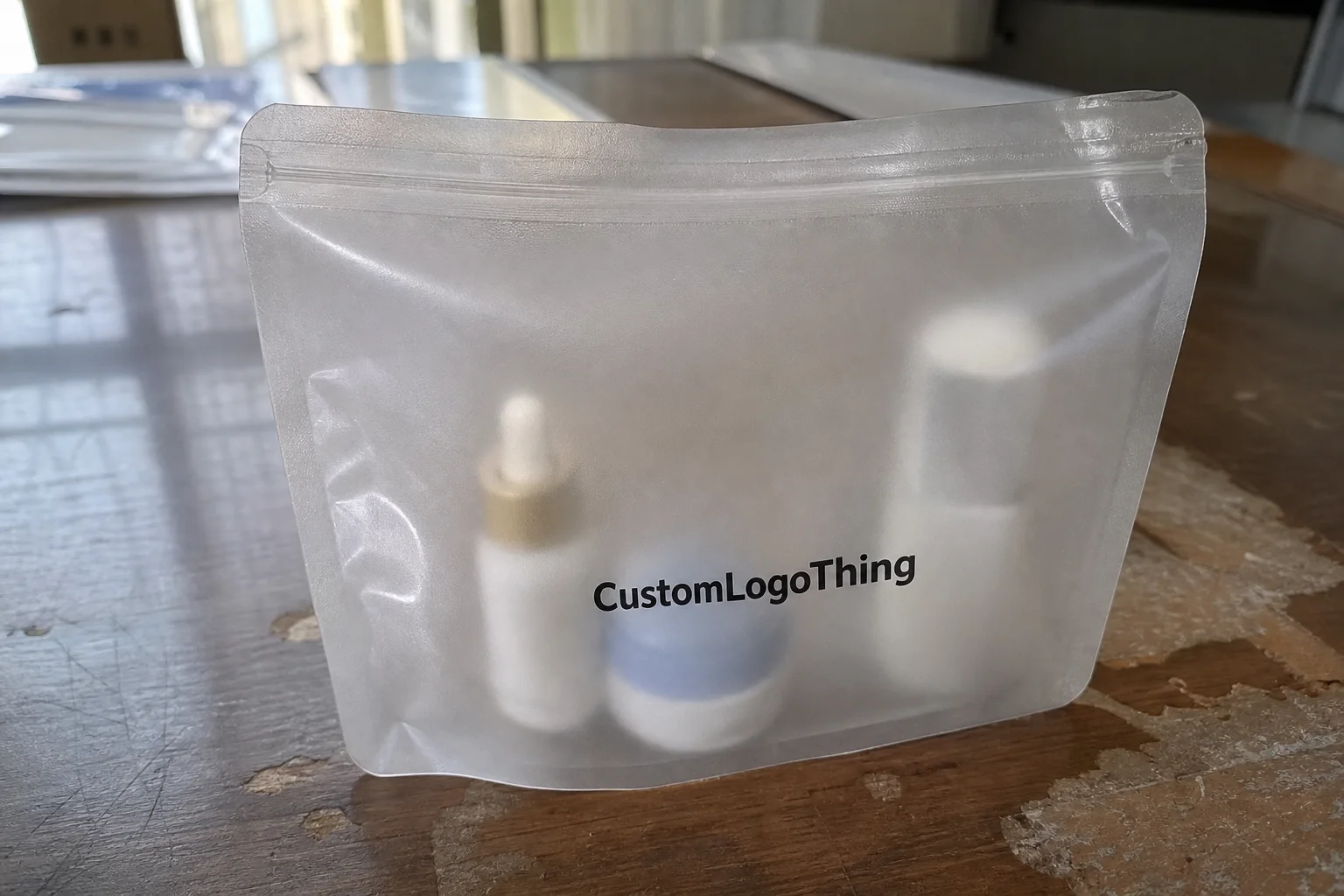
Buying garment bags in a small run is not mainly about saving money on the first order. It is about reducing the cost of uncertainty. In apparel, uncertainty shows up in three places: fit, handling, and appearance. A garment bag can pass a visual mockup and still fail in daily use if the item inside is bulkier than expected, the closure catches during packing, or the film scuffs too easily in transit.
Custom Garment Bags plastic low MOQ programs are useful because they let the buyer validate the full system. Not just the printed logo. Not just the size on paper. The whole chain: garment volume, folding behavior, warehouse handling, and how the bag looks once it is on a hanger and under store lights. A pilot run of 300 to 500 pieces often reveals more than a polished quotation ever will.
There is also a cash flow reality that buyers in apparel know well. Inventory can quietly become a tax on the business. If you overbuy the wrong bag, you are paying for storage, rework, and sometimes disposal. If you underBuy the Right one, you can end up with inconsistent packaging across a launch window. Low MOQ gives you a middle path. It is not unlimited flexibility. It is controlled exposure.
Packaging has a branding role here too. A garment bag does for apparel what a well-built box does for cosmetics or electronics: it tells the customer the brand cares about condition, not just shipment. That first impression can be practical rather than theatrical. Clean, correctly sized, and properly printed packaging usually does more for perceived value than a louder design with poor fit.
A low-MOQ run is not a compromise if it prevents a production mistake from becoming the default across an entire line.
That is why smaller programs make sense for:
- Boutiques testing one or two garment categories before scaling.
- Private-label brands that need inventory discipline more than volume.
- Uniform and hospitality programs with recurring replenishment needs.
- Seasonal launches where styles, lengths, and hang requirements change quickly.
Materials, Thickness, and Closure Choices
Plastic garment bags are not a single product class. The differences are practical, not cosmetic. A clear polyethylene bag is often the most economical route because it is flexible, light, and easy to produce in short runs. Co-extruded film can improve clarity or give a more refined feel. EVA is usually chosen when buyers want better softness and a more premium hand. PVC still exists in the market, but many buyers avoid it because of odor, feel, or policy concerns.
Thickness is where a lot of buying mistakes happen. More microns are not automatically better. They just mean more material. A 40-micron bag can be enough for shirts, light dresses, or low-stress retail use. Around 60 to 80 microns is more realistic for blazers, suits, and garments that hold structure. Outerwear, multiple-piece ensembles, or items with embellishment may need 80 to 120 microns. The right answer depends on garment weight, how often staff handle the bag, and whether the item travels far before it reaches the customer.
Closures deserve the same attention as film choice. A zipper track supports repeated use and storage programs. A flap seal is economical and fast, but only if the seal is consistent and the adhesive or fold stays aligned. Open-bottom bags keep the design simple. Gusseted bottoms create more usable space for bulkier garments and reduce pressure on fabric folds. A reinforced hanger opening is worth asking for if the bag will be reused or handled repeatedly; otherwise the top edge can fail long before the film itself wears out.
Some buyers focus on clarity first and treat everything else as secondary. That works for certain retail programs, but it can mislead you on higher-volume or transit-heavy orders. A softer film, a better seal, or a little extra width often does more for the user experience than a slightly clearer surface.
| Option | Typical Use | Common Thickness | Buyer Tradeoff |
|---|---|---|---|
| Clear PE with flap | Shirts, dresses, entry-level retail packaging | 40-60 microns | Lowest cost, good visibility, limited structure |
| Gusseted PE | Suits, blazers, heavier hanging garments | 60-90 microns | Better volume control, slightly higher unit cost |
| Zippered EVA or co-extruded film | Repeat-use storage, premium branded packaging | 80-120 microns | Better hand feel and durability, higher setup cost |
| Semi-opaque film | Uniform programs, warehouse storage | 50-90 microns | Hides contents, trades some visibility for consistency |
If the order will travel through a rougher supply chain, ask whether the supplier tests against recognized transport or material checks. ISTA methods are useful for shipping-related stress, while ASTM-aligned checks can help validate film behavior. The important point is not the acronym. It is whether the bag still performs after packing, stacking, and handling, not just when it is flat on a sample sheet.
Sizing, Printing, and Fit Controls
Good sizing starts with the garment, not a standard bag catalog. Measure the full hanging length, shoulder width, and the maximum volume once the item is steamed or pressed. A tailored blazer and a floor-length dress do not share the same profile. Neither do a thin shirt and a coat with lining or padding. If the garment ships with tissue, inserts, or multiple components, those details belong in the spec.
That same logic applies to printing. A single-color logo near the top edge often gives the best mix of visibility and cost control. Full-surface graphics can look strong in a presentation deck, but they raise ink coverage, create more registration risk, and push unit cost up quickly. For transparent or semi-transparent film, a restrained mark usually reads better than a crowded layout. The bag should support the brand, not fight with the garment inside it.
Precise placement matters more than many buyers expect. If the logo is too low, it may disappear when the bag is folded or hung. If it is too high, it can interfere with the hanger opening. If the print sits off-center by even a small amount, that offset becomes obvious on a clear bag. That is where production discipline beats design enthusiasm.
A short pre-production checklist can prevent most fit failures:
- Confirm hanger opening size and whether it is reinforced.
- Check width and length tolerance before approving the dieline.
- Measure print placement from the top edge, not just from the artwork file.
- Validate the bag with the garment fully steamed or pressed.
For multi-style programs, this stage often reveals whether a single bag size can serve several SKUs or whether the line needs two dimensions. One universal size can look efficient on paper and still perform poorly in practice. A little segmentation usually beats a false simplification.
Packaging design is practical here. The same visual system should work across garment labels, inserts, and any other branded packaging element. If the logo treatment on the bag is cleaner than the rest of the set, the line can feel unfinished. If every surface is overloaded, it becomes noise. Buyers usually get the best result by keeping the bag plain enough to feel controlled and branded enough to feel deliberate.
Pricing, MOQ, and Unit Cost Breakpoints
MOQ is mostly a function of setup economics. Printing plates, film conversion, closure parts, dieline work, and quality checks all create fixed costs. Spread those costs over enough units and the order starts to look reasonable. Keep the run too small and the same setup becomes expensive per piece. That is why the minimum order is rarely arbitrary, even when it feels that way from the buyer side.
The more specific the bag, the more likely the MOQ moves upward. Standard clear PE bags with one-color branding usually sit at the lower end of the range. Custom dimensions, gussets, heavier film, and multiple print colors raise production complexity. Zippered or premium-feel materials do the same. The unit cost is not just paying for resin. It is paying for consistency, labor, and the tolerance required to make the bag look intentional rather than improvised.
A useful way to think about price is total risk, not just unit cost. A slightly more expensive bag can be the better buy if it reduces wrinkling, speeds packing, or avoids a second reorder because the first run was undersized. Buyers who only compare quote numbers often miss the hidden cost of handling and rework.
| Specification | Typical MOQ | Indicative Unit Cost | What Drives the Price |
|---|---|---|---|
| Clear PE, standard size, one-color logo | 500-1,000 pcs | $0.18-$0.32 | Simple setup, lighter gauge, limited print area |
| Gusseted PE, custom size, one- to two-color print | 1,000-3,000 pcs | $0.28-$0.55 | Extra material, larger footprint, tighter tolerance control |
| Zippered EVA or co-extruded film | 1,000-3,000 pcs | $0.40-$0.75 | Heavier film, closure hardware, premium feel |
| Full-coverage print, custom shape, specialty finish | 2,000+ pcs | $0.55-$0.90+ | Ink coverage, setup time, additional QC, more packing labor |
These ranges move with resin pricing, labor markets, freight, and print complexity. A quote that looks competitive on paper can still lose once shipping is added. Bulky film is expensive to move, especially if the packaging format is inefficient. This is why experienced buyers compare thickness, packing style, and delivery terms together instead of treating the factory number as the whole story.
If sustainability targets are part of the brief, keep the claim concrete. Paper inserts, hang tags, and cartons can often be specified with FSC-certified paper. Plastic film is a different conversation. Material declarations, recycled-content claims, and local recycling realities vary by region, so the cleanest approach is to ask for documentation rather than assuming an eco label means the same thing across suppliers.
Production Timeline and Sample Approval
The production path should be boring. Brief, quote, dieline, sample, approval, production, shipment. If it gets complicated, the usual cause is missing information at the start. Dimensions arrive incomplete. Artwork is not final. Closure style changes after the proof is already in motion. The schedule stretches because the supplier is forced to guess.
Low MOQ does not automatically mean slow. Sometimes the opposite is true. Smaller orders can move faster because they require less queue time and fewer tooling complications. The real constraint is readiness. If the spec is complete and the approval cycle is tight, a standard low-MOQ garment bag order can move through the system efficiently.
A realistic timeline often looks like this:
- Quote response in 1-2 business days if the brief is complete.
- Dieline or spec confirmation in 1-2 business days.
- Sample or pre-production proof in 3-7 business days, depending on structure.
- Production in about 10-20 business days after approval for standard low-MOQ runs.
- Freight time added separately, based on shipping method and destination.
The biggest delays are predictable. Unclear artwork creates proof revisions. Late dimension changes require another sample. Switching from a flap closure to a zipper after confirmation can reset the schedule. The buyer who locks the spec early usually gets fewer surprises and a cleaner delivery window.
Sample approval is the point where paper spec meets physical reality. That sample should match the actual material, thickness, closure, and print method planned for the run. A lookalike sample is not enough. If the final order will be used with other branded packaging elements, this is also the time to check whether the whole set still feels aligned in color, finish, and visual weight.
Supplier Comparison: What Actually Matters
Price matters, but consistency decides whether the bag works over time. A good supplier can hold size tolerance, print alignment, and film consistency from one run to the next. If a supplier cannot tell you the acceptable variation on width, length, or seam placement, that is a problem. Even small deviations are visible on a garment bag because the product itself hangs in open space.
Buyers should compare more than the quote sheet. Ask what resin grade is being used. Ask how incoming material is checked. Ask whether batch-to-batch repeatability is documented. If your order includes restocks, the ability to reproduce the same result six months later is more valuable than shaving a few cents off the first run.
Service matters, but only after the technical basics are in place. A responsive supplier that cannot control tolerances is still a weak supplier. A quieter one with stronger process discipline is usually the better partner.
- Ask for the allowed tolerance on bag dimensions and print placement.
- Confirm whether the same material lot will be used for the full run.
- Review proof turnaround speed and who signs off on revisions.
- Check whether the supplier can repeat the same spec for future replenishment.
- Ask how defects are handled if a run arrives with tearing, off-register print, or closure failure.
Communication speed matters because delays usually happen before production starts. A clear answer on thickness, packaging format, and tolerance can save days of back-and-forth. That is especially important for Custom Garment Bags Plastic low MOQ orders tied to a launch window, where the first delivery sets the tone for the next reorder.
The cheapest quote is often the one that leaves out the hard questions: tolerance, repeatability, and what happens when the proof is wrong.
If a supplier also handles garment covers, poly mailers, or custom printed boxes, that can be useful for consolidation. It should not replace the core evaluation. Fit, protection, and repeatability come first. Service is useful because it keeps the process moving, not because it compensates for a weak spec.
What to Send for a Fast Quote
If you want a useful quote, send a complete brief. The fewer assumptions the supplier has to make, the better the result. Include garment dimensions, preferred thickness, closure type, artwork, quantity, and your delivery target. If possible, add a photo of the garment on a hanger or folded flat. A picture often communicates volume and shoulder shape faster than a paragraph of description.
If you are unsure between two specs, ask for both. Compare 60 microns against 80 microns. Compare a clear flap bag against a zippered version. Compare one-color printing with a more restrained mark. That gives you a real decision set instead of a guess dressed up as a choice.
Use this checklist before approving production:
- Garment dimensions and any added bulk from padding, lining, or embellishment.
- Preferred material, thickness, and closure style.
- Logo placement, number of colors, and artwork format.
- Expected MOQ, replenishment plan, and receiving date.
- Need for sample approval or pre-production proof.
For buyers still refining the spec, the practical path is straightforward: request pricing by size, confirm MOQ by material, lock the spec sheet, and approve the timeline before production starts. That keeps cost, timing, and quality in the same frame. If you need a reference point for the next step, our FAQ covers the common setup questions that usually slow first-time orders.
Custom garment bags plastic low MOQ work best when the buyer gives precise information up front. That is what keeps the fit controlled, the unit cost defensible, and the first run usable for the next one.
What is the usual MOQ for custom garment bags plastic low MOQ orders?
MOQ depends on size, thickness, print complexity, and closure style. Standard clear bags with simple branding can often start around 500 to 1,000 pieces. More complex bags with gussets, heavier film, or premium closures usually need a larger minimum. Ask for MOQ by specification, not as one blanket number, because the real minimum changes with the production method.
Can I order different sizes in one run?
Yes, but mixed sizes can affect price, packing efficiency, and setup unless the supplier can batch them cleanly. If you need multiple sizes, keep the material and artwork consistent so the order stays easier to control. Request pricing for each size separately and compare whether splitting the run gives you better inventory control.
What should I decide before asking for a quote?
Have the garment dimensions, preferred thickness, closure style, print needs, and target quantity ready before you request pricing. If one spec is still uncertain, ask for two or three options instead of guessing. That usually produces a more useful quote and reduces back-and-forth during sampling.
How long does production usually take after approval?
Turnaround depends on order size, printing method, and whether artwork and sample approval happen without revisions. Standard low-MOQ runs can often move through production in about 10 to 20 business days after approval. Freight time is separate, so confirm the shipping window before you lock the launch schedule.
Are low-MOQ custom garment bags suitable for retail and shipping?
Yes, if the material thickness, closure, and size are matched to the garment and the transit conditions. Retail use usually prioritizes appearance and clarity, while shipping use needs better tear resistance and edge protection. Ask the supplier to recommend a spec based on the actual packing process instead of choosing only by price.
What quality checks should I ask for?
Ask for width and length tolerance, print alignment tolerance, hanger-hole reinforcement, seam integrity, and material consistency across the run. If the bag will be reused, ask how the closure holds up after repeated opening. A sample that looks correct but fails at the top edge or the seal is not a passing sample.


