For apparel brands, distributors, and private-label programs, Custom Garment Bags wholesale is rarely a decorative purchase. It sits at the intersection of protection, presentation, and handling efficiency. A garment bag is often the first layer a buyer, warehouse team, or retail associate touches before the item reaches the customer, so the bag has to do more than cover fabric. It has to protect shape, reduce dust and scuffing, and still look deliberate when the piece is on a rack or moving through receiving.
The best versions do that quietly. They keep coats from picking up lint, hold pressed garments in cleaner condition, and reduce the kind of rebagging that wastes time in distribution centers. For brands that ship uniforms, suits, bridal pieces, outerwear, or event apparel, that matters more than it sounds. The bag becomes part of the packaging system, not just a sleeve that disappears after unpacking.
That is also why garment bags should be specified with the same care used for other branded packaging. A bag that fits the product well can reinforce the line’s presentation without adding unnecessary cost or visual clutter. When the garment bag is designed alongside custom printed boxes, inserts, or hang tags, the entire package reads as one system instead of a collection of unrelated parts.
Why garment bags change how apparel is received on arrival
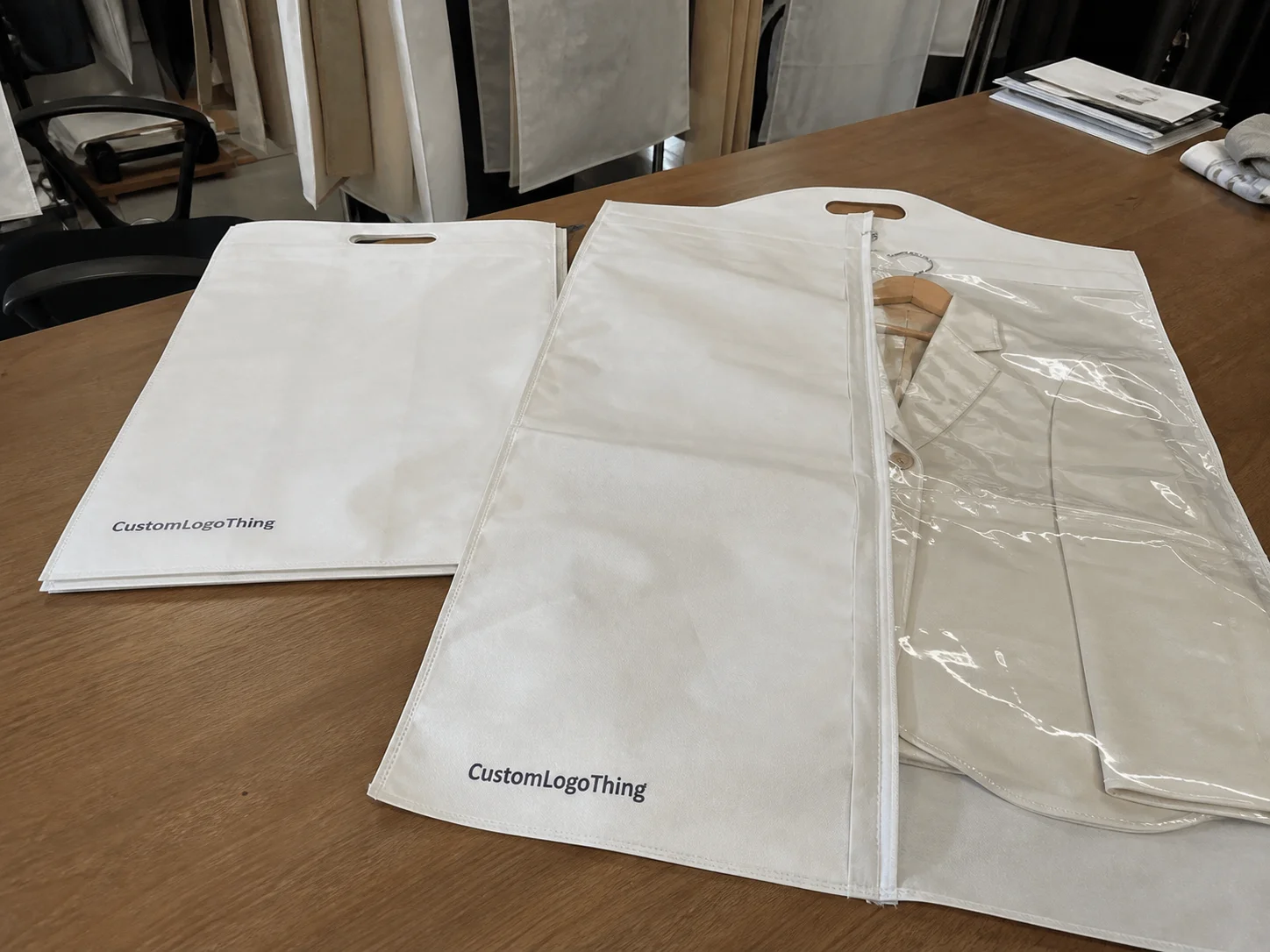
Presentation is the obvious benefit, but the operational value is often larger. A garment that arrives cleaner and less wrinkled moves faster through inspection, merchandising, and storage. Staff spend less time correcting avoidable handling damage, and that saves money in ways that do not always show up on a quote sheet. A clean bag also protects dark fabrics from dust and reduces lint transfer, which is one reason buyers in premium apparel and eventwear tend to treat garment bags as a standard part of the package rather than an optional add-on.
Custom Garment Bags wholesale orders make sense when the same protection has to be repeated across hundreds or thousands of units. That is where consistency becomes a real advantage. If the size, seal quality, and closure style stay the same across production runs, packing teams can work faster and stores receive product in a more predictable condition. A few seconds saved per item becomes visible once the order reaches scale.
A garment bag should protect the piece without fighting it. If the bag is doing its job, the garment still looks intentional when the carton is opened.
There is another practical reason the bag matters: not every garment travels well in a standard poly mailer or carton insert. Structured jackets, long dresses, uniforms, and layered pieces can crease or rub if they are left exposed inside the outer box. A dedicated bag adds a controlled barrier between the fabric and the rest of the shipment. For brands balancing cost against perceived value, that is a relatively light upgrade compared with moving every item into heavier custom printed boxes.
For teams building a broader packaging program, it helps to keep garment bags in the same planning conversation as Custom Packaging Products. The best result comes when dimensions, print tone, and materials complement the apparel rather than compete with it.
Material and style options that match the garment you ship
Material choice should start with the garment, not the supplier’s stock catalog. LDPE is still a common option for clear or semi-clear garment sleeves because it is flexible, relatively low cost, and easy to produce in volume. For basic dust protection or short-term retail handling, a lighter gauge can be enough. When the bag needs to survive repeated folding, carton movement, or longer storage, buyers usually move up to a thicker film so the seams and hanger opening hold up better.
PVC-free film is often requested in retail-facing programs because it avoids the odor and stiffness that can come with older PVC constructions. That does not make it automatically more sustainable, but it can be a better Fit for Brands that want a cleaner product feel or fewer material concerns at receiving. Frosted finishes tend to look more polished on racks, while full clear film is better when the garment itself needs to remain visible for quick identification. Opaque bags are useful when the brand wants a more uniform shelf look or when the contents should not be immediately visible in transit.
Closure style matters just as much as material. Open-bottom sleeves are fast on a packing line and suit high-volume programs. Fold-over tops work well for hanging apparel, but the dimensions need to be right or they look loose and improvised. Zipper closures and resealable tops cost more and add some packing time, yet they are useful for travel kits, premium storage, and pieces that may be opened and closed multiple times before final use. Side gussets are worth considering for coats, uniforms, and heavier garments because they create room without crushing the shoulders.
Print should stay disciplined. A small logo, size indicator, or narrow brand panel usually adds enough identity without making the bag heavy on ink or visually busy. In many apparel programs, restraint is the better move. The garment should stay central, and the bag should support the product packaging system rather than become the main design event. If paper components are part of the same order, FSC-certified stock can be a useful detail for inserts or tags, but it is not a substitute for choosing the right film or thickness for the bag itself.
For buyers who want a sanity check on materials and shipping performance, references from packaging.org and transit-testing bodies like ISTA are useful. They do not replace supplier specs, but they help frame the right questions about handling, load stress, and material performance.
| Bag Style | Typical Use | Typical Thickness | Buyer Note |
|---|---|---|---|
| LDPE clear sleeve | Basic dust protection, high-volume packing | 1.5-2.5 mil | Lowest material cost, best for simple presentation |
| PVC-free frosted bag | Retail-facing apparel and branded display | 2-3 mil | Cleaner look, better fit for premium brand positioning |
| Heavy-duty gusseted bag | Outerwear, uniforms, travel storage | 3-4 mil | More tear resistance, better for repeated handling |
| Zipper or closure bag | Long-term storage and higher-end apparel | 2.5-4 mil | Slower to pack, but more secure in transit and storage |
Specifying size, thickness, and print without overbuying
Size is where many garment bag orders go wrong. The correct measurement is not the hangar-only footprint; it is the garment as it will actually ship. That means checking shoulder width, total length, sleeve bulk, and any shape at the chest or hem that changes how the piece sits in the bag. A bag that is too large wastes material and looks careless. A bag that is too tight can crease the garment or stress the seam.
For Custom Garment Bags wholesale, the important specifications are usually finished width, finished length, gusset depth, opening style, closure type, thickness, and print location. Those numbers drive fit and also affect production efficiency. If a line includes multiple garment types, it is often smarter to build two or three standard bag sizes and use them consistently rather than creating one oversized spec that tries to cover everything.
Thickness should match the use case, not just the budget target. A thinner film can work for a short-distance dust cover or a one-time retail handoff. Once the bag is expected to move through distribution, sit in storage, or be reused, a heavier gauge tends to pay for itself in fewer tears and less rework. The same logic applies to print. A full-coverage graphic may look impressive on screen, but it can add cost and complication without improving function. A restrained logo or simple brand panel usually performs better in actual packing conditions.
It also helps to think about the broader packaging system. If the garment bag sits alongside hang tags, labels, or inserts, keep the visual language aligned so the line feels deliberate. That does not mean every piece needs the same treatment. It means the bag should look like it belongs to the same program. For paper components, FSC-certified stock can support a cleaner sourcing story, while the bag itself should be judged first on fit, strength, and handling behavior.
Bottom line: lock down dimensions before debating embellishment. Most overbuying happens when the bag is made too large, too thick, or too heavily printed for what the garment actually needs.
Pricing, MOQ, and quote drivers for bulk orders
Custom garment bags wholesale pricing moves with a handful of variables: size, material grade, thickness, print coverage, number of print colors, closure style, and carton configuration. Two bags that look similar can land in very different price bands if one has a zipper, a gusset, or a larger decorated area. Setup charges matter too, especially when the artwork is custom or the tooling needs to be adjusted for a nonstandard size.
MOQ is usually set by production efficiency. A plain clear bag with a single-color print is easier to run than a heavily customized bag with special features, so the minimum order tends to be lower. Trial quantities are sometimes possible, but the unit price generally drops as volume rises because setup time is spread over more pieces. Standardizing sizes across a product line can reduce the landed cost in a way that is more meaningful than shaving a few cents off the film.
Typical planning ranges are useful, but they are only ranges. Material markets, print complexity, and freight all affect the final number. Still, the table below gives a realistic starting point for budget conversations:
| Order Band | Typical Unit Price | Best For | Cost Driver |
|---|---|---|---|
| 1,000-2,500 pcs | $0.35-$0.80 | Trials, seasonal runs, limited SKUs | Higher setup share per unit |
| 5,000 pcs | $0.18-$0.38 | Multi-store launches, replenishment programs | Better spread of tooling and print setup |
| 10,000+ pcs | $0.12-$0.26 | Chain supply, steady private-label demand | Most efficient production pricing |
Where can a buyer save without damaging the result? Usually in print coverage first. A smaller print area or one-color layout can simplify production and reduce ink use. Where should a buyer avoid cutting corners? On thickness for heavier garments, on seam quality, and on closure strength if the bag will be handled multiple times. Freight and carton configuration also affect the landed price, so a good quote should separate product cost from shipping and any one-time setup charge. If a vendor cannot break those out cleanly, the comparison is not very useful.
That is the real pricing issue with wholesale apparel packaging. The lowest per-unit number is not always the lowest total cost once packing time, damage risk, and storage behavior are included. A bag that saves a fraction of a cent but creates extra labor is not a win.
Process and lead time from sample approval to shipment
The fastest projects start with clean specs. For custom garment bags wholesale, the sequence is usually the same: confirm dimensions and material, submit the artwork file, review a proof or sample, approve production, run the order, then arrange packing and freight. When the sequence is followed in order, the project moves with fewer corrections and the final product is easier to repeat.
Most delays happen at the same points. Measurements are estimated instead of checked. Artwork is delivered in the wrong format. Print placement changes after proof approval. Each of those errors can add time because even a small adjustment can affect layout, seal location, or bag dimensions. If a physical sample is needed, it should be built into the schedule early. Treating sampling as an afterthought usually creates a deadline problem later.
A realistic timeline helps buyers plan around store resets and inbound inventory windows. Sample turnaround is often a few business days. Production for a straightforward run commonly falls in the low-to-mid teens in business days after final approval, depending on volume and material availability. Special finishes, thicker films, or busy periods can extend that timeline. If the bags are tied to a campaign date, add a buffer for freight and receiving rather than assuming the production clock is the only clock that matters.
Carton handling deserves attention too. Bags that look fine on a spec sheet may behave differently once boxed, stacked, and moved through multiple checkpoints. That is where transit testing standards such as ISTA become useful. They provide a framework for evaluating how the outer pack performs under handling stress, which reduces surprises when the shipment reaches distribution or store receiving.
For brands coordinating multiple packaging elements, it helps to align the garment bag order with Custom Packaging Products. That keeps the visual system consistent across bags, labels, inserts, and any other parts of the order that need to match.
How to compare suppliers without guessing at quality
The best supplier comparisons are concrete. Ask for the film type, thickness tolerance, seal width, hanger hole reinforcement, carton pack count, and acceptable variation across production. Those details matter more than a polished sales sheet. In custom garment bags wholesale, consistency is the thing that keeps the first run and the repeat order aligned.
Documentation is not bureaucracy here. It is the quality-control record. A written spec, a proof that matches the order, and either a sample or a clear sample photo are the basics. If a vendor cannot distinguish between nominal size and finished size, or cannot explain what variation is acceptable, that is a warning sign. Good suppliers should also be able to support small trial runs and larger replenishment orders without changing the spec in the middle.
Testing language should stay grounded. For film performance, it is reasonable to ask whether material has been checked against methods such as ASTM D882 for tensile properties or ASTM D1709 for impact resistance. Most buyers do not need to run a lab program, but asking for a defined test method is a better filter than accepting broad claims about strength. If the order includes paper components, a sourcing question about FSC-certified stock is equally practical. Specific questions usually reveal whether the supplier actually controls production or is just collecting quote requests.
Packaging quality is rarely a single feature. It is the accumulation of ordinary details: a hanger hole that does not tear, a seal that stays even, a print that lands where it should, a carton pack that matches the count on the label. Those details are what keep a retail program from drifting over time. They also matter if the bag is part of a broader packaging design plan that has to stay consistent across seasons and multiple SKUs.
One useful test is to ask how the supplier handles changes after approval. A clear answer about revisions, reproofs, and production holds tells you more than a sales promise. If the process is documented and repeatable, the odds of receiving a clean order improve quickly.
What to send for a fast quote and clean first order
If the goal is a useful quote for custom garment bags wholesale, send the facts first. The quickest response usually comes from a buyer who already knows the garment type, target dimensions, preferred material, thickness, closure style, artwork, quantity, and delivery location. That gives the supplier enough information to price accurately instead of padding the estimate for unknowns.
A photo helps when the garment has unusual proportions, a heavy shoulder line, or a long hem that affects fit. A sample bag is even better if one is available because it removes guesswork from the sizing conversation. If the bag has to coordinate with other branded packaging, reference those components too so the supplier can keep logo size, placement, and tone consistent with the rest of the program.
Here is the cleanest order brief to prepare:
- Garment type and use case
- Finished bag width, length, and gusset depth
- Material preference and thickness target
- Closure style or opening style
- Print artwork and color count
- Quantity and replenishment expectations
- Delivery address and needed in-hand date
A brief like that shortens back-and-forth and improves pricing accuracy. It also prevents the common mistake of approving a bag that fits the showroom sample but not the packed production piece. Once the proof is approved, keep the production schedule stable unless a real spec issue appears. That discipline protects the first shipment and makes future reorders easier to manage.
For apparel programs that need cleaner receiving, better presentation, and bulk pricing that holds up in production, custom garment bags wholesale works best when the order is treated as a packaging decision, not a last-minute accessory. The strongest programs start with exact measurements, realistic material choices, and a supplier process that keeps proof, sample, and shipment aligned.
What should I know before ordering custom garment bags wholesale for apparel shipping?
Confirm the garment type, whether it will ship folded or hanging, and the exact bag dimensions needed for the final packed item. Choose material and thickness based on whether the bag is mainly for protection, retail presentation, or storage. Ask for a clear proof so print placement, closure style, and carton packing are approved before production starts.
What is the usual MOQ for custom garment bags wholesale orders?
MOQ depends on bag size, print complexity, and whether the run uses standard or fully custom tooling. Higher volumes usually reduce unit cost because setup and press time are spread across more pieces. If you are testing a new program, ask whether the supplier can quote a smaller trial run before a full replenishment order.
How do I choose the right thickness for wholesale garment bags?
Use a lighter film for simple dust covers or short-distance retail handling. Choose a heavier gauge when the bag needs better tear resistance, repeated use, or added protection in transit. Match thickness to the garment weight and shipping method so you do not overspend on material you do not need.
How long does production usually take for custom garment bags wholesale?
Timing depends on artwork approval, material availability, order size, and whether samples are required first. Straightforward runs move faster than projects with special printing, custom dimensions, or complex closures. The fastest way to stay on schedule is to approve specs early and keep artwork files clean and complete.
Can I print branding on custom garment bags wholesale without making them heavy or expensive?
Yes, but the best results usually come from restrained print coverage and a clean layout. A focused logo, sizing mark, or simple brand panel often gives better value than full-surface decoration. Ask for options that balance visibility, material use, and unit cost so the bag still performs as packaging, not just as a graphic piece.


