Buyer Fit Snapshot
| Best fit | Custom Hang Tags with Die Cutting projects where brand print, material claims, artwork control, MOQ, and repeat-order consistency need to be specified before quoting. |
|---|---|
| Quote inputs | Share finished size, material target, print colors, finish, packing count, annual reorder estimate, ship-to region, and any compliance wording. |
| Proofing check | Approve dieline scale, logo placement, barcode or warning zones, color tolerance, closure strength, and carton packing before bulk production. |
| Main risk | Vague material claims, crowded artwork, missing packing details, or unclear freight terms can make a low unit price expensive after revisions. |
Fast answer: Custom Hang Tags with Die Cutting: Design, Cost, Process should be specified like a repeatable production item. The safest quote records material, print method, finish, artwork proof, packing count, and reorder notes in one written spec.
Production checks before approval
Compare the actual filled-product size with the drawing, then confirm tolerance on folds, seals, hang holes, label areas, and retail display edges. Reserve space for logos, QR codes, warning copy, and material claims before decorative graphics fill the panel.
Quote comparison points
Review material grade, print process, finish, sampling route, tooling charges, carton quantity, and freight assumptions side by side. A quote is only useful when the supplier can repeat the same color, closure quality, and packing count on the next order.
Custom Hang Tags with die cutting do more than carry a price or SKU. They set the first tactile tone for a garment, accessory, or gift item the moment a shopper reaches for it. A tag with a well-chosen contour can make a product feel more deliberate, more polished, and more aligned with the rest of the branded packaging story. Shape does a surprising amount of work here. On a crowded shelf, a distinctive outline can do what a louder headline cannot: it slows the hand.
I have watched buyers make snap judgments on a rack without even realizing it. A plain rectangle can be perfectly functional, but a custom contour suggests somebody made decisions with care. That matters because shoppers tend to translate care in the package into care in the product. The tag is small, yes, but small surfaces often carry the loudest signals.
That is the practical strength of Custom Hang Tags with die cutting. They let a brand add personality without rebuilding the entire product packaging system. A buyer can shape a tag around a logo, a product line, a hang-hole location, or a visual cue that fits the item better than a plain rectangle ever could. The result may whisper or announce itself, but it should always look chosen rather than accidental.
For brands that already think carefully about packaging design, the tag is a small surface with a large job. It is part label, part sales tool, and part finishing touch. In retail packaging, that little piece of board travels farther than many teams expect. It gets handled during assortment, photography, merchandising, and final sale. Done well, Custom Hang Tags with die cutting support the full package branding story instead of hovering at its edge.
I also like to think of these tags as the handshake before the handshake. They do not close the sale by themselves, but they set the tone. If the material feels right and the silhouette makes sense, the item feels more credible before anybody reads a word. That is not fluff; it is the kind of visual shorthand retailers have depended on for decades.
What Custom Hang Tags with Die Cutting Really Do
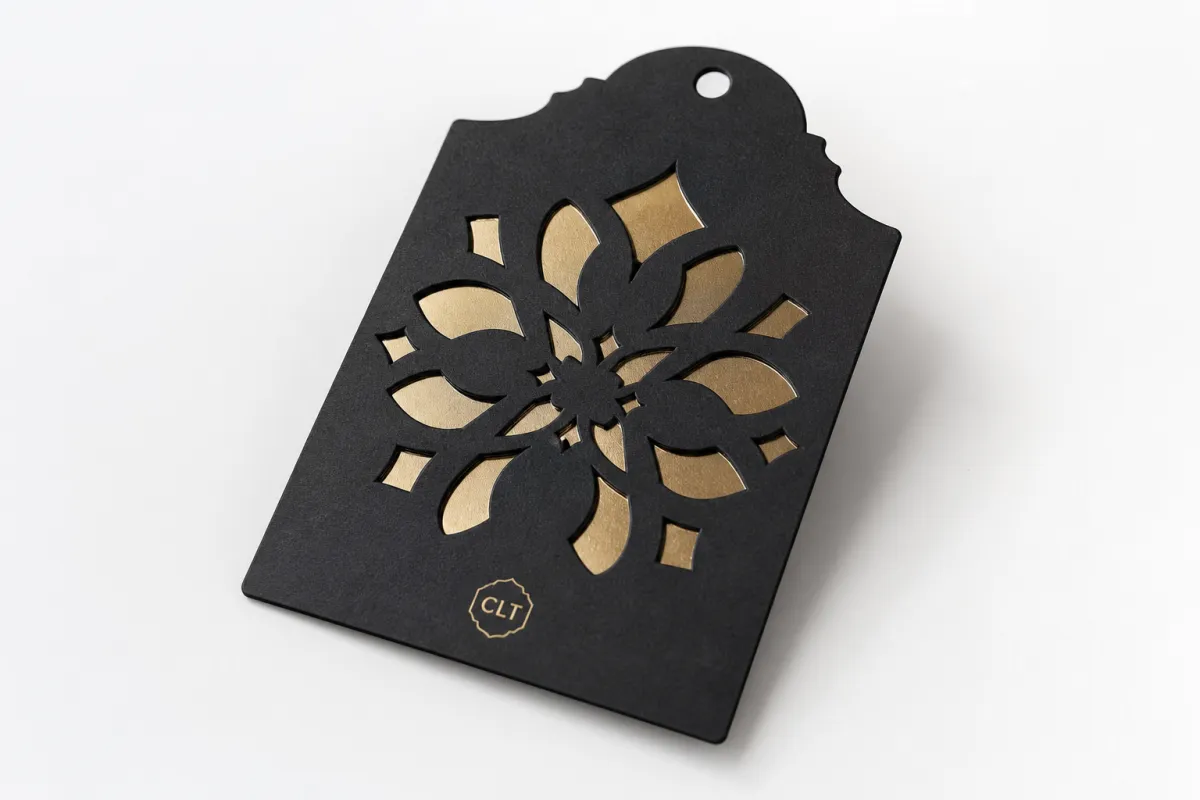
Walk past a crowded rack and notice what catches your hand first. It is rarely the most expensive garment on the rail. It is usually the one that feels different before you read a word. That is where custom hang tags with die cutting earn their keep. A rounded corner, a clean contour, a scalloped edge, or a logo-shaped silhouette can turn a simple information card into a quiet signal of quality.
Die cutting, in plain terms, means a custom steel rule die is built to cut the stock into a specific shape. The die presses through paperboard, coated stock, kraft, recycled board, or specialty laminated materials and creates a finish that standard guillotine trimming cannot match. With custom hang tags with die cutting, the cut line becomes part of the design language instead of sitting in the background as a production note.
The shape matters for more than aesthetics. A cutout can frame a logo. A contour edge can echo a product category. A hang-hole integrated into the silhouette can make the tag feel cleaner and less generic. In retail packaging, those details help a brand stand out in a crowded environment where a shopper may only give each item a second or two of attention. When the tag feels considered, the product often feels more considered too.
There is a practical side as well. Custom hang tags with die cutting can support storytelling by giving you room for sections, shapes, icons, or even a window that reveals a texture beneath. They can also help the tag line up visually with other pieces of Custom Printed Boxes, inserts, or labels in the same collection. That matters for brands building a consistent family of custom packaging products, where one weak link makes the whole set feel improvised.
I have seen the contrast up close. A premium sweater on a flimsy stock rectangle can feel a little off, almost like a good suit with cheap buttons. On the other hand, a modest tee on a well-cut tag suddenly looks like it belongs in a more thoughtful collection. That is why the contour is not decoration. It is packaging behavior.
The tradeoff is real. A more custom shape usually means more setup complexity, more tooling, and stricter discipline in the artwork stage. A simple radius corner is easy to run. A fragile point, a thin bridge, or a tiny interior notch is not. The best custom hang tags with die cutting usually balance visual impact with manufacturing sanity and a budget that still makes sense at the quantity you need.
A die-cut shape should earn its space by making the tag easier to notice, easier to handle, or easier to remember. If it only adds complexity, it is probably the wrong shape.
That idea runs through the rest of this piece. Custom hang tags with die cutting are a design decision, but they are also a tooling decision, a print decision, and a cost decision. The smartest orders make room for all four.
How Custom Hang Tags with Die Cutting Work
The workflow is straightforward once you see it from the production side. The designer creates the artwork and separates the cutline from the print file. The converter reviews the layout, checks clearances, and builds or assigns a matching die. After proof approval, the sheets move through print, then through die cutting, then through finishing and inspection. Custom hang tags with die cutting depend on that sequence staying tidy, because the cut has to match the artwork rather than fight it.
Registration matters more than many people expect. If the printed graphic is supposed to hug a contour, frame a window, or sit safely away from the edge, even a small shift can change how finished custom hang tags with die cutting look in hand. A millimeter off on the proof may not sound dramatic on a screen, yet on a real tag it can make a logo look crowded or expose a cut where the design assumed more margin.
Most tag stocks fall into a few practical families. Coated paperboard gives sharp print detail. Uncoated cover stock feels a little warmer and more tactile. Kraft stock supports a natural or earthy brand story. Recycled board can help with sustainability messaging. Laminated specialty papers may add durability or a premium sheen. The right choice depends on the look, the handling conditions, and whether the tag needs to pair with other branded packaging materials such as labels, sleeves, or boxes.
Finishes can change the feel of custom hang tags with die cutting in a big way. Foil stamping adds flash and contrast. Embossing raises the logo or pattern off the surface. Debossing presses it down for a quieter, more technical feel. Spot UV can create contrast between matte and gloss zones. Soft-touch coating can make a tag feel expensive in the hand, though it should be specified carefully because too much coating can soften fine detail. Drilled or slotted hang holes also matter, since hole placement changes both the look and the strain on the tag once it is hung.
Some shapes are simply easier to run. Clean arcs, generous radii, and broad shoulders tend to cut more consistently than tiny interior windows or narrow necks. Full die cutting uses a physical die to cut all the way through the sheet, which is the most common route for custom hang tags with die cutting. Kiss cutting only cuts the top layer and is more common for labels and sticker-like applications. Digital cutting, by contrast, uses a plotter or laser-style system and can be useful for very short runs, prototype work, or unusually complex contours that would not justify a steel die.
Think of the process as a chain of tolerances. Artwork tolerance, print tolerance, cutting tolerance, and finishing tolerance all stack together. A project may look simple and still fail if those tolerances are ignored. That is why many seasoned buyers ask for a prepress review before they commit. For broader production support, it can also help to review our Manufacturing Capabilities, compare options in Custom Labels & Tags, or browse the wider range of Custom Packaging Products that can match the same brand system.
Custom Hang Tags with Die Cutting: Cost, Pricing, and MOQ
Price is where the conversation gets real. Custom hang tags with die cutting usually cost more than a standard rectangle because the order carries extra tooling, extra setup, and more production care. That does not mean they are out of reach. It means the cost model changes. Instead of paying only for material and print, you are also paying for the shape that makes the tag unique.
The main cost drivers are easy to name: die creation, press setup, stock selection, print method, finishing, labor, and quantity. If you need foil on one side, embossing on the other, and a custom contour with a window cut, the price rises faster than if you stay with a clean shape and a standard paperboard. In most quote comparisons, the cut itself is only one line item, but the shape can influence several others.
A useful way to think about custom hang tags with die cutting is this: the smaller the run, the more the setup costs matter. At 500 pieces, a die fee can loom large. At 5,000 or 10,000 pieces, that same fee gets spread across many more units, so the unit price drops even though the total spend grows. That is why buyers often see a better per-tag rate on larger jobs even when the invoice is obviously higher.
The table below gives a practical feel for how pricing often behaves. These are illustrative ranges, not fixed quotes, because stock, coverage, and finishing can move the number in either direction.
| Option | Typical Quantity | Estimated Unit Range | What Drives the Price |
|---|---|---|---|
| Standard rectangle with rounded corners | 500-5,000 | $0.12-$0.28 | Basic print, minimal tooling, simple trim |
| Custom hang tags with die cutting, simple contour | 500-10,000 | $0.18-$0.42 | Custom die, moderate setup, standard board |
| Custom hang tags with die cutting plus foil or embossing | 1,000-10,000 | $0.28-$0.65 | Multiple finishing steps, tighter registration, slower handling |
| Complex shape with interior cutouts or specialty stock | 1,000-25,000 | $0.35-$0.85 | Tooling complexity, waste, slower finishing, premium materials |
MOQ is not a universal number. One supplier may be comfortable at 250 pieces on a digital workflow. Another may price best at 1,000 or more because that quantity suits the press sheet and the die better. Custom hang tags with die cutting can still be economical at lower volumes if the shape is simple and the material is standard. Once the design gets intricate, the economics usually favor a larger run.
Another point that buyers sometimes miss: specialty finishes may influence price more than the cut shape itself. A clean contour on a good uncoated board can be easier to budget than a rectangle with multiple metallic passes, a heavy soft-touch laminate, and tight foil registration. If you are comparing quotes, make sure every supplier is pricing the same stock weight, the same bleed, the same hole placement, the same finish, and the same carton pack. Otherwise, the numbers will look comparable when they really are not.
In practice, a cleaner die-cut design can also reduce waste and speed the run. Fewer fragile points means fewer sheet handling issues. Better nesting means less scrap. The savings may not erase the tooling cost, but they can soften it. That is why custom hang tags with die cutting should be designed with production in mind from the start rather than added as an afterthought once the artwork is already crowded.
Process and Timeline: From Art File to Finished Tag
A reliable timeline starts with a clear sequence. The project usually moves from concept, to dieline creation, to prepress review, to proofing, to tooling, to printing, to die cutting, to finishing, to inspection, and finally to packing. Custom hang tags with die cutting can move quickly when that chain is organized, yet they can slow down fast if one link needs rework.
Delays most often show up in prepress. The artwork may not include enough bleed, the safe area may be too small, or the cutline may be drawn as if the tag were a rectangle instead of a contour piece. On a die-cut tag, the spaces around the hang hole and outer edge matter just as much as the visible copy. If the design ignores them, the proof stage becomes a correction stage, and the schedule slips.
Typical timing depends on stock availability, color count, finishing, and whether a new die has to be made. A simple order on standard board may move through in roughly 10-15 business days after proof approval. Add foil, embossing, or a specialty coating, and the lead time can stretch closer to 15-20 business days. Custom hang tags with die cutting that use a brand-new, complex die can take longer if tooling needs to be built and approved before the press run starts.
Sampling is worth the extra day or two. A physical sample can reveal whether the tag feels too flimsy, whether a narrow neck bends too easily, or whether the hang hole lands where the garment hardware actually sits. Digital proofs are useful for copy, color intent, and layout, but they cannot tell you how a contour behaves in the hand. For custom hang tags with die cutting, that tactile check matters.
Planning backward from a launch date is a habit that saves stress. If the garments need to be in a store on a Monday, the tags should not still be in proof on the prior Friday. You want enough margin for shipping, pack-out, and the unexpected review cycle. That matters just as much for custom printed boxes and other retail packaging items as it does for hang tags, because the whole presentation has to arrive together.
For teams working on sustainable materials or chain-of-custody requirements, it can help to review the certification language early. The FSC site is a useful reference for responsible fiber sourcing, while the ISTA standards are useful when tags or bundled packaging need to survive transit testing and handling. If the project touches more than the tag itself, those references keep the discussion grounded in performance rather than appearance alone.
Step-by-Step Guide to Ordering the Right Tag
Start with purpose. Is the tag there to carry price, tell a product story, support security, reinforce a premium position, or do all of those things at once? Custom hang tags with die cutting work best when the shape supports the job, not when the shape is chosen first and the function is squeezed in afterward.
Once the goal is clear, choose a silhouette that fits the product category and the brand tone. A crisp geometric shape can suit technical apparel or performance goods. Softer curves may suit beauty, gifts, or lifestyle items. The important part is avoiding weak points. If the shape has to survive shipping, hanging, folding, and being touched by shoppers, it should not include fragile corners or paper-thin bridges.
Then select stock with a realistic eye. A 16 pt cover may be enough for a lightweight retail tag, while a 350gsm C1S artboard can add stiffness and a more premium hand feel. Uncoated stock can be easier to write on. Coated stock can hold sharper color. Recycled board can support sustainability messaging. Custom hang tags with die cutting often feel better when the stock and the shape are chosen together, because the wrong paper can make even a good die look awkward.
Artwork setup is the place to be careful. Keep critical text away from the cut edge and hang hole, make the bleed clear, and label the dieline correctly. If a window or interior cutout is part of the design, give it enough margin so the surrounding graphics do not crowd the opening. That same discipline pays off across branded packaging: the tag should sit comfortably next to the garment, the box, the insert, or any other component it supports.
Request a sample or proof before production. Review the trim, the color, the hole placement, and the overall hand feel. A proof that looks fine in a PDF may still feel off in the hand if the shape is too narrow or the finish is too glossy. Custom hang tags with die cutting reward this extra check because the cut profile is such a visible part of the finished piece.
Compare quotes using the same spec sheet. Include size, quantity, stock, finish, hole size, packing method, and delivery target. If one supplier quotes 5,000 tags on 14 pt uncoated and another quotes 5,000 on 18 pt coated board, the lower number is not really lower. The spec sheet should remove that noise before you try to compare.
Finally, lock the logistics. Confirm carton counts, bundle counts, and whether the tags need to be packed flat, banded, or kitted with other items. That matters for production line speed later on. A clean order for custom hang tags with die cutting should arrive ready to use, not ready to sort.
One practical habit I have seen save time more than once: print the dieline at full size and compare it against the physical product or a sample garment. On screen, a narrow neck or oversized hole can look fine. In hand, it can be the difference between a tidy tag and a tag that hangs kinda awkwardly.
Common Mistakes With Die-Cut Hang Tags
The first mistake is making the shape too clever. Tiny points, narrow bridges, and delicate cutouts may look interesting on screen, but they can tear during finishing or bend in transit. They can also slow the die-cutting run because the press has to work harder to hold consistency. Custom hang tags with die cutting should feel distinctive, not fragile.
Another common problem is placing text too close to the cut line or the hang hole. That can make the tag feel crowded, and it can create real risk if the trim shifts even slightly. A retail buyer notices that crowding instantly. The tag may still be printable, yet it will not feel refined. Good branded packaging usually gives copy enough breathing room to breathe.
There is also confusion around dielines. Some teams reuse a rectangular layout and try to force it into a custom contour later. That creates proofing headaches and sometimes expensive revisions. If the outline changes, the layout should change with it. Custom hang tags with die cutting need a proper cutline from the beginning, not a redraw after the art is already approved.
Overcomplicating finishes is another trap. A foil border, spot UV, soft-touch coating, and embossing can all look strong on their own, but together they can become too busy for a tag that is only a few square inches. The more special effects you add, the more you risk losing the clean visual rhythm that made the shape attractive in the first place. In many cases, one strong finish is better than three average ones.
Sample comparisons can also mislead. A buyer may compare a thick coated sample from one vendor to a thinner recycled board from another and assume the first supplier is simply better. In reality, the materials are different, so the result is different. That same issue shows up with custom hang tags with die cutting when one sample uses a polished edge and another uses a more fiber-forward stock. Compare like with like or the decision will be skewed.
Rushed approvals create the last big headache. When the cutline, color profile, or hole placement has not been checked carefully, small mistakes can travel all the way to production. A good rule is simple: if the shape is new, print a small test or approve a meaningful sample before you commit to a large run. That habit saves money, time, and frustration.
Expert Tips for Better Results and Lower Risk
Design the shape around the product, not around a trend. A good contour should help the item sit naturally in the hand and on the rack. It should also support the product story. If the brand sells minimalist basics, a calm geometric tag may say more than an ornate shape ever could. Custom hang tags with die cutting work best when they feel like they belong to the product family.
Keep the outer contour elegant and efficient. Smooth shapes usually cut cleaner, stack better, and handle better through finishing and shipping. They also leave less room for defects at sharp intersections. That does not mean everything must be round, only that the die should respect the realities of paper grain and press pressure. A strong cut line often looks simpler than the original concept sketch.
Think about motion. A tag does not just sit still in a mockup; it hangs, swings, folds, rubs, and gets touched. That means balance matters. If one side is much heavier visually or structurally than the other, the tag may hang crooked. With custom hang tags with die cutting, a centered hole and sensible weight distribution can make a surprising difference in how polished the final piece feels on the garment or accessory.
Ask the printer or converter for material recommendations, especially if you want a premium feel without making the tag difficult to run. Sometimes a slightly different board weight can remove the need for lamination or reinforcement. Sometimes a cleaner coating can do more for the finish than a heavier stock. Custom hang tags with die cutting do not always need more material; they often need better material selection.
Lock the specs early. Size, shape, stock, finish, quantity, and due date should all be agreed before proof approval. That one habit reduces change orders and keeps the job from drifting. It also makes it easier to compare custom hang tags with die cutting against other parts of the launch, such as custom printed boxes or insert cards, because everything is moving from the same spec sheet.
Build a reusable shape family if you can. One die or one closely related set of dies can often serve multiple SKUs, which lowers future setup costs and keeps the brand system consistent. That is a good fit for seasonal apparel, product lines with variants, and retail programs that need to repeat. A smart reusable system keeps custom hang tags with die cutting from becoming a one-off expense every time a new product lands.
Practical note: for brands that rotate product colors or sizes but keep the same structure, a single die-cut silhouette can become part of the visual signature. That is one of the quiet strengths of custom hang tags with die cutting; the shape becomes recognizable before a shopper even reads the text.
And if a concept feels ambitious, pressure-test it against the actual production method before falling in love with the mockup. I have seen a beautiful concept fail because a narrow bridge snapped during finishing. The fix was not dramatic; it was just a wider radius and a slightly heavier stock. That kind of adjustment is boring on paper and brilliant in practice.
Next Steps for Ordering Custom Hang Tags with Die Cutting
Before you request a quote, gather the basics: artwork, target quantity, preferred stock, finish, hang-hole needs, and delivery date. The cleaner the starting brief, the easier it is to get a usable number back. Custom hang tags with die cutting are easiest to quote accurately when the supplier is not guessing at half the spec.
Decide what matters most right now. If lower unit cost is the priority, the design should stay simple and the stock should stay standard. If speed matters most, minimize finishing steps. If premium feel matters most, spend your budget on the stock and the finish rather than on a shape that looks fancy but does not read well in hand. If distinction matters most, make the contour work harder while keeping the rest of the layout controlled.
Create one comparison sheet for vendors. Use the same dieline, the same file version, the same stock description, the same finish, and the same packing method. That way, every quote is measured against the same assumptions. Custom hang tags with die cutting can look very different in price if one vendor is quoting a different board weight or a different press method, so the comparison sheet keeps everyone honest.
If the shape is new, ask for a sample, proof, or mockup. That is especially useful when the tag has interior cutouts or when the logo sits close to the edge. A physical sample gives you a chance to check proportion, hole placement, and stiffness before the whole run starts. It is a small step that can protect a much larger order.
Most of all, treat custom hang tags with die cutting as part of the broader packaging system, not a standalone ornament. The best results happen when the design, the budget, and the production timeline are planned together. That is how the tag supports the product instead of competing with it, and that is how custom hang tags with die cutting become a smart part of the brand rather than an expensive extra.
FAQs
How much do custom hang tags with die cutting usually cost?
Cost depends on quantity, stock, print method, finish, and whether a custom die has to be made. Low quantities usually carry a higher unit price because setup and tooling are spread across fewer tags. Simple shapes and standard papers are the easiest ways to control pricing without losing impact.
What is the minimum order quantity for die-cut hang tags?
MOQ varies by printer and by how the tags are produced, so there is no single universal number. Some suppliers will run small batches, but the unit cost usually improves as the order gets larger. If you need a low quantity, ask whether digital cutting or a simplified shape can reduce setup costs.
How long does production take for custom die-cut hang tags?
Lead time depends on artwork approval, die creation, printing, finishing, and shipping. Simple orders can move quickly, while specialty finishes or complex shapes need more turnaround time. The fastest way to avoid delays is to approve proofs promptly and send print-ready artwork early.
What file do I need for custom hang tags with die cutting?
You usually need editable artwork plus a separate dieline or cutline layer. Keep bleed, safety margins, and hole placement clearly marked so the trim does not cut into key text. A vendor can often help refine the dieline if you provide the desired finished size and shape.
Are die-cut hang tags better than standard rectangular tags?
They are better when you want stronger shelf presence, a more distinctive brand feel, or a shape that supports the story of the product. Standard rectangles can be cheaper and faster, so they are often the better choice when budget and speed matter most. The best option depends on how much visual differentiation you need versus how tightly you need to control cost. For many brands, custom hang tags with die cutting strike the right balance between retail presence, production efficiency, and package branding.
If you are choosing only one rule to carry into the next brief, make it this: decide the structure before you decide the flourish. Size, stock, quantity, and hang method should come first; the contour should follow those realities, not fight them. That is how custom hang tags with die cutting stay sharp, printable, and worth the spend.

