Buyer Fit Snapshot
| Best fit | Custom Kraft Corrugated Inserts for Sustainable Packaging projects where brand print, material claims, artwork control, MOQ, and repeat-order consistency need to be specified before quoting. |
|---|---|
| Quote inputs | Share finished size, material target, print colors, finish, packing count, annual reorder estimate, ship-to region, and any compliance wording. |
| Proofing check | Approve dieline scale, logo placement, barcode or warning zones, color tolerance, closure strength, and carton packing before bulk production. |
| Main risk | Vague material claims, crowded artwork, missing packing details, or unclear freight terms can make a low unit price expensive after revisions. |
Fast answer: Custom Kraft Corrugated Inserts for Sustainable Packaging should be specified like a repeatable production item. The safest quote records material, print method, finish, artwork proof, packing count, and reorder notes in one written spec.
Production checks before approval
Compare the actual filled-product size with the drawing, then confirm tolerance on folds, seals, hang holes, label areas, and retail display edges. Reserve space for logos, QR codes, warning copy, and material claims before decorative graphics fill the panel.
Quote comparison points
Review material grade, print process, finish, sampling route, tooling charges, carton quantity, and freight assumptions side by side. A quote is only useful when the supplier can repeat the same color, closure quality, and packing count on the next order.
Custom Kraft Corrugated Inserts for Sustainable Packaging
Products can arrive looking intact and still be functionally ruined. The carton survives, the item shifts, and the damage hides itself until the customer opens the box. I have seen that happen in sample reviews more times than I care to count. The box looks fine on the outside, which is exactly why the failure gets missed. That quiet failure mode is what Custom Kraft Corrugated inserts are built to prevent. The real cost is not only the damaged item. It is the support ticket, the refund, the reshipment, and the slow erosion of trust that follows.
Well-made Custom Kraft Corrugated inserts do more than occupy empty space. They lock the product in place, absorb motion, and make the interior of the box feel designed instead of improvised. That matters in product packaging and retail packaging alike, where brands are trying to balance protection, cost, and sustainability without defaulting to plastic cushioning and calling the result responsible. The insert is not a decorative extra. It is structural. Sometimes it is the only thing standing between a clean arrival and a costly mess.
The practical test is simple. A good insert should reduce movement, survive normal parcel abuse, and pack efficiently enough that freight and labor do not balloon. Natural kraft also supports package branding because it suggests restraint and intent without shouting for attention. For brands using Custom Shipping Boxes or other Custom Packaging Products, the insert belongs to the system. It should match the outer carton, the product, and the fulfillment process. Even a minimal design can feel premium when the fit is exact and the pack-out is tidy.
The standard here is straightforward: fit, board grade, flute choice, print, Pricing, Lead Time, and the mistakes that turn a simple interior component into a recurring problem. If you are evaluating custom kraft corrugated inserts, the goal is not a pretty sample. The goal is a package that does its job at scale, under pressure, and without forcing your warehouse team to improvise around bad geometry.
Custom Kraft Corrugated Inserts: What They Are and Why They Matter
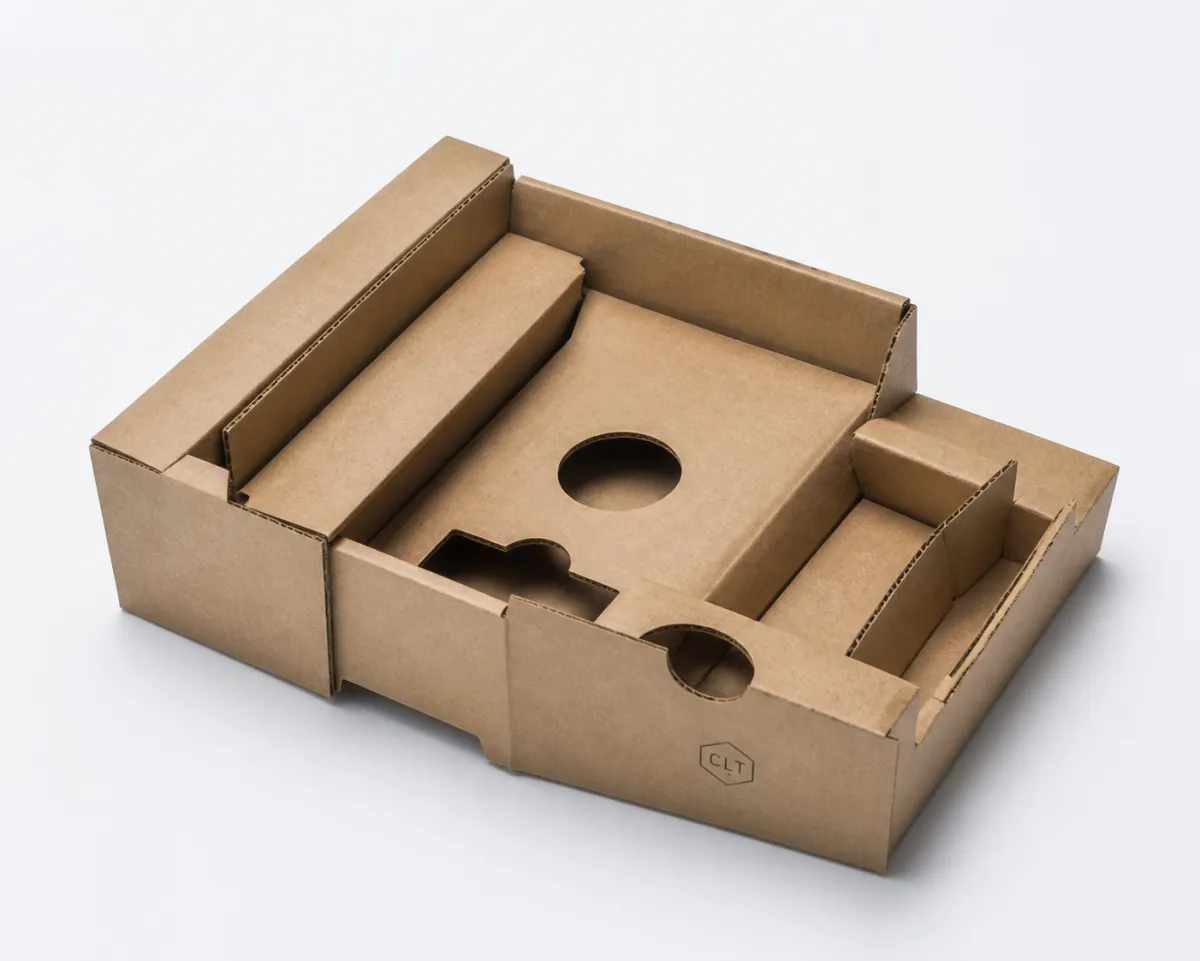
Custom kraft corrugated inserts are paper-based supports engineered to hold products in fixed positions inside a carton. Think of them as the package's internal frame. They separate components, create friction against movement, and protect edges and corners so the item does not slide around and bruise itself against the box walls. The outer carton gets credit, but the insert often does the real work.
The common failure is easy to picture. A product survives the shipper, yet the interior system allows it to rattle. A candle leans and scuffs. A glass bottle bangs against a divider. A multi-item kit arrives with accessories scattered under the main product. None of those outcomes requires a crushed box. They only require a bad interior layout. Custom kraft corrugated inserts cut those risks down by controlling the motion that happens between pickup and delivery.
I once sat through a launch review for a skincare line that looked flawless in renderings. The cartons were crisp, the print was sharp, and the unboxing sequence was carefully choreographed. Then the first real samples came back from parcel testing and the bottles had worn rings into the board. The problem was not the carton. It was the insert geometry. That is the kind of mistake that makes a brand look careless even when the outer package is doing its best.
Sustainability is part of the appeal too. Most custom kraft corrugated inserts use fiber-based material, which is easier to place into common recycling streams than mixed-material cushioning, foam, or plastic trays. Local rules still matter. Adhesives, coatings, and inks can change the recycling story, and no honest packaging buyer should pretend otherwise. Even so, a paper-based insert with a clean structure is usually a better environmental bet than a mixed-material alternative that only looks thoughtful from a distance.
There is also a freight argument. A well-designed insert is built around product dimensions, not guessed after the carton is chosen. That reduces void fill, tightens the overall pack size, and can improve palletization. On shipping lanes where dimensional weight matters, the savings can be real. Ship less air and you stop paying to move nothing, which is a surprisingly elegant way to trim packaging spend. Custom kraft corrugated inserts can reduce waste in the box and waste in the budget at the same time.
Brand perception matters as well. Not every package needs gloss, foil, or visual drama. Some products benefit more from discipline and clarity. Kraft gives that signal immediately. It feels restrained, responsible, and deliberate. For brands that care about branded packaging, custom kraft corrugated inserts can support the story without becoming the story. That quietness is part of the point.
“The box looked fine. The insert was the problem.” That sentence tends to appear after launch, not before it.
People usually discover the issue after returns start showing up. The carton looked strong, the print looked polished, and the interior was assumed to take care of itself. Then the first damage photos arrive, and the package has been reinterpreted by transit abuse. If you want custom kraft corrugated inserts to earn their place, the design has to start with failure modes, not with the marketing mockup.
How Custom Kraft Corrugated Inserts Work Inside the Box
The mechanics are plain. Custom kraft corrugated inserts use friction, compression, and separation to stop products from colliding with carton walls or other components during drops, vibration, and stacking. Parcels are not treated gently once they leave your dock. They are lifted, turned, stacked, dropped, and rattled. The insert either manages that motion or fails quietly, which is the more dangerous version because the damage hides until the end customer sees it.
Different styles solve different problems. Die-cut retainers hold products through shaped openings. Folded partitions split the interior into cells. Sleeves and pads create layered support. Nested structures wrap around the product for a tighter, more premium fit. The right choice depends on weight, surface sensitivity, and how much labor your pack line can tolerate. Custom kraft corrugated inserts are not interchangeable, and treating them that way usually produces a weak design with a neat drawing.
Kraft finish matters visually, but the finish itself does not protect anything. Real performance comes from the board structure, the score quality, and how securely the insert locks into the carton. A loose fit lets the product move. A cut that is off by a few millimeters can create a wobble point that looks harmless on screen and behaves badly in production. That is why custom kraft corrugated inserts should be tested with physical samples, not only with a dieline and a hopeful email.
Geometry carries more weight than most teams expect. Tight contact points stabilize the product, but poorly placed cutouts create stress points that can crack under load. A bridge that spans too far can sag. A tab that is too narrow can fold during assembly. After a few damaged returns, the insert stops looking like a cardboard accessory and starts looking like a small structural system with measurable consequences. Custom kraft corrugated inserts are architecture at a small scale.
Use case shapes the design. Cosmetics often need a clean retail presentation with crisp edges and easy shelf alignment. Supplements usually need bottle retention and label visibility. Glass demands separation plus corner control. Candles need base support and anti-scuff positioning. Electronics accessories need compartmentalization so cords, chargers, and inserts do not become a loose pile. Custom kraft corrugated inserts can support each category, but the geometry changes with the failure risk.
There is also a directional detail that gets missed a lot: corrugated board behaves differently depending on the flute direction and the grain of the paper. A score line against the grain can crack or spring back awkwardly. That small choice can affect assembly speed and the lifespan of the insert during transit. It sounds fussy until you have a pallet of product that starts looking sloppy because the board was asked to bend the wrong way.
The simplest rule is the most useful one: protection comes from contact, not decoration. The product should touch the insert where movement needs to be stopped and avoid contact where abrasion would be a risk. That sounds obvious. It is also the place where rushed custom kraft corrugated inserts fail most often, because speed tends to flatten the design into something that fits on paper rather than in the box.
For validation, I prefer test standards over gut feeling. ISTA parcel tests and ASTM distribution methods give structure to drop, vibration, and compression testing instead of turning the process into a guess-and-pray exercise. The International Safe Transit Association publishes practical protocols at ista.org, and those standards matter because they simulate actual shipping abuse, not just neat lab conditions.
Key Factors That Shape Fit, Strength, and Sustainability
Start with the product, not the carton. Custom kraft corrugated inserts should be built from actual measurements and tolerances, not brochure dimensions or whatever number happens to be in the catalog. A few millimeters can separate a snug design from a sloppy one. Packaging has very little patience for approximation. “Close enough” often becomes “returned later.”
Weight and fragility are the next two variables. Heavier items usually need stronger board, better locking surfaces, or more support points so the load does not concentrate on one weak edge. Fragile items usually need shock absorption and separation more than raw thickness. A glass gift set and a lightweight skincare bundle can share the same carton size and still demand completely different custom kraft corrugated inserts. The box footprint may match; the interior physics does not.
Board grade and flute choice shape the result from the beginning. Single-wall board often works for lighter goods and compact interiors. E-flute gives a crisp fold and is useful where print and tight geometry matter. B-flute offers more cushioning and a little more compression resistance. C-flute brings more structure, while double-wall construction may be appropriate for heavier loads or wider spans. The wrong flute can make custom kraft corrugated inserts look substantial without actually making them safer.
Nesting and pack-out efficiency deserve more attention than they usually get. A clever insert can reduce void space, lower the final carton volume, and improve pallet count. That is where sustainability turns concrete instead of rhetorical. Less material, less air, fewer boxes moving through the warehouse. Custom kraft corrugated inserts designed with pack-out efficiency in mind often save money on freight and labor, which is a better argument than saying the box “feels greener.”
Print and surface finish should be intentional, not automatic. Kraft can stay natural, carry a one-color logo, or remain unprinted if the team values the simplest recycling story. Some brands want a subtle mark, a product callout, or a quiet visual cue to support package branding and keep the interior aligned with the exterior. Others want no print at all because visual restraint matters more than interior branding. Both choices can work. Custom kraft corrugated inserts do not need heavy ink coverage to feel deliberate.
Assembly labor is the hidden cost most teams underestimate. If the insert takes an extra 8 seconds per pack-out and you ship 10,000 units, that is more than 22 labor hours gone. Multiply that across a season and the number stops looking small. A design that is cheap to manufacture but irritating to assemble is not actually cheap. That is one reason I push buyers to compare custom kraft corrugated inserts against real pack-out labor, not only against the sheet price.
When sustainability is the goal, look at the whole system. Are you using mixed materials? Are you oversizing cartons? Are you pairing a recyclable insert with a plastic accessory tray for no good reason? A paper-based insert helps, but the larger win comes from package architecture that removes waste across the entire shipper. That is where custom kraft corrugated inserts usually do their best work.
One more thing that gets overlooked: a package that uses less board but causes more damage is not sustainable in any meaningful sense. The replacement shipment, the extra transport, and the support load all carry an environmental cost. The cleanest-looking structure on the shelf is not always the cleanest one in practice. That is the uncomfortable part, and packaging teams have to sit with it.
Custom Kraft Corrugated Inserts Process and Timeline
The production process should be boring, and that is a compliment. Custom kraft corrugated inserts usually begin with product dimensions, weight, carton size, and a plain description of the failure you are trying to prevent. From there, the supplier creates a CAD layout, builds a prototype, checks fit, revises if needed, and moves to production after approval. The sequence sounds simple because the sequence is simple. The hard part is refusing to skip the steps that reveal the flaws.
Sampling is not optional. A flat dieline can look tidy on a monitor and still fail when someone lifts the product, shakes the box, or inserts the items at production speed. Prototype approval matters because it shows how custom kraft corrugated inserts behave with the real product, the real carton, and the real motion of pack-out. Paper has no interest in optimism. It only responds to geometry and pressure.
Timing depends on complexity. Straightforward inserts with one or two cavities can move quickly, with samples ready in a few business days and production following soon after approval. Multi-cavity kits, tight tolerances, and inserts that need carton coordination take longer because the revision loop gets longer. If the project includes both outer carton and insert, the schedule needs room for the two parts to fit each other properly. Custom kraft corrugated inserts tend to suffer when they are designed as if the outer box does not exist.
Typical lead times can look like this:
- Simple prototype: 3-7 business days
- Revision cycle: 2-5 business days per round
- Production after approval: 10-15 business days for standard runs
- Complex or multi-part builds: 15-25 business days, sometimes more if materials are constrained
Lead time drivers are predictable once you know where to look. Tooling complexity affects setup. Board availability matters if you need a specific flute or caliper. Print requirements add steps if branding is included inside the insert. If the supplier also has to source the outer carton, the schedule can stretch again. That is why I like launch plans with buffer time for at least one revision cycle. Custom kraft corrugated inserts are cheaper to fix before production than after a warehouse has to rework boxes by hand.
For brands scaling into new packaging lines, operator workflow deserves a test of its own. Can the insert be placed quickly without confusion? Does it lock in one direction only, or can it be assembled wrong? If the answer is uncertain, there is a labor issue waiting to happen. Good custom kraft corrugated inserts should protect products and reduce pack-line mistakes, not create a puzzle before every shipment.
If you are already ordering cartons or other packaging components, it makes sense to coordinate the insert spec with the rest of the system. That keeps the carton footprint, product presentation, and interior protection aligned. It also makes custom kraft corrugated inserts easier to quote because the supplier is not guessing at three variables at once.
Custom Kraft Corrugated Inserts Cost, Pricing, and MOQ
Pricing is where everyone wants a single number, and cardboard refuses to be that tidy. Custom kraft corrugated inserts are priced from a mix of board type, size, cut complexity, print, fold count, and how efficiently the parts nest on the sheet. If the layout wastes board or requires extra handling, the unit price rises. If the design is clean and the volume is healthy, the price gets better. The material may be simple. The economics are not.
MOQ usually comes from setup costs and sheet utilization. The supplier has to pay for layout, die setup, sampling, and production prep, so very small runs tend to look expensive per unit even when the board itself is inexpensive. That is normal. A 300-unit run and a 5,000-unit run are different businesses. Anyone pretending otherwise is selling comfort, not accuracy. Custom kraft corrugated inserts become more attractive as setup cost gets spread over more pieces.
Here is a practical way to think about cost at scale. For a straightforward insert in moderate volume, you might see something like $0.12-$0.25 per unit. More intricate die-cut structures, larger formats, or inserts with tighter print and fit requirements can move into the $0.28-$0.65 range or higher. Short-run prototypes can cost much more per piece because setup is doing all the heavy lifting. That is not a failure of the quote. It is just how custom kraft corrugated inserts are manufactured.
| Insert Style | Best For | Typical Volume Pressure | Relative Unit Cost | Practical Notes |
|---|---|---|---|---|
| Folded partition | Multi-item kits, bottles, candles | Lower setup pressure | Low to moderate | Efficient when the product count is stable and the cavities are simple |
| Die-cut retainer | Fragile items, cosmetics, accessories | Moderate setup pressure | Moderate | Good for clean presentation, but cut accuracy has to be tight |
| Sleeve and pad system | Retail-ready sets, layered product packaging | Moderate to higher setup pressure | Moderate to high | Useful when the pack-out needs a polished feel and strong separation |
| Nested premium structure | Electronics accessories, high-end DTC kits | Higher setup pressure | High | Very effective, but labor and material usage rise quickly |
| Prototype sample | Fit testing and launch validation | Very high per unit | Highest | Priced for iteration, not scale |
Where do buyers overspend? Three places show up again and again. First, they overbuild strength because “more cardboard” feels safer. Second, they request print or finishing that adds cost without improving performance. Third, they choose a geometry that is harder to manufacture than the product really needs. That last one is common. A compact item does not need a dramatic origami sculpture. It needs a well-fit insert. Custom kraft corrugated inserts reward restraint more often than spectacle.
When requesting a quote, send the information that matters: product dimensions, product weight, fragility concerns, carton size, forecast volume, shipping method, assembly constraints, and whether the insert must ship flat or arrive pre-assembled. If you have a sample or CAD file, include that too. Better input usually means better pricing and fewer revisions. It also means fewer surprises later, which is where packaging budgets tend to get damaged in silence. Better data leads to better custom kraft corrugated inserts.
For sustainability-minded buyers, ask about board source and chain-of-custody documentation. FSC-certified material can support procurement goals when your brand needs proof as well as paper. You can review certification basics at fsc.org. The shape may stay the same and the price band may not change much, but the sourcing story matters in retail programs and larger corporate accounts.
Common Mistakes With Custom Kraft Corrugated Inserts
Mistake one: designing for the product in isolation. The item may fit the cavity perfectly, then fail once labels, accessories, manuals, or secondary components are added. That is how a seemingly correct design breaks at the last step. Custom kraft corrugated inserts need to account for the full contents, not just the hero product that looks good in the render.
Mistake two: choosing the thinnest board just to shave unit cost. That move looks clever until damage claims start landing. Then the savings disappear into replacements, refunds, and support time. A board that is too light can collapse under stacking or flex too much during parcel handling. If the savings are pennies and the risk is expensive, the math is not difficult. Custom kraft corrugated inserts should be costed against failure, not only against board thickness.
Mistake three: ignoring assembly labor. A design can be cheap to manufacture and annoying to pack. That is a bad trade. If the insert requires multiple folds, careful orientation, or a small manual dance before every shipment, the labor hit can erase the material savings quickly. At scale, even a few extra seconds per box become real money. Good custom kraft corrugated inserts reduce complexity instead of pushing it downstream into fulfillment.
Mistake four: treating sustainability like a color choice. Brown kraft is not a magic spell. If the structure uses mixed materials, unnecessary coatings, plastic add-ons, or oversize packaging, the environmental story gets muddy fast. Sustainability lives in the whole system: material choice, volume efficiency, recyclability, and actual damage reduction. That is why custom kraft corrugated inserts should be evaluated as part of a packaging system, not as a visual cue.
Mistake five: skipping drop, compression, and vibration testing. This one is almost predictable in how often it happens. A box that behaves well on a desk can react very differently after a carrier scans it, stacks it, tosses it, and moves it through a route you would not choose for anything fragile. Test to a standard such as ISTA or ASTM instead of trusting guesswork. Custom kraft corrugated inserts are easy to get almost right and expensive to get almost right.
There is one more mistake worth naming: overcomplicating the brand story inside the box. If the insert is doing serious protection work, let it do that work cleanly. You can still support branded packaging with restrained print, a tidy fit, and consistent material language. The interior does not need to become a museum exhibit. A good insert is calm, efficient, and clear. That usually looks better than trying too hard.
Expert Tips and Next Steps for Better Custom Kraft Corrugated Inserts
Start with a sample pack-out test. Build the insert around the exact product lineup, then shake, invert, and drop the box before you approve anything. If the product shifts, rubs, or impacts the carton walls, the design needs work. The step sounds basic because it is basic, yet it remains the one many teams want to skip. Custom kraft corrugated inserts become much easier to approve once the product is tested in the real configuration rather than in the abstract.
Ask for more than one design option. Compare a simple protective structure against a more polished retail-ready version so you can see the tradeoffs in cost, labor, and presentation. One option may be cheaper but less refined. Another may look better and cost more to assemble. That comparison matters because it turns assumptions into choices. Strong custom kraft corrugated inserts are built from informed tradeoffs, not wishful thinking or a single quote that happens to fit the budget spreadsheet.
Keep the structure as simple as possible. The best insert is usually the one that uses the least material while still controlling movement and protecting edges. Simplicity helps with manufacturability, assembly speed, and recycling friendliness. It also reduces the odds that a tiny cut or fold point becomes the weak link. If one clean geometry can solve the problem, that is usually a better answer than four nested parts. Custom kraft corrugated inserts should be efficient before they are clever.
Build a spec sheet before you talk to suppliers. Include product weight, dimensions, carton size, shipping method, brand goals, desired insert orientation, and target volume. If there is a known damage issue, state it plainly. If the insert has to ship flat, say so. If it can arrive pre-assembled, say that too. Clear input produces better quotes and fewer revision loops. That is true for custom kraft corrugated inserts, and it is true for most packaging design work that has to function in the real world.
Use standards to keep everyone honest. If the parcel profile is rough, ask about ISTA test paths or ASTM D4169 distribution cycles. If sourcing goals include responsible fiber, ask about FSC documentation. If the brand needs the outside carton aligned with the interior experience, coordinate the insert with the rest of the product packaging system. That is usually the line between a package that performs and a package that merely survives the meeting.
For teams building a new launch, I would keep the next steps very direct:
- Compare two prototype structures for the same product.
- Confirm recycling compatibility with the materials and coatings you choose.
- Review the pack-out labor, not just the board cost.
- Lock the final insert spec before production starts drifting into improvisation.
If the outer carton still needs work, pair the insert review with the carton spec so the fit is resolved together. That is where Custom Shipping Boxes and Custom Packaging Products can be planned as one system instead of three disconnected purchases. Custom kraft corrugated inserts are strongest when the rest of the packaging supports them.
Custom kraft corrugated inserts are not glamorous, and that is exactly why they matter. They protect the product, support sustainable packaging goals, and give the box a cleaner interior story without wasting material on unnecessary extras. If you design them with real measurements, realistic testing, and a clear cost target, custom kraft corrugated inserts can improve damage rates, reduce pack-out friction, and make the package feel more deliberate from the first lift to the final unboxing.
FAQ
What are custom kraft corrugated inserts used for?
They hold products in place during shipping, reduce movement, and protect against impact, crushing, and abrasion. Custom kraft corrugated inserts are common for fragile, premium, or multi-part products that need a cleaner, more sustainable interior pack.
Are custom kraft corrugated inserts recyclable?
Usually yes, if they are made from paper-based corrugated board without plastic lamination, foam, or mixed-material attachments. Recyclability still depends on local rules and any inks, coatings, or adhesives used in the final design. When in doubt, keep the structure simple and the materials consistent.
How much do custom kraft corrugated inserts cost?
Pricing depends on board grade, size, cut complexity, print, and order quantity, so there is no honest one-price answer. Small runs usually cost more per unit because tooling and setup are spread across fewer pieces. Custom kraft corrugated inserts with simple geometry and healthy volume usually land in a much better price range than highly detailed short-run prototypes.
How long does the custom kraft corrugated inserts process take?
Simple jobs can move quickly, but prototype approval, revisions, and material availability can add time. Expect longer lead time for complex shapes, tight tolerances, or projects that need carton and insert coordination. A realistic plan usually leaves room for at least one revision cycle.
What information should I send for a quote on custom kraft corrugated inserts?
Send product dimensions, weight, fragility concerns, carton size, forecast volume, and any shipping or assembly constraints. If you have a sample or CAD file, include it; that usually produces a faster and more accurate quote. The clearer the input, the better the first round will be.
Practical takeaway: before you approve any insert, test the real product inside the real carton, check the assembly time on the pack line, and confirm the board choice against the damage risk rather than the unit price alone. If those three things line up, custom kraft corrugated inserts are usually doing their job; if they do not, fix the geometry first and worry about the pretty details later.

