Buyer Fit Snapshot
| Best fit | Custom Kraft Garment Bags Wholesale projects where brand print, material claims, artwork control, MOQ, and repeat-order consistency need to be specified before quoting. |
|---|---|
| Quote inputs | Share finished size, material target, print colors, finish, packing count, annual reorder estimate, ship-to region, and any compliance wording. |
| Proofing check | Approve dieline scale, logo placement, barcode or warning zones, color tolerance, closure strength, and carton packing before bulk production. |
| Main risk | Vague material claims, crowded artwork, missing packing details, or unclear freight terms can make a low unit price expensive after revisions. |
Fast answer: Custom Kraft Garment Bags Wholesale: Film, Print, MOQ, and Carton Packing should be specified like a repeatable production item. The safest quote records material, print method, finish, artwork proof, packing count, and reorder notes in one written spec.
Production checks before approval
Compare the actual filled-product size with the drawing, then confirm tolerance on folds, seals, hang holes, label areas, and retail display edges. Reserve space for logos, QR codes, warning copy, and material claims before decorative graphics fill the panel.
Quote comparison points
Review material grade, print process, finish, sampling route, tooling charges, carton quantity, and freight assumptions side by side. A quote is only useful when the supplier can repeat the same color, closure quality, and packing count on the next order.
Custom Kraft Garment Bags Wholesale: What Buyers Need
Custom kraft garment bags wholesale makes sense for brands that need protection, presentation, and a package that can actually do its job without feeling flimsy or overdesigned. The bag is rarely the expensive part. The real cost shows up later if the shoulder gets crushed, the return arrives wrinkled, or the packaging slows the team down because it does not hold shape well enough. That is why custom kraft garment bags wholesale deserves a close look at paper weight, construction, and finish before anyone chases the lowest number on a quote.
For Custom Logo Things, the question stays practical: does the bag protect the garment, support the brand, and survive the trip through retail, storage, or shipping? If the answer is yes, custom kraft garment bags wholesale can work for retail stores, e-commerce shipments, showrooms, hospitality uniforms, and seasonal storage without leaning on plastic just because plastic has been the default for years.
A bag that saves a few cents but creates a second repack is not savings. It is extra work with a logo on it.
Why Custom Kraft Garment Bags Wholesale Makes Sense
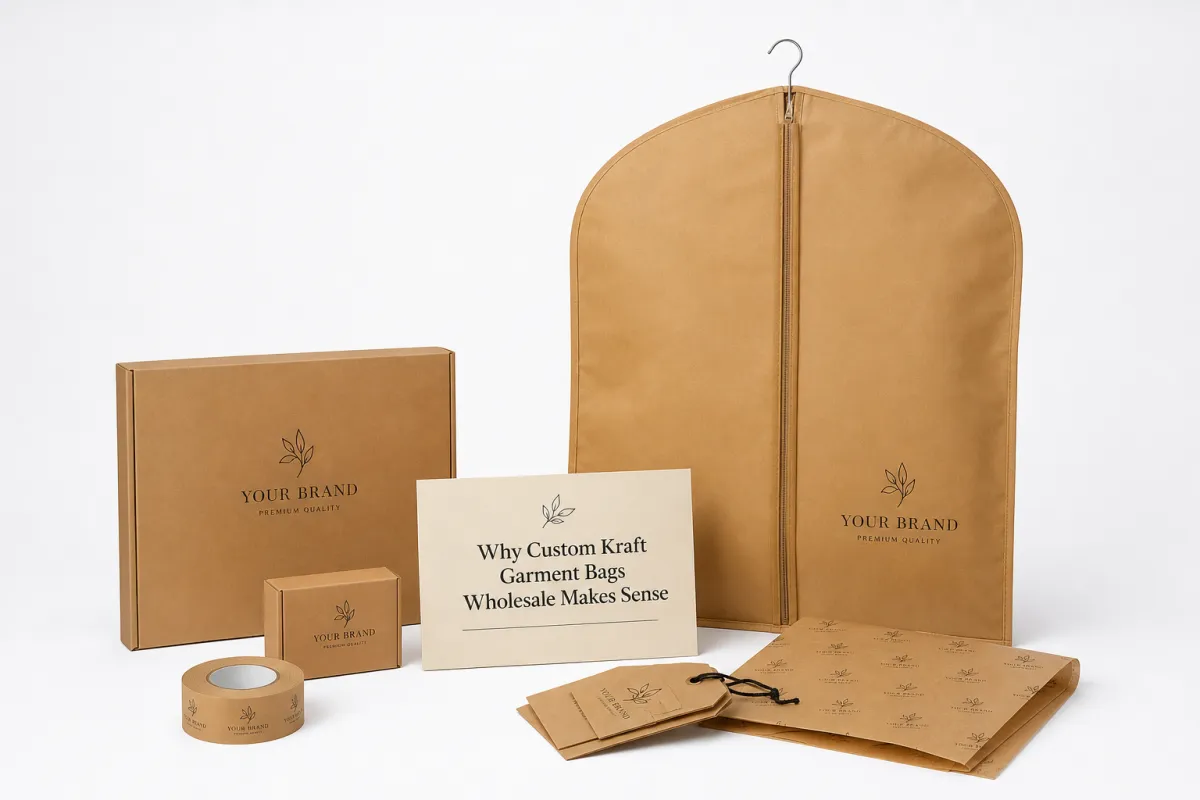
Custom kraft garment bags wholesale earns its place fastest in businesses that move apparel more than once. Retail stores need a neat handoff from display to register. E-commerce brands need a protective layer that helps guard against scuffs and handling marks. Showrooms need something more intentional than a clear sack that makes a garment look like it belongs in a clearance bin. Hotels, spas, and uniform programs need storage that stays organized and still looks professional. In each of those settings, custom kraft garment bags wholesale gives a brand a useful surface for identity without turning the package into a loud billboard.
The strongest buyers keep the garment at the center of the decision. A shirt bag can stay lighter and flatter. A coat bag needs more body. A bridal cover needs more length and better care around the hanger area. That is why custom kraft garment bags wholesale should begin with fit and performance, then move to print. If the spec misses the mark, the logo only helps people remember the mistake.
Supply chain math matters too. Cheap packaging often gets expensive after the sale. A wrinkled return means labor. A bent shoulder can trigger markdown risk. A weak seam turns into a customer service issue. Custom kraft garment bags wholesale helps reduce those problems while still supporting sustainability goals and brand presentation standards. I've seen teams save time simply because the garments stopped arriving in the back room needing a second pass.
For buyers comparing options, the quickest gains usually show up in five use cases:
- Retail packaging for folded or hanger-ready apparel that needs a cleaner handoff.
- Branded packaging for seasonal drops, opening-day displays, and premium assortment changes.
- Product packaging for e-commerce shipments where the outer carton is not the only layer that matters.
- Hospitality uniforms that move between storage, laundry, and back-of-house handling.
- Showroom presentation where the garment must look deliberate before anyone touches it.
A lot of brands overthink decoration and underthink structure. A one-color logo on a stiff, well-cut bag usually looks stronger than a busy print on soft paper that buckles at the fold. Custom kraft garment bags wholesale is not about decorating for decoration's sake. It is about keeping the garment in shape and letting the package do its work.
For broader packaging vocabulary and industry context, the Packaging.org resource library is a useful reference point. It will not choose your bag for you, which is exactly the point. Specs still matter.
Another way to think about custom kraft garment bags wholesale is as a low-drama packaging upgrade. If the current setup is plastic, thin tissue, or a generic cover that never quite fits, moving to kraft can change the presentation without forcing a full packaging redesign. That matters in packaging design because it keeps the garment in front while the bag quietly supports the sale.
Custom Kraft Garment Bags Wholesale Product Details
Several formats sit inside custom kraft garment bags wholesale, and each one behaves differently on the floor and in transit. Flat sleeves keep things simple for lighter items. Folded garment bags add structure and usually feel better for presentation. Gusseted bags create room for coats, dresses, or layered uniforms. Open-top styles work for quick access and storage. Window cutouts improve visibility, yet they also add another design decision the buyer needs to justify. Handles and hanger access points help when the bag has to move between departments or reach the customer in a ready-to-carry form.
Choosing the Right format starts with the garment. Shirts and light blouses fit neatly in flatter builds. Dresses and bridal pieces usually need more length and a softer interior so the fabric does not get stressed at the fold. Coats and uniforms benefit from heavier stock and a wider gusset. Folded items can work in a sleeve if the layout is tight and the paper is stiff enough to stay neat. Custom kraft garment bags wholesale should never be treated as one universal product. That is how buyers end up with a polished sample that fails in real use.
Construction choices become easier once the use case is clear. A display-focused bag may prioritize print and a crisp fold line. A transit-focused bag may need reinforced edges, secure closures, and a hanger notch that does not tear after two uses. A storage-focused bag may need ventilation so the garment does not sit in trapped moisture. Those details matter because custom kraft garment bags wholesale often supports several touchpoints, not just one.
Finish also changes the outcome. Natural kraft brings a warm, earthy feel and usually pairs well with minimal branding. Bleached kraft looks cleaner and brighter for premium retail packaging. Printed kraft works when a brand wants a stronger visual identity. Recycled board can fit sustainability goals, but the buyer still needs to check stiffness and surface quality. Coatings are not always needed; in some cases they add cost without solving a real problem. That is the kind of tradeoff that should be settled before the quote goes out, not after the order is packed.
Common features buyers ask for in custom kraft garment bags wholesale include:
- Closures such as fold-over tops, adhesive tabs, or tuck-in flaps.
- Ventilation through small holes or open sections for storage use.
- Interior reinforcement for shoulder areas and hanger points.
- Window cutouts for quick identification, usually on select retail programs.
- Handle options when the bag needs to move like a carry piece, not just hang in place.
The practical split stays the same: display, transit, or storage. If the buyer tries to make one structure do all three, the bag often ends up overbuilt, overpriced, or both. Custom kraft garment bags wholesale works best when the job is defined first and the structure follows the job.
The branding angle deserves attention too. Garment packaging is not the same as custom printed boxes, but the logic is similar. The surface carries a message. That message should stay clean, legible, and consistent with the rest of the line. If the brand already uses minimal product packaging, the garment bag should support that language instead of fighting it.
Recycled and recyclable paper structures are useful, but they are not magic. The paper weight and fold style still have to protect the garment. Sustainability does not excuse poor performance. Buyers should ask whether the build actually suits the garment, not whether the sales sample sounds noble.
Material and Print Specifications Buyers Should Lock In
The spec sheet is where custom kraft garment bags wholesale either becomes efficient or turns into a guessing game. Start with paper weight. Then lock down dimensions. Then confirm gusset depth, fold style, adhesive points, and any reinforcement around the hanger opening or shoulder area. Those details decide whether the bag hangs properly, stacks properly, and survives real handling.
For lighter shirts and simple retail apparel, buyers often look at paper in the 120gsm to 180gsm range, depending on the structure and whether the bag is a sleeve or a folded build. For coats, uniforms, or premium presentation pieces, heavier stock in the 200gsm to 300gsm range is more realistic. Those are not hard rules. They are practical starting points. Custom kraft garment bags wholesale should always match the garment weight and handling load, because a soft paper build can look fine in a mockup and then collapse under a wool coat.
Dimensions matter just as much. A bag that is too short exposes the hanger. A bag that is too narrow compresses the fabric. A bag that is too deep can bunch up and look awkward on a rack. The buyer should confirm finished width, height, and gusset depth in writing before artwork starts. In custom kraft garment bags wholesale, the dieline is not a nice-to-have; it is the blueprint that keeps expensive surprises off the table.
Print should receive the same care. A one-color logo can look sharp and clean, especially on natural kraft. Two-color branding can help a label feel more polished without pushing the bag into loud territory. Full-coverage graphics make sense for some fashion programs, but they are not automatically better. On kraft stock, strong coverage can work against the recycled feel the buyer is trying to create. In packaging design, restraint often prints better than enthusiasm.
A simple way to approach print choices for custom kraft Garment Bags Wholesale:
- One-color logo for minimalist retail packaging and lower-cost branded packaging.
- Two-color logo for fashion brands that want more presence without full coverage.
- Pantone matching when the brand color must stay consistent across product packaging and store fixtures.
- Full-coverage printing for campaigns, launches, or high-visibility package branding.
Artwork approval is where many issues get prevented. Buyers should confirm bleed area, safe zone, logo placement, and whether the image is vector-based before anything goes to production. If the logo sits too close to a fold, it can disappear in use. If the color target is vague, the final result can drift. If the file is low resolution, the printed line will show it. Those mistakes are boring, predictable, and expensive. They are also easy to avoid.
For buyers who want a general benchmark on packaging materials and sustainability language, the FSC site is a useful place to understand paper sourcing and certification context. Certification is not the same as performance, but it helps when a brand needs a paper story that sounds credible instead of decorative.
In practice, custom kraft garment bags wholesale should be reviewed like any other part of a branded packaging program. Ask whether the paper surface will accept the print cleanly, whether the fold will hold, whether the bag will survive storage, and whether the final look fits the rest of the line. That is the difference between a real packaging system and a box of hopeful samples.
Custom Kraft Garment Bags Wholesale Pricing and MOQ
Pricing for custom kraft garment bags wholesale depends on a handful of familiar drivers: size, paper grade, print count, coatings, windows, handles, and special finishing. If a quote looks unusually low, the missing cost is usually hiding in one of those areas. That is not cynicism. That is how packaging works.
The order quantity matters just as much. Lower runs carry higher unit pricing because setup costs get spread across fewer pieces. Larger runs bring the unit cost down, sometimes sharply, because the press setup, die work, and handling labor are amortized over more bags. For many buyers, the sweet spot is not the absolute lowest MOQ. It is the point where the unit price drops enough to justify a slightly larger inventory without creating storage headaches.
Custom kraft garment bags wholesale often starts in the low hundreds for simple builds, but the actual MOQ varies by construction and print complexity. A plain one-color sleeve may be possible at a lower volume than a fully printed bag with a window, handle, and extra reinforcement. The more custom the structure, the more likely the MOQ rises. Buyers should ask for price breaks at several quantity points, not just one number. That is how the real cost curve shows up.
Here is a practical pricing frame for custom kraft garment bags wholesale. These are general ranges, not promises, because paper grade and print coverage move the numbers quickly:
| Build Type | Best For | Typical MOQ | Estimated Unit Price | Typical Lead Time After Approval |
|---|---|---|---|---|
| Basic kraft sleeve, one-color logo | Shirts, light apparel, simple retail packaging | 300-1,000 pcs | $0.18-$0.32 | 12-18 business days |
| Folded bag with gusset, two-color print | Dresses, uniforms, showroom presentation | 500-2,000 pcs | $0.28-$0.55 | 15-22 business days |
| Heavier kraft, reinforcement, window or handle | Coats, premium branding, durable storage | 1,000-3,000 pcs | $0.42-$0.85 | 18-28 business days |
Those ranges work as a buying tool, not a promise sheet. They still help more than vague language like affordable or budget-friendly. If a supplier cannot explain why a quote sits in a certain range, that deserves a closer look. Custom kraft garment bags wholesale should be priced by spec, not by wishful thinking.
Hidden costs are where buyers get annoyed. Sample fees can apply, especially for custom dielines or printed proofs. Tooling and plate charges may appear if the design changes. Freight can swing the budget if the order ships palletized or export-packed. Extra protection for cartons, moisture barriers, and export labeling can add cost too. None of this is unusual. It is just packaging. It should be visible before the order gets approved.
It helps to think about budget in three lanes:
- Lean storage: low print coverage, simpler paper, and a structure that only needs to protect the garment briefly.
- Mid-tier retail packaging: a cleaner finish, better print control, and enough stiffness to support display use.
- Premium presentation: heavier board, stronger reinforcement, and more careful print placement for higher-end package branding.
Custom kraft garment bags wholesale is not about buying the cheapest line item. It is about buying the right line item for the use case. If the bag will be used once and discarded, the spec can stay lean. If it needs to support a premium retail experience or repeated handling, the paper needs to step up. Cheap paper becomes expensive when it fails during the first customer interaction.
Warehouse and export packing deserve a look too. Bags shipped flat versus nested versus boxed can change freight efficiency. If the order is large, ask how the cartons are packed and whether palletization will reduce damage. A quote for custom kraft garment bags wholesale only helps if the shipping method fits the budget and the receiving team can handle it without drama.
Custom Kraft Garment Bags Wholesale Process and Timeline
The cleanest order process for custom kraft garment bags wholesale is straightforward: brief, quote, dieline, artwork review, sample, approval, production, quality check, shipping. Nothing fancy. Just fewer mistakes. The better the brief, the less back-and-forth the team needs, and the faster the actual order moves.
Start by sending the garment type, finished bag size, target quantity, print count, and delivery deadline in one message. If the order is for coats, say so. If it needs to hang in a retail store, say that too. If the bag must ship flat, say that before the quote lands. Custom kraft garment bags wholesale becomes easier when the supplier is not guessing at the usage.
Sampling usually takes days to a couple of weeks, depending on the structure and whether the artwork is final. Production commonly runs about two to four weeks after approval for standard builds, though larger quantities or more complex finishing can stretch that window. Shipping time sits separately. Buyers often forget that part and then act surprised when the freight clock exists. It does, inconveniently.
The biggest delay points are predictable:
- Unclear dimensions that force multiple dieline revisions.
- Late artwork changes after the sample is already moving.
- Color mismatch concerns that were never defined at the start.
- Slow sample approval that pushes the whole production window back.
- Packaging changes that arrive after cartons and labels are already planned.
If the order is going into an e-commerce or distribution workflow, it is smart to think about transit testing and carton durability too. Industry resources like ISTA help frame the conversation around shipping stress, vibration, and handling. The garment bag is only one layer. The package still has to survive the trip.
Custom kraft garment bags wholesale works best when the buyer treats the process like a production schedule, not a shopping cart. Approve the sample quickly. Keep the artwork stable. Confirm the size once. Then let the job run. The more indecision that sits in the middle, the less useful the timeline becomes.
Repeat orders usually move faster. Once the dieline is confirmed and the print file is locked, future custom kraft garment bags wholesale runs get much simpler. The supplier already knows the structure, the bag nests correctly, and the next order can often move faster than the first one. That is one reason disciplined packaging programs stay cheaper over time than ad hoc buying.
For teams managing broader package branding, the process looks a lot like custom printed boxes or other printed packaging work. The difference sits in the garment-specific details: hanger access, paper stiffness, and how the bag behaves on a rack. Get those right, and the rest is execution.
Why Choose Us for Sustainable Garment Packaging
At Custom Logo Things, the value is not just that custom kraft garment bags wholesale can be made. It is that the spec can be matched to the job without inflating the order into something unnecessary. Consistent sizing, dependable print quality, and packaging that supports the brand instead of fighting it are the basics. Fancy claims do not help if the bag arrives warped or printed off-center.
Manufacturing control matters because buyers need repeatable results. If one batch hangs neatly and the next batch folds unevenly, the whole packaging program gets shaky. That risk shows up often in garment packaging, especially when the bags sit inside a larger product packaging system that also includes hang tags, tissue, cartons, or custom printed boxes. The set should look like it belongs together.
Sustainability should stay practical, not theatrical. Recycled content helps when the structure still performs. Recyclable paper is useful when the local recovery stream can actually handle it. Reduced plastic use is a sensible goal when the application allows it. That is the honest version. Not every garment needs the heaviest board, and not every brand needs a complicated coating package to look responsible.
What buyers usually want most is support that lowers friction:
- Fast quoting so the team can compare options without waiting a week.
- Honest material recommendations based on garment weight, not just margin.
- Samples or proofs that resemble the final order closely enough to trust.
- Clear production notes so the repeat order does not drift.
Custom kraft garment bags wholesale can support a brand’s sustainability story when it is handled with discipline. The wrong build undercuts the message. The right build supports it quietly. That is usually how good packaging works anyway: it does the job and steps aside.
It also helps to think beyond the bag itself. The strongest branded packaging programs keep the look consistent across garment bags, mailers, cartons, inserts, and shelf-facing materials. That consistency is what customers remember. Not a single spec line. Not a single slogan. The whole package branding system.
From a sourcing standpoint, buyers should ask for the plain facts: paper grade, print method, quantity breaks, lead time, and freight method. If those are clear, custom kraft garment bags wholesale becomes much easier to approve. If those are fuzzy, expect rework. Packaging always collects its debt.
Next Steps to Order Custom Kraft Garment Bags Wholesale
If you are ready to move, start with the basics: garment type, finished bag size, target quantity, logo files, preferred paper grade, and delivery deadline. That one bundle of information will do more for custom kraft garment bags wholesale than ten vague emails. The cleaner the brief, the cleaner the quote.
Then compare at least two builds. One should be lean and cost-controlled. The other should be heavier or more polished for retail use. That side-by-side view makes the tradeoff obvious. Sometimes the difference is a few cents. Sometimes it is the difference between a bag that merely covers the garment and a bag that actually supports the sale.
Ask for a sample or digital proof before you lock the order, especially if the logo sits on every shipment and the bag is part of your customer-facing experience. In custom kraft garment bags wholesale, that step is cheap insurance. It catches size issues, print placement problems, and material assumptions before they turn into inventory.
The fastest way to get a usable quote is to send everything in one message. No scavenger hunt. No five-email chain to confirm the width. No mystery around the print count. Custom kraft garment bags wholesale should be quoted from real specs, not from hopeful guesses.
If you want a broader view of product options, review our Wholesale Programs and browse Custom Packaging Products to compare related packaging formats. That makes it easier to keep garment bags aligned with the rest of your product packaging line and avoid one-off decisions that never quite match.
Done well, custom kraft garment bags wholesale is a practical packaging move, not a decorative one. It protects the garment, supports the brand, and keeps the presentation from slipping into generic territory. For buyers who want clean results without unnecessary plastic, it is one of the easier upgrades to justify. Send the specs, compare the builds, and make the bag earn its place in the program. That is how custom kraft garment bags wholesale should be bought.
What sizes work best for custom kraft garment bags wholesale?
Match the bag to the longest garment plus hanger height, not just the folded width. Shirts and light apparel usually need a smaller profile, while coats and dresses need extra length and gusset space. If you are unsure, request two size options so you can compare fit and shipping cost before you commit to custom kraft garment bags wholesale. A good sample will tell you more than a spec sheet alone.
What is a typical MOQ for custom kraft garment bags wholesale?
MOQ varies by construction, print count, and paper grade, but custom runs often start in the low hundreds and climb quickly for complex builds. Simple one-color designs are easier to run at lower quantities than fully printed, specialty-finished bags. Ask for price breaks at several volume points so you can see where the unit cost actually drops on custom kraft garment bags wholesale. That keeps the budget conversation grounded in real numbers.
Can custom kraft garment bags wholesale include logo printing?
Yes, most buyers add one-color or multi-color logo printing to keep the bag on brand. Simple layouts usually cost less and print cleaner than full-coverage artwork. Share vector files and Pantone targets early so the proof does not turn into a guessing game, which is a common problem in custom kraft garment bags wholesale. A clean logo on good kraft stock usually carries more authority than a busy print that fights the material.
How long does production take after approval?
Sampling often takes about one to two weeks depending on structure and print complexity. Production commonly runs from two to four weeks after approval, with longer lead times for larger or more detailed orders. Shipping time is separate, so confirm the delivery window before you finalize custom kraft garment bags wholesale. If the schedule is tight, build in a little buffer for freight and final inspection.
Are kraft garment bags strong enough for coats and uniforms?
Yes, if the paper weight, fold structure, and reinforcement are chosen correctly. Heavier garments need thicker stock and a more rigid build than lightweight retail pieces. If the bag will be reused often, ask for a sturdier spec instead of the cheapest option. That is usually the smarter move in custom kraft garment bags wholesale, especially for back-of-house handling where bags get opened and closed more than once.
Do kraft garment bags help with sustainability goals?
They can, as long as the structure still performs and the paper source is clear. Recycled content, recyclable paper, and lower plastic use all support a better packaging profile, but none of those points matter if the garment arrives damaged. Sustainability works best here as a practical material decision, not a slogan. That is the honest way to approach custom kraft garment bags wholesale.

