Buyer Fit Snapshot
| Best fit | Custom Label Rolls for Packaging projects where brand print, material claims, artwork control, MOQ, and repeat-order consistency need to be specified before quoting. |
|---|---|
| Quote inputs | Share finished size, material target, print colors, finish, packing count, annual reorder estimate, ship-to region, and any compliance wording. |
| Proofing check | Approve dieline scale, logo placement, barcode or warning zones, color tolerance, closure strength, and carton packing before bulk production. |
| Main risk | Vague material claims, crowded artwork, missing packing details, or unclear freight terms can make a low unit price expensive after revisions. |
Fast answer: Custom Label Rolls for Packaging: Material, Adhesive, Artwork, and MOQ should be specified like a repeatable production item. The safest quote records material, print method, finish, artwork proof, packing count, and reorder notes in one written spec.
Production checks before approval
Compare the actual filled-product size with the drawing, then confirm tolerance on folds, seals, hang holes, label areas, and retail display edges. Reserve space for logos, QR codes, warning copy, and material claims before decorative graphics fill the panel.
Quote comparison points
Review material grade, print process, finish, sampling route, tooling charges, carton quantity, and freight assumptions side by side. A quote is only useful when the supplier can repeat the same color, closure quality, and packing count on the next order.
The last thing most teams add to a package is often the first thing customers notice. That is why Custom Label Rolls for packaging matter more than the phrase sounds: they can carry the logo, compliance text, barcode, and shelf message that tell a buyer the brand has its act together before the product is even opened. In practice, a well-specified roll label can make a carton look sharper, a bottle scan faster, and a fulfillment line move with fewer pauses.
If your program covers pouches, cartons, mailers, and bottles, the same visual logic can carry across Custom Packaging Products and Custom Labels & Tags without forcing a package redesign. That matters because branding and operations are not separate chores. They meet at the label.
I keep coming back to Custom Label Rolls for packaging for one simple reason: the label is small, but the fallout from a bad spec is not. A roll label can shape retail packaging perception, speed up application, and keep product packaging consistent from one run to the next. Get the spec right and the label fades into the workflow. Get it wrong and everyone suddenly has opinions, usually loudly.
What Custom Label Rolls for Packaging Are and Why They Matter
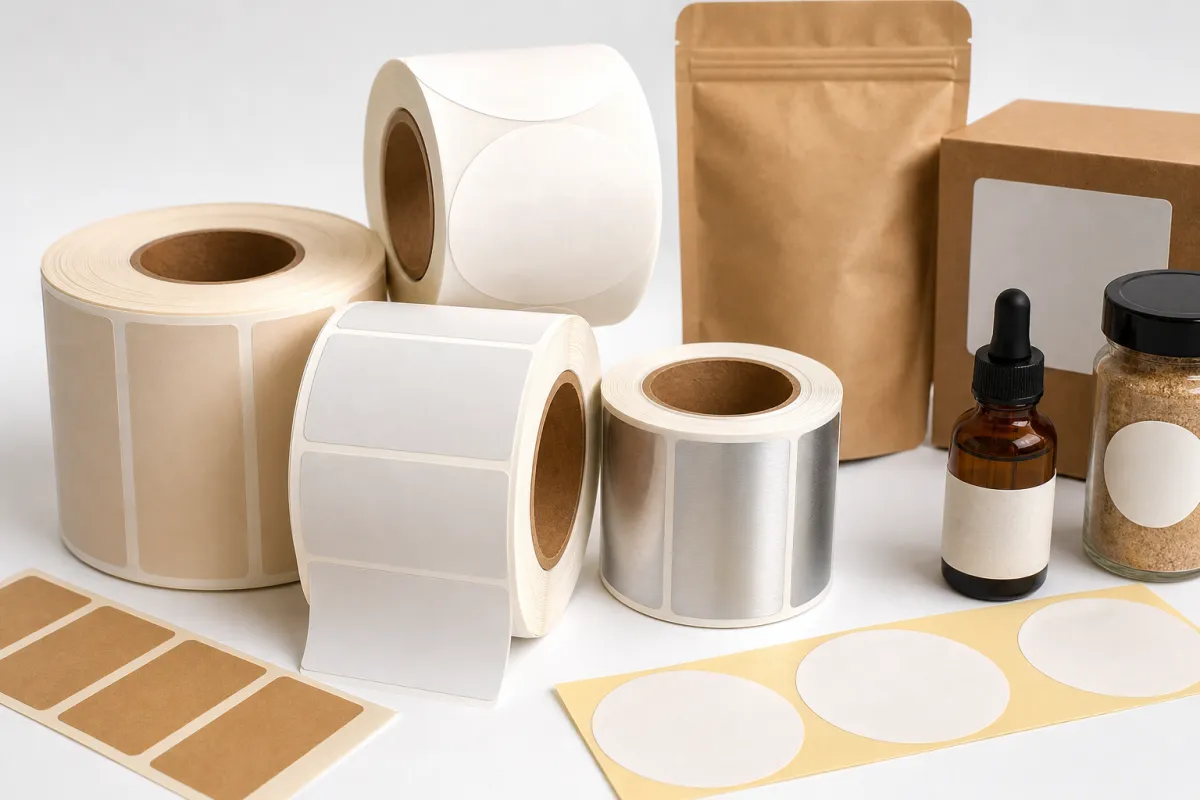
Custom Label Rolls for packaging are pressure-sensitive labels printed, cut, and wound onto a roll so they can be applied by hand or by machine. They show up on boxes, pouches, jars, bottles, tubes, sleeves, and mailers. The format is simple. The effect is not. A roll label can carry package branding, ingredient information, compliance language, price codes, and barcodes in one place without changing the underlying package.
That is why many brands choose custom label rolls for packaging instead of sheet labels. Rolls are easier to store, easier to dispense, and much better suited to repetitive application. If a team is labeling 200 units a week, sheet labels may be enough. If the team is labeling 2,000 or 20,000 units with a consistent placement requirement, rolls usually make more sense because they cut handling time and give a steadier application rhythm.
From a packaging buyer's point of view, the format also supports consistency. A flat carton label applied by hand can drift a few millimeters from unit to unit. On a bottle or pouch, that slight shift is obvious. With custom label rolls for packaging, especially in semi-automatic or fully automatic workflows, placement is more predictable. That matters in branded packaging because small variations can make a run look accidental instead of deliberate.
The label is rarely the biggest line item in a packaging budget, but it is often the one that decides whether the package looks finished or compromised.
There is also a practical side. A roll can support a packaging line that needs speed, light inventory, and clear version control. One SKU may need a matte white label for a dry pantry product. Another may need a moisture-resistant film label for a chilled beverage. A third may need a tamper cue for retail packaging. The structure changes, but the point stays the same: custom label rolls for packaging turn brand information into a production tool.
That is why I think of roll labels as part visual system and part industrial component. They belong in the same conversation as packaging design, machine uptime, and customer perception. A good label does all three jobs at once.
There is one more truth that gets ignored too often: a label spec that works in the office can still fail on a dock, on a cooler shelf, or on a packing table with a tired operator trying to keep pace. Packaging has a nasty habit of testing every assumption. Labels are not exempt.
How Custom Label Rolls for Packaging Work From File to Finished Roll
The process behind custom label rolls for packaging starts long before the first label is printed. It begins with artwork setup. A buyer or designer submits a file, and the supplier checks the dimensions, bleed, safe zones, barcode size, and any required legal copy. If the design is for product packaging that must carry nutrition facts, lot codes, or regulatory text, that stage matters more than most people expect. A beautiful label that fails scan tests or trims critical text too close to the edge is still a bad label.
Next comes proofing and print method selection. Digital printing often suits shorter runs, multiple SKUs, or frequent artwork changes. Flexographic or other high-volume methods can make sense when quantities are larger and artwork is stable. For custom label rolls for packaging, the print choice should follow the workload, not the other way around. A buyer planning a seasonal rollout may care more about flexibility than absolute unit cost. A high-volume filler may care more about line speed and repeatability.
After that, the supplier matches the face stock, adhesive, and liner. This is where performance is won or lost. Paper, polypropylene, polyester, and specialty films do not behave the same way. Adhesives do not either. A freezer-grade adhesive on a dry shipping label is unnecessary. A basic adhesive on a cold, damp bottle is a mistake. The liner, topcoat, and finish also affect how custom label rolls for packaging behave during application and how they survive abrasion after application.
Then comes die cutting, slitting, and rewinding. The roll is cut to the correct width and wound in the correct direction so the label can feed through a dispenser or automated applicator. Here, roll direction and core size are not minor details. They can stop a line. A hand-applied roll may work on a 1-inch core. A machine-fed roll may need a 3-inch core, specific outer diameter limits, and a defined unwind direction such as top-out or bottom-out. With custom label rolls for packaging, those mechanics matter as much as the print.
For a machine application, the supplier also needs to know the gap between labels, the roll diameter, and the orientation of the labels on the web. If the labels are too tightly wound, too loosely wound, or rotated incorrectly, the applicator may misfeed. The result is usually not a dramatic failure. It is worse: small interruptions, waste, and line frustration.
One more point deserves emphasis. Not every package behaves the same. A beverage label, a frozen-food label, and a shipping label all face different storage and transit stresses. That is why custom label rolls for packaging should be specified for the actual environment, not just for the artwork file.
I once watched a run go sideways because a team approved the proof from a bright office monitor and never checked the label on the actual frosted bottle. The art was fine. The adhesive was fine. The glare was the problem. Tiny detail, big headache. That kind of miss is annoyingly common, and it is exactly why physical testing still matters.
Key Factors That Shape Custom Label Rolls for Packaging Performance
The performance of custom label rolls for packaging depends on a handful of choices that look small on paper and become obvious on the line. Material is the first. Paper labels are cost-efficient and work well for dry, short-life applications. Polypropylene, often called BOPP in packaging circles, handles moisture better and tends to be a stronger fit for bottles, jars, and pouches that may face handling or condensation. Polyester is usually selected when abrasion, heat, or longer service life matters. Specialty stocks can help with premium package branding, but they should still match the job rather than chase decoration for its own sake.
Adhesive is the second major variable. Permanent adhesives are common because many brands want a label that stays put for the life of the product. Removable adhesives work when the label must come off cleanly, such as on reusable containers or promotional applications. Freezer-grade, high-tack, oil-resistant, and wet-strength adhesives all exist for specific conditions. With custom label rolls for packaging, the wrong adhesive is one of the easiest ways to create waste. A label that lifts at the corners or slides on a curved surface can make a premium package look cheap fast.
Finish changes both appearance and durability. Matte finishes reduce glare and can fit a natural or understated brand. Gloss creates a brighter retail presence. Soft-touch can feel premium, though it can also show marks if the package is handled roughly. Foil and clear-label effects can elevate branding, but they need precise alignment and good artwork discipline. The more elaborate the finish, the more the team should think about print registration, scuff resistance, and line compatibility. That is especially true for custom printed boxes and other branded packaging where the label has to match the rest of the visual system.
The application environment may matter more than the finish. Condensation, refrigeration, rounded container shapes, textured corrugate, dusty warehouse conditions, and fast-moving filling lines all affect whether custom label rolls for packaging perform as expected. A label that looks perfect in a proof may wrinkle on a matte-coated carton or release too slowly in a chilled room. I have seen teams choose a stock based on the sample sheet, only to discover that the actual product surface changed the result.
There is also the content requirement. If the label needs ingredients, nutrition panels, barcodes, QR codes, warnings, or tamper cues, the layout may need to grow. That can change label size, which then changes roll diameter, liner waste, and application behavior. In other words, design decisions and production decisions are tied together. A packaging design team can treat them separately; a packaging buyer usually cannot.
For teams that want a technical benchmark, the testing mindset behind ISTA transit testing is useful even if the label itself is not the only item being tested. If a package must survive vibration, abrasion, humidity, and temperature swings, the label needs to be part of that conversation. The same is true for paper-based programs that aim for certified sourcing; FSC certification can matter when the label stock or liner is part of a wider sustainability plan.
One caveat: no label stock is magic. If the container is oily, curved, cold, and handled roughly, you can still pick a nice-looking film and watch it struggle. The spec has to match the messiest version of reality, not the neat one.
Custom Label Rolls for Packaging Cost and Pricing Factors
Pricing for custom label rolls for packaging is shaped by more than print area. Material choice, adhesive type, artwork complexity, quantity, roll dimensions, finishing, and any special testing or certification requests all affect the quote. The cleanest way to think about pricing is to separate what changes the actual label from what changes the setup around the label. A two-color paper label in a standard roll format is very different from a clear polypropylene label with foil accents and variable data.
At lower quantities, unit price rises because the fixed work is spread across fewer labels. Proofing, press setup, die cutting, and calibration all take roughly the same amount of time whether the order is 500 labels or 50,000 labels. That is why custom label rolls for packaging often look more expensive in small runs. The machine does not care that the order is short; the setup time is still there.
There are also hidden cost traps. A label that is oversized by even a small amount can waste material across the run. A finish that looks premium but adds no real shelf value can inflate the budget without improving conversion. Changing artwork late in the process can trigger another proof cycle or new plates. And ordering the wrong adhesive can create costs later in the line through relabeling, spoilage, or machine downtime. For that reason, the cheapest quote on custom label rolls for packaging is not always the lowest-cost choice.
| Label option | Typical use | Approx. unit range | Operational note |
|---|---|---|---|
| Paper pressure-sensitive | Dry cartons, mailers, short-life retail packaging | $0.03-$0.08 each at medium volumes | Lowest material cost, but not ideal for moisture or abrasion |
| Polypropylene film | Bottles, pouches, jars, chilled product packaging | $0.05-$0.12 each at medium volumes | Better moisture resistance and shelf durability |
| Polyester / high-durability film | Rough handling, long-life labels, utility or compliance uses | $0.08-$0.18 each at medium volumes | Stronger against scuffing and heat, often overkill for simple branding |
| Specialty finish or clear label | Premium package branding and high-visibility retail packaging | $0.10-$0.30+ each at medium volumes | Can lift shelf appeal, but print and application tolerances matter more |
Those numbers are broad, because real pricing depends on size, coverage, and finishing. Still, they give a buyer a sane starting point. For custom label rolls for packaging, a standard 1-inch core and simple unwind direction usually stays economical. Wider rolls, longer repeat lengths, or machine-specific formats can add cost. So can specialty adhesives or finishes that need extra quality control.
A practical budgeting move is to ask for multiple quotes. One version can be optimized for hand application. Another can be tuned for machine application. A third can include a premium finish. When teams compare custom label rolls for packaging that way, they see the total operational picture, not just the per-label figure.
And yes, suppliers vary a lot here. Some are good at short-run digital work, some are better at higher-volume converting, and some are just better at talking. The quote matters, but so does whether the vendor actually understands your line.
Step-by-Step Guide to Ordering Custom Label Rolls for Packaging
Ordering custom label rolls for packaging goes better when the buyer brings the right information from the start. The first step is to document the package itself. What is the substrate? Is it corrugate, glass, HDPE, PET, laminated film, or coated paperboard? What shape is the container? Flat, curved, tapered, or textured? What is the storage condition? Room temperature, refrigerated, frozen, humid, or exposed to frequent handling? Those details help the supplier avoid recommending the wrong spec.
The second step is to define the application method. Manual application, semi-automatic dispensing, and fully automated labeling all have different requirements. A hand-applied label can tolerate a looser roll configuration. A machine-fed version needs tighter control over roll width, core size, unwind direction, spacing, and outer diameter. If the team does not know those specs yet, the machine manual or maintenance team should be consulted before the order is placed. With custom label rolls for packaging, guessing is expensive.
Step three is artwork preparation. The file should include bleed, safe zones, barcode sizing, and any mandated text. If the label will sit on a curved bottle or a small pouch, text size and panel depth become more important than on a flat carton. For custom label rolls for packaging, the artwork should be built for the actual shape, not just the screen mockup. A proof can look beautiful and still fail once the label wraps around a surface.
Step four is to request a proof or sample. A digital proof checks content and placement. A physical sample checks finish, color tone, adhesion, and how the label behaves on the actual package. That distinction matters because a label that looks acceptable on a PDF may not perform on a cold bottle, a textured mailer, or a glossy pouch. If the supplier offers test rolls, use them. Those few days can prevent a production mistake.
Step five is the order checklist. Buyers should confirm quantity, dimensions, adhesive, finish, core size, roll diameter, unwind direction, spacing, and ship date. If the label must integrate with custom printed boxes, folding cartons, or a larger branded packaging system, the label spec should be reviewed alongside the rest of the pack. That prevents a situation where the box looks premium and the label looks like an afterthought.
Step six is approval. The fastest projects are the ones where marketing, operations, and compliance review the proof together. Sequential signoff often creates delays because each group discovers something new after the previous group has already approved it. If the label is part of a launch, a short internal checklist saves more time than a long email chain ever will.
- Confirm the package surface and storage conditions.
- Define the application method and equipment details.
- Prepare artwork with production margins and legal text.
- Request proofing and, if possible, a physical sample.
- Lock quantity, roll format, and delivery timing.
- Approve with marketing, operations, and compliance at the same time.
That process is simple, but it is also where most friction gets removed. Custom label rolls for packaging perform best when the order request is specific before the first quote is even drafted.
If you want the shortest path to a clean order, build a spec sheet that reads like a production note, not a brainstorming file. Vague requests create vague labels, and vague labels usually end up costing more. Funny how that works.
Process Timeline for Custom Label Rolls for Packaging
Most custom label rolls for packaging jobs follow the same sequence: quote, artwork review, proof approval, production, finishing, quality check, and shipping. The exact timing shifts with quantity and complexity, but the logic rarely changes. Standard jobs tend to move faster when the file is ready and the spec is ordinary. Specialty jobs take longer because more variables need to be checked.
A straightforward order can often move from proof approval to finished rolls in about 7-10 business days. A more complex order with specialty stock, foil, clear film, or variable data may need 12-20 business days or more. If the project involves a large multi-SKU launch, the calendar can stretch further simply because there are more proofs to approve and more chances for a copy change. That is not a label problem; it is a coordination problem.
Where do delays usually happen? Incomplete artwork is one. Unclear adhesive requirements is another. Late text changes are common. So is waiting on internal approvals from teams that were not looped in early enough. With custom label rolls for packaging, the biggest time losses rarely come from printing itself. They come from decisions that were left unfinished before production started.
If the labels need to survive parcel distribution, the best planning mindset is to think beyond print quality. Transit introduces vibration, rubbing, temperature swings, and warehouse handling. That is one reason ISTA test methods are useful references for packaging teams. Even when the label is only one part of the pack, it still has to stay attached and legible through the distribution path.
Launch windows should be treated as fixed dates, not soft wishes. If the label has to arrive before a photo shoot, trade-show shipment, or seasonal rollout, the schedule should include a buffer. A day lost in proofing can matter more than a day lost in printing. With custom label rolls for packaging, the safest schedule is the one that assumes one round of revision, not three.
Ask the vendor for a calendar with realistic checkpoints. That calendar should show artwork review, proof return, production start, finishing, inspection, and delivery. A clear calendar helps the packaging team line up filling, boxing, and distribution without last-minute scrambling.
I also like to build in one small cushion for the dumb stuff. Files get renamed. Someone notices a typo. A barcode version changes after approval. It happens. Planning for one hiccup is not pessimism; it is experience.
Common Mistakes and Expert Tips for Better Label Rolls
One of the most common mistakes with custom label rolls for packaging is choosing the material before understanding the package surface. That often leads to peeling, wrinkling, or poor bond strength. A label stock that works beautifully on a smooth bottle can fail on a textured carton. The fix is boring but effective: test on the real package, not only in a digital mockup.
Another mistake is overlooking storage and handling. Labels that perform well in dry warehouse conditions may struggle in refrigeration, on oily surfaces, or in high-friction shipping environments. If the product packaging will be touched repeatedly, stacked tightly, or exposed to condensation, the adhesive and topcoat must be chosen with that in mind. This is not a place for assumptions. It is a place for samples and test runs.
If a label has to survive cold rooms, greasy hands, or rough transit, the spec should be designed for the worst case, not the best one.
Here is the part many brands get wrong: they treat the label as decoration, then expect it to behave like a performance component. That is not how custom label rolls for packaging work. A clean hierarchy, readable type, and sensible ink coverage often do more for shelf appeal than a packed design with too many claims. Strong packaging design is usually clearer, not busier.
My practical advice is to keep artwork disciplined. Use one primary message, one supporting message, and one clear product identifier. Avoid tiny legal text where it can be helped. Make barcodes easy to scan. And if the package is part of a broader branded packaging program, keep the label aligned with the rest of the line, especially if the product also uses custom printed boxes or coordinated inserts.
Another useful tip is to ask for a small overage. Launches get messy. Reprints happen. A reorder can be delayed. A demand spike can happen faster than the production schedule. Keeping a modest reserve of custom label rolls for packaging is a simple way to avoid emergency jobs that cost more and stress the team.
Finally, test the label in motion. Put it on the package, move the package, chill it, wipe it, stack it, and inspect it again. That is the closest thing to a real answer. A sample that survives the environment is worth more than a beautiful spec sheet. And if the first test fails, good. Better to find out early than during a launch, which is a terrible time to discover the adhesive had other plans.
Next Steps for Choosing Custom Label Rolls for Packaging
If you are sorting through options for custom label rolls for packaging, start with three facts: the package surface, the application method, and the storage condition. Those three variables narrow the field faster than anything else. Once they are known, a supplier can recommend the right face stock, adhesive, finish, and roll format without a lot of back-and-forth.
The next move is to gather a proper spec sheet before requesting quotes. Include dimensions, roll core size, unwind direction, roll diameter limits, artwork status, and the expected quantity per run. That level of detail speeds up quoting and reduces the chance of a mismatch later. For teams comparing custom label rolls for packaging with other parts of the pack, it also helps to review labels alongside Custom Packaging Products so the label strategy supports the wider package system.
It also helps to compare two or three options side by side. One can be a standard spec. Another can be a moisture-resistant or machine-ready version. A third can be a premium finish for shelf-facing retail packaging. That comparison makes trade-offs visible. Sometimes the most expensive option is unnecessary. Sometimes the extra spend buys better throughput, cleaner presentation, and fewer rejects. Both outcomes are useful if they are understood before the order is placed.
A short pilot run is smart whenever the label will be used on a new substrate, a new machine, or a new launch. Pilot runs surface issues early: curl, misfeed, glare, barcode placement, adhesive lift, or alignment drift. In packaging, the smallest pilot often saves the biggest headache. That is especially true when custom label rolls for packaging are part of a larger product packaging refresh.
Strong package branding is rarely an accident. It is usually the result of a label spec that respects the production line, the container, and the customer's eye at the same time. Match the spec to the job, and custom label rolls for packaging can support speed, consistency, and brand recognition without creating extra work downstream.
The clean takeaway: test on the real container, confirm the machine details, and do not let the prettiest proof win if the spec does not hold up. That is the whole trick, honestly.
What are custom label rolls for packaging used for?
Custom label rolls for packaging are used to brand and identify products on boxes, bottles, jars, pouches, and mailers while also carrying barcodes, ingredients, compliance text, or promo details. They suit both hand application and machine application, which is why many teams choose them when speed and consistency matter. Compared with sheet labels, custom label rolls for packaging usually fit production workflows better.
How do I choose the right material for custom label rolls for packaging?
Match the material to the surface and the environment. Paper is usually fine for dry, simple applications. Film stocks such as polypropylene are better for moisture, condensation, and handling. Polyester is often selected for tougher conditions. Before you commit, test custom label rolls for packaging on the real package so you can check adhesion and appearance in practical conditions.
What affects the price of custom label rolls for packaging most?
Quantity, material, print complexity, and finishing usually drive the biggest price changes. Setup work, proofing, and special specs like variable data or unusual roll sizes can also move the quote. The hidden cost usually shows up when the spec is wrong, because custom label rolls for packaging that misfeed or peel can create waste, relabeling, and downtime.
How long does it usually take to produce custom label rolls for packaging?
Simple jobs can move quickly once artwork is ready and the specs are standard. More complex custom label rolls for packaging jobs can take longer if they use specialty materials, custom finishes, or several proof revisions. A realistic production calendar is the best way to keep launch dates stable and avoid avoidable delays.
Can custom label rolls for packaging work with labeling machines?
Yes, but the roll width, core size, unwind direction, spacing, and adhesive must match the machine's requirements. Machine application usually needs tighter spec control than hand application because misfeeds can slow the line. If you plan to automate, ask the supplier to confirm compatibility before ordering custom label rolls for packaging.

