Buyer Fit Snapshot
| Best fit | Custom Label Rolls Wholesale projects where brand print, material claims, artwork control, MOQ, and repeat-order consistency need to be specified before quoting. |
|---|---|
| Quote inputs | Share finished size, material target, print colors, finish, packing count, annual reorder estimate, ship-to region, and any compliance wording. |
| Proofing check | Approve dieline scale, logo placement, barcode or warning zones, color tolerance, closure strength, and carton packing before bulk production. |
| Main risk | Vague material claims, crowded artwork, missing packing details, or unclear freight terms can make a low unit price expensive after revisions. |
Fast answer: Custom Label Rolls Wholesale: Pricing, Specs, and Ordering should be specified like a repeatable production item. The safest quote records material, print method, finish, artwork proof, packing count, and reorder notes in one written spec.
Production checks before approval
Compare the actual filled-product size with the drawing, then confirm tolerance on folds, seals, hang holes, label areas, and retail display edges. Reserve space for logos, QR codes, warning copy, and material claims before decorative graphics fill the panel.
Quote comparison points
Review material grade, print process, finish, sampling route, tooling charges, carton quantity, and freight assumptions side by side. A quote is only useful when the supplier can repeat the same color, closure quality, and packing count on the next order.
Custom Label Rolls Wholesale: Pricing, Specs, and Ordering
A production line can look tidy right up until the labels start causing problems. Then the whole operation gets slower, noisier, and a little more expensive than anyone planned. Custom Label Rolls wholesale matters because the wrong label format adds friction at every step: loading, dispensing, application, packing, and reordering. The sticker price may look fine. The labor cost and downtime usually tell the real story. For manufacturers, fulfillment teams, food brands, and private-label sellers, roll-fed labels are not a nice-to-have. They are part of the workflow.
Most buyers need three things at the same time: clean feeding, fast application, and a spec that actually fits the equipment on the floor. That is why Custom Label Rolls wholesale often beats sheets for branded packaging, product packaging, retail packaging, and projects that also include Custom Labels & Tags, Custom Packaging Products, or a broader packaging refresh. Paper is easy to buy. Uptime is harder.
Custom label rolls wholesale also makes repeat ordering less of a headache. Seasonal promos, SKU updates, holiday artwork, and size changes create tiny disruptions that pile up fast. Wholesale ordering keeps the base spec steady, which means the next reorder does not turn into a scavenger hunt through old emails, old proofs, and somebody's half-remembered machine settings.
The cheapest roll is not the cheapest label if it creates rework, waste, or a pack line that keeps stopping for no good reason.
Why Custom Label Rolls Wholesale Solves High-Volume Bottlenecks
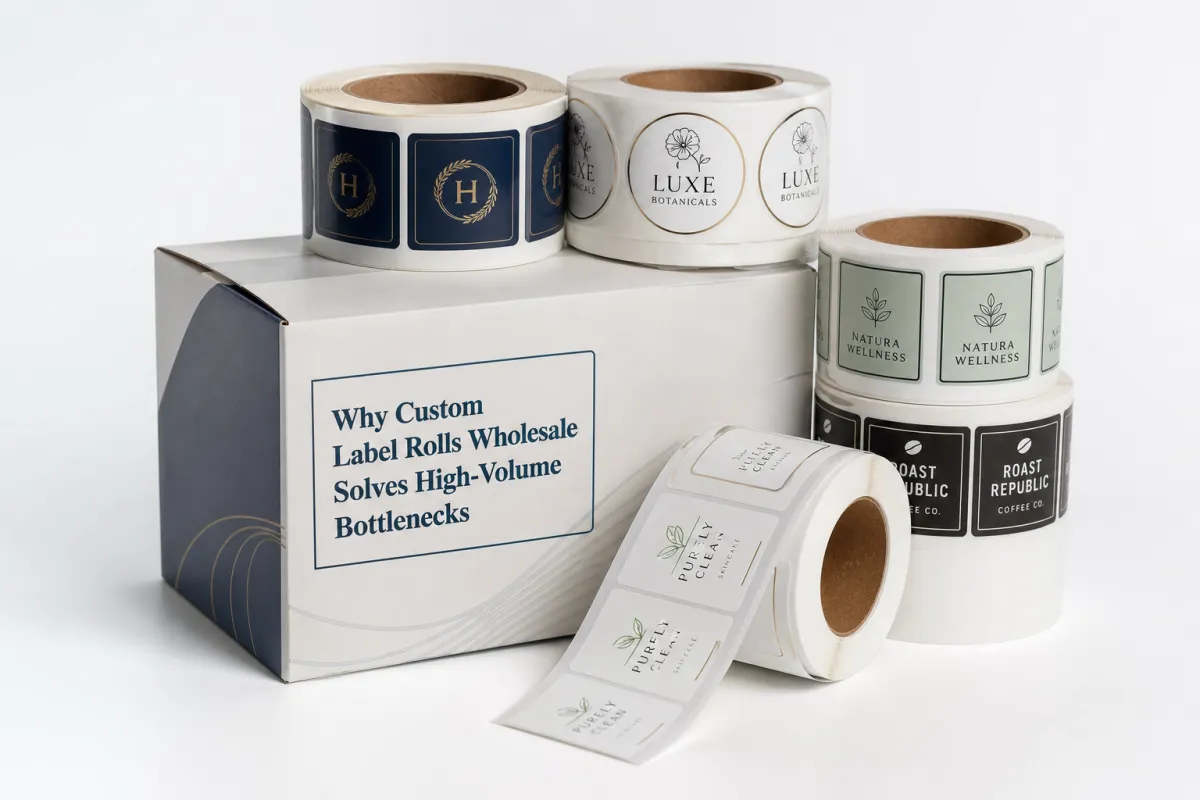
High-volume labeling stops being a branding detail and starts acting like part of the production system. A team applying 800, 1,500, or 5,000 labels a day does not have time for poor spacing, weak adhesion, or rolls that load the wrong way. That is where custom label rolls wholesale earns its keep. It cuts hand-applied time, lowers misfeeds, and keeps the labeling step from becoming the one weak link everyone keeps calling temporary. It is rarely temporary.
The real cost sits in downtime. A label that looks a few cents cheaper can add seconds to every unit. Multiply that by thousands of units and the savings disappear fast. custom label rolls wholesale helps buyers think in throughput, not just print price. Co-packers, e-commerce fulfillment teams, food processors, beverage brands, cosmetics lines, and private-label sellers feel that difference every day.
Roll-fed labels also make storage and staging simpler. They stack neatly, count cleanly, and move to the packing station without drama. For operations running multiple SKUs, that matters. So does repeatability. Once the label length, core size, and unwind direction are fixed, operators stop fiddling with the setup. That predictability is one reason custom label rolls wholesale beats short-run or loose-sheet ordering when production needs to keep moving.
Seasonal changes bring another headache. One month the team wants the standard product label. The next month it needs a limited-edition version, a barcode update, or a revised ingredient panel. Wholesale roll ordering keeps the base spec stable and lets the artwork change without reworking the whole production setup. Procurement stays cleaner. Packaging design stays cleaner. The line does too.
Think about labels the same way you think about cartons or inserts. If the boxes show up late, everybody notices. If the labels show up with the wrong core size or wound backward, the problem lands immediately on the floor. custom label rolls wholesale reduces that risk because the purchasing record carries the spec instead of one person’s memory.
For brands that also buy custom printed boxes or other branded packaging pieces, the label is often the fastest-moving item in the whole system. It may be small, but when it is wrong, it causes a big mess. Experienced buyers treat custom label rolls wholesale as a control point. That is the sensible move.
I have seen orders go sideways for a dumb reason: the art was right, but the unwind direction was wrong for the applicator. Everyone spent an hour blaming print quality. The labels were fine. The setup was not. That kind of mistake is exactly why a proper spec sheet matters more than a pretty mockup.
What Custom Label Rolls Wholesale Orders Typically Include
A proper custom label rolls wholesale order is more than artwork and quantity. Buyers need a production spec that tells the label how to behave on the line and how it should look on the package. At minimum, that means label dimensions, shape, roll diameter, core size, spacing between labels, winding direction, and the finished count per roll. Leave out one of those details and the odds of a mismatch go up. No surprise there.
Standard roll specs usually begin with the basics: width, height, and die-cut shape. Then the useful stuff shows up. Is the core 1 inch, 1.5 inch, or 3 inch? Does the roll need top-first unwind or bottom-first unwind? How many labels should go on each roll to fit the operator's workflow? Those details sound small until a dispenser jams or a semi-automatic applicator rejects the roll. That is why custom label rolls wholesale is about process fit as much as it is about design.
Common formats include product labels, barcode labels, shipping labels, ingredient labels, warning labels, and branding seals. A food brand may need one roll for the front panel and another for compliance text. A warehouse may need barcode labels that still scan after rough handling. A cosmetics line may want moisture resistance and a color finish that supports premium package branding. A supplement seller may need labels that work across retail packaging and e-commerce cartons. The point is simple: custom label rolls wholesale should match the actual use case.
It also helps to know where the labels sit in the production flow. Some teams apply them by hand. Others use desktop dispensers. Many use semi-automatic labelers. Larger operations feed rolls into automated equipment where winding direction, liner strength, and core fit matter more than the artwork itself. A label can look perfect on screen and still fail on the machine. Suppliers should ask how the labels will be used before locking in custom label rolls wholesale.
Good specs save money. The more accurate the order is before production starts, the fewer surprises show up later. That means fewer test runs, fewer rejected rolls, and fewer emergency reorders. For buyers managing multiple SKUs, custom label rolls wholesale keeps the operation stable while the packaging mix changes around it.
- Product labels: front-of-pack branding, size labels, and SKU identification.
- Barcode labels: inventory, logistics, and retail scan applications.
- Ingredient or compliance labels: regulated text with clean readability.
- Shipping labels: parcel, fulfillment, and warehouse use.
- Warning labels: safety, handling, and storage instructions.
Material, Adhesive, and Finish Specifications to Compare
Material choice affects performance more than many buyers expect. custom label rolls wholesale can be produced in paper, thermal paper, polypropylene, polyethylene, vinyl, and specialty constructions made for freezer storage, abrasion, or moisture exposure. Paper is usually the simple choice for dry goods and short handling cycles. BOPP or polypropylene tends to work better for bottles, jars, and retail packaging that needs moisture resistance. Vinyl can make sense in tougher environments. Thermal paper is common for variable data or logistics use.
Adhesive choice matters just as much. Permanent adhesive is the default for most labels because it bonds well to cartons, bottles, and containers that need the label to stay put. Removable adhesive works for temporary messaging or reusable containers. Freezer-grade adhesive helps when labels need to survive cold storage or condensation. High-tack adhesive is useful on textured surfaces, flexible pouches, or packaging materials that are harder to bond. If the label needs to stick to a low-surface-energy film, that needs to be stated early in the custom label rolls wholesale process.
Finish changes both the look and the behavior. Matte finishes improve readability and reduce glare. Gloss finishes bring out color and make graphics pop. Soft-touch or protective coatings can improve feel and scuff resistance. For premium product packaging, finish choices affect shelf appeal. For functional work, finish often matters more for legibility, adhesion, and durability than for style. The right option depends on the environment, not the mood board.
Buyers should also ask for the technical details that affect consistency: label thickness, liner type, print durability, temperature range, and resistance to water, oil, and abrasion. If the labels will be handled by refrigerated goods, exposed to shipping moisture, or stored in warm warehouses, those details matter. custom label rolls wholesale is easiest to manage when the spec sheet is specific enough that the second order matches the first without guesswork.
For food, cosmetics, health, and logistics programs, compliance often matters as much as appearance. Labels may need to hold up through refrigerated transport, warehouse handling, or repeated touching. If the package includes lot codes, ingredient declarations, or barcode readability requirements, proof approval should not be rushed. For shipment testing, many packaging teams also refer to ISTA shipping test standards when the label must survive broader package handling. That kind of discipline keeps custom label rolls wholesale tied to real conditions instead of wishful thinking.
The cheapest material is not always the lowest total cost. A slightly more durable construction can prevent peeling, smudging, and rework. That matters even more when the label is part of a larger branding packaging system that includes cartons, inserts, and other product packaging pieces. If the label fails, the whole presentation feels off.
Buyers who care about sustainability should ask about paper sourcing and recycling compatibility. In some programs, a fiber-based label makes more sense than a plastic film. If FSC-certified paper is important, the supplier should be able to speak to sourcing and documentation through organizations such as FSC. In wholesale ordering, that detail belongs in the quote, not in a frantic email three minutes before approval.
Custom Label Rolls Wholesale Pricing, MOQ, and Cost Drivers
Pricing for custom label rolls wholesale comes down to a few variables that hit the final number harder than most people expect. Size is the first one. A tiny SKU label with light coverage costs much less than a large wraparound label with full-color graphics and a specialty finish. Material is the second. Paper usually costs less than film. Adhesive type, die-cut complexity, number of colors, and print coverage all shape the quote. Quantity matters too, because setup costs spread out as volume rises.
MOQ, or minimum order quantity, is where wholesale buying starts making financial sense. Lower quantities can be convenient, but they often carry a higher unit price because setup and production time are not spread across enough labels. In custom label rolls wholesale, the unit price usually drops at predictable breakpoints. Ask for tiered quotes instead of a single number. One tier might be 1,000 labels, another 5,000, another 10,000. The difference can be real.
For a rough planning model, many buyers see ranges like these for standard constructions at mid-volume. Exact pricing shifts with artwork coverage and finishing:
| Label Construction | Typical Use | Approx. Price Range Per 1,000 Labels | Notes |
|---|---|---|---|
| Paper roll label | Dry goods, cartons, basic branding | $30-$80 | Usually the lowest-cost option for straightforward runs |
| Polypropylene / BOPP | Bottles, jars, moisture-prone packaging | $50-$120 | Better durability and moisture resistance |
| Thermal or variable-data label | Shipping, inventory, date coding | $35-$110 | Pricing depends on print method and data handling |
| Specialty adhesive or finish | Freezer, textured surfaces, premium retail | $90-$200+ | Use only where performance justifies the premium |
Those figures are directional, not fixed. They still help a buyer judge whether a quote is in the right neighborhood. A quote should also show setup charges, proof fees if applicable, shipping, and any added cost for variable data or specialty finishing. If the order is rush-routed or split into multiple deliveries, freight can change the total faster than the print price does. That is why custom label rolls wholesale should be judged on landed cost, not unit price alone.
Hidden cost drivers deserve attention. Custom shapes can increase die time. Short timelines may narrow material choices. Metallic inks or specialty coatings add cost. Variable data and serialized labels need a different production workflow. Exact color matching can raise proofing complexity. Even a small change in liner or unwind direction may alter setup. None of this is unusual. It is the difference between a basic reorder and a fully specified custom label rolls wholesale job.
Ask for pricing breakpoints before committing. If 5,000 labels cost only a little more than 3,000, the larger run may lower cost per label enough to justify the extra inventory. That calculation works best when demand is steady. It also works well for brands that know they will reorder the same label several times during the year. In that case, custom label rolls wholesale becomes a budgeting tool, not just a print order.
One more thing buyers miss: the same label can be more expensive in a small roll if the core, gap, or winding has to be customized for a machine. A packaging supplier can usually prevent that by matching the roll spec to the equipment early. That is one of the easiest ways to protect margin on custom label rolls wholesale without giving up quality.
Ordering Process and Production Timeline for Custom Label Rolls Wholesale
A clean ordering process saves time at every stage. The best custom label rolls wholesale jobs start with a complete quote request, move to artwork review, then proof approval, production, finishing, packing, and shipment. When a buyer sends exact dimensions and application details up front, the supplier can quote faster and cut the back-and-forth that usually drags out first orders.
The fastest-moving inputs are the ones that affect the press and the roll build. Send label size, shape, material, adhesive, quantity, core size, unwind direction, application method, and artwork status. If the label must fit a dispenser, a bottling line, or a hand-applicator, say so. If you need split shipping for multiple locations, say that too. Specific orders are easier to execute. Vague ones are not. No mystery there.
The proof stage matters more than many buyers expect. It is where color balance, barcode readability, dieline accuracy, and legal or ingredient text placement get checked. If the label includes a barcode or QR code, proofing should include a scan test. If the label includes compliance text, line breaks and font size need careful review. Pretty is not enough. The proof must read well, print cleanly, and apply the way the packaging team needs it to.
Timeline depends on complexity. Simple repeat orders with approved artwork can move quickly, often in about 8-12 business days after final approval. New artwork, specialty film, or complex finishing can stretch that to 12-18 business days or more, especially if the order needs multiple proof rounds. That is normal in custom label rolls wholesale. Missing information, not the press, usually slows things down.
Logistics matter too. Some orders ship by parcel, while larger runs may move on pallets. Multi-location businesses may want split delivery to warehouse and production sites. If the labels are part of a larger procurement plan, it helps to line them up with the packaging calendar so cartons, inserts, and labels arrive in the same window. That is especially useful for buyers handling multiple product launches or seasonal refreshes. A well-run custom label rolls wholesale program should feel planned, not improvised.
Here is a planning sequence that works in practice:
- Confirm the label size, material, and adhesive.
- Lock the roll spec: core, unwind, spacing, and quantity per roll.
- Review pricing tiers and compare landed cost.
- Approve the proof after checking color, barcode, and copy.
- Schedule production before inventory gets tight.
That sequence prevents the most common failure point: ordering too late. Once inventory gets low, buyers tend to accept a rushed spec. Rush orders can narrow material choices, raise freight cost, and make proofing messier. The better move is to place custom label rolls wholesale orders while there is still time to compare specs and Choose the Right construction.
Why Choose Us for Custom Label Rolls Wholesale
At Custom Logo Things, the value is not a slogan. It is a process built around consistency, clear communication, and packaging know-how. Buyers looking for custom label rolls wholesale need a supplier that understands how labels behave on real equipment, not just how they look in a mockup. That difference shows up in roll accuracy, color control, and the ability to repeat the same spec without drift from one order to the next.
We treat label production as part of the broader packaging system. That means we pay attention to how the label interacts with the package surface, whether the project sits inside a larger retail packaging rollout, and whether the brand needs alignment with custom printed boxes, inserts, or other branded packaging components. A label is rarely isolated. It is one piece of a larger product packaging story, and custom label rolls wholesale should support that story without causing production headaches.
Specialized packaging suppliers usually do better on this kind of job because the details matter more. A general printer may focus on the artwork file. A packaging-focused supplier looks at unwind direction, core diameter, label count per roll, and how the adhesive behaves on the actual substrate. That is the difference between a nice sample and a roll that actually runs correctly on the line. For custom label rolls wholesale, operational fit matters more than a polished pitch deck.
We also help with sampling and spec review. If a buyer is unsure about material or adhesive, we can suggest a construction based on the packaging surface, storage conditions, and application method. If the label needs to work in a dispenser, around a curved bottle, or through a high-volume pack station, we can narrow the choices to what is likely to run cleanly. That support matters because it cuts waste before production starts.
Trust also comes from direct timing and clear quoting. Buyers do not want vague promises. They want a quote that shows what the job includes, what changes the price, and what the timeline depends on. They want to know whether the reorder path is simple. They want the next run to match the first run. That is where custom label rolls wholesale should pay off: repeatable supply, fewer surprises, and better control over packaging cost.
For businesses that buy through a broader procurement plan, our Wholesale Programs are built to make repeat ordering easier. That matters when the same artwork may need to move across multiple products or product lines. A good wholesale relationship turns custom label rolls wholesale into a stable part of the supply chain instead of a scramble every time inventory drops.
I care a lot about this part because packaging teams get blamed for problems they did not cause. If the roll spec is sloppy, the machine will remind you. Loudly. A supplier should help catch the mismatch before it becomes a shift-ending annoyance, not pretend every label can run everywhere.
Good label sourcing should feel boring in the best way. The roll arrives right, the proof is clear, the line keeps moving, and nobody has to explain a preventable delay.
Next Steps: Build Your Spec Sheet and Request a Quote
If you are ready to price custom label rolls wholesale, start with five inputs: label size, material, quantity, application method, and artwork status. Those five details move the quote process faster than anything else. If you already know your roll spec, include core size, unwind direction, and labels per roll too. That makes the first estimate much more accurate.
It usually helps to compare two or three spec options. One option may be the lowest-cost paper version. Another may be a more durable film. A third may offer a better adhesive for cold storage or textured packaging. That comparison helps the buyer balance performance, price, and lead time before committing. custom label rolls wholesale works best when the decision is based on how the label will behave in production, not just how it looks in a quote sheet.
If the label must fit a dispenser, wrap neatly around a package, or support barcode scanning, request a sample or proof test. A short trial is cheaper than a production mistake. That matters even more for labels that need to coordinate with custom printed boxes, shrink sleeves, or other branded packaging elements. Consistency across the package set improves the final presentation and reduces waste.
Before you submit the order, confirm the schedule. Ask how long proofing will take, how the finished rolls will be packed, and whether shipping will be parcel or pallet. If there are multiple delivery points, set that up before production begins. A good custom label rolls wholesale plan should reduce friction, not create it.
When the goal is repeatable supply, lower handling time, and predictable costs, custom label rolls wholesale is usually the smartest purchasing path. It gives your team a stable spec, a cleaner reorder process, and a label that is built for the actual line, not just the design file. Build the next run around the equipment, storage conditions, and handling reality you already have. That is the part that keeps the labels from becoming somebody else's problem.
What information do I need to order custom label rolls wholesale?
Provide label size, shape, material, adhesive, quantity, core size, unwind direction, and whether the labels will be applied by hand or machine. Share artwork files early, along with any barcode or compliance requirements, so proofing moves faster. If you are unsure about material or adhesive, ask for a recommendation based on the packaging surface and storage conditions.
How does MOQ affect custom label rolls wholesale pricing?
Higher quantities usually lower the unit cost because setup and production time are spread across more labels. MOQ can vary by material, print method, and finishing requirements, so compare tiered pricing before choosing a quantity. If annual usage is steady, ordering closer to a higher price break can reduce total spend over time.
Which adhesive is best for custom label rolls wholesale orders?
Permanent adhesive works for most retail and shipping applications where the label should stay put. Removable or specialty adhesives are better for temporary labeling, textured surfaces, cold storage, or hard-to-stick packaging. Test the adhesive on your actual packaging, since surface finish and temperature can change performance.
How long do custom label rolls wholesale orders usually take?
Simple repeat orders can move quickly once artwork is approved and specs are finalized. New artwork, specialty materials, or variable data jobs usually take longer because of proofing and production setup. Lead time is easiest to control when the buyer confirms specs before requesting a quote.
Can custom label rolls wholesale support barcode or compliance labels?
Yes, roll labels can be produced for barcode, ingredient, warning, and other regulated applications. The key is print clarity, correct sizing, durable material, and proof approval before production. If scan accuracy matters, request a sample or proof test on the same scanner and packaging surface you will use in-house.

