Buyer Fit Snapshot
| Best fit | Custom Label Rolls for Products projects where brand print, material claims, artwork control, MOQ, and repeat-order consistency need to be specified before quoting. |
|---|---|
| Quote inputs | Share finished size, material target, print colors, finish, packing count, annual reorder estimate, ship-to region, and any compliance wording. |
| Proofing check | Approve dieline scale, logo placement, barcode or warning zones, color tolerance, closure strength, and carton packing before bulk production. |
| Main risk | Vague material claims, crowded artwork, missing packing details, or unclear freight terms can make a low unit price expensive after revisions. |
Fast answer: Custom Label Rolls for Products: Material, Adhesive, Artwork, and MOQ should be specified like a repeatable production item. The safest quote records material, print method, finish, artwork proof, packing count, and reorder notes in one written spec.
Production checks before approval
Compare the actual filled-product size with the drawing, then confirm tolerance on folds, seals, hang holes, label areas, and retail display edges. Reserve space for logos, QR codes, warning copy, and material claims before decorative graphics fill the panel.
Quote comparison points
Review material grade, print process, finish, sampling route, tooling charges, carton quantity, and freight assumptions side by side. A quote is only useful when the supplier can repeat the same color, closure quality, and packing count on the next order.
A label can look perfect on a proof and still peel off a cold bottle in ten minutes. Pretty artwork is nice. A label that survives the real line matters more. That is why Custom Label Rolls for products are about far more than looks. They have to handle the surface, the temperature, the adhesive, the liner, and the abuse that comes with shipping and handling. If your packaging needs to move fast, look sharp, and not create a mess on the production floor, roll format deserves a real look.
Most buyers start with the design. Fair enough. Packaging design is the part people see first. But the material, adhesive, unwind direction, core size, and roll diameter decide whether Custom Label Rolls for products make life easier or hand your team a pile of avoidable problems. I have watched perfectly good artwork get blamed for a failure that was really a materials mismatch. Happens all the time.
For most brands, the useful question is simple: what format fits the product, the run size, and the environment around it? That is where custom label rolls for products start to beat sheets, and where a little planning keeps a lot of labels out of the trash.
Custom label rolls for products: what they are and why they beat sheets
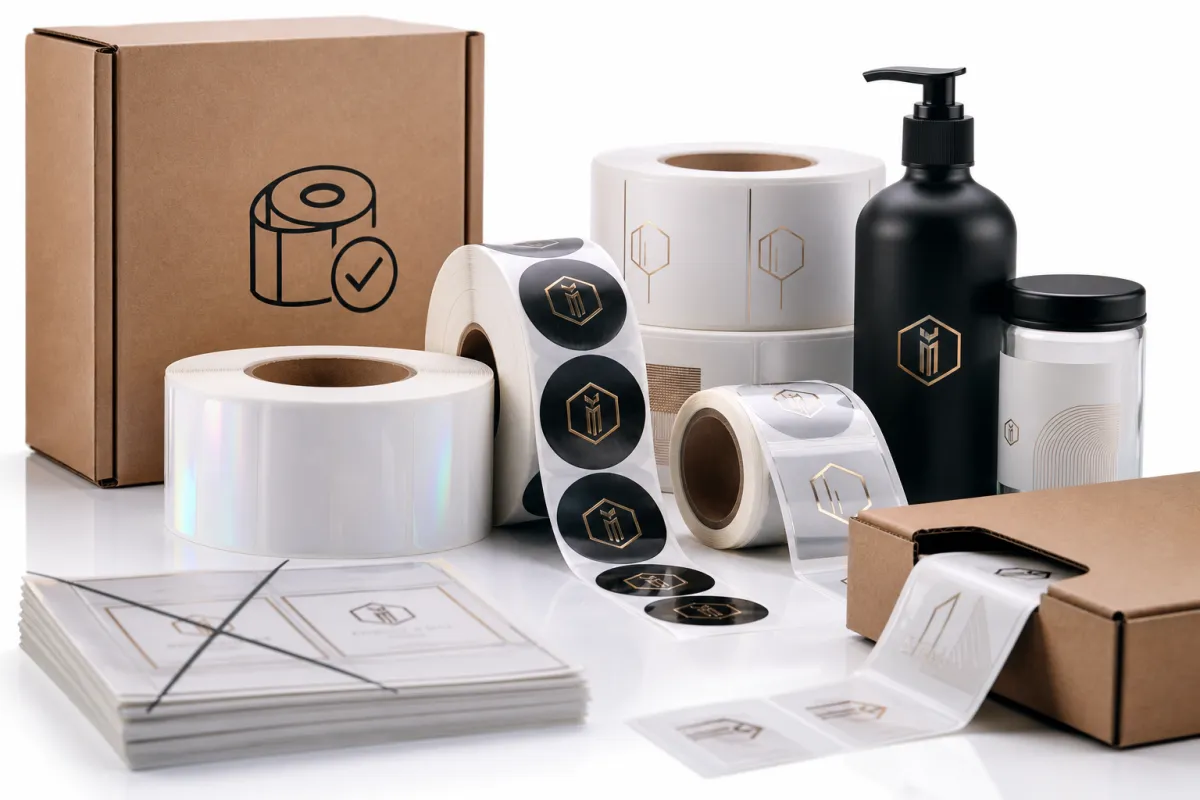
Custom label rolls for products are pressure-sensitive labels wound on a core so they can be stored, dispensed, and applied in a controlled way. That sounds like packaging jargon because packaging people enjoy making easy things sound complicated. Strip it down and the idea is simple: labels come off a roll one by one, cleanly, instead of being stacked on sheets that need manual peeling and awkward handling.
The main win is speed. Sheets work for tiny jobs, samples, office use, and low-volume packaging. Rolls fit real production. They keep the process moving when you need to label dozens, hundreds, or thousands of units without turning the task into a bottleneck. Hand application is usually easier with a roll because the labels stay organized and behave better in transit and storage. Semi-automatic and automatic applicators usually want rolls, full stop.
There is a reason people learn this the hard way: a label that looks flawless on a flat proof can fail the moment it touches a curved bottle, a chilled jar, or a slightly oily surface. That is not a design issue. It is a materials and application issue. Custom label rolls for products are built to bridge the gap between a mockup and a real package.
Roll format helps with storage too. Sheets bend. They snag. Dust collects on them. They take up more awkward space in cartons. Rolls are tighter, easier to stack, and easier to protect in transit. When you need consistent branded packaging across repeat runs, that predictability saves money and time.
Rolls make the most sense in these cases:
- Higher-volume SKUs that need repeat labeling without extra labor.
- Hand application where workers need fast peel-and-stick behavior.
- Automatic or semi-automatic application where the roll has to feed correctly through equipment.
- Retail packaging that needs consistent shelf presentation across many units.
- Product packaging exposed to moisture, refrigeration, shipping friction, or rough handling.
Sheets still have a place. Testing a new design? Tiny run? Weird surface? Sheets can be handy. Direct print can also work for some cartons or rigid containers, especially when the artwork is simple and the line is built around that method. For most repeat product lines, though, custom label rolls for products win on speed, consistency, and fewer headaches on the floor.
If your label needs to work with Custom Packaging Products like cartons, mailers, inserts, or branded shipping materials, the roll format often creates a cleaner system across the whole line. It is easier to keep package branding aligned when the label application process is boring. Boring is good.
How custom label rolls for products are printed, wound, and applied
The production flow is not glamorous, but it matters. Good custom label rolls for products usually move through a sequence like this: artwork prep, proofing, print setup, printing, cutting or die cutting, rewinding, inspection, and shipping. Every step is a chance to catch a problem before it becomes a stack of rejected labels and a mildly furious operations team.
Artwork prep starts with the right dieline and the right size. If the label is even a little off, the whole roll can be annoying to apply. Proofing checks color, copy, barcodes, and placement. Then the print method gets chosen. Digital printing is common for smaller and mid-size runs because setup is faster and changeovers are easier. Flexographic printing makes sense for long repeat runs and can be efficient at higher quantities, but it usually needs more setup and planning. Variable data printing is a separate conversation for serialized labels, lot codes, and barcodes.
After printing, the labels are cut to shape and rewound on a core. That core is not random. Core size, roll diameter, unwind direction, and label gap all affect how the roll behaves in real use. A roll that seems fine on a desk can jam an applicator if the unwind direction is wrong or the diameter is too large for the equipment. That is why custom label rolls for products should always be specified with the application method in mind, not just the artwork.
Hand application versus machine application
Hand application is usually forgiving, but not infinitely forgiving. Workers still need a label that peels cleanly and lands straight. If the stock is too flimsy or the adhesive grabs too slowly, application time goes up and the finish looks sloppy. Machine application is less forgiving. The roll has to feed consistently, the label gap has to be correct, and the adhesive cannot behave like a surprise guest.
For a hand-applied roll, a 1 inch core might be enough, depending on quantity and label size. For machine use, 3 inch cores are more common. Roll outside diameter can range widely, but many practical orders land somewhere between 4 inches and 12 inches depending on the label count and equipment. That is the sort of detail buyers skip, then wonder why the line stops every 20 minutes. A classic.
Finishes that change the result
Matte, gloss, soft-touch, and protective varnish are not just visual choices. They change durability, scuff resistance, and how the label feels in the hand. Gloss can make color feel louder and more retail-ready. Matte usually looks calmer and more premium on certain packaging. Soft-touch is tactile and distinct, but it can cost more and is not always the right move for wet handling. A protective varnish or coating can improve abrasion resistance, especially for labels that rub against other products during shipping.
For a simple carton label, paper stock might be enough. For bottles, jars, cosmetics, cleaners, or refrigerated items, film labels often perform better. BOPP is common because it resists moisture and handles basic abrasion well. Polyester and specialty films can be tougher still, though they cost more. The right choice depends on the product, not the mood board.
A label should do three things well: release cleanly, stick fast, and survive the trip. If it fails any one of those, the pretty artwork does not matter much.
Packaging professionals often check label performance against transit and handling expectations from the ISTA test family, especially when the product has to survive shipping abuse. That does not mean every label needs a full lab program. It means the label should be judged on real use, not just on a sample sheet under flattering lighting.
If your packaging line includes Custom Labels & Tags, the same production logic applies. The roll format is only as good as the specs behind it. The wrong unwind, the wrong core, or the wrong finish can waste more time than the label cost in the first place.
What changes the price of custom label rolls for products
Pricing for custom label rolls for products is not magic. It comes down to material, adhesive, finish, quantity, shape complexity, print method, and how much setup the job needs. If a quote looks strangely cheap, somebody probably left out a detail that will show up later as a compromise, a delay, or a surprise fee. Packaging buyers know that trick.
Quantity is one of the biggest factors. Small runs cost more per label because setup gets spread across fewer pieces. Once you move into larger runs, the unit price usually drops because the press setup, proofing, and die cutting costs are diluted. That is why 500 labels can feel expensive while 5,000 labels suddenly look sane. It is not generosity. It is math.
Material is the next major driver. Economy paper stocks are usually the lowest-cost option. Mid-range BOPP or polypropylene labels cost more, but they hold up better in moisture and handling. Premium films and specialty stocks cost more again because they are built for tougher environments, special finishes, or a more specific look. If you need extra durability, paying for the right stock is usually cheaper than replacing failed labels after launch.
Common price bands buyers can actually use
| Material type | Typical use | Rough price band per 1,000 labels | Main tradeoff |
|---|---|---|---|
| Economy paper | Dry goods, cartons, short display runs | $40-$90 | Lowest cost, but weaker against moisture and abrasion |
| BOPP / polypropylene | Bottles, jars, general retail packaging | $60-$140 | Better moisture resistance, slightly higher price |
| Premium film / specialty stock | Cold chain, cosmetics, cleaners, premium branding | $90-$200+ | Better performance and finish, but not cheap |
Those ranges are not a quote. They are a practical buying frame for common custom label rolls for products, assuming average sizes and ordinary print coverage. If you ask for heavy ink coverage, complex die cuts, metallic effects, or specialty varnish, the numbers move. If the label is tiny and simple, they may move down. Anyone promising one universal price is either guessing or trying to sound helpful while skipping the math.
Adhesive also changes cost. A standard permanent adhesive is usually the baseline. Removable adhesive, freezer-grade adhesive, or high-tack adhesive adds cost because the chemistry has to do more work. A label for a dry cardboard box is not the same animal as a label for a chilled bottle with condensation on it. That is why custom label rolls for products need adhesive choices based on the actual surface: glass, plastic, powder-coated metal, kraft carton, or coated paperboard all behave differently.
Finish and added processing affect cost too. Gloss or matte laminations, spot varnish, and soft-touch coatings add value, but they also add machine time and material cost. Rush production does the same thing. So do multiple versions, special inks, variable data, and extra inspection. If you need a barcode version, a promotional version, and a main retail version, expect complexity to show up in the quote.
To compare quotes properly, match these items line by line:
- Stock type - paper, BOPP, film, or specialty material.
- Adhesive - permanent, removable, freezer, or high-tack.
- Finish - matte, gloss, soft-touch, or coated.
- Roll specs - core size, roll diameter, unwind direction, label gap.
- Print setup - digital, flexo, or other method.
- Production lead time - standard or rush.
For sustainable sourcing questions, FSC is a useful reference when you are evaluating paper-based options and chain-of-custody claims. It does not choose your label for you, obviously, but it helps separate real sourcing information from vague eco-fluff. Buyers still get plenty of that.
One more buying point: if the label is part of a larger branded packaging system, do not evaluate it alone. The label might be fine, but if the carton, mailer, or insert design clashes with it, the overall retail packaging looks sloppy. Good package branding usually comes from matching label stock, print style, and the rest of the product packaging.
Ordering custom label rolls for products: timeline and step-by-step process
A smooth order for custom label rolls for products usually starts with three things: the dimensions, the application method, and the environment the label has to survive. If you do not know those yet, you can still start a quote conversation, but expect the back-and-forth to take longer. Buyers who bring clear specs get better answers faster. Strange how that works.
Here is the practical order flow:
- Gather the product specs. Measure the label area, note the container material, and record whether the item is dry, chilled, frozen, oily, curved, or textured.
- Define the application method. Hand-applied, semi-automatic, or fully automatic matters because the roll format changes with the equipment.
- Request a quote. Share artwork, quantity, finish preferences, and any compliance details like barcode placement or ingredient panels.
- Review the proof. Check spelling, color expectations, margins, and roll configuration, not just the front artwork.
- Approve a sample if needed. For tricky surfaces, a real sample is worth more than another round of email optimism.
- Print and inspect. The supplier should verify the cut, wind, finish, and overall consistency before shipping.
- Ship and test on the line. Real application is the final proof, not a JPEG.
Timeline depends on the job. A straightforward digital order for custom label rolls for products can often move in about 7-12 business days after art approval. More complex jobs - especially flexo, specialty adhesives, unusual finishes, or multiple versions - can take 12-20 business days or longer. Rush orders are possible, but they can compress testing and leave less room for corrections. That is usually where people save a day and lose a week.
What slows projects down? Missing dielines. Unclear barcode requirements. Late artwork changes. No agreement on core size or unwind direction. No substrate test. These are not tiny details. They are the things that decide whether labels work cleanly or turn into a production headache.
How to plan around a launch date
If the labels support a product launch, work backward from the ship date, not the design date. Give yourself time for proofing and one round of fixes. If the product is seasonal or tied to inventory runs, order early enough that labels are on hand before filling starts. That sounds obvious, but people still schedule packaging like the box fairy handles logistics.
For brands building out a larger packaging line, custom label rolls for products should be coordinated with cartons, inserts, mailers, and any related Custom Packaging Products so the whole system moves together. A label that arrives on time but does not fit the packaging plan is not helpful. It is just paper with commitment issues.
There is another timing point buyers miss: reorders are faster if the original spec is documented properly. Save the approved artwork, material, adhesive, core size, label gap, and unwind direction. When the next run comes around, you should not have to rediscover the same decisions. That is how repeat packaging systems stay efficient.
Common mistakes that waste custom label rolls for products
The most expensive label mistake is buying on price alone. Cheap labels that peel, wrinkle, or scuff early are not cheap. They are delayed expenses. I have seen buyers save a little on the order and then pay for rework, line downtime, and damaged presentation. That is a wonderful way to make procurement feel busy without making the business stronger.
Another classic mistake is choosing the adhesive for the wrong surface. A permanent adhesive that behaves fine on corrugated carton may fail on a chilled bottle or a curved plastic container. A label intended for one environment can look fine in the office and fail in the cooler. Custom label rolls for products need surface matching, not wishful thinking.
Then there is the roll-format screwup. If the core size, roll diameter, unwind direction, or label gap is not matched to the equipment, the labels can jam, misfeed, or force extra manual handling. That wastes labels and labor at the same time. If your line is already busy, custom label rolls for products should reduce work, not create a new side quest called "fix the applicator."
Artwork mistakes are common too. Tiny fonts, weak contrast, barcode placement too close to the edge, and no safe margin are all predictable problems. A label can look elegant on screen and be nearly unreadable on the shelf if the hierarchy is weak. Packaging design should help the customer find the product, not force them to squint like they are solving a puzzle.
Testing the real product matters more than the sample sheet
One of the biggest production mistakes is approving labels without testing them on the actual product. A flat sample sheet tells you almost nothing about how the label behaves on a curved jar, a powder-coated tin, a cold bottle, or a greasy container. The label needs to survive transport, handling, and storage conditions. Skip that test and you are gambling with the launch.
Real-world testing should include the actual surface, the actual temperature, and the actual handling pattern. If the product is refrigerated, let the label sit in cold conditions and see how it bonds. If the product gets packed tightly in shipping cartons, rub a few units together and check for scuffing. If the item is exposed to condensation, make sure the adhesive still performs. These are basic checks, not luxury extras.
For regulated or high-risk packaging, use standards like ASTM where relevant, especially for adhesion or material performance discussions. Not every order needs a formal lab report, but the label supplier should know how to think in terms of peel, shear, and environmental stress. That is the difference between a vendor and a partner who understands product packaging.
And yes, if the product is tied to retail packaging, the label has to look right under store lighting, not just on a design proof. That means checking color contrast, border thickness, and the finish under real conditions. Bright lights expose flaws. They also expose people who never bothered to test.
Expert tips for better custom label rolls for products
If you want better results from custom label rolls for products, stop treating each reorder like a brand-new science project. Build a label spec sheet for every SKU. Include dimensions, artwork version, stock, adhesive, finish, core size, unwind direction, and approved application method. That one document saves time, reduces confusion, and keeps different teams from arguing over the same details six months later.
Test under the same conditions the label will face in use. That means cold storage if the product is chilled, condensation if the package sweats, abrasion if the product gets shipped tightly packed, and handling if workers touch the label often. A label that survives office conditions is not automatically ready for retail packaging. Office conditions are soft. Real life is not.
Pick typography and layout for speed. Strong contrast, simple hierarchy, and readable font sizes matter more than decorative cleverness. If customers need to find product name, flavor, size, or key claim in two seconds, the label should make that easy. This is where packaging design earns its keep. Clean information flow helps both shelf impact and day-to-day operations.
Sometimes premium material is worth the money. If the container is clear, curved, chilled, or likely to rub against other items, a better film stock or stronger adhesive may be the right call. If the package is dry, flat, and short-lived, paper might be perfectly fine. There is no virtue in overspending on a label just because it sounds fancy. There is also no virtue in underbuying and then reprinting the run.
Use standards as guardrails, not decoration. For shipping and transit behavior, ISTA testing is a useful reference. For surface performance, ASTM methods can help frame discussions. For paper sourcing, FSC provides a clear benchmark. These references keep conversations grounded, especially when multiple teams are debating what "good enough" means.
There is also a cost-control angle. Standardize label sizes across product families when the packaging structure allows it. If three SKUs can share one label size with minor artwork changes, you reduce tooling hassle and simplify inventory. That does not work for every brand, but when it does, it pays off. Repetition is not boring in packaging. It is efficient.
- Use one spec sheet per SKU so reorders do not drift.
- Test the actual package under the real environment.
- Choose stock for the surface instead of choosing it for the spreadsheet.
- Keep artwork simple where possible so retail packaging reads faster.
- Standardize sizes when your product line makes that possible.
Custom label rolls for products are also easier to manage when they are part of a wider branded packaging system. If the carton, insert, shipper, and label all follow the same visual logic, the brand looks intentional instead of assembled by committee. That is how package branding feels polished Without Wasting Money on unnecessary complexity.
And yes, if your labels are part of a broader launch, pairing them with Custom Labels & Tags can keep the whole package language consistent. Small details stack up. They always do.
Next steps for custom label rolls for products: from sample to rollout
The cleanest way to move forward is to treat custom label rolls for products like a production decision, not a design afterthought. Start by auditing the product line. List each surface, each environment, and each application method. A bottle in a dry warehouse is not the same as a jar in a cooler or a carton on a fast-moving filling line. That distinction shapes everything else.
Before requesting quotes, gather three things: exact dimensions, application method, and the conditions the label has to survive. If you know those, the supplier can narrow stock, adhesive, finish, and roll specs much faster. If you do not know them, expect more revisions and more time. Not impossible. Just slower. Packaging people call that "normal," which is a bit generous.
For anything more than a tiny test run, order a sample batch or short production trial. The sample should be checked on the actual product, under actual storage and handling conditions. Once that passes, lock the approved material and roll format into a spec sheet. Save the proof. Save the dimensions. Save the unwind direction. Future-you will be grateful, which is not a common outcome in packaging workflows.
If you are building a new product line, keep the label, carton, and shipping packaging decisions aligned. That makes the whole launch cleaner, faster, and less expensive to manage. It also protects the look of the product on shelf and in transit. Good product packaging does not happen by accident. It happens because the boring details were handled early.
Bottom line: custom label rolls for products work best when they are treated as a repeatable system. Get the right material, the right adhesive, the right roll format, and a real test on the actual item. Write the spec down, then use it every time you reorder. That is the part that saves money, cuts mistakes, and keeps production from getting weird.
FAQ
What are custom label rolls for products used for?
They are used for faster application on packaging lines, hand labeling, and products that need consistent branding across repeated runs. They are usually a better fit than sheets when you need cleaner storage, easier dispensing, or compatibility with labeling equipment.
How do I choose the right adhesive for custom label rolls for products?
Match the adhesive to the real surface and environment: glass, plastic, frozen items, condensation, oils, and rough cartons all behave differently. Test labels on the actual product before ordering at scale, because a sticker that works on a sample box may fail on a cold bottle.
How much do custom label rolls for products cost?
Price depends on material, adhesive, finish, quantity, and whether the artwork needs special setup or cutting. Lower quantities usually cost more per label, while larger runs spread setup costs and bring the unit price down.
How long do custom label rolls for products take to produce?
Standard jobs usually move faster once artwork and specs are approved, but proofing, sampling, and revisions add time. Rush orders are possible, but they often cost more and leave less room for testing or corrections.
Can custom label rolls for products work for refrigerated or moisture-prone items?
Yes, but only if you Choose the Right stock and adhesive for cold, condensation, or wet handling conditions. Do a real-world test on the finished product, because moisture and temperature changes expose weak materials fast.

