Buyer Fit Snapshot
| Best fit | Custom Logo Boxes Wholesale projects where brand print, material claims, artwork control, MOQ, and repeat-order consistency need to be specified before quoting. |
|---|---|
| Quote inputs | Share finished size, material target, print colors, finish, packing count, annual reorder estimate, ship-to region, and any compliance wording. |
| Proofing check | Approve dieline scale, logo placement, barcode or warning zones, color tolerance, closure strength, and carton packing before bulk production. |
| Main risk | Vague material claims, crowded artwork, missing packing details, or unclear freight terms can make a low unit price expensive after revisions. |
Fast answer: Custom Logo Boxes Wholesale: Pricing, Specs, and Process should be specified like a repeatable production item. The safest quote records material, print method, finish, artwork proof, packing count, and reorder notes in one written spec.
Production checks before approval
Compare the actual filled-product size with the drawing, then confirm tolerance on folds, seals, hang holes, label areas, and retail display edges. Reserve space for logos, QR codes, warning copy, and material claims before decorative graphics fill the panel.
Quote comparison points
Review material grade, print process, finish, sampling route, tooling charges, carton quantity, and freight assumptions side by side. A quote is only useful when the supplier can repeat the same color, closure quality, and packing count on the next order.
Custom Logo Boxes Wholesale: Pricing, Specs, and Process
Buying Custom Logo Boxes wholesale isn't just a packaging purchase. It affects storage, labor, freight, damage rates, and how many times your team has to touch the same order before it ships. If you are running 5,000 units a month, a messy box program gets expensive kind of fast. A clean one does the opposite. Fewer box styles. Fewer pick errors. Fewer cartons sitting around because nobody knows which SKU they belong to.
The box price matters, sure. But landed cost is the part that really moves the needle. Oversized cartons get hit with dimensional weight. Extra packaging styles chew through shelf space. Every time a warehouse team has to pause and ask, "Which box is this?" you pay for that pause. In a lot of cases, custom logo boxes wholesale lowers the full packaging bill even if the printed unit price is a little higher than a plain stock box.
Branding still has a job to do. A blank shipping box says almost nothing. A branded mailer or retail carton does a lot more with the same trip through the supply chain. That is why custom logo boxes wholesale helps margin and presentation at the same time. Packaging stops acting like dead overhead and starts carrying part of the product story.
This page is for buyers who need a real quote, not a fluffy pep talk. You will find the box types, the material choices, the specs that change pricing, and the production steps that keep orders on track. If you are comparing suppliers, start with a clean spec sheet and a real quantity target. That gets you to a useful custom logo boxes wholesale quote faster than guessing ever will.
Why Custom Logo Boxes Wholesale Lower Packaging Cost
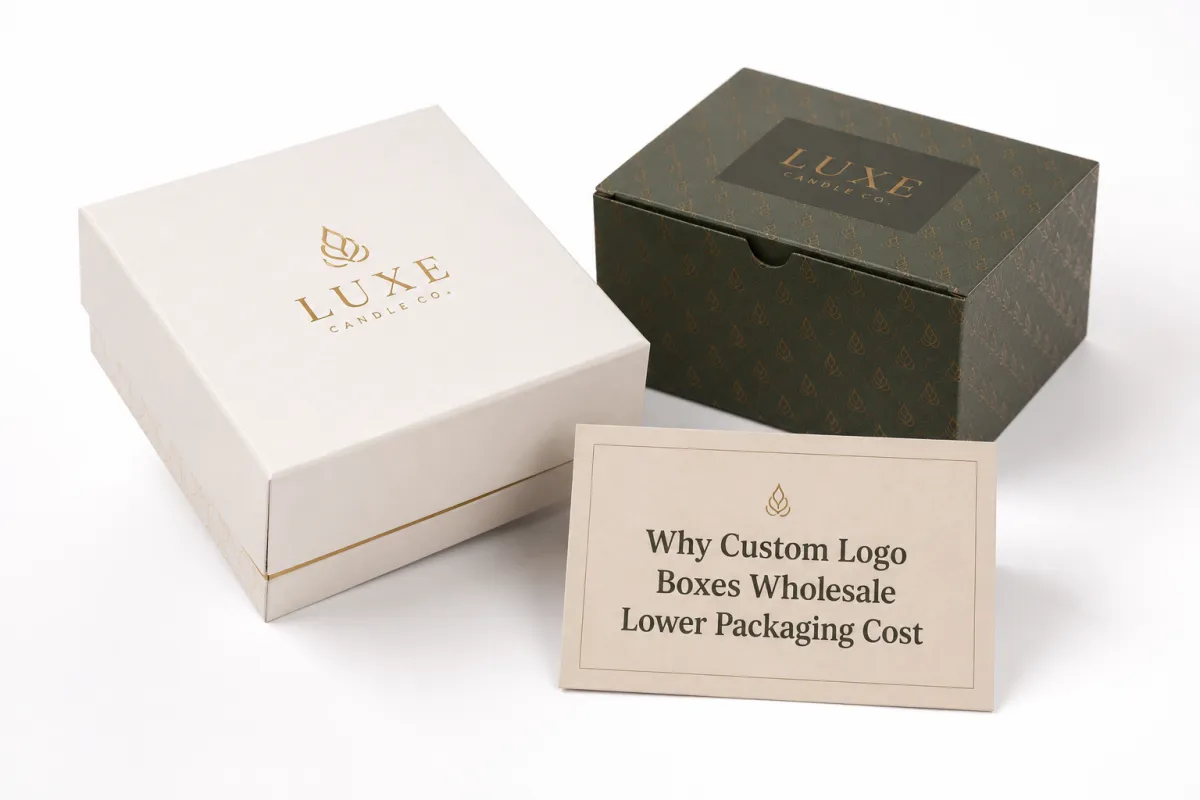
The first savings usually shows up in handling. A warehouse team that pulls from one approved box size moves faster than a team sorting through five almost-identical cartons. Less deciding means fewer interruptions. Fewer interruptions mean fewer mistakes. That matters most in custom logo boxes wholesale programs tied to one product family, one shipping lane, or one recurring subscription pack.
Freight is the next place the savings show up. A carton built to fit the product cuts down on void fill, reduces cube, and improves pallet density. That sounds small until you multiply it across hundreds or thousands of shipments. A 15 to 20 percent drop in unused space can change parcel charges, storage layout, and truck loading efficiency. I have seen a line item that looked harmless on paper become a real headache once it hit monthly freight totals.
Inventory gets easier too. When a buyer orders random packaging sizes, they are also ordering more complexity: more reorder points, more carton IDs, more bins, more confusion on busy days. A standardized custom logo boxes wholesale setup trims that mess. It gives procurement cleaner forecasting and gives operations fewer reasons to stop the line and search for the right box.
Branding belongs in the conversation, but not as a vague nice-to-have. Branded packaging can carry a logo, a color system, an interior note, or a QR code that points to setup instructions or support. Custom printed boxes do not need to shout to feel intentional. A clean one-color logo on the right stock usually beats a crowded carton that costs more and says less.
Good buyers stop talking about custom logo boxes wholesale as a discount play. They talk about control. Fewer vendors. Fewer size changes. Easier reorders. More predictable lead times. Those are the details that keep budgets sane and keep production from wandering into guesswork.
If you are still comparing formats, keep the rule simple: match the box style to the channel, not to ego. Retail packaging for a shelf-facing item has a different job than a mailer box for ecommerce shipping. Product packaging should fit the route, the weight, and the customer expectation. That sounds obvious. Plenty of programs still miss it and then wonder where the money went.
If two quotes cannot be compared on size, stock, print coverage, finish, and freight assumptions, they are not really comparable. They are just two packaging plans wearing the same name tag.
For buyers who want to review formats before requesting a spec check, our Custom Packaging Products page is a good place to sort box types by use case. For volume planning, the Wholesale Programs page is the cleaner starting point for repeat orders and account setup.
Custom Logo Boxes Wholesale Options: Materials, Print, Finishes
Most custom logo boxes wholesale projects start with a choice between mailer boxes, folding cartons, rigid boxes, sleeve boxes, and subscription packaging. The right pick depends on the product, the shipping path, and the level of value the packaging needs to signal. A monthly subscription box needs stiffness, repeatable print, and fast assembly. A premium gift set may justify rigid stock and a stronger closure. A lightweight retail SKU may do fine in a folding carton with a simple tuck end.
Corrugated board is the protection-first option. It handles compression well and gives better crush resistance for parcel shipping. E-flute and B-flute show up often where print quality and durability both matter. Paperboard is lighter and usually fits retail packaging programs where shelf appearance matters more than rough handling in transit. Rigid stock, usually wrapped over chipboard, is the premium choice when the box itself should feel solid in hand.
Print method matters almost as much as material. Digital printing is often the practical pick for shorter runs, seasonal launches, and custom logo boxes wholesale orders where speed matters more than the lowest possible unit cost. Offset printing tends to win at higher volumes because color consistency and setup cost spread better across the run. Flexographic printing can make sense on utility-driven cartons where the branding needs to stay clean, but the design does not need fine detail.
Finishes change both the look and the price. Matte lamination gives a quieter, modern feel. Gloss adds contrast and color pop. Soft-touch adds a tactile finish that people notice right away, though it is not always the best pick for high-abrasion shipping. Foil, embossing, debossing, spot UV, and aqueous coating all change the quote, and each one should earn its place through product value or channel needs. With custom logo boxes wholesale, finish selection should support conversion, shelf impact, or protection, not just personal taste.
Branding details need early decisions. Inside print works well for messaging and unboxing. One-color logo work can be enough for repeat B2B shipments. Full-bleed graphics make sense for consumer-facing product packaging. Barcodes and QR codes should be planned before proofing starts so they do not get squeezed into the artwork at the last minute. Insert compatibility matters too, especially if the box holds a bottle, kit, or fragile item that needs a fixed orientation.
Material quality is also where sustainability claims need to be handled carefully. FSC-certified paperboard can support sourcing goals when the application calls for it, and buyers who need chain-of-custody documentation should ask for it up front. For reference, the Forest Stewardship Council explains certification standards at fsc.org. If packaging reduction is the goal, the environmental conversation should include box efficiency and freight savings, not just recycled content.
For parcel-shipped custom logo boxes wholesale programs, transit testing is worth the time. The ISTA test family is widely used to check shipping performance, including drop and vibration exposure. Not every order needs a formal test package, but products with breakage risk, high return cost, or long shipping lanes often benefit from it.
- Mailer boxes: good for ecommerce, subscriptions, and branded deliveries.
- Folding cartons: suited to retail packaging, lightweight goods, and shelf presentation.
- Rigid boxes: useful for gifts, luxury goods, and high perceived value.
- Sleeve boxes: practical when the base pack is already fixed and the sleeve carries the brand story.
Key Specifications to Lock Before You Order
Pricing for custom logo boxes wholesale only gets accurate when the specs are tight. Interior dimensions come first. A box measured by outside size can create fit trouble if the board thickness is ignored. A few millimeters may not sound like much. In packaging design, those millimeters decide whether a product sits neatly, needs an insert, or rattles around in transit.
Board caliper and flute type come next. A corrugated carton with the wrong flute can lose stacking strength or create a larger outside footprint than the warehouse expected. Paperboard has its own caliper range and its own folding behavior. If the product is heavy, fragile, or oddly shaped, the board spec should enter the conversation early instead of after the proof comes back.
Structural style affects both labor and performance. Tuck-top cartons are quick to assemble. Crash-lock bottoms cut setup time for packs that need stronger bases. Magnetic closures work for premium gifting but add cost and extra assembly steps. Auto-bottom styles move well on lines where speed matters. For custom logo boxes wholesale, structure should be chosen with the pack line in mind, not just the render.
Artwork files need the same discipline. Vector logos print cleaner than low-resolution raster images. Color should be defined in a standard system, and bleed and safe zones need to be settled before design starts. If the file is off by even a little, the proof cycle slows down. That delay is not harmless. It pushes production, which pushes inventory, which pushes revenue.
Some functional specs get forgotten until they cause trouble. Moisture resistance matters in humid storage or long freight lanes. Stack strength matters for warehouse racking. Tamper evidence matters in consumer goods and regulated categories. Retail durability matters if the box gets handled several times before purchase. A well-built custom logo boxes wholesale order answers those questions before they turn into complaints.
I usually ask buyers to fill out a short spec sheet before anyone quotes a price. It saves everyone from playing email ping-pong later. If you want the quote process to move fast, prepare these fields:
- Exact product dimensions and weight.
- Desired inside box dimensions.
- Box style and closure type.
- Stock or material preference.
- Print coverage and color count.
- Finish selection.
- Insert need, if any.
- Quantity target and reorder expectation.
- Ship-to location and delivery window.
That list keeps custom logo boxes wholesale quotes lined up. It also cuts down the back-and-forth that happens when one supplier quotes a full-bleed laminated carton and another quotes a plain stock box with no finish at all. Same request, different product. That is how budget meetings get messy.
A useful check is simple: can the spec be repeated next quarter without changing the form? If the answer is no, the design may be too custom for the operating model. Packaging should support the product packaging plan, not trap the team in a one-off that nobody can reorder cleanly.
Custom Logo Boxes Wholesale Pricing, MOQ, and Volume Breaks
Custom logo Boxes Wholesale Pricing usually comes down to five drivers: size, material grade, print complexity, finish selection, and order quantity. A small carton with one-color print on standard paperboard is one type of order. A large rigid box with foil, embossing, and a custom insert is a very different animal. Buyers who treat them like the same thing end up with bad expectations and slow approvals.
MOQ works the way most manufacturing math works. Setup costs exist whether you order 500 boxes or 50,000. Die making, plate creation, press setup, and quality checks all need to be paid for. Larger quantities spread those costs across more units, which is why custom logo boxes wholesale gets cheaper per box as volume rises. The unit price drops fastest where the order crosses setup thresholds in print method or structure.
On a practical level, digital runs usually make sense when the order is smaller, the artwork changes often, or the program is still under test. Offset becomes more attractive when the quantity is stable and color consistency matters. Rigid packaging usually needs a higher minimum because the handwork and wrapping steps take longer. None of that is strange. It is just the math behind custom logo boxes wholesale.
Here is a simple comparison buyers can use as a starting point. These ranges are directional because structure, print coverage, and location all affect the final number. They still help with early budget work, which is the whole point.
| Box Type | Typical Use | Common MOQ | Approx. Unit Price at 5,000 | Notes |
|---|---|---|---|---|
| Mailer box, corrugated, one-color print | Ecommerce, subscriptions | 500-1,000 | $0.42-$0.78 | Good balance of strength and brand visibility |
| Folding carton, paperboard, full color | Retail packaging, light products | 1,000-2,500 | $0.18-$0.36 | Lower material cost, strong shelf presentation |
| Rigid box, wrapped chipboard | Gift sets, premium goods | 500-1,000 | $1.20-$3.50 | Higher perceived value, more hand assembly |
| Sleeve with inner tray | Multi-pack, promotional kits | 1,000+ | $0.55-$1.10 | Good for layered branding and product reveal |
Those numbers do not tell the whole story. Freight, storage, insert work, and rush fees can shift landed cost in a meaningful way. A low unit price that comes with expensive shipping or a warehouse reshuffle is not cheap. This is where custom logo boxes wholesale needs to be judged like a supply chain input, not like decoration.
Hidden costs show up often enough to deserve their own line. Custom inserts can add material and tooling cost. Specialty coatings can require extra setup. Domestic or international freight can swing the budget based on pallet count and carton dimensions. Rush production fees are real when a sales launch moves before artwork is final. The cleanest way to compare vendors is to require the same assumptions across all quotes: same size, same stock, same print coverage, same finish, same packing method, same shipping term.
Storage is the other piece people try to ignore. Larger custom logo boxes wholesale orders lower the unit cost, but they tie up space and cash. That is not a reason to avoid volume breaks; it is a reason to plan them. If reorder frequency is predictable, a larger first run can make sense. If demand moves around, smaller batches may protect working capital. The right answer depends on sell-through speed, not on a slogan someone repeats in a meeting.
A useful decision rule: if the package is tied to a stable SKU and the artwork will stay put for several months, ask for tiered pricing at 1,000, 3,000, and 5,000 units. If the design is still under test, ask for digital or short-run options first. That keeps custom logo boxes wholesale aligned with business reality instead of forcing a volume bet too early.
Production Process and Timeline for Wholesale Orders
Most custom logo boxes wholesale orders move through the same sequence: spec review, quotation, dieline or structure confirmation, artwork submission, proof approval, production, packing, and shipment. The order moves quickly if the first three steps are complete. It slows down for days if the dimensions are fuzzy or if three people are trying to sign off on artwork from different corners of the company.
The proof stage causes most delays. A logo may sit too close to a fold line. A barcode may be too small. A finish may fight with the paper stock. None of those issues feels huge on its own. Put them together and they can add a week or more to the timeline. That is why custom logo boxes wholesale buyers should name one final approver whenever possible.
Lead time depends on complexity. Straightforward custom printed boxes move faster, especially when artwork is final and stock is available. Specialty finishes, rigid structures, or cartons with inserts add setup time. Simpler runs can move from proof approval to shipment in roughly 12 to 15 business days. More involved projects may need several extra days for finishing and inspection. Exact timing depends on the plant schedule and the build details.
There are a few ways to shorten turnaround without cutting corners. Finalize dimensions before design begins. Send vector artwork from the start. Keep the print spec simple where possible. Do not change the proof after approval unless you enjoy delays. Those steps sound basic because they are basic, and they have the biggest effect on whether custom logo boxes wholesale arrives on time.
Quality control should be visible in the process, not tucked behind a promise. Buyers should expect material checks, print alignment review, glue integrity inspection, and fit testing where needed. If the box is going into retail packaging channels, the sample should be checked in hand, not just on a screen. A box can look fine digitally and still fail in the fold.
Launch timing matters just as much as box design. If packaging lands after the product, the warehouse waits. If it lands too early, storage costs climb. If it arrives without a buffer for receiving and put-away, the team absorbs the delay instead of the supplier. Custom logo boxes wholesale works best when lead time is part of the launch calendar, not a surprise hanging off the end of it.
There is also a testing standard worth considering for products that ship by parcel. ISTA procedures help teams understand how a box behaves under vibration, drop, and compression conditions. That matters when returns are expensive or the product has a fragile component. The box is not just a shell. It is part of the protection system.
If you need to roll out several SKUs, do it in phases. Approve one master structure first. Then adjust the artwork or insert layout for each variation. That keeps custom logo boxes wholesale under control and avoids rebuilding the structural work every time the brand wants a new colorway or message panel.
Why Buyers Choose Us for Custom Logo Boxes Wholesale
Buyers do not stick with a packaging supplier because the website looks polished. They stay because the specs repeat correctly, the color holds, and reorders do not create new headaches. That is the real value of custom logo boxes wholesale done well: consistent sizing, predictable production, and fewer surprises when the next order lands on the desk.
Account-level support matters more than teams usually admit at the start of a project. Procurement needs documentation. Operations needs clear packing instructions. Design needs proof accuracy. Sales wants the box to protect the brand. A supplier that can answer all four without sending the customer through different rabbit holes is already ahead of a generic reseller.
Manufacturing depth matters too. If a project starts with one box style and later adds inserts, sleeves, or a second carton size, the supplier should handle that change without turning it into a new search process. Custom logo boxes wholesale often grows into a broader packaging program. The easier it is to expand from one SKU into a coordinated family, the lower the long-term friction.
Control is the key word. Direct manufacturing cuts handoffs. Fewer handoffs mean fewer errors in spec translation, fewer mix-ups on finishing, and fewer delays caused by messages getting passed through middle layers. That matters especially for teams buying custom logo boxes Wholesale for Retail packaging, product packaging, or recurring ecommerce shipments.
For buyers who want a wider view of packaging formats, our Custom Packaging Products page covers the main options in one place. For repeat orders, program pricing, and volume planning, the Wholesale Programs page gives a cleaner path to procurement talks and reorder management.
There is a real difference between a supplier who quotes a box and a supplier who helps manage a packaging system. The first sends numbers. The second helps protect margin, reduce errors, and keep custom printed boxes lined up with the product calendar. That gap is usually obvious only after a brand has already paid for the wrong carton once.
We also look at the job through a business outcome lens. A better spec sheet can cut down misprints. A better proof review can reduce scrap. A cleaner reorder process can save staff time. Put those together and custom logo boxes wholesale becomes less about the box itself and more about the cost of running the packaging program over time.
Next Steps: Build a Quote-Ready Custom Box Spec
If you want an accurate quote for custom logo boxes wholesale, gather five things before you ask for pricing: product dimensions, target quantity, artwork files, desired finish, and shipping destination. Without those details, any number is a rough estimate. With them, the quote becomes useful for budgeting and production planning.
Sample requests are smart when the fit or print detail is still under review. A prototype can catch problems that a screen proof will miss, especially if the product is fragile or the structure has a special closure. For custom logo boxes wholesale, a sample is often the cheapest way to avoid a larger mistake later.
The fastest quote path is also the simplest: one box style, one dimension set, one print method, one finish, one delivery target. If the project needs options, ask for them separately instead of blending them into one request. That way, custom logo boxes wholesale pricing reflects actual capability rather than missing information.
Comparing vendors only works if every supplier gets the same spec sheet. Same board. Same print coverage. Same insert requirement. Same ship date. Otherwise, the lower quote may only be the result of thinner assumptions. Buyers who run packaging like a sourcing project usually get better results than buyers who run it like a design contest.
Set a reorder trigger before the first shipment leaves the warehouse. That sounds small, but it saves panic later. If the team knows the minimum stock point and the approved artwork is already on file, the next custom logo boxes wholesale run can move faster and with less internal friction. Future-you will thank you for that one.
One last rule keeps the process honest: choose the box that balances cost, protection, and brand presence for the actual product and channel. Not the most elaborate one. Not the cheapest one. The right one. That is the point of custom logo boxes wholesale, and it is the standard that protects both margin and customer perception.
For brands that need a repeatable packaging system, custom logo boxes wholesale is often the cleanest route. It lowers complexity, supports branded packaging, and gives procurement a steadier framework for ordering. Done well, custom logo boxes wholesale does not just cut box cost; it improves the whole packaging operation.
What is the minimum order for custom logo boxes wholesale?
For custom logo boxes wholesale, MOQ depends on the box style, stock, and print method. Simple cartons usually support lower minimums than rigid boxes or highly finished builds. The best way to judge it is to ask for the MOQ tied to your exact size and finish, because a generic minimum can be misleading.
How long do custom logo boxes wholesale orders usually take?
For custom logo boxes wholesale, lead time usually depends on artwork approval, material availability, and print complexity. Straightforward orders move faster when the files are final and the dimensions are already confirmed. Specialty finishes, inserts, and structural samples typically add extra time before shipment.
Which materials are best for custom logo boxes wholesale?
For custom logo boxes wholesale, corrugated board is the best choice when shipping protection matters most. Paperboard works well for retail packaging and lighter products. Rigid stock is the premium option for gift sets, luxury goods, and projects where the box needs to signal higher perceived value.
How can I reduce custom logo boxes wholesale pricing?
For custom logo boxes wholesale, the cleanest savings usually come from simplifying the structure, reducing special finishes, and keeping the print layout efficient. Larger quantities lower unit cost when storage and cash flow allow it. The other big win is to compare quotes using one accurate spec sheet so you can see the real price differences.
Do I need a dieline before ordering custom logo boxes wholesale?
For custom logo boxes wholesale, a dieline is strongly recommended because it helps prevent sizing and artwork mistakes. If you do not already have one, ask the supplier to provide or confirm it before design starts. Final approval should include the print layout, fold lines, and insert placement if the box needs them.

