A winter beanie has staying power. A paper insert may get one glance. A cheap promo item may disappear into a drawer. A warm hat can show up for months on job sites, campuses, delivery routes, ski weekends, warehouse shifts, and morning commutes. That is why a custom logo patch Beanies Bulk Order can be a smarter buy than another forgettable giveaway.
The product is simple. The ordering is not always simple. Patch material, knit weight, cuff height, logo size, carton labeling, and lead time all affect the finished result. Skip those details and the price quote may look fine right up until the hats arrive.
Buyers do not need to overcomplicate this. They do need to define the product before comparing numbers. A beanie with a stiff oversized patch is not the same product as a rib-knit cuffed beanie with a clean woven label. Same category. Different outcome.
Why Bulk Beanie Buyers Move Faster With Clear Specs
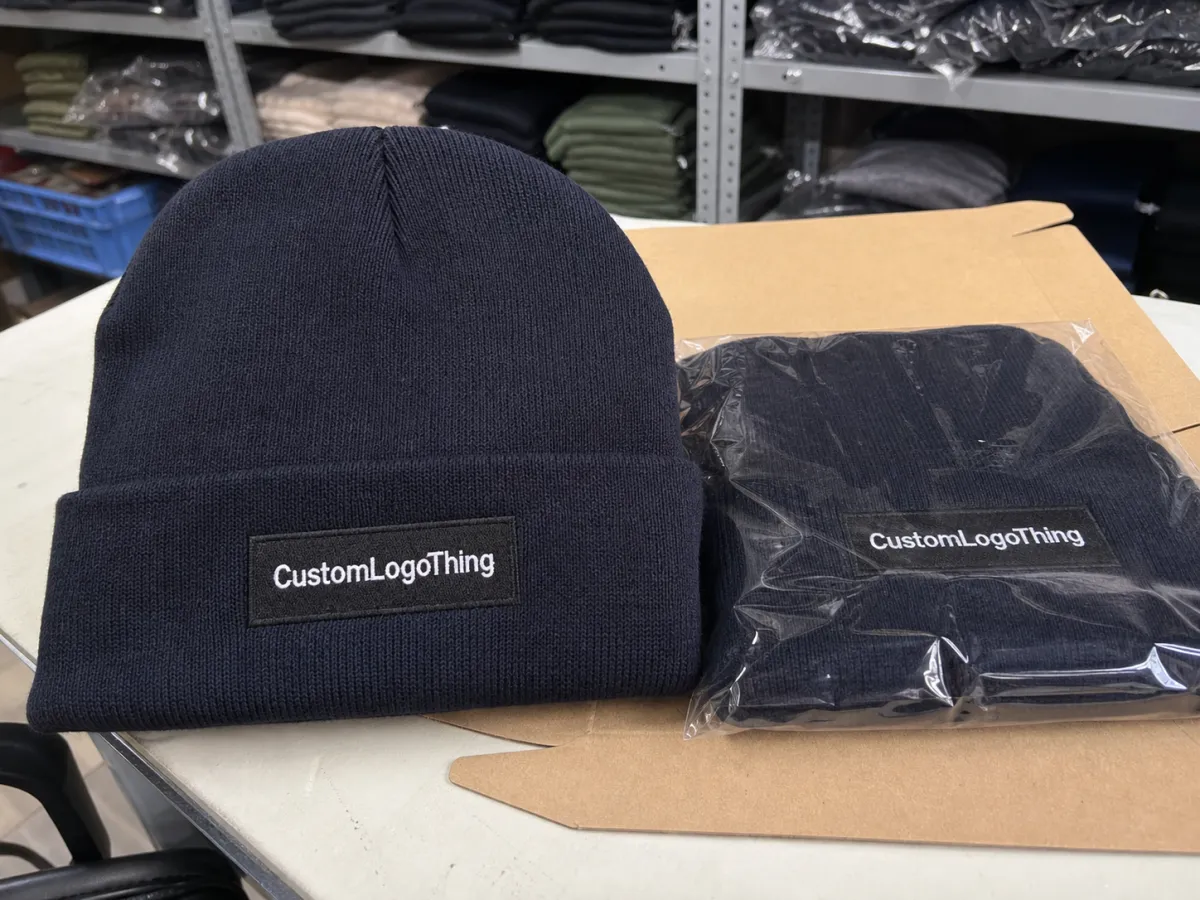
Bulk beanies work because they are seasonal, useful, and size-flexible. One size does not fit every head perfectly, because of course it does not. But it avoids the inventory mess that comes with jackets, hoodies, fitted caps, or anything that needs multiple sizes. For HR teams, agencies, field-service companies, schools, and event buyers, fewer SKUs mean fewer mistakes.
A patch beanie also behaves like a durable brand panel. The same practical thinking used for branded packaging applies here: material, finish, placement, color contrast, packing method, and delivery timing all shape how the item is perceived. A logo sewn onto a rib-knit cuff is not just decoration. It is the visible part of the product.
Utility matters. People keep warm hats because warm hats do a job. That retention gives the logo more exposure than a flyer, a single-use insert, or a thin plastic trinket that gets tossed before lunch.
Bulk ordering gives procurement teams better control, too. Ordering 500, 1,000, or 5,000 units at one time can reduce the effect of setup costs, standardize logo placement, improve color consistency, and simplify carton planning. It also gives a clearer view of landed cost before production starts.
Practical rule: if the beanie is meant to represent the brand for more than one day, define the patch and attachment method before asking for the final price. A quote without patch size, material, placement, and packaging detail is only a guess wearing a nicer shirt.
Most weak branded beanies fail for predictable reasons. The logo is too detailed. The patch is too stiff. The cuff is too short. The order is rushed after the event date is already fixed. These are not creative failures. They are specification failures.
Patch Options That Change the Finished Look
The patch controls the first impression. It also affects cost, production time, durability, and perceived retail value. Buyers planning a bulk custom beanie order should compare patch types early, before the artwork proof has already been approved and everyone pretends changing direction is still easy.
| Patch Type | Best Use | Typical Strength | Buyer Watchout |
|---|---|---|---|
| Woven label patch | Small text, thin lines, detailed marks | Clean detail at compact sizes | Can look flat if colors lack contrast |
| Embroidered patch | Classic event, team, and uniform branding | Raised texture and strong visibility | Tiny lettering can close up |
| Leather or faux leather patch | Retail-style, outdoor, and lifestyle brands | Premium look with debossed, engraved, or printed marks | Stiff backing may affect cuff comfort |
| PVC patch | Outdoor teams, rugged giveaways, wet weather | Durable, weather-resistant surface | Molding costs can raise MOQ or setup cost |
| Chenille patch | Collegiate, mascot, and streetwear styling | Thick texture and high visual impact | Not suitable for fine details |
| Sublimated patch | Gradients, full-color graphics, photo-style artwork | Color flexibility | May feel less dimensional than embroidery |
Woven patches usually handle small logos well because the threads can hold more detail than standard embroidery. Embroidered patches are better when the buyer wants visible texture from several feet away. Leatherette patches often sit in the sweet spot for retail-style programs because they look intentional without requiring a luxury garment.
PVC has a different role. It fits outdoor crews, fishing events, snow sports, utility teams, and rugged merchandise. Chenille is louder. It belongs on initials, mascots, short words, and bold shapes, not legal copy or complicated seals.
The hidden issue is distortion. A patch that looks clean on a flat digital mockup may lose clarity once it is sewn to a curved rib-knit cuff. Backing thickness, border style, stitch pattern, and patch size all matter. A 2.5-inch-wide patch often looks balanced on a standard cuff. A 4-inch patch can work for a bold streetwear placement, but it may feel rigid if the backing is heavy.
Ask for the proof at actual patch size. Simplify thin lines. Remove tiny trademark text if it will not reproduce cleanly. Choose thread, leather, PVC, or woven colors with real contrast against the beanie. Black on charcoal may look refined on a screen and nearly invisible under warehouse lighting. That is not subtle branding. That is a hide-and-seek logo.
Placement changes the mood. Front cuff is standard and safe. Side cuff feels more retail. Centered fold-over is traditional. Off-center placement can look current if the brand has a lifestyle angle. Private label interior tags support resale programs, especially when paired with Custom Packaging Products such as hangtags, inserts, or branded cartons.
Beanie Specifications to Confirm Before You Request a Quote
A quote is only as accurate as the specs behind it. Before requesting pricing, gather the knit style, material blend, gauge, cuff height, beanie depth, stretch, color, patch type, patch size, attachment method, packaging, quantity, and delivery destination. Yes, that is a long list. It is still cheaper than reworking 2,000 hats.
Common styles include cuffed beanies, slouch beanies, fisherman beanies, pom beanies, rib-knit styles, waffle knits, and recycled yarn options. Cuffed beanies remain the safest choice for a custom Logo Patch Beanies bulk order because the folded cuff creates a stable patch area. Fisherman beanies sit higher and look more modern, but the shorter profile is not right for every audience.
Material choice affects cost, comfort, and how the hat holds shape. Acrylic is widely used because it is cost-effective, color-stable, and warm enough for most promotional programs. Cotton blends can feel softer but often cost more and may dry slower. Wool blends add warmth and perceived value, though some wearers find them itchy. Recycled polyester can support sustainability-led campaigns, but claims should be backed by supplier documentation rather than wishful copy.
If the program includes paper hangtags, cartons, or other product packaging, sourcing standards may also matter. The Forest Stewardship Council is a widely recognized certification body for responsibly sourced paper-based materials. For shipping and distribution planning, ISTA procedures are commonly referenced in packaging logistics and transport testing.
Fit is the quiet risk in bulk purchasing. One-size beanies work for most campaigns, but cuff height, stretch recovery, knit density, and crown depth decide whether the hat feels retail-grade or like something grabbed from the bottom bin. A 3-inch cuff gives a common patch zone. A taller cuff can handle larger branding. A shallow cuff may force a smaller patch whether the logo team likes it or not.
- Small patches: often 1.5 to 2.25 inches wide, suited for initials, symbols, and minimalist marks.
- Mid-size patches: often 2.25 to 3 inches wide, a common range for company logos.
- Large patches: often 3 to 4 inches wide, useful for bold marks but more likely to stiffen the cuff.
- Attachment: sewn edges are common; heat application may be available for some materials but is not always ideal on textured knit.
Quality-control details belong in the quote stage, not after production. Ask about stitch density, edge finishing, colorfastness expectations, backing stiffness, and carton labeling. For multi-location shipments, confirm carton marks before packing starts. A perfect hat in the wrong carton can still miss the event.
Cost, Pricing, MOQ, and Unit Cost Drivers
Pricing is driven by beanie style, quantity, patch type, number of patch colors or materials, packaging requirements, and delivery location. Freight can change the whole budget quickly, especially if the deadline forces air shipping.
Minimum order quantity depends on the blank, patch type, and customization level. Lower MOQs help with testing, but larger runs usually reduce the impact of setup charges. Ask for tiered pricing at several quantities: a pilot run, a likely reorder level, and a full campaign volume. One random quantity rarely tells the full story.
| Order Scenario | Typical Buyer Goal | Cost Behavior | Best Spec Choice |
|---|---|---|---|
| 100-250 units | Small team, local event, sample retail drop | Higher unit cost because setup is spread across fewer units | Standard cuffed beanie with woven or embroidered patch |
| 500-1,000 units | Employee gift, regional campaign, agency order | Better unit economics and more practical decoration options | Custom patch with individual bagging or simple hangtag |
| 2,500+ units | Retail program, national event, multi-location rollout | Setup impact drops; freight and packing plan become more important | Coordinated patch, private label, carton marks, and split shipment planning |
Woven and embroidered patches are often efficient at scale. Leather, PVC, chenille, and specialty die-cut shapes can raise unit cost because of material, molding, minimums, or attachment labor. Individual polybagging, hangtags, inserts, and retail cartons add cost as well. They may still be worth it for resale, employee kits, influencer mailers, or holiday gifting where presentation matters.
For rough planning, buyers often see meaningful unit-cost improvement as orders move from a few hundred units to 1,000 or more. Exact pricing depends on the blank, patch type, decoration method, packaging, and freight. A simple acrylic beanie with a woven patch will not price like a recycled yarn beanie with a leatherette patch, private label, printed insert, and split delivery.
Surprise charges usually come from missing details. Provide the final logo file, Pantone or thread colors, patch dimensions, beanie color count, bagging requirements, hangtags, inserts, carton marks, and delivery requirements. If you need matching custom printed boxes or retail cartons, say so during quote intake. Adding them after approval can change cost and schedule.
Speed has a price. Rush orders may limit material choices, reduce sampling options, or increase freight cost. Planned orders allow cleaner proofing, better batching, and more predictable landed cost. For repeat or larger programs, Wholesale Programs can help align quantity tiers with future ordering needs.
Production Steps, Timeline, and Lead Time Expectations
A typical order moves through specification review, artwork check, quote, digital proof, sample or pre-production approval, bulk production, quality inspection, packing, and shipping. The beanie itself is rarely the only timeline driver. Artwork readiness, patch complexity, sample approval speed, material availability, and shipping method usually decide the schedule.
Many standard programs move efficiently once the proof is approved. Still, decoration should not be treated like a same-day print job. A sample, production photo, or pre-production image protects against scale, texture, color, and placement surprises before hundreds or thousands of units are made.
- Send vector artwork, target quantity, style preference, delivery address, and deadline.
- Confirm patch type, patch size, beanie color, cuff placement, and packaging needs.
- Review the quote and request tiered pricing if volume is flexible.
- Approve a digital proof at actual patch size.
- Review a physical sample, production photo, or pre-production sample when timing allows.
- Release bulk production with one written approval and final shipping instructions.
Common delays are easy to spot. Low-resolution logos. Unclear patch dimensions. Last-minute color changes. Too many internal approvers. Proofs sitting untouched for a week. Freight instructions supplied after production is complete. None of this is exotic. It is the normal paperwork sludge that pushes ship dates.
A practical sequence works better: lock the artwork first, approve the sample or production image second, confirm quantities and delivery addresses third, then release production. If the order supports employee onboarding, holiday gifting, a trade show, or a retail launch, build in review time. A fast quote helps, but fast approvals matter just as much.
For a custom Logo Patch Beanies bulk order, a clear spec sheet and proofing workflow reduce revision loops. They also give buyers a better chance of hitting event dates without paying unnecessary rush freight.
Quality Checks That Prevent Bulk Order Mistakes
Most disappointing branded beanies do not fail because the logo idea is weak. They fail because nobody checked how the patch behaves on knitted fabric at production scale.
Digital mockups flatten texture. Screens hide rib distortion. Tiny type looks sharper on a monitor than it may look on a woven patch sewn to a curved cuff. The physical object tells the truth, which is rude but useful.
- Patch alignment: confirm center position, side placement, and distance from cuff edges.
- Stitch tightness: check that the patch is secure without puckering the knit.
- Edge finishing: inspect merrowed, laser-cut, or folded edges for fray risk.
- Color match: compare thread, material, or print color against approved references.
- Logo legibility: review small text, thin outlines, and negative space at actual size.
- Packaging count: verify units per carton, carton marks, and split-shipment instructions.
For multiple beanie colors, do not assume one patch color works on every knit. A tan leatherette patch may look strong on navy, forest green, and black, but weaker on heather gray or oatmeal. A white woven patch may pop on dark colors and look cheap on light colors. Alternate patch versions can solve that, though they may affect setup and unit cost.
Check stretch recovery. A patch that is too rigid can make the cuff feel awkward. A heavy patch on a thin knit can pull, curl, or distort. For retail programs, inspect the front and side view. Shoppers judge symmetry quickly, even if they cannot explain why the product feels off.
Quality control protects money. Catching a poor border, unreadable slogan, wrong thread color, or crooked placement before full production is far cheaper than replacing an entire shipment after the event date. For buyers using beanies alongside retail packaging, the same discipline applies: proof the details before the carton is packed.
How Custom Logo Things Supports Branded Beanie Programs
Custom Logo Things is built for buyers who need more than a one-line promotional quote. A strong branded beanie program needs specification support, decoration guidance, packaging planning, and a production path that matches the deadline.
The advantage is operational. The same thinking used in packaging design applies to wearable merchandise: dimensions, materials, print specs, proofs, color targets, finishing, packing method, and carton labels. A beanie patch is smaller than a folding carton, but the margin for error is still real.
Buyers can coordinate exterior patch branding with private labels, hangtags, inserts, individual polybags, retail cartons, or other package branding components. That matters for subscription boxes, employee kits, trade show packs, and retail accessories where presentation affects perceived value.
Different teams need different answers. HR teams may prioritize comfort, consistency, and delivery to one office. Retailers may need a sharper patch, private label, and shelf-ready packaging. Event managers usually need budget control and clear ship dates. Agencies need repeatable specs across client programs.
The mistake is shopping the lowest unit price before defining the product. That can work for a throwaway item. It is risky for a beanie people will wear in public with your logo on it.
Custom Logo Things helps buyers match patch material, beanie style, quantity tier, and packaging to the use case. The strongest order is built from clear specs, realistic lead times, and transparent pricing, not from a vague quote with missing production details.
Next Steps Before You Approve the Order
Before approving production, gather the logo file, target quantity, preferred beanie color, patch type, deadline, delivery address, and packaging requirements. If the order includes multiple locations, prepare the address list and carton labeling instructions early.
Request a tiered quote. One arbitrary quantity can hide the real economics. A 300-unit order, 750-unit order, and 1,500-unit order may show very different setup-cost behavior. Procurement teams make better decisions when they can compare the movement.
Approve artwork at actual size. Ask whether fine text, gradients, thin outlines, or legal marks should be simplified. If a logo requires four thread colors but still looks muddy at 2 inches wide, a cleaner one-color patch may be the better commercial decision.
Define the use case clearly: employee uniform, retail shelf, holiday gift, outdoor event, subscription box insert, or trade show giveaway. Each scenario changes specs. A retail beanie may need a private label and hangtag. A job-site beanie may need warmth and durability. A giveaway may need a lower-cost patch and faster packing plan.
Set one internal approver for proofs. Multiple approvers often create slow revision cycles and inconsistent feedback. One person should confirm logo, color, placement, packaging, and delivery details in writing.
If questions remain, review the FAQ or send a complete spec request to Custom Logo Things. The fastest path is not magic. It is clean artwork, complete specs, confirmed quantity, and a production timeline agreed before money is spent.
FAQs
What is the usual MOQ for bulk custom logo patch beanies?
MOQ depends on beanie style, patch type, and customization level. Buyers should ask for tiered pricing because unit cost often improves at higher quantities. If you need a smaller test run, choose standard beanie colors and a simple woven or embroidered patch to keep setup and sourcing simpler.
Which patch type is best for custom logo beanies in bulk?
Woven patches work well for fine logo detail, embroidered patches add texture, leatherette patches create a retail look, and PVC patches suit outdoor or rugged branding. The best option depends on logo complexity, budget, desired texture, and whether the beanie is for uniforms, resale, events, or gifts.
How long does a custom logo beanie bulk order take?
Lead time depends on proof approval, patch complexity, material availability, quantity, and shipping method. To avoid delays, provide vector artwork, confirm patch size, approve the proof quickly, and finalize delivery details before production starts.
Can I see a sample before placing a full patch beanie order?
A physical sample or pre-production sample is recommended when color, patch texture, placement, or retail presentation matters. For urgent orders, a detailed digital proof or production photo may be used, but physical sampling gives stronger confidence before full bulk production.
What should I include when requesting a quote for custom patch beanies?
Include quantity, beanie style, beanie color, patch type, patch size, logo file, deadline, shipping address, and packaging needs. Also mention whether you need individual bagging, hangtags, inserts, carton labels, or split shipments to multiple locations.


