For winter merch, a custom Logo Patch Beanies bulk order often makes more sense than direct embroidery on ribbed knit. A patch gives the logo a flatter surface, holds small details better, and can be reused across multiple body colors with less artwork rework. That is useful when one program has to cover employee gifts, retail inventory, or event giveaways.
The main risk is not the decoration itself but the way knit, cuff depth, and logo scale interact. A beanie can look straightforward in a proof and still fail in production if the patch is too large for the cuff or the contrast is too low on the finished body. Good buying decisions reduce those variables before the order goes to press or stitch.
Custom logo patch beanies bulk order: what buyers actually save
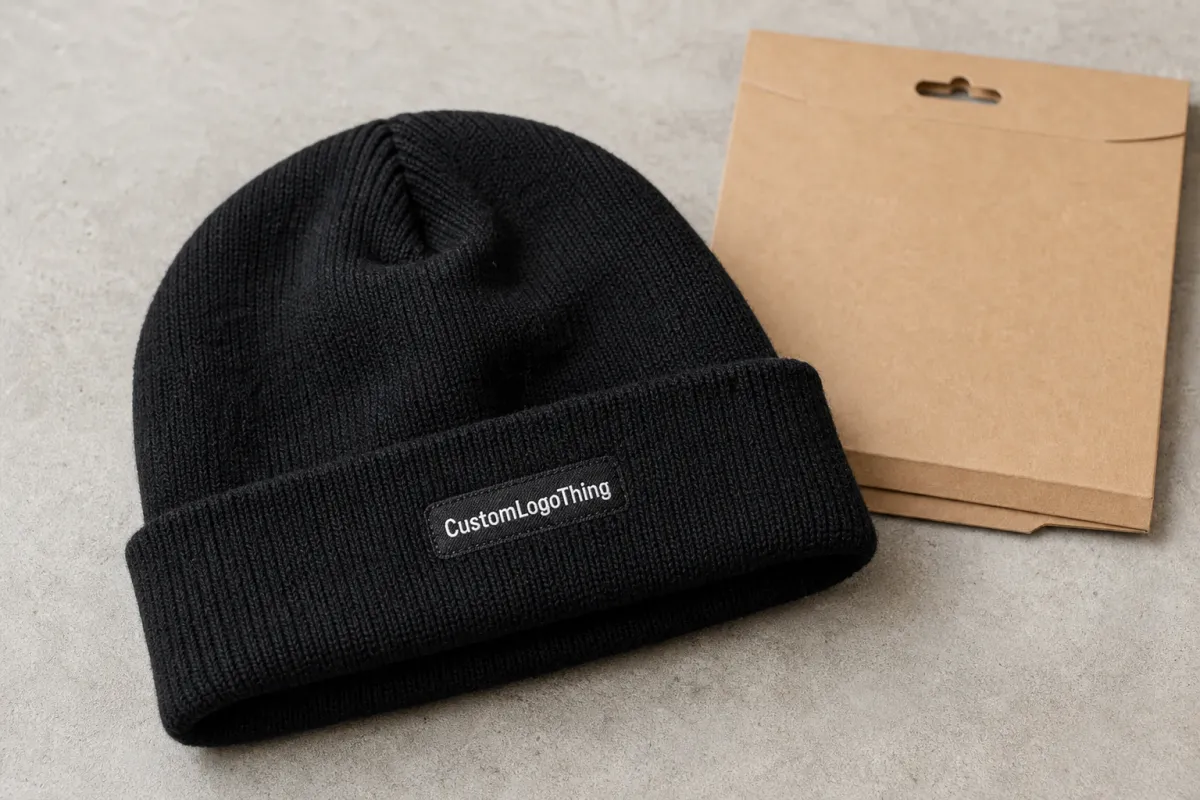
The savings come from repeatability. One approved patch can be used across several beanie colors and future runs, which reduces setup work and avoids redrawing the logo every time. That makes the order easier to manage and lowers the chance of slight changes between production cycles.
Patch beanies also handle textured knit better than many direct decoration methods. Ribbing can swallow fine lettering, and tiny details can blur on a stretched surface. A woven or embroidered patch gives the logo a steadier face, so it reads more clearly from a distance and photographs better for retail listings or internal merch pages.
“The safest bulk order is usually the one with the fewest moving parts. If the patch, color, and fold spec are locked early, production tends to stay predictable.”
That predictability matters for cost as well as quality. Fewer revisions mean fewer delays, and fewer delays mean less rush freight. In a seasonal program, that often matters more than shaving a small amount off the unit price.
Patch styles, knit bodies, and finish choices that change the look
Patch style changes both the look and the readable detail. Woven patches are usually strongest for small type, thin lines, and multi-color logos because the weave keeps edges tighter. Embroidered patches add texture and depth, which works well for bold marks, but they can soften very fine detail. Leather and faux-leather move the beanie toward a premium lifestyle finish. PVC creates a sharper, more graphic look that suits outdoor or utility-driven brands.
The body style matters just as much. Cuffed beanies give the most reliable front panel and the easiest decoration area. Slouch styles are more relaxed and fashion-forward, but the logo needs careful placement so it does not look off-center. Fisherman beanies sit shorter, which leaves less room for a large patch and makes scale more sensitive.
Yarn choice changes both price and performance. Acrylic is the most common option because it is stable, widely available, and easier to source in volume. Recycled blends support sustainability goals and can fit a lower-impact brand story. Wool blends add warmth and a softer hand, but they usually increase unit cost and may require more care.
Placement should be decided with the body style, not after it. Front-center on the cuff is the safest option for corporate use and general distribution. Side placement can feel sharper for retail, but it reduces legibility if the patch is small. A woven label near the hem may work as secondary branding, but it rarely replaces a true front patch.
A good sample should show the patch on the actual blank, not just on a floating mockup. Heavy patches on lightweight knits can look top-heavy, while tiny patches on thick fisherman beanies can disappear. That is why buyers should review the real scale before bulk production starts.
Specs that matter: size, gauge, cuff depth, and labeling
The spec sheet does not need to be long, but it should include the numbers that affect fit and readability. Ask for patch width and height, knit gauge, cuff depth, crown height, and the planned fold. Those details determine whether the logo sits cleanly or gets squeezed by the shape of the beanie.
Scale is a production issue, not just a design preference. A mark that works at 2.5 inches wide may lose border definition if the lines are too thin. The same artwork can look balanced on a deep cuff and cramped on a shallow one. Buyers should ask for a proof showing the actual patch size on the actual blank.
Comfort specs matter too. Seam finish, stretch range, and the inside hand feel influence whether the beanie gets worn. If the interior edge scratches or the fold creates a bulky ridge, perceived value drops quickly. That applies to retail, employee gifts, and event merch alike.
Labeling should be set before production starts. Care tags, size labels, barcode stickers, and fold instructions all affect packing and distribution. Polybags are usually enough for promo programs. Branded header cards, inserts, or retail-ready folds make more sense when the beanies are headed for shelf display or a higher-touch gift pack. If the order ships with other branded items, carton spec should match the rest of the shipment.
A clear request list keeps the quote process focused:
- Body style, yarn type, and color
- Patch material, patch size, and placement
- Cuff depth and preferred fit
- Packaging style, carton count, and labeling needs
- Delivery destination and required in-hand date
That list trims guesswork and makes a custom Logo Patch Beanies bulk order easier to price because the supplier can quote against real specs instead of assumptions.
Cost, pricing, MOQ, and quote drivers for larger runs
Bulk pricing usually follows the same pattern seen in apparel and Custom Packaging Products: setup costs spread out as quantity rises. A 250-piece run can carry a very different unit price than a 1,000-piece order even if the beanie body stays the same. Patch type, logo complexity, and packing format move the price more than many buyers expect.
These are the usual cost drivers:
- Patch material: woven and PVC can cost more than a simple embroidered patch, depending on detail
- Logo complexity: more colors and finer elements usually raise setup time
- Body style: cuffed, slouch, and fisherman styles can price differently
- Inventory base: stock blanks usually cost less than custom-dyed bodies
- Packaging: bulk cartons, polybags, inserts, and hang tags all change landed cost
MOQ is usually a production decision, not a universal rule. A supplier using stock blanks may support smaller runs. A custom-dyed body or specialty patch can push the minimum upward. The better question is not only, “What is your minimum?” It is, “What MOQ gives me the best landed cost without holding too much inventory?”
| Option | Typical use | Relative cost | What to watch |
|---|---|---|---|
| Woven patch on stock cuffed beanie | Corporate gifts, general merch | Lowest to mid | Patch size, small text, proof accuracy |
| Embroidered patch on slouch beanie | Lifestyle retail, staff apparel | Mid | Border bulk, placement on loose crown |
| Leather or faux-leather patch on premium knit | Premium retail packaging, brand drops | Mid to high | Contrast, texture, care expectations |
| PVC patch on custom body color | Outdoor brands, strong logo marks | High | Artwork simplification, tooling, timeline |
Ask for tiered pricing at several quantity breaks. A quote at 250, 500, and 1,000 pieces shows the real savings curve. Sometimes a slightly larger order lowers the unit cost enough to justify extra inventory. Sometimes it does not. That is a landed-cost decision, not a guess.
To get a clean quote, send the logo file, patch preference, quantity, target ship date, packaging needs, and destination ZIP or country. If freight matters to the budget, ask for a landed estimate rather than factory pricing alone.
Production steps and turnaround: from proof approval to shipment
The workflow is straightforward: quote, art review, digital proof, sample or pre-production approval, bulk production, quality check, packing, and shipment. Delays usually begin with revisions. A changed logo line, a patch material swap, or uncertainty about color matching can move the schedule more than buyers expect.
Turnaround gets faster when the supplier can use in-stock bodies and one approved patch type. Clean source artwork helps too. A vector file saves redraw time and reduces the chance of proof mistakes. A low-resolution logo adds steps, often in the form of extra proof rounds that slow everything down.
Transit time deserves its own buffer. Seasonal launches, retail drops, and event giveaways often need the goods earlier than the warehouse date suggests. A week of freight delay can break a launch plan. That is why the delivery deadline should be confirmed before approval, not after.
“If a supplier cannot explain the proof stage in plain language, the order usually gets harder to manage later.”
For retail handling or shipping standards, packaging durability matters as much as decoration. That is where references like ISTA test standards are useful. The same discipline used for custom printed boxes applies here: if the outer pack fails, the product inside suffers even when the patch is correct.
A custom logo patch Beanies Bulk Order usually moves fastest when the artwork is ready, the quantity is set, and the delivery date is realistic. Those are the decisions that keep the project from drifting.
How to vet a supplier for repeat patch consistency and QC
Price alone does not say much. Good suppliers prove consistency, not just a low quote. Ask how they check patch placement across the full run, how they manage color repeatability on reorders, and whether proof approval happens before mass production starts. They should be able to explain where measurements are checked and what happens if a body color or patch finish shifts from one batch to another.
Factory-direct sourcing often gives better visibility into materials and lead times. Broker-led ordering can be easier if you need one contact for multiple items. The tradeoff is transparency. Buyers should know who is checking the beanies, who is approving the patch, and where a failure would be caught.
Quality control on beanies is specific, but not complicated. Look for logo alignment, loose threads, patch adhesion or stitching integrity, consistent fold and pack standards, and clean labeling. If the beanies are going into retail packaging, carton count matters. If they are being distributed internally, size labels and bundle counts matter just as much.
Reorders are the real test. A supplier worth using should be able to match a prior run without rebuilding the spec from scratch. Saved proof files, a reference sample, and a clear measurement sheet save time. That is one reason buyers handling branded packaging often prefer a vendor that can coordinate apparel, inserts, and shipping materials in the same system.
For repeat programs, ask for:
- Saved artwork files and approved proof references
- Photo evidence of patch placement before bulk packing
- Clear tolerance on color and size variation
- Written notes for fold style and carton configuration
- Reorder pricing at the same quantity break
If those answers are vague, the risk is not just a flawed beanie. It is a brand consistency problem that carries into every future order.
Next steps to lock in artwork, quantities, and ship dates
To move from interest to production, start with vector artwork, patch style, beanie color, quantity, and delivery deadline. That five-part brief is enough to get a meaningful quote and a workable timeline. If the logo is not in vector format, ask whether the supplier can redraw it before proofing.
Decide early whether the order needs retail packaging, individual polybags, size stickers, or simple bulk cartons. Packaging changes both cost and schedule. A basic bulk carton may be right for internal distribution, while a cleaner pack-out fits a shelf display or a more polished gift.
Ask for a side-by-side quote at multiple quantity tiers. That shows whether the budget should sit at 250, 500, or 1,000 pieces. It also makes setup fees, sampling charges, and freight assumptions easier to compare. If the beanie program is part of a larger merch rollout, view it alongside other purchasing decisions in the same calendar.
Before approval, check the logo proportions, patch placement, and color contrast on the actual beanie body. A mockup can hide problems that show up on knit fabric. Dark bodies, narrow cuffs, and small lettering deserve extra attention. A careful proof is still cheaper than redoing production.
Handled well, a custom logo patch beanies bulk order becomes a repeatable branded item that can support retail packaging, employee programs, and event distribution without forcing a new decoration decision every time you reorder.
What is the usual MOQ for custom patch beanies in bulk?
MOQ depends on the body style, patch method, and whether the blank item is already in stock. Many suppliers can work with smaller runs on stock bodies and higher minimums on custom-dyed or specialty options. Ask for pricing at multiple quantity breaks so you can see where the unit cost improves most.
How much does a custom logo patch beanies bulk order cost per unit?
Unit cost is shaped by patch material, logo complexity, body style, packaging, and quantity. Simple stock-beanie orders with woven patches often sit much lower than custom bodies with premium finishes. The best quote separates base price, setup, sampling, and freight so the landed number is easy to judge.
Which patch type works best for detailed logos on beanies?
Woven patches are often the best choice when small text or thin lines need to stay readable. Embroidered patches add texture, but they can soften fine detail compared with woven construction. If the logo is bold and simple, leather or PVC can create a stronger retail look.
How long does production usually take after proof approval?
Turnaround depends on inventory, decoration method, and whether the order needs sampling before bulk production. Stock bodies with one approved patch style often move in a few weeks after proof approval, while custom yarns or specialty patches take longer. Build in freight time so the in-hand date reflects both production and shipping.
What files do I need to start a custom beanie order?
Send a vector file when possible, plus brand color references, placement notes, and quantity targets. Include the delivery address and required arrival date so the quote can factor in timing. If you do not have a vector file, ask whether the supplier can redraw the logo before proofing.

