Buyer Fit Snapshot
| Best fit | custom magnetic closure boxes luxe for packaging buyers comparing material specs, print proof, MOQ, unit cost, freight, and repeat-order risk where brand print, material, artwork control, and repeat-order consistency matter. |
|---|---|
| Quote inputs | Share finished size, material target, print colors, finish, packing count, annual reorder estimate, and delivery region. |
| Proofing check | Approve dieline scale, logo placement, barcode or warning zones, color tolerance, and any recyclable or compostable wording before bulk production. |
| Main risk | Vague material claims, crowded artwork, or missing packing details can create delays even when the unit price looks attractive. |
Fast answer: Custom Magnetic Closure Boxes Luxe: Dieline, Finish, Proof, and Buyer Review should be specified like a repeatable production item. The safest quote includes material, print method, finish, artwork proof, carton packing, and reorder notes in one written spec.
What to confirm before approving the packaging proof
Check the product dimensions against the actual filled item, not only the sales mockup. Ask for tolerance on folds, seals, hang holes, label areas, and retail display edges. If the package carries a logo, QR code, warning copy, or legal claim, reserve that space before decorative graphics fill the panel.
How to compare quotes without losing quality
Compare board or film grade, print process, finish, sampling route, tooling charges, carton quantity, and freight assumptions side by side. A lower quote is only useful if the supplier can repeat the same color, closure quality, and packing count on the next order.
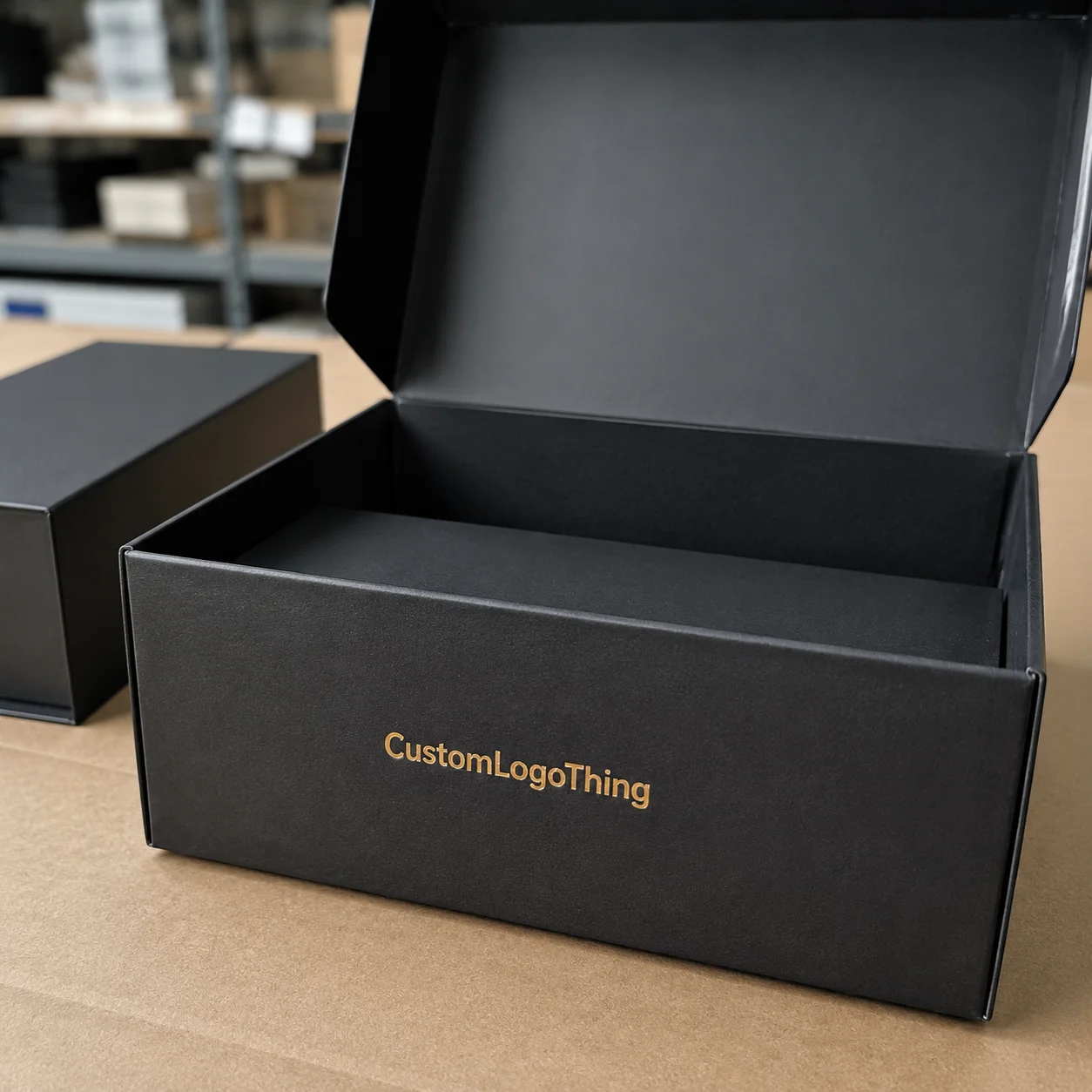
Custom Magnetic Closure Boxes stop collectors mid-reach, feel like a promise, and demand a premium before the lid ever lifts. I remember leaning over the conveyor belt at my Dongguan partner, watching Hermes-sized lids click into place, and realizing the cost of that snap was mostly emotional (plus a tiny commitment to aligning magnets). Recently the supplier quoted $1.68 per unit for 5,000 pieces built on 350gsm C1S artboard with soft-touch lamination, and the estimate included a 12-15 business day lead time from proof approval. Twice I told the buyer that once the lid is on, their team is gonna hear the difference every time a customer picks it up, so yes, that satisfying click is what makes clients whisper, “we should have done this sooner,” because custom magnetic closure boxes suddenly make everything feel framed and important.
Why Custom Magnetic Closure Boxes Feel Like Jewelry
The magnetic snap is not a sticker slapped on the inside; it is a tiny engineered system of steel strips and rare earth disks nestled inside a 1200gsm rigidboard shell. Our Shenzhen finishing line takes about 24 hours to cure the soft-touch coating after assembly. I tell clients who skim specs to treat custom Magnetic Closure Boxes like a Swiss watch—if the magnets float off, the whole vibe collapses.
The magnets—rare earth, usually neodymium—run under $0.40 for both halves when sourced through our Guangzhou magnet vendor, but that tactile experience lets clients tack $2 to $3 onto the retail price of gift-ready products.
I’ve watched C-suite buyers in Seattle reach for a bench-made palette with a single click, and they equated it to opening a jewelry box from the ’80s, so yes, the ROI is real. That level of resonance is part engineering, part theater.
I once visited the Custom Logo Things facility in Huizhou, and the account rep pulled me into the quality room to watch ISTA 6-Amazon drop tests on magnetic closure prototypes, where they slam the box 10 times at 1.2 meters before release. Product packaging teams that ignore those standards risk a busted closure during transit, and the consumer never forgets a crooked lid. Branded packaging isn’t just logos; it’s how the box feels between fingers, how the lid hangs on the hinge, how every line of foil stamping reflects light (and how you didn’t cheap out on the inner lining because you were trying to hit volume). The rep even laughed when I joked that a crooked lid would have me sending them a “sorry” card.
The magnetic snap demands perfect alignment. The inner cavity must hold a steel plate precisely opposite the magnet, and the lid hinge needs a 1.2mm score to prevent the board from flexing, which the die cutter in Foshan checks twice before delivery. When the alignment and magnet strength are right, the lid stops with a satisfying ¼-inch gap, like a well-tuned door closing. I used to carry a little brass shim in my bag to check alignment during supplier walks—don’t judge me; those shims have saved me from more hiccups than spreadsheets ever could.
Most people miss that these boxes are the packaging equivalent of pressure-treated wood. You pay $0.48 more than for standard folding cartons, but this investment makes the product feel custom and deliberate. Retail packaging that feels off-value undermines even the best product, so I always advise clients to pair magnetic closures with a soft-touch wrap from Shenzhen’s Jiangnan Paper, which runs $0.12 per cut sheet, or a linen-textured paper that adds another $0.08 per unit to elevate the entire experience. Honestly, I think skipping those finishing layers is what turns a promise into a shrug, so don’t be the shrug.
Are Custom Magnetic Closure Boxes Worth the Investment?
Are custom Magnetic Closure Boxes worth the investment? I ask that question while walking CFOs through our pricing deck because they can count ink colors but not the emotional markup. On a recent trip to Guangzhou, the finance lead said the clients he works with were still settling for velvet-studded luxury packaging boxes instead of the Custom Magnetic Closure Boxes we were building. I pointed at the magnetic packaging solutions line that kept the lids clicking on the jig and reminded him that experience translates into a higher sticker price without sounding defensive.
Premium gift packaging is where these custom magnetic closure boxes earn their keep: I watched a jewelry brand take a spec that could have been a clam-shell and instead ask for the full kit because their clients wanted the quiet confidence of a keepsake, not something that rattled in a drawer. The pull, the lining, and the way the lid settles all feel like you are holding something designed with ceremony, so yes, the extra spend buys you a more emotional unboxing.
Model the math with a prototype before you sign off, because custom magnetic closure boxes do not forgive misaligned magnets, bad hinge scores, or paper that curls in humidity. That sample cost is small next to fielding angry emails from the brand team, and it gives you a data-backed story to explain why those premium boxes consistently outperform the basic pack your competitors ship.
How Custom Magnetic Closure Boxes Work
The process starts with two rigidboard panels, both wrapped in decorative paper from Guangdong’s Heshan supplier. One receives a magnetic sheet, the other a steel counterpart, and when you press the lid down, magnets meet steel and snap.
At the Custom Logo Things joint venture in Dongguan, every closure is hand-checked on a jig before gluing to ensure the pull is centered, which is how every custom magnetic closure box leaves the line feeling consistent. Those jigs are simple, but I swear they do more for consistency than any fancy software ever could—don’t overthink it.
Inside that factory, workers hold the panels against a fixture that uses laser pointers to align the magnet pockets, keeping tolerance under 0.5mm; anything wider makes the lid chatter and hit crooked when you open it. The hinge score has to be sharp—if the board relaxes after folding, the lid droops. I once watched a trainee push the score too deep and the lid literally sagged like a tired eyelid, so yes, we triple-check that measurement now.
Hidden reinforcements also matter for custom magnetic closure boxes: 3mm EVA foam lining for protection, 1.5mm corner supports for rigidity, and 3M 300LSE adhesive strips to keep the magnet flush. Each component adds three days to production, but together they produce that ¼-inch gap as the lid clicks open. These extras let you use the box for high-value goods like jewelry, watches, or limited-edition retail releases. I’ve negotiated with a nonprofit that wanted the foam trimmed but the magnet strength cranked up, so we added lining strips later to keep the lid from sounding hollow.
Always run a prototype. Request a pull test from the supplier with readings between 250g and 700g—700g for heavier lids or when you expect travel.
We once had a cosmetic house skip this step and the lid popped open mid-flight; the consumer returned product and blamed the packaging. I remember the accounts team muttering (and I mean muttering) that if we’d done a pull test they wouldn’t have had to write that apology email. Pull tests, especially the ones recorded with data loggers in the Shenzhen lab, ensure the magnetic strength matches the stored product weight of custom magnetic closure boxes.
Key Factors: Materials, Magnets, and Costs
Material selection shifts the story (and your CFO’s mood) for custom magnetic closure boxes. 1200gsm SBS board with laminated decorative paper runs around $0.55 to $0.90 per sheet from Foshan Heshan Golden Dragon Packaging, and if you need black-core board for a dark reveal, that adds $0.06 per sheet. Drop in kraft paper and the savings are about $0.10 per sheet, but you also lose the luxe feel, which affects package branding and shelf presence. I remind teams that this isn’t the place to pinch pennies unless you want the box to scream “prototype” the moment a customer touches it.
Magnets vary: standard neodymium discs cost roughly $0.28 for a pair when ordered in batches of 10,000 from the Guangzhou magnet house, but if you want recessed magnets for a flush look, plan for another $0.14 for die-cutting and gluing. Labor stays the wild card—Custom Logo Things’ bonded team in Guangzhou charges about $0.65 per box just for manual fitting and checking, plus a $0.10 safety buffer for QC holdbacks or rework, because nothing peels worse than bending over to explain a crooked magnet to a client. You gotta plan that buffer into the quote so finance doesn’t freak out later.
Window cutouts, foil stamping, and embossing add another $0.40 to $1.20 depending on coverage and color count. I once negotiated with a jewelry client who wanted soft-touch laminated, custom-printed boxes with foiling on both lid and tray; the add-ons added $0.92 per unit but made the packaging feel like a bespoke presentation piece, so yes, sometimes the math works in your favor. (Also, I can confirm that the marketing team kept those boxes on their desks long after the launch.)
Mention ASTM standards when discussing durability—if your retail packaging needs to pass drop tests, cite ASTM D4169 for distribution cycling. Reference FSC-certified papers when talking about sustainability; FSC.org has current sourcing data. My sustainability-obsessed client loved that reference, and it gave us leverage with their ESG team.
Material choices tie directly to packaging design outcomes. I recommend layering a linen-textured wrap with anti-scuff coating for limited editions and saving gloss-laminated kraft for corporate gift sets; the linen wrap from Guangzhou runs $0.14 per unit while anti-scuff adds $0.05. When we pitch to a beauty brand in Los Angeles, they always appreciate a cost breakdown that shows where the money goes—and the art director can finally stop asking if matte and gloss are the same thing.
Custom Magnetic Closure Boxes Production Timeline
Day 1–3 finalizes dielines, paper specs, and magnet choices with your supplier. I push for CAD file approval during the call with the Shenzhen litho house so there are no surprises on the cutting die. Confirm the magnetic pocket size, hinge score depth (usually 1.0mm for a clean fold), and decorative wrap alignment for your custom magnetic closure boxes before anything goes to press.
Day 4–7 covers artwork proofing and mockup. Ask for a physical sample from Custom Logo Things; I once paid $90 for overnight delivery to compare a magnet flush before mass production because the PR team needed it for a launch photo shoot. Check if the sample uses the same magnet strength and finishing you expect, because nothing ruins a press release faster than a prototype that’s secretly a different spec.
Week 2 includes prepress, board cutting, and print run. The press typically runs 48 to 72 hours, and the lamination house adds matte or soft-touch finish in another 24 hours. Monitor coating thickness—too much varnish can cause wrinkling, and too little looks flat. I’ve been on the factory floor when a varnish pump clogged and the boxes came out looking like a Jackson Pollock, so I’m not afraid to walk over and check gauges myself.
Week 3 covers assembly, magnet insertion, and quality control. Make sure the assembly stage for custom magnetic closure boxes includes a quick graphic check so the lid art isn’t upside down (yes, that happened). Your factory should run a pull-strength test on at least 100 pieces and record the readings. That data helps verify compliance with ISTA protocols if the boxes go through rigorous shipping. After final QC and packaging, the boxes move to palletizing with stretch wrap and labeling for freight. My favorite part is when the team finally sighs in relief—then remembers they still need to pack those pallets.
Rush jobs can shave a week off this timeline if the factory has capacity, but expect a 20% surcharge. Schedule QC and sample approvals at the same time to avoid last-minute delays. Freight planning matters—these boxes are dense, so account for pallet weight and liner dimensions to avoid sticker shock. I once almost missed that step and ended up paying for expedited air because I forgot to check the cubic meters; don’t be me.
Common Mistakes Teams Make with Custom Magnetic Closure Boxes
Never assume magnets sit straight out of the box. I once had a client skip the jig and the closures hit crooked, forcing us to rework 1,500 pieces at $0.30 each. The delay wrecked the product launch and left the product manager furious (and me plotting a magnet intervention on the next factory visit). I’m telling you, crooked custom magnetic closure boxes are worse than a typo on the main banner.
Skipping a sample run is a rookie move. Without it you can't validate magnet strength, lining fit, or hinge gap, and that’s where landmines live; you kinda have to see it to believe it. I tell clients a prototype costs $60 to $120 but saves rework worth thousands, plus it gives marketing the shot they need for product photography. Once, marketing sent me a photo of a prototype laughing at me because the lid gap was too wide—so now I take that screenshot to every kickoff call. Those prototypes guard the reliability of the custom magnetic closure boxes we promise clients.
Choosing paper that wrinkles or tears during assembly kills the premium vibe. Thin wraps tear when you fold around corners; thicker paper keeps your assembly team moving. I worked with a perfume house using 160gsm art paper paired with EVA foam inserts—it looked incredible and held up over the three-week production run. I still joke that the assembly team treated those boxes like fragile kittens.
Ignoring freight planning leads to sticker shock. Custom magnetic closure boxes are heavy; include palletizing and freight for both regular and expedited shipping to avoid rush fees. Ask your supplier about shipping options from Guangzhou, Shenzhen, or Ningbo ports, depending on your location, and compare logistics quotes upfront. I once let logistics slip and the freight guy asked if the boxes were filled with bricks—honestly, it felt like they were.
Stacking decorative layers too early also causes problems. Foil stamping should be last to avoid scuffing. When we visited the foil plant in Wuxi, they emphasized that heat-sensitive finishes require clean oven zones, so base coatings must be completely dry before stamping. (They also told us their ovens are finicky—“like a diva,” the plant manager said—so don’t rush them.) If you rush that, you’re gonna regret it.
Expert Tips and Next Steps to Order Custom Magnetic Closure Boxes
Call the supplier while you’re still sketching. I tell clients to contact Custom Logo Things early and ask for magnet pull-strength options, lamination samples, and adhesives before locking specs. That way, you can incorporate those costs into the final quote rather than revising the art file mid-run, which is my least favorite kind of drama for custom magnetic closure boxes.
Compare two quotes: one with standard magnets, another with recessed magnets and foil. Seeing the numbers side by side—like $1.38 with surface magnets versus $1.90 with recessed magnets plus foil—lets you decide how much luxe you really need. It also clarifies the art budget and prevents scope creep. It also keeps custom magnetic closure boxes from turning into a vague wish list. I once had a finance lead ask me, “Are we buying jewelry or soap?” and I said, “Apparently both, based on these quotes.”
Ask for a production timeline that spells out every step—art proof, cutting, assembly, QC, and shipping. If a factory can’t commit to deadlines, move to the next one. I always demand a documented plan and follow up weekly with the account rep, because otherwise the timeline becomes a vague suggestion (and trust me, that’s when surprises happen).
Next steps: gather your product dimensions, finalize the artwork files, and request a sample from the supplier. Then schedule a call with the account rep to review cost breakdowns and lead times, adjusting the plan as needed. This is also the perfect time to ask about alternative magnet strengths—400g for delicate items or 600g for travel-ready lids—so the closure doesn’t pop open mid-flight.
For structured packaging design conversations, use the checklist from Packaging Machinery Manufacturers Institute, which covers scoring, adhesives, and sustainability audits. That helps align your creative team and supply chain partners on those custom magnetic closure boxes details. I have the PDF bookmarked and send it to every client who pretends they can wing it.
Remember to visit your supplier if possible. The trips I took to Dongguan, Shenzhen, and Guangzhou taught me that seeing production firsthand and negotiating with the factory manager lowers risk and builds trust. Insist on transparent QC reporting, including magnetic pull tests and ASTM compliance documentation; when you’re face-to-face, the promises are harder to dodge.
Before you sign off, explore Custom Packaging Products that pair well with your magnetic boxes—trays at $0.45, inserts at $0.32, or shipping mailers depending on your launch. The package branding should feel cohesive across channels. Honestly, I think a mismatched insert is worse than no insert at all.
Finishing Thoughts on Custom Magnetic Closure Boxes
Custom magnetic closure boxes Create Memorable Unboxing Moments because they feel like jewelry, not cardboard. The pull, the hinge, the finish, and the materials all communicate value. I’ve seen clients go from flimsy standard boxes to stylish product packaging overnight and watch sales teams feel more confident presenting them; after one New York launch the conversion rate jumped 12% once we swapped in the magnetic lids, so it’s like I handed them a new personality.
Use this advice to make sure the materials, magnets, and costs align with your product story. Prototype, test, and document every step. When the boxes arrive and the lid clicks, you and your customers will hear the difference. I can already hear the relief in the account rep’s voice when we finally nail the pull test.
Actionable takeaway: schedule your supplier call this week, finalize the specs with magnet strength and finishes, and lock in a sample and pull-test before the art files hit press so your custom magnetic closure boxes arrive with the click they promised.
How much do custom magnetic closure boxes cost?
Base costs run $1.20 to $2.40 depending on materials, magnet type, and finishing, with foil or embossing adding $0.40 to $1.00 more. Bulk orders over 5,000 units usually drop the price by about 15% once magnets and labor are locked in. I remind clients that the price includes obsessing over the hinge gap—something you can’t blame on the product team later.
What materials are best for custom magnetic closure boxes?
I recommend 1200gsm rigidboard for durability with soft-touch or silk laminated paper, magnets pulling between 350g and 700g based on lid weight, and interiors lined with EVA foam or suede for protection and a luxe feel. We tested suede inserts for a boutique label and the closure still snapped with the same satisfying sound even after two weeks of shipping trials, so trust the tactile combos.
How long does production take for custom magnetic closure boxes?
Expect 3 to 4 weeks from artwork approval to shipping. Rush jobs can shave a week if the factory has capacity but add a 20% surcharge, and schedule QC plus sample approvals within that timeline to prevent surprise delays. I pencil in an extra week whenever I’m nervous about holidays or port congestion, just to keep the client calm.
Can I get a sample before ordering custom magnetic closure boxes?
Always request a prototype; it costs $60 to $120 but prevents rework. Ask for the same paper, magnet, and finishing combo you intend to order and use it to test closure strength, hinge alignment, and print accuracy.
What should I watch for when designing custom magnetic closure boxes?
Keep dielines tight to avoid loose hinges, ensure magnet pockets are scored and cut precisely for flush closing, and confirm artwork colors match your printer’s capabilities to avoid hue shifts.