Buyer Fit Snapshot
| Best fit | Custom Mailer Box Inserts Wholesale projects where brand print, material claims, artwork control, MOQ, and repeat-order consistency need to be specified before quoting. |
|---|---|
| Quote inputs | Share finished size, material target, print colors, finish, packing count, annual reorder estimate, ship-to region, and any compliance wording. |
| Proofing check | Approve dieline scale, logo placement, barcode or warning zones, color tolerance, closure strength, and carton packing before bulk production. |
| Main risk | Vague material claims, crowded artwork, missing packing details, or unclear freight terms can make a low unit price expensive after revisions. |
Fast answer: Custom Mailer Box Inserts Wholesale: Specs, Pricing, Timing should be specified like a repeatable production item. The safest quote records material, print method, finish, artwork proof, packing count, and reorder notes in one written spec.
Production checks before approval
Compare the actual filled-product size with the drawing, then confirm tolerance on folds, seals, hang holes, label areas, and retail display edges. Reserve space for logos, QR codes, warning copy, and material claims before decorative graphics fill the panel.
Quote comparison points
Review material grade, print process, finish, sampling route, tooling charges, carton quantity, and freight assumptions side by side. A quote is only useful when the supplier can repeat the same color, closure quality, and packing count on the next order.
Custom Mailer Box inserts wholesale decisions can look straightforward on paper, but the real picture changes fast once product movement, breakage risk, and presentation are measured against the cost of shipping. A well-built insert keeps a bottle from rattling, holds a kit in place, and gives a mailer the kind of order that feels planned instead of patched together, all without adding much weight. For Custom Logo Things, that distinction matters because buyers are not shopping for decoration alone; they are comparing protection, fit, repeatability, and unit economics for packaging that has to perform in the real world.
From a packaging buyer’s point of view, the insert is part of the shipping system, not an extra piece tossed in at the end. Custom mailer box inserts wholesale can reduce replacements, cut repacking time, and improve the first impression a customer gets the moment the box opens. Operations teams, procurement teams, and brand managers usually ask the same three questions first: Will it fit? What will it cost? How long will it take? The rest of this piece answers those questions in practical terms, with enough detail to help you move from sample to order without wasting time on vague design language.
Fragile products, premium goods, and multi-item sets all benefit from an insert that does more than fill empty space. The insert affects returns, customer complaints, and the way the product is perceived before the brand is even discussed. That is especially true in retail packaging and direct-to-consumer programs, where the box itself is part of the product experience. Seen that way, custom mailer box inserts wholesale is not only about board stock or foam density. It is about protecting margin while supporting package branding, packout speed, and the kind of order that makes fulfillment repeatable.
A simple rule usually helps: if a box costs less but causes more damage, it is the expensive option. Buyers save a few cents on the insert and lose far more to remakes, freight, customer service time, and the damage that follows a bad unboxing. The better approach is to treat custom mailer box inserts wholesale as a system choice. That means looking at product shape, transit risk, assembly labor, and how much visual structure the insert creates inside the mailer. Once the insert is considered part of the package architecture, the buying decision gets a lot easier to defend.
For teams that also need outer packaging, it can help to compare inserts with broader Custom Packaging Products or pair a mailer program with Custom Poly Mailers for secondary protection in a ship-from-store flow. Buyers managing larger programs can also review our Wholesale Programs page to align quantities and re-order planning across packaging lines.
Custom Mailer Box Inserts Wholesale: Why the Insert Changes the Unboxing Math
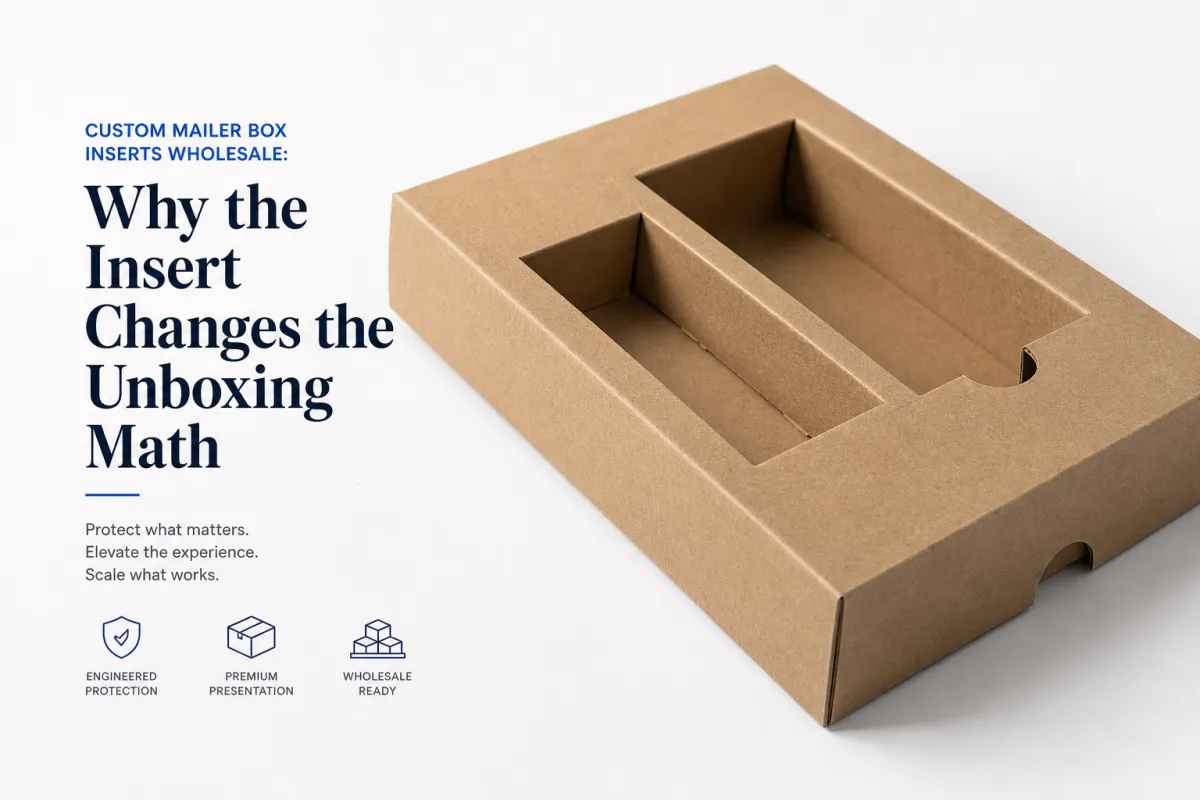
The insert changes the unboxing math because it does more than hold product still. It changes the shipping outcome, the labor profile, and the customer’s first read on value. A mailer with custom mailer box inserts wholesale can absorb small dimensional differences between products, reduce corner crush, and keep a mixed kit from turning into a jumble in transit. That matters in categories like candles, cosmetics, electronic accessories, bottles, and sample sets, where even minor movement can create visible scuffs or outright breakage.
Buyers often underestimate how much a low-cost insert can protect a high-value item. A basic die-cut solution can hold a lid closed, separate fragile surfaces, or brace a bottle neck so the outer box does not have to carry all the load. In practice, custom mailer box inserts wholesale turns the mailer from a plain container into a structured retail packaging experience. That is especially helpful for subscription boxes and DTC launches, where the customer is opening a story, not just a shipping carton.
The business case is direct. Better fit means fewer movement-related damages. Fewer damages mean fewer replacements. Cleaner presentation means better perceived value, and customers often judge the item before they judge the brand claims behind it. A well-executed insert can also improve packout speed because the cavity map gives fulfillment teams a faster, more repeatable process. That is a real cost advantage, not a cosmetic flourish. For high-volume programs, custom mailer box inserts wholesale can pay back quietly through lower labor waste and fewer exceptions.
From a transactional perspective, strong buyers ask how the insert supports the entire shipping workflow. They want to know whether it stacks cleanly in storage, whether it ships flat, whether it folds easily, and whether it can handle vibration and compression. If the answer is yes, custom mailer box inserts wholesale often becomes the least expensive way to improve package quality without changing the mailer itself. Procurement teams usually care more about structural performance than decorative features, and for good reason.
“A cheap insert is expensive if it shifts.” That line is blunt, but it is accurate. In shipping, movement is the enemy.
There is a branding effect too, and it is easy to overlook. A tidy insert signals control. It tells the customer the product was packed with intent, which raises the perceived value of the whole shipment. That is one reason custom mailer box inserts wholesale appears often in premium gift sets, launch kits, and influencer mailers. The cost of the insert is usually small compared with the visual lift it creates. In branded packaging, those small signals matter because they shape how the customer reads the brand’s discipline.
For testing and validation, buyers with protective requirements should compare transit performance against recognized methods such as ISTA protocols. If the package has to survive drops, vibration, or stacking pressure, the insert should be designed around those conditions. Fiber-based options can also be evaluated against FSC sourcing expectations when sustainability claims matter to your retailer or internal procurement policy.
Product Details: Custom Mailer Box Inserts Wholesale Options
Custom mailer box inserts wholesale usually falls into a handful of structural families, and each one solves a different problem. Die-Cut Corrugated Inserts are the most common because they are sturdy, efficient, and easy to customize. Paperboard inserts work well for lighter products and a cleaner presentation. Molded pulp makes sense for fiber-forward programs that want a more natural look and a recyclable structure. Foam still has a place for delicate items, especially where cushioning needs are high. Hybrid constructions combine materials, often for mixed-product kits that need both holding power and visual order.
The right choice depends on what the insert is supposed to accomplish. If it only needs to stop sliding, a simple corrugated tray may be enough. If the insert has to separate several SKUs, hold a bottle upright, and support a premium unboxing moment, custom mailer box inserts wholesale may need multiple cavities, tabs, and layered pieces. Some buyers ask for finger notches so the customer can remove items without tearing the board. That sounds small, yet it changes the user experience and cuts down on frustration.
Customization usually starts with the product, not the box. The most useful input is a clean set of product dimensions, plus the number of units the mailer must hold. From there, a good supplier can recommend cavity depth, wall thickness, cutout shape, and orientation. If the set includes mixed items, the insert should reflect the heaviest piece first, because gravity does not care about branding. With custom mailer box inserts wholesale, the cavity for a bottle is not the cavity for a jar, and the cavity for a charger is not the cavity for a candle tin.
Branding can be added without turning the insert into a billboard. A small printed message, a color accent, a logo panel, or a hidden note under the top layer can support package branding while preserving function. That is usually the better move. Heavy printing can complicate production and raise cost without improving the customer’s perception enough to justify it. In most custom mailer box inserts wholesale programs, restrained branding performs better than loud graphics because the product stays in focus.
Here are the most common use cases buyers ask about:
- Cosmetics: serum bottles, compacts, lip products, and skincare kits that need precise cavities and a polished presentation.
- Candles: glass jars and tins that need edge protection, especially if the outer mailer is also part of retail packaging.
- Beverage or bottle kits: neck support, base retention, and separation between items to limit breakage.
- Electronics accessories: chargers, cables, earbuds, and small devices that benefit from clean segmentation.
- Gift sets: multi-item bundles where order and spacing matter as much as protection.
Assembly is the detail that gets overlooked most often. An insert can be engineered well and still be the wrong choice if it slows packout too much. If you are shipping thousands of units, custom mailer box inserts wholesale should be judged partly on how fast the team can load product without misplacing parts. A well-cut insert should guide the packer naturally. If it requires constant checking, the design is not finished yet.
In the shop, we have seen beautifully drawn inserts fail for a very ordinary reason: the pack line hated them. That is a pretty boring failure mode, but it shows up all the time. If the team has to twist product at odd angles, force tabs into place, or stop and ask which cavity goes where, the design is fighting the operation instead of helping it.
Specifications: Sizing, Materials, and Structural Fit
The measurement process should begin with the product, then move outward. Measure the item itself first: length, width, height, and weight. After that, measure the inside size of the mailer box. Only then define the insert cavity and wall thickness. That sequence sounds simple, yet it prevents the most common fit mistake, which is designing to the box before the product is fully understood. With custom mailer box inserts wholesale, a millimeter of extra play can matter when the item is heavy, glossy, or fragile.
Buyers should ask for a spec sheet that lists board caliper, flute type, material grade, compression strength, finish compatibility, and tolerance range. If the insert is die-cut corrugated, ask whether the flute direction supports the load. If it is paperboard, ask whether the board has enough stiffness to keep cavity walls from bowing. If molded pulp is under review, ask how the part nests and whether the surface finish fits the level of presentation the brand needs. Custom mailer box inserts wholesale becomes more reliable when the supplier treats the spec like an engineering document rather than a guess.
Structural fit is not just about whether the item stays put. It is about how the package behaves under vibration, drops, stacking, and temperature swings. A product can look stable on a table and still fail in transit if the insert does not restrain motion in several directions. That is why transit testing matters. If the insert is part of a protective system, the buyer should ask whether the design is compatible with basic ISTA-style testing and whether edge crush or compression performance has been considered. For product packaging that moves through multiple handoffs, those questions save money later.
Sustainability can be built into the spec without making the conversation abstract. Fiber-based materials are often easier to explain to retailers and end customers, especially when the insert is visibly recyclable. Some programs use FSC-certified board to support sourcing claims and procurement documentation. That is useful, but only if the material still performs. The cheapest recyclable insert is not useful if it collapses under load. Custom mailer box inserts wholesale should balance the material story with performance reality. A buyer who ignores one side for the other usually pays for it in rework or damage.
When a package has to survive repeated handling, the shape of the insert matters just as much as the substrate. Tall side walls, narrow channels, and weak corners can create pressure points that are invisible until the first rough transit cycle. That is why a spec sheet should include more than a finished size. It should describe where the load lands, where the product can touch, and where the board needs extra support. A supplier who can talk through those points is usually thinking about the package as a system, which is exactly what buyers need.
For procurement teams, a structured spec sheet shortens approvals. A good sheet should include:
- Product dimensions and weight.
- Mailer box inside dimensions.
- Insert style and material.
- Number of cavities or layers.
- Print requirements, if any.
- Tolerance expectations.
- Assembly method and packout notes.
That level of detail cuts down revision loops. It also gives the vendor enough information to recommend the right version of custom mailer box inserts wholesale instead of forcing the buyer to choose between underbuilt and overbuilt. In practice, the best results come from a short technical conversation early, not from a long correction cycle after sampling.
| Insert Type | Typical Strength | Approx. MOQ | Common Unit Range | Best Fit |
|---|---|---|---|---|
| Die-cut corrugated | High for its cost; good crush resistance | Usually lower than molded options | $0.18-$0.45 depending on complexity and volume | Most DTC kits, bottles, candles, and mixed product sets |
| Paperboard | Moderate; best for lighter items | Often accessible for smaller runs | $0.12-$0.32 at volume | Cosmetics, samples, and premium presentation layers |
| Molded pulp | Good for structure, fiber-based appeal | Typically higher due to tooling and setup | $0.20-$0.60 depending on tooling and quantity | Eco-focused programs and shaped retention needs |
| Foam | Excellent cushioning; less sustainable | Varies widely by cut complexity | $0.22-$0.70 depending on density and cutouts | Fragile electronics, glass, and specialty protection |
The table above is directional rather than fixed. Final pricing depends on the number of cavities, the amount of waste in the dieline, whether the insert ships flat, and whether the design needs custom scoring or lamination. Even so, it gives a useful starting point for custom mailer box inserts wholesale buyers who need to compare protection against cost quickly.
Custom Mailer Box Inserts Wholesale Pricing and MOQ
Pricing is driven by several levers, and the biggest mistake buyers make is assuming the insert price mostly comes down to material. Material matters, but complexity often matters more. A simple single-cavity corrugated insert can be economical because it is easy to cut and fast to run. Add extra pockets, tight tolerances, printed surfaces, or intricate product cutouts, and the price rises. Custom mailer box inserts wholesale also gets more expensive when the design needs a custom dieline or special tooling, especially for molded pulp or unusual shapes.
Most pricing structures reward volume, though the break points are not always linear. A small jump in quantity can unlock a better unit rate if it moves the order into a different production tier. That is why buyers should request at least two or three quantity options. A quote at 1,000 pieces can be useful for sampling, while a quote at 5,000 or 10,000 pieces often shows the real economics of custom mailer box inserts wholesale. The difference in per-unit cost can be large enough to affect launch budgeting or quarterly procurement planning.
MOQ expectations vary by material and structure. Simple corrugated and paperboard inserts often allow lower minimums because they are easier to produce. Molded pulp and highly engineered inserts usually need higher minimums, partly because setup cost has to be spread across more units. Sample orders may be priced separately, and that is normal. Buyers should also budget for prototype revisions. A first sample that needs a cavity adjustment is common, especially for product packaging with irregular shapes or tight tolerances.
There are also budget items that are easy to miss. Freight can be meaningful if the insert is bulky. Assembly labor may matter if the insert ships flat and requires manual folding. Rework becomes a cost if the product dimensions change after proofing. If the packaging design team updates the product after the insert is approved, the insert may need to be redone. Custom mailer box inserts wholesale looks inexpensive until those variables enter the picture. Then it becomes obvious that the real cost is the total landed cost, not just the quoted unit price.
One useful purchasing tactic is to compare pricing against risk. A slightly higher unit price may be the cheaper option if it lowers the damage rate by even a small margin. That is especially true in high-value or fragile categories, where one replacement can wipe out the savings from dozens of units. From a procurement lens, custom mailer box inserts wholesale should be judged on total cost to serve, not unit price alone. That is the number finance cares about.
Here is a practical rule: if the product is fragile, multi-piece, or already generating returns, ask for a sample quote and a production quote at the same time. The sample tells you whether the fit is right. The production quote tells you whether the structure is scalable. If the numbers are close enough, custom mailer box inserts wholesale can move forward with confidence. If the sample cost is high because the structure is overcomplicated, the redesign often pays for itself quickly.
For buyers comparing suppliers, the quote should clearly separate insert construction, print, setup, and freight. When those costs are lumped together, it becomes harder to see where savings can be found. A transparent quote is usually a sign that the vendor understands wholesale packaging and can support repeat orders without surprises. That is exactly what large branded packaging programs need.
Pricing should also be read through the lens of the full system. If the insert allows the team to use a lighter mailer, reduce void fill, or pack more consistently, those savings belong in the analysis too. Custom mailer box inserts wholesale is not only an added line item. In many programs, it is the part that makes the whole mailer system more efficient.
For teams that review packaging budgets every quarter, I usually suggest comparing the insert against the cost of the problems it prevents. That includes damage claims, customer service time, and the ugly little expense of rework that never makes the first spreadsheet cut. The math is not fancy. It is just honest.
Process and Timeline: From Quote to Delivery
A clean process keeps custom mailer box inserts wholesale on schedule. The usual flow starts with inquiry, then product measurement review, recommendation, quote, dieline creation, sample approval, production, and shipping. That sounds standard, but timing slips quickly when the input data is weak. If the product weight is missing, if the dimension sheet is inconsistent, or if the team changes the packaging design midway through sampling, the schedule stretches right away. A good supplier will point out those issues early rather than wait for a failed prototype.
Sample lead time and bulk lead time should be treated separately. Sample production is about validating fit, presentation, and function. Bulk production is about repeatability and capacity. For straightforward custom mailer box inserts wholesale projects, the sample may move fairly quickly, while full production can still take longer because the factory has to schedule die cutting, finishing, packing, and freight. Buyers who mix those timelines together often underestimate launch dates.
For planning purposes, many teams should expect a sample-and-approval cycle that takes longer than the production run itself. That is especially true if the product is fragile or if there are multiple cavities to tune. A simple insert for a single item may move smoothly. A three-piece gift set with bottle, jar, and accessory cavities may need revision. In that case, custom mailer box inserts wholesale is not delayed by the factory alone; it is delayed by the need to make sure the design works before volume is committed.
The best vendors help in the middle of the process. They should be able to check files, suggest structural changes, flag weak points in the dieline, and explain how the insert will be packed. That kind of support lowers the risk of approval loops. It also shows whether the vendor understands product packaging in a practical sense. If the answer to every question is just “yes, we can do that,” the buyer should be cautious. A serious partner explains what should change, why it matters, and what it will do to timing or cost.
Custom mailer box inserts wholesale also benefits from a simple decision rule: if the item is fragile, high-value, or part of a launch with no room for error, build extra time for sampling and transit testing. That buffer is cheap insurance. A week spent validating fit can prevent a month of damage claims later. In packaging, speed only looks efficient when the package actually arrives intact.
In my experience, the fastest projects are not the ones that skip steps. They are the ones where the buyer sends clean measurements, names the real shipping risk, and gives the supplier room to solve the structural part before anyone starts arguing over print. That kind of clarity saves time every single time.
Why Choose Us for Wholesale Mailer Box Inserts
Custom Logo Things focuses on the parts of custom mailer box inserts wholesale that buyers can measure: fit accuracy, stable supply, repeatable quality, and direct communication. That matters because most packaging failures are not abstract design failures. They are execution failures. The product was measured loosely. The cavity was drawn too wide. The sample was approved too fast. The re-order did not match the first run. A dependable supplier reduces those risks with disciplined proofing and clear production checks.
Our approach is practical. We look at the product first, then the mailer size, then the insert structure. That order keeps the conversation grounded in function. It also helps teams compare custom mailer box inserts wholesale with other packaging paths, including custom printed boxes or broader retail packaging programs. A buyer may decide the insert should stay simple, or that it should coordinate with a stronger outer box. Either way, the decision is cleaner when the supplier talks in dimensions, materials, and use case instead of vague promises.
Repeatability is another advantage. Wholesale programs are rarely one-time purchases. A good insert has to work for replenishment orders months later, sometimes with different production partners or updated inventory. The value of custom mailer box inserts wholesale grows when the first run and the fifth run match closely enough that fulfillment teams do not have to relearn the packout. Consistency is savings in a very plain form. It prevents waste, protects brand standards, and makes reordering less painful for procurement.
Communication also matters. Procurement teams do not want five different answers to the same fit question. They want a clear recommendation, a clean quote, and a realistic lead time. That is why the best wholesale packaging relationships feel orderly. The packaging partner brings structure to a process that can get messy quickly. For a brand managing multiple SKUs, that discipline is worth more than flashy presentation language.
When teams compare suppliers, the quiet advantage often comes down to fewer surprises. Fewer surprises mean fewer delays. Fewer delays mean launch schedules stay intact. Fewer errors in the insert reduce the chance that customer service has to clean up avoidable damage. In other words, custom mailer box inserts wholesale is not just a purchase. It is a control point in the supply chain.
If your packaging strategy includes other branded pieces, the same logic applies across the system. The outer mailer, insert, and secondary materials should all support the same brand message without fighting each other. That is how package branding becomes coherent. It is not about more decoration; it is about stronger structure. The insert plays a bigger role in that than many teams expect.
Next Steps: Order Custom Mailer Box Inserts Wholesale
To move forward, gather the information a good supplier actually needs. Start with product dimensions, item weights, a photo of the product from several angles, the inside size of the mailer box, the target quantity, and any branding requirements. If there are multiple products in the same box, list them separately. If the product is delicate, mention the damage risk and the expected shipping path. That data is enough to start a serious custom mailer box inserts wholesale quote.
Ask for at least two quantity breaks. That lets you compare unit cost across production levels and see whether a larger order creates meaningful savings. If the item is fragile, ask for a sample or prototype before production. If the product has an odd shape, ask for a dieline proof. These steps are not delays; they are checkpoints. They lower the chance of costly changes later and make the final insert far more likely to perform as intended.
Here is a short checklist that keeps the process moving:
- Confirm the product dimensions and weight.
- Confirm the mailer box inside dimensions.
- Choose the insert material and style.
- Review the dieline and cavity layout.
- Approve the sample or prototype.
- Lock the timeline before production starts.
- Place the order and schedule freight separately from production.
Buyers who follow that sequence usually get better results because they remove guesswork early. That matters in custom mailer box inserts wholesale, where small dimensional errors can create big operational problems. A well-prepared request also makes it easier for the supplier to recommend the right substrate, the right cavity depth, and the right print treatment if branding is needed.
For brands that want more than protection, the insert can also reinforce the look and feel of the shipping experience. It can echo the same color logic used in product packaging, support a cleaner brand reveal, and help the outer box feel intentional without adding visual clutter. That balance is what most strong branded packaging programs aim for: simple, reliable, and easy to repeat.
Bottom line: custom mailer box inserts wholesale works best when the buyer treats fit, material, Cost, and Timing as one decision. Get the measurements right, compare a few volume tiers, and test the sample before you commit to full production. That is the fastest route to an insert that protects the product, supports package branding, and holds up in real shipping conditions.
What sizes are available for custom mailer box inserts wholesale?
Sizes are built around your product dimensions and the inside size of the mailer box, not a fixed catalog format. A good supplier will ask for length, width, height, and weight before recommending a cavity layout. If the item has an irregular shape, request a sample insert or dieline proof so the fit can be checked before full production. That is the safest way to handle custom mailer box inserts wholesale when the product does not sit neatly in a standard cavity.
What is the minimum order for custom mailer box inserts wholesale?
MOQ depends on the material, the level of customization, and whether tooling or special die cutting is required. Simple corrugated or paperboard inserts usually allow lower minimums than molded or highly engineered versions. If you need a pilot run, ask for sample pricing and then request a second quote at a larger quantity. That gives you a clearer view of cost efficiency for custom mailer box inserts wholesale and helps procurement compare real unit economics.
Which material is best for custom mailer box inserts wholesale?
Corrugated board is often the strongest all-around choice for protection, cost control, and recyclability. Molded pulp can be a strong option for eco-focused brands that want a fiber-based insert with structure. Foam may suit delicate products, but buyers should weigh protection needs against sustainability goals and disposal requirements. The best material for custom mailer box inserts wholesale depends on product weight, transit risk, and the look you want customers to see when they open the box.
How long does custom mailer box inserts wholesale production take?
Lead time usually depends on proof approval, sampling needs, and the complexity of the insert structure. Straightforward projects move faster; custom engineering and multiple revisions add time before production starts. Freight time should be counted separately so the launch schedule does not rely on production completion alone. For custom mailer box inserts wholesale, the smartest plan is to separate sample timing from bulk timing and build in a buffer if the product is fragile.
Can custom mailer box inserts wholesale include branding?
Yes, many inserts can include printed messaging, simple graphics, or branded color accents depending on the substrate. Branding works best when it does not interfere with structural fit or protection performance. If branding is a priority, ask how the print method affects MOQ, cost, and production timing before approving the design. In custom mailer box inserts wholesale, restrained branding usually performs better than heavy graphics because the product remains the main focus.

