Buyer Fit Snapshot
| Best fit | custom packaging boxes with foil for packaging buyers comparing material specs, print proof, MOQ, unit cost, freight, and repeat-order risk where brand print, material, artwork control, and repeat-order consistency matter. |
|---|---|
| Quote inputs | Share finished size, material target, print colors, finish, packing count, annual reorder estimate, and delivery region. |
| Proofing check | Approve dieline scale, logo placement, barcode or warning zones, color tolerance, and any recyclable or compostable wording before bulk production. |
| Main risk | Vague material claims, crowded artwork, or missing packing details can create delays even when the unit price looks attractive. |
Fast answer: Custom Packaging Boxes with Foil: Design, Cost, and Process should be specified like a repeatable production item. The safest quote includes material, print method, finish, artwork proof, carton packing, and reorder notes in one written spec.
What to confirm before approving the packaging proof
Check the product dimensions against the actual filled item, not only the sales mockup. Ask for tolerance on folds, seals, hang holes, label areas, and retail display edges. If the package carries a logo, QR code, warning copy, or legal claim, reserve that space before decorative graphics fill the panel.
How to compare quotes without losing quality
Compare board or film grade, print process, finish, sampling route, tooling charges, carton quantity, and freight assumptions side by side. A lower quote is only useful if the supplier can repeat the same color, closure quality, and packing count on the next order.
Custom Packaging Boxes with Foil tend to earn a second look before a shopper has fully registered the brand name. I have seen that happen in retail reviews more times than I can count: the box catches light, the logo flashes for half a second, and the product suddenly feels more considered than its neighbor on the shelf. That reaction is not magic. It is design discipline. Foil only delivers when the structure, the artwork, and the production method are working toward the same result. A metallic mark on a carton that scuffs, shifts off register, or loses detail in transit is not premium. It is just reflective.
That distinction matters because packaging is judged in less controlled conditions than most creative teams imagine. It gets handled under warehouse lights, stacked beside competing products, dropped onto counters, photographed on phones, and opened in homes where the buyer is paying attention to the smallest cues. Custom packaging boxes with foil can cut through that visual noise quickly, but only if the finish has a clear job. Used well, it sharpens hierarchy, raises perceived value, and signals that the brand made deliberate decisions rather than adding shine as an afterthought.
I have also seen the opposite. A beautiful foil logo on a weak carton can flatten the entire impression, especially after shipping. That is the part brands sometimes miss when they focus only on the mockup. The box is a physical object first and a marketing surface second.
What Custom Packaging Boxes with Foil Actually Are
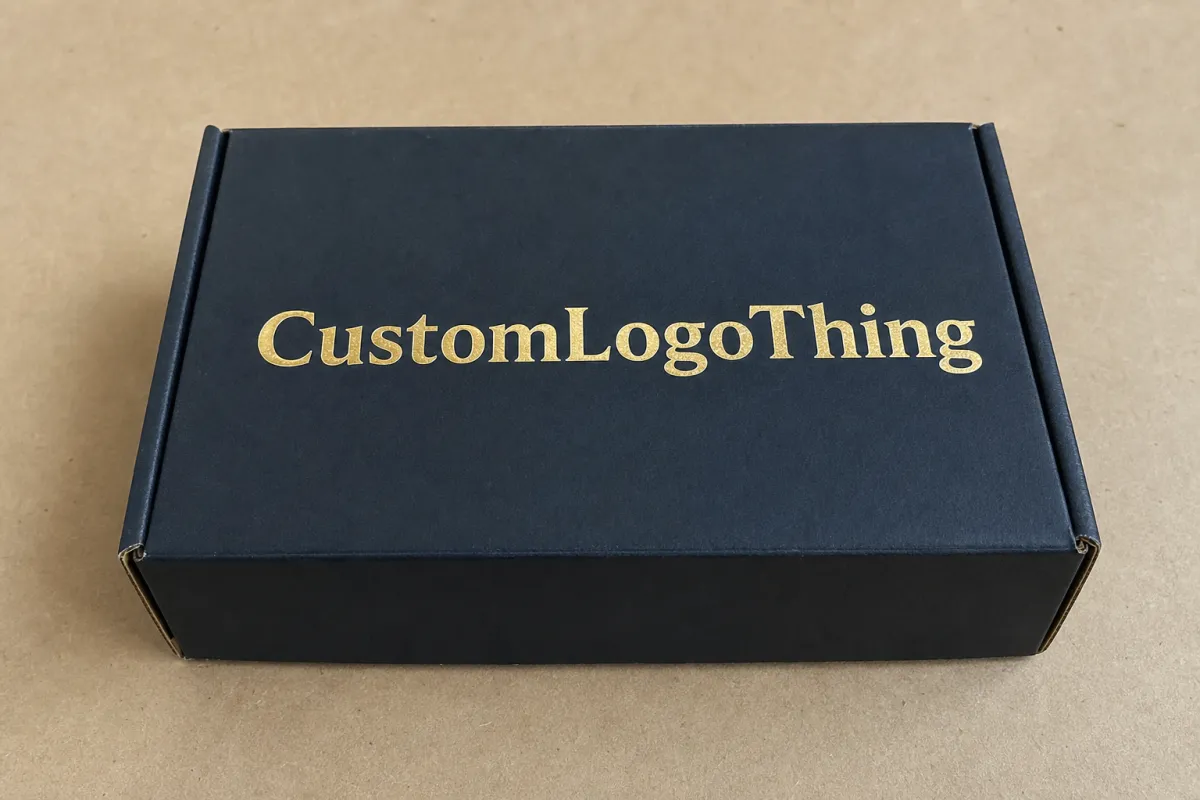
At the simplest level, custom packaging boxes with foil are cartons, sleeves, or rigid setups that use a metallic layer to highlight selected parts of the design. Logos are the most common target. Borders, icons, monograms, seals, and short lines of type follow close behind. The foil usually covers only a small share of the surface because contrast does the real work. A restrained metallic accent on a matte field often feels more luxurious than a box that reflects light everywhere.
That contrast is the mechanism. The eye wants a pause point, and foil creates one. A gold mark on a charcoal panel can feel more expensive than a fully mirrored package because the shine arrives with restraint. It behaves a little like polished cuff hardware on a dark suit: small, precise, hard to ignore. Custom packaging boxes with foil use that same principle to suggest care, celebration, and value without turning the package into a billboard.
The approach works across categories because the message can shift without changing the production logic. Cosmetics use foil for precision and polish. Stationery brands use it for borders, seals, and monograms. Food gift boxes use it to suggest occasion and seasonal value. Apparel boxes use it to create a cleaner opening moment. Even plain cartons become memorable once the metallic detail is placed with intent. The gap between "nice box" and "brand asset" is often one well-placed foil element.
If you are evaluating options for a launch, treat the box as a layered object. Board grade, print quality, coating, foil method, and structural design all shape the final result. A beautiful mockup that collapses in transit does not help the product. A carton that opens awkwardly does not help the brand. Custom packaging boxes with foil need to be planned with the same care you would give to any packaging that has to support a premium price point or a retail-first presentation.
Practical rule: foil should support the hierarchy, not become the hierarchy. If every panel shouts, nothing reads as premium.
That is why the best examples feel controlled. They do not look overloaded. They look deliberate, and that calm confidence is often what makes custom packaging boxes with foil feel worth the extra production effort.
How Custom Packaging Boxes with Foil Are Made
Three methods show up most often in custom packaging Boxes with Foil: hot foil stamping, cold foil, and digital foil. Hot foil stamping uses heat and pressure to transfer metallic film onto the substrate. Cold foil builds the effect on press with adhesive and a foil web, which can suit certain long-run jobs. Digital foil uses a digital system or toner-based process to place metallic detail without the traditional stamping tool. They all produce foil, but they do not perform the same way, and they do not always look identical once the box is folded, glued, and handled.
Hot foil stamping remains the classic method for a reason. It can create sharp edges, crisp logos, and a tactile impression that feels physical rather than printed on. The process depends on the die, the pressure, the heat, and the registration. If one of those elements slips, the result changes quickly. Fine lines blur. Small type fills in. A logo that looked elegant on screen starts to look tired on board. Custom packaging boxes with foil need artwork that respects the process from the start, not artwork that gets patched together in prepress.
Substrate choice changes the outcome as much as the foil method. Smooth coated paperboard usually gives the cleanest metallic detail because the surface is predictable. Kraft board still works, but the final look leans more natural and less mirror-bright. Textured stocks can be beautiful, though they often soften fine detail. A brand that wants a polished, reflective result needs to think about the board before it thinks about the foil color. That sounds ordinary on paper. In production, it is the difference between a crisp finish and an expensive compromise.
Extra finishing steps can shift the look in useful ways. Matte lamination behind foil creates a strong visual break. Soft-touch coating adds a velvety surface that makes the metal pop harder in the hand. Embossing and debossing add depth so the foil does not sit flat like a sticker. Those combinations matter in premium product packaging because the box should feel considered before the seal is even broken. The package becomes part of the product story.
There is a practical side to sustainability as well. FSC-certified board is a reasonable starting point for projects that need documented sourcing, and the standard is laid out clearly by FSC. That does not make every metallic finish low-impact, and anyone claiming that would be oversimplifying. Foil still adds material and process steps. Even so, custom packaging boxes with foil can sit inside a broader materials strategy if the project is planned carefully and the sourcing is handled with transparency.
On production lines, the quality differences are easier to spot than many brand teams expect. Hot foil stamping usually delivers the deepest impression and the cleanest edge. Cold foil can be efficient for certain high-volume runs, especially when artwork is built for press integration. Digital foil is often more flexible for samples and short runs. None of them is universally best. The right choice depends on quantity, substrate, desired texture, and the level of detail the artwork needs to hold.
| Foil Method | Best Use | Typical Strength | Common Tradeoff |
|---|---|---|---|
| Hot foil stamping | Logos, borders, short runs, premium cartons | Sharp metallic detail and strong tactile feel | Die cost and press setup add expense up front |
| Cold foil | Longer runs, press-integrated metallic effects | Efficient for certain high-volume jobs | Less flexible for very small quantities |
| Digital foil | Short runs, samples, variable artwork | Fast development with less tooling | May not match the depth of stamped foil |
If you are comparing Custom Packaging Products, ask which method fits the quantity, deadline, and design complexity. A process that looks inexpensive at the quote stage can become costly if it forces extra revisions or cannot reproduce the detail you actually need.
Custom Packaging Boxes with Foil Cost and Pricing Factors
Pricing for custom packaging boxes with foil is shaped by more than box size. Board grade matters. Print coverage matters. Foil area matters. Structure matters. Even the finish stack can nudge the quote upward. A compact carton with heavy artwork, multiple coatings, and detailed foil can end up costing more than a larger box with a much simpler layout. Production complexity usually matters more than raw dimensions.
Setup costs deserve attention because they change the math quickly. Hot foil stamping requires tooling, press setup, and calibration before the first clean sheet comes off the line. That means the earliest units carry a larger share of the labor. Small runs feel that burden most sharply. As quantity increases, setup cost spreads across more pieces and the unit price drops. That is the basic economic logic behind custom packaging boxes with foil, and it is worth understanding before you commit to a launch quantity that sounds neat but does not match your sales plan.
As a directional range, a simple premium carton with limited foil might land around $0.18-$0.28 per unit at 5,000 pieces, depending on board, print coverage, and finish stack. More complex builds with embossing, inside printing, custom inserts, or larger foil areas can move into the $0.40-$0.80 range or higher. Those figures are only starting points. Real quotes will vary with size, geometry, production location, and the number of finishing passes. Even so, ranges like these help anchor the first budgeting conversation and keep the discussion grounded in manufacturing reality.
Minimum order quantities influence the answer too. A short seasonal run of custom packaging boxes with foil can make perfect sense for gift sets, limited drops, or holiday packaging. The price per unit usually rises at lower volume, which is the tradeoff for flexibility. Larger runs are more efficient, though they only make sense if inventory will move quickly enough to justify the stock. I have seen brands over-order elegant packaging simply because the first proof looked impressive. That is a costly way to learn that packaging is not the same thing as demand.
Optional extras can change the quote fast. Embossing adds tooling and another finishing pass. A custom window adds converting steps and may need film or a patch. Interior printing gives the unboxing more personality, but it also adds ink, setup, and inspection time. Soft-touch coating, multiple foil zones, or specialty structures all raise the level of difficulty. That is why custom packaging boxes with foil should be priced as a complete production plan instead of a single decorative line item.
Shipping and warehousing should also sit in the cost model. Premium cartons are often heavier than the plain folding boxes brands start with, and thicker board can affect freight, pallet count, and storage density. That does not make foil packaging a bad investment. It just means the real cost lives beyond the per-unit quote.
For a clearer comparison, here is how the cost picture often shifts:
| Project Style | Cost Pressure | Best For | Notes |
|---|---|---|---|
| Simple carton with small foil logo | Low to moderate | Startup launches, core SKUs | Good balance of polish and budget control |
| Foil plus embossing | Moderate to high | Gift sets, prestige retail packaging | Strong tactile feel, more tooling involved |
| Large foil coverage with inside print | High | Luxury presentation boxes | More setup, more finishing, more inspection time |
| Short-run digital foil sample | Moderate | Prototype approvals, test markets | Lower tooling, but not always the cheapest at scale |
If distribution testing is part of the plan, ask whether the box needs to survive the same handling it will see in transit. Packaging engineers often refer to ISTA procedures for shipment validation, and ISTA is a useful starting point if you want to understand drop, vibration, and compression testing. That matters because custom packaging boxes with foil can look flawless on a sample table and still scuff or crush if the structure is too light for the supply chain.
Custom Packaging Boxes with Foil Process and Timeline
The production sequence for custom packaging boxes with foil is usually familiar, but every step has room for error. It starts with the brief. Size, style, quantity, finish, target date, and budget should all be defined early. After that, the dieline is reviewed, the artwork is positioned, and the converter checks whether the foil areas are placed in a way that the press can actually hold cleanly. This is the point where a lot of trouble can still be avoided, which is why it pays to slow down before anyone commits to press time.
Once the design is approved, proofing begins. Digital proofs are useful for layout, panel orientation, and typography, but they cannot fully show the final sheen or the surface feel. A physical sample is the safer option when the project is sensitive. Sampling matters even more for custom packaging boxes with foil because foil can change character depending on the board, the coating, and the line weight. What looks elegant on screen can read very differently in hand.
After approval, production moves into printing, finishing, die cutting, foil application, and folding or gluing. Jobs with multiple finishing passes naturally take longer. A carton with one foil logo and a matte coat moves faster than a box with foil, embossing, inside printing, and inserts. Not every quote follows the same clock, and pretending they do only creates frustration later. The timeline should match the design, not the other way around.
Typical turnaround on a clean, well-prepared job often lands around 12-15 business days after proof approval, though complex custom packaging boxes with foil can take longer if materials need to be sourced or if the structure requires extra setup. Shipping time sits outside that window, and international freight can add meaningful buffer. Deadlines should be treated with a little skepticism. Foil work is better with breathing room than with panic.
A few habits help keep the schedule under control:
- Send final dimensions early so the dieline does not change late in the process.
- Provide print-ready artwork with separate foil layers instead of a flattened file.
- Keep revision rounds tight and assign one decision-maker for approval.
- Approve the sample quickly if the launch depends on a fixed date.
For brands that manage launches across several channels, the production calendar and the packaging calendar have to meet somewhere. Retail rollout, direct-to-consumer shipping, and wholesale receiving windows rarely align by accident. Custom packaging boxes with foil can support all three, but only if lead time is treated as part of the launch plan rather than a problem to solve later.
One more practical point: if the design is going to require a revised dieline after artwork begins, build in extra time. I have seen teams lose days because a logo crossed a fold by a few millimeters. That is avoidable, and it is usually cheaper to fix on screen than on press.
Key Design Factors That Change the Final Look
Foil needs space. A restrained layout often feels more premium than a box crowded with metallic accents because contrast gives the finish somewhere to land. On custom packaging boxes with foil, the strongest designs usually place the metallic detail where the viewer expects to look first: the logo, the product name, a framing line, or a pattern that supports the composition instead of fighting it.
Color choice changes the message fast. Gold reads warm, familiar, and giftable. Silver feels clean and contemporary. Rose gold softens the mood and often leans lifestyle-friendly. Copper carries a grounded, rich feel. Black foil is subtler than people expect, which can make it especially effective on restrained luxury packaging. Holographic foil can work for limited editions or youth-oriented products, though it needs discipline. Each color carries a different tone, and custom packaging boxes with foil should match that tone to the brand story instead of treating color as decoration.
Typography deserves more respect than it usually gets. Thin serif fonts, tiny reversed text, and hairline rules are risky if the design was not built for foil from the start. Metal can fill in small counters or lose its edge on textured surfaces. A prepress review is a lot cheaper than a remake. Custom packaging boxes with foil are unforgiving of sloppy type decisions, yet they reward confident hierarchy and clean spacing.
Placement matters as much as style. Foil should stay away from folds, edges, and closure flaps unless the structure and tooling are designed around that movement. Safe margins are not optional. On folding cartons, even a slight shift can make a metallic element sit too close to a crease, where it can break or disappear. That is a small problem on screen and a visible problem in the hand.
There is also a tactile effect that gets underestimated. A matte or soft-touch surface behind the foil can make the metallic element feel brighter by comparison. The hand notices that contrast just as quickly as the eye does. In custom packaging boxes with foil, the physical sensation is part of the branding. It is one reason a box can feel expensive before it is opened.
Many teams underestimate the finish stack. A gloss coating makes foil read brighter. Soft-touch coating darkens the background and makes the metallic area feel more dramatic. Embossing can turn a logo into a small architectural detail. Custom packaging boxes with foil should treat those choices as part of the artwork, not as a separate production note buried in an email thread.
There is also a shelf context problem that designers sometimes miss. A box does not sit alone. It sits next to competing products, under uneven lighting, at different angles, and sometimes behind shelf guards or shipping film. A foil detail that looks dramatic in a studio can read almost invisible if the surrounding surfaces are too busy. The best designs hold up under bad lighting, because retail lighting is often worse than creative teams expect.
For sustainability-minded brands, the board and the destination market should be considered together. The question is not only whether the box looks good on a bench. It is also whether it ships well, sources well, and fits the broader product system. That wider view separates real packaging strategy from expensive decoration.
Common Mistakes with Foil Packaging Boxes
The most common mistake is too much foil. Metallic detail loses its force when it covers every surface. The eye stops treating it as special and starts reading it as clutter. Premium packaging depends on contrast, and custom packaging boxes with foil can slide into visual noise very quickly if the design tries to make every element important at once.
Wrong stock choice is another frequent problem. Very rough, highly absorbent, or overly fibrous papers may not hold fine detail with enough clarity. Foil can look patchy, dull at the edges, or inconsistent from sheet to sheet. Textured stocks are not banned; they just require a more realistic approach. Kraft board can be beautiful, but the result will feel earthy and grounded rather than mirror-bright.
Artwork often fails because the screen version was never prepared for production. Tiny reversed text, thin rules, and tight spacing may look acceptable on a monitor, then fall apart once heat and pressure enter the process. This is one of the places where custom packaging boxes with foil punish assumptions. A clean PDF is not the same thing as a clean press result.
Some mistakes have nothing to do with appearance. Brands can obsess over shine and forget protection. They can forget that the carton will be handled in fulfillment, on carrier belts, and in retail backrooms before a customer sees it. Scuff resistance matters. Compression matters. Closure strength matters. A foil box that arrives dented does not read as premium, even if the artwork is beautiful.
Opening behavior gets ignored more often than it should. If the foil sits on a surface that gets rubbed repeatedly during opening, the finish may wear sooner than expected. That is why custom packaging boxes with foil should be designed around the customer journey, not just the front panel mockup. A good reveal is only good if the package survives the reveal.
Fast-moving projects sometimes skip sample approval or rely on a flattened mockup alone. That is a risky habit. A physical sample can show whether the foil is crisp enough, whether the board feels substantial enough, and whether the finish stack matches the brand tone. In packaging work, the sample is not a luxury item. It is one of the most useful ways to protect the final result.
If you want to compare a few directions before committing to a run, review sample boards side by side. That makes it easier to judge how foil behaves on different substrates, how the light catches the panel, and whether the visual rhythm feels right for the shelf. Custom packaging boxes with foil often reveal their strengths only when they are compared in hand instead of viewed one at a time on a monitor.
Another mistake is treating foil as a rescue tool for weak design. A poor layout does not become strategic because it has a metallic accent. If the typography, spacing, or proportions are unsettled, foil usually makes the problem more visible. The finish amplifies the system around it. That is why experienced packaging teams begin with structure and hierarchy first.
Expert Tips and Next Steps for Better Results
Start with a plain checklist. Confirm the box dimensions, choose the foil method, define the exact foil areas, and decide whether embossing, coating, or matte contrast panels belong in the build. That simple planning step keeps custom packaging boxes with foil from becoming a chain of surprises late in the process. The clearer the brief, the easier the quote, and the cleaner the artwork path.
Ask for material samples before settling on a final direction. A coated board sample, a kraft sample, and a soft-touch sample can tell you more in two minutes than a spec sheet can tell you in twenty. If you can get previous foil examples, compare shine, texture, and edge sharpness in hand. That helps when the brand is choosing between a subtle accent and a bolder premium look.
Build a spec sheet that includes more than the artwork. Quantity, budget range, ship date, storage conditions, and brand rules around logo placement or color matching all belong there. If the project has a retail launch window, say so early. If it needs to hit several channels, mention that too. Custom packaging boxes with foil are easier to manage when everyone is looking at the same information from the start.
A useful specification file might include:
- Final dimensions and carton style
- Board type and finish preference
- Foil color and exact placement
- Target quantity and acceptable cost range
- Deadline, ship-to location, and sample approval timing
As the project moves toward approval, review the digital proof carefully, then decide whether a physical sample is worth the extra time. For a sensitive launch, the answer is usually yes. For a repeat order that has already been tested, a proof may be enough. The right choice depends on risk, not habit. That is the cleanest way to handle custom packaging boxes with foil without paying for unnecessary steps.
If the box will sit inside a wider product family, keep the finish language consistent across the range. One premium carton can look good on its own, but a coordinated family of Custom Printed Boxes and foil-accented cartons creates stronger shelf recognition. Consistency makes package branding feel deliberate instead of improvised.
For teams that want to move efficiently, the next step is straightforward: request a dieline, review a digital proof, approve a sample if the project is sensitive, and move only when look, Cost, and Timing all fit the launch plan. That process gives custom packaging boxes with foil the best shot at landing where they should, visually and commercially.
One final check helps more than brands expect. Hold the sample at arm's length, then look at it from twelve inches away, then under warm light and cool light. If the foil still reads clearly in those conditions, the design is probably working. If it only looks right on a screen, it probably is not ready.
Good foil work does not start on press. It starts when the brief, the board, and the artwork are all speaking the same language.
That is the part many people miss. Custom packaging boxes with foil are not just about making a box look expensive; they are about making the whole package behave like the brand promised, from shelf impact to shipping performance to the final unboxing. When those pieces line up, the result feels natural, and that is what makes custom packaging boxes with foil worth the effort.
Frequently Asked Questions
What is the difference between foil stamping and printing on custom packaging boxes with foil?
Foil stamping transfers metallic foil with heat and pressure, while printing uses ink to simulate a metallic effect or lay down base color. Foil stamping usually delivers sharper shine and a more tactile premium feel, especially on logos and short type. Printing is better for full-color artwork, while foil is often strongest as an accent on custom packaging boxes with foil.
What materials work best for custom packaging boxes with foil?
Smoother coated paperboard and SBS-style stocks usually give the cleanest detail. Kraft can work well too, although the result is more muted and organic than mirror-bright. Very rough or highly absorbent stocks can reduce clarity, so it is smart to test before full production on custom packaging boxes with foil.
How much do custom packaging boxes with foil cost?
Price depends on quantity, box size, stock, foil coverage, and whether you add embossing or special coatings. Setup costs matter more on small runs because dies and press time are spread across fewer boxes. A simple layout with limited foil usually costs less than a fully wrapped premium box with multiple finishes.
How long does production take for custom packaging boxes with foil?
Lead time depends on proof approvals, sampling needs, and the complexity of the foil and finishing steps. Straightforward jobs move faster, while custom structures or multiple finishes usually need more time. Approving artwork early and keeping revision rounds tight is the best way to protect turnaround for custom packaging boxes with foil.
Can small text or fine details be used on custom packaging boxes with foil?
Yes, but the artwork needs enough stroke width and spacing to survive the foil process cleanly. Tiny serif fonts, hairline rules, and cramped spacing can blur or fill in, especially on textured stocks. A prepress review and sample proof are the safest way to confirm the detail level before ordering custom packaging boxes with foil.
Do custom packaging boxes with foil help products sell better?
They can improve shelf visibility and strengthen perceived value, but they are not a substitute for product quality or clear positioning. In my experience, foil works best when the brand already has a strong visual system and the packaging supports that story. The finish helps the buyer notice the product faster; it does not fix a weak offer.

