Buyer Fit Snapshot
| Best fit | Custom Pallet Boxes Recycled Board projects where brand print, material claims, artwork control, MOQ, and repeat-order consistency need to be specified before quoting. |
|---|---|
| Quote inputs | Share finished size, material target, print colors, finish, packing count, annual reorder estimate, ship-to region, and any compliance wording. |
| Proofing check | Approve dieline scale, logo placement, barcode or warning zones, color tolerance, closure strength, and carton packing before bulk production. |
| Main risk | Vague material claims, crowded artwork, missing packing details, or unclear freight terms can make a low unit price expensive after revisions. |
Fast answer: Custom Pallet Boxes Recycled Board: Board, Finish, Dieline, and Unit Cost should be specified like a repeatable production item. The safest quote records material, print method, finish, artwork proof, packing count, and reorder notes in one written spec.
Production checks before approval
Compare the actual filled-product size with the drawing, then confirm tolerance on folds, seals, hang holes, label areas, and retail display edges. Reserve space for logos, QR codes, warning copy, and material claims before decorative graphics fill the panel.
Quote comparison points
Review material grade, print process, finish, sampling route, tooling charges, carton quantity, and freight assumptions side by side. A quote is only useful when the supplier can repeat the same color, closure quality, and packing count on the next order.
The cheapest pallet setup is often the one that ends in a damage claim. Custom pallet Boxes Recycled Board can help stop that spiral because a well-built recycled-board pallet box protects product, stacks cleanly, and usually costs less than a pile of overbuilt materials that were never necessary in the first place.
For a packaging buyer, Custom Pallet Boxes recycled board is not a marketing phrase. It means a pallet-sized corrugated or fiberboard container made with recycled content, sized for bulk freight, and built to survive the way the shipment actually moves. That could be retail replenishment, industrial parts, returnable shipments, or oversized e-commerce orders that need edge protection and stacking strength without turning the dock into a mess of loose wrap and bad assumptions.
The usual failure points are boring, which is exactly why they get missed. Wrong dimensions. Wrong flute. Too much humidity. Load assumptions pulled out of thin air. The recycled content itself is rarely the problem. More often, Custom Pallet Boxes recycled board gets blamed for a spec mistake that started long before the box was made.
The real question is not whether recycled board is “strong enough” in some abstract sense. The real question is whether the board grade, box style, and handling conditions match the shipment. Get that right and Custom Pallet Boxes recycled board becomes a practical, sustainable workhorse. Get it wrong and you have paid for a box that crushes products with confidence.
Why custom pallet boxes recycled board is not just cardboard
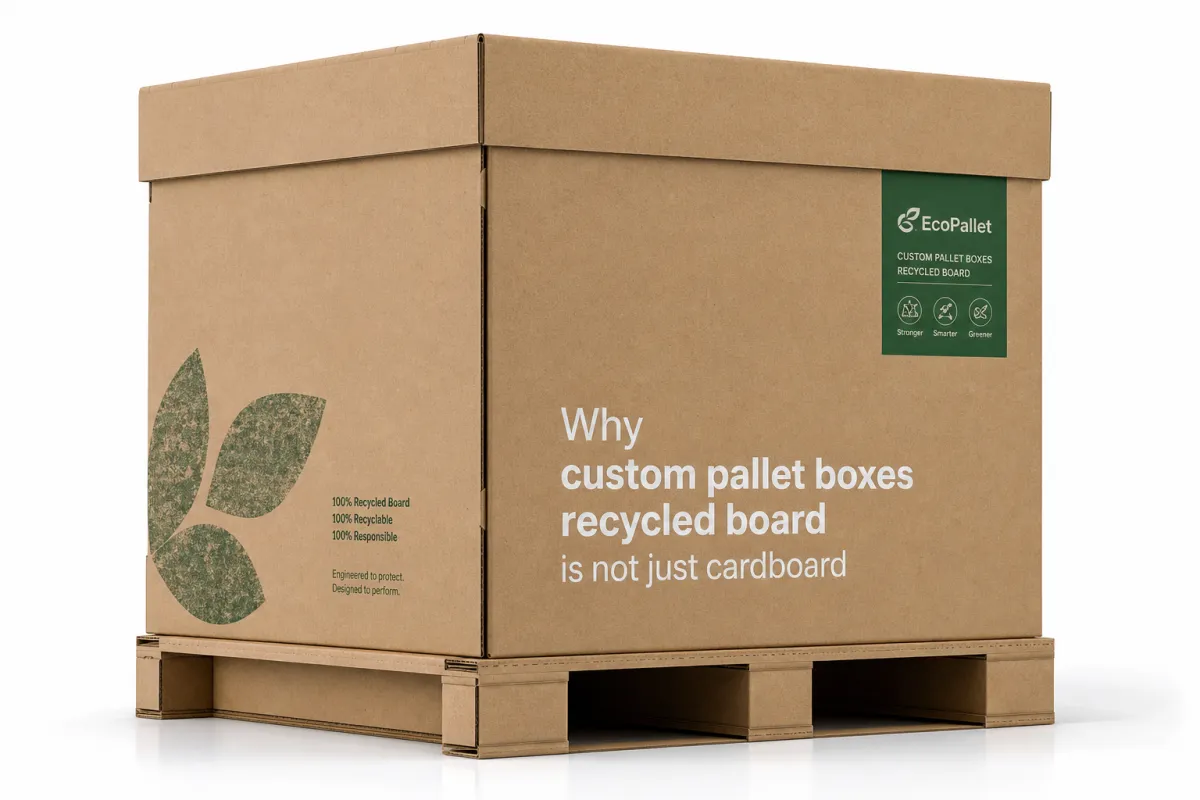
People say “cardboard” when they mean several different materials. That sloppy habit leads to bad purchasing decisions. Custom pallet boxes recycled board is usually built from corrugated board, heavy fiberboard, or multiwall constructions designed for palletized freight. That is a very different thing from a thin retail mailer or a random shipper pulled from a warehouse stack.
The use cases are easy to recognize. Retail replenishment needs tidy pallet builds that survive handling and keep shelf-ready units aligned. Industrial parts need puncture resistance and stack strength. Returnable shipments need enough durability for more than one trip. Large e-commerce and DTC orders need a container that protects the contents without forcing you to use a mountain of void fill. In those jobs, custom pallet boxes recycled board can replace a mixed-material patchwork and reduce crushed corners, bowed panels, and unstable stacks.
Its value is not limited to sustainability, even though recycled content does matter. Fit is the bigger advantage. A properly designed custom pallet boxes recycled board package uses less unnecessary material than a one-size-fits-all approach. That usually means less wasted air, fewer extra wraps, and a cleaner pallet footprint. Better fit also means better product packaging performance, which is what matters once the shipment leaves the building.
There is also a branding angle. If the pallet box is visible in a warehouse, club store, showroom back room, or receiving area, the outer package becomes part of the presentation. That is where branded packaging and practical shipping design meet. You do not need a wall of graphics on the carton. A clean logo, handling marks, and a simple identifier can make the shipment easier to sort and easier to trust. If the job calls for a more polished look, custom printed boxes can be folded into the same structural spec without pretending the box has turned into luxury packaging.
The simplest way to think about custom pallet boxes recycled board is this: it is a load-bearing packaging tool, not a decorative carton. It exists to protect, stack, and ship. If it also carries decent package branding, good. If not, nobody should be losing sleep over the corrugator.
Practical rule: if a pallet box will sit on a warehouse floor, ride on a truck, and get handled by people who are not paid to baby it, the spec has to be based on real load and route conditions, not wishful thinking.
For a broader look at material recovery and recycled fiber streams, the EPA’s recycling overview is a useful reference: EPA recycling resources. And if you are comparing corrugated performance language across suppliers, the standards and test references matter more than sales copy.
How custom pallet boxes recycled board are made and converted
The board itself starts with recycled linerboard and medium, then gets built into a structure with the flute profile and wall construction chosen for the job. That sounds plain, but the details matter. A single-wall box can be light and economical. A double-wall build adds stiffness and crush resistance. Triple-wall constructions move into heavy-duty territory. Custom pallet boxes recycled board is not one product class; it is a family of structures with very different performance levels.
Flute choice changes the result more than most buyers expect. Larger flutes can improve cushioning and compression in some cases, while smaller flutes can help with print quality and tighter folding. If the shipment has sharp corners or rough contents, puncture resistance matters. If the load stacks high, vertical compression matters more. That is why custom pallet boxes recycled board should be specified as a structure, not just a size.
Common constructions include regular slotted containers, die-cut pallet boxes, reinforced panels, sleeves with separate lids, and knockdown styles that ship flat. A regular slotted container is familiar and easy to produce. A die-cut box gives tighter control over fit. A sleeve-and-lid style can make loading easier for bulky goods. For many bulk shipping programs, the strongest custom pallet boxes recycled board answer is a box that uses a simple main body with reinforcement only where the load actually needs it.
Conversion is where the design becomes real. The converter takes the dieline, cuts and scores the board, adds glue or tabs as needed, and checks that the pallet footprint works in practice. If the box is supposed to sit on a 48 x 40 pallet, that footprint cannot be vague. A sloppy pallet fit can create overhang, shifting, or wasted space. Wasted space on a pallet is not just cosmetic. It can change stack stability and freight efficiency. Good custom pallet boxes recycled board projects are validated against the pallet, not against a spreadsheet fantasy.
Inserts and reinforcements matter too. Heavy corners, odd shapes, and concentrated pressure points often need dividers, pads, or corner posts. If a product is tall and narrow, an internal brace can stop racking. If the top load is heavy, a stronger lid or top pad may be smarter than increasing the whole box specification. That is the quiet advantage of custom pallet boxes recycled board: you can reinforce the weak points without overbuilding the entire package.
Recycled content does not mean one standard quality level. A recycled-board pallet box can be designed with different basis weights, different compression values, and different test ratings depending on the job. In plain English, there are grades within the grade. A supplier should be able to speak in terms of board construction, estimated edge crush, burst or compression targets, and any relevant test method. If they cannot, you are being sold a story, not a structure.
For reference points on testing and shipping performance, ISTA publishes widely used transport simulation methods: ISTA testing standards. Those tests are not magic, but they are better than staring at a sample and saying, “Looks sturdy enough.”
What actually determines strength, fit, and durability
Strength starts with sizing. If the pallet footprint is wrong, everything else suffers. Measure the pallet type, product dimensions, clearance for loading, and any lid or insert thickness. Then decide whether the box should sit flush, overhang slightly, or nest with another packaging layer. Custom pallet boxes recycled board performs best when the box, pallet, and product were planned together instead of patched together after the fact.
Load behavior comes next. Ask a blunt question: how much weight will this box carry, and how much compression will it see in a stack? A 35 lb shipment and a 300 lb shipment do not need the same structure. Neither do one-way shipments and reusable shipments. If the box will be reused, the recycled board spec should usually be bumped up because handling wear accumulates fast. With custom pallet boxes recycled board, the job is not only to survive the first move; sometimes it has to survive the second and third too.
Environment matters more than people admit. Humidity softens fiber. Cold storage can change board performance. Wet docks and long transit routes create ugly surprises. Even a strong design can sag if it sits in damp conditions long enough. That is why a recycled-board pallet box for a dry regional shipment may be very different from one traveling through humid cross-docks or refrigerated storage. In the real world, custom pallet boxes recycled board gets judged by the route, not by a lab brochure.
Wall construction and flute combination do a lot of the heavy lifting. A heavier recycled liner can improve compression. A double-wall structure can resist stack pressure better than a single-wall box of the same size. Triple-wall may be the right answer for dense industrial parts or export-style abuse, but it is overkill for many retail replenishment jobs. More material is not automatically better. More appropriate material is better. That distinction saves money and avoids bloated package design.
Testing is the adult in the room. Compression testing helps predict stack performance. Drop testing reveals corner and edge weak points. Vibration testing exposes looseness and shifting. Edge crush testing helps compare board strength across options. ASTM methods and ISTA profiles are common reference points, and they are useful because they turn “I think this should work” into something closer to evidence. If a shipment is valuable, custom pallet boxes recycled board should be tested before production quantities are approved.
- Compression: useful for stacked pallet loads and warehouse dwell time.
- Drop: useful for corner impact, edge damage, and handling mistakes.
- Vibration: useful for long truck routes and product shift.
- Moisture exposure: useful for cold chain, wet docks, and humid storage.
Custom pallet boxes recycled board is also affected by how the box is handled. Forklift tines, manual grabs, and conveyor contact all introduce stress. A package that looks fine in a clean sample room may fail in the warehouse because people handle it like it owes them money. That is why good packaging design always includes the handling method, not just the product dimensions.
If the sample only survives when everyone is gentle, the design is not finished.
For teams buying custom pallet boxes recycled board, the smart move is to ask the supplier for the board grade, the intended stack load, and the test logic behind the recommendation. That gives you a way to compare quotes honestly instead of comparing vague adjectives.
Custom pallet boxes recycled board cost: what changes the price
Price is where good intentions get messy. The unit cost of custom pallet boxes recycled board can look high until you compare it with damage, rework, extra stretch wrap, and labor spent rescuing bad pallets. Box cost should be measured against total freight risk, not just carton price.
The biggest pricing levers are board grade, wall construction, dimensions, print coverage, inserts, and tooling complexity. A simple recycled-board pallet box with a standard style and minimal print will usually cost far less than a fully custom die-cut build with sleeves, interior pads, and branded graphics on every panel. Size matters too. Large pallet boxes eat more board, require bigger dies, and can increase shipping and storage costs because flat packs take up real space. Custom pallet boxes recycled board is never priced in a vacuum; it is priced against materials, labor, and logistics.
Volume changes the math. Higher quantities usually lower unit cost because setup and tooling get spread across more units. Lower quantities can still make sense if the shipment is specialized or the risk is high, but nobody should pretend short runs are cheap. Custom tooling, samples, and special board grades can add upfront expense. That is normal. What is not normal is hiding those costs until the last minute and then acting surprised when the quote jumps. A clean custom pallet boxes recycled board brief reduces that nonsense.
| Option | Typical use | Approx. unit cost range | Pros | Tradeoffs |
|---|---|---|---|---|
| Single-wall recycled pallet box | Light to medium bulk shipments | $2.75-$5.00 | Lower cost, lighter weight, easier to handle | Less crush resistance, more sensitive to stacking and moisture |
| Double-wall recycled pallet box | Most industrial and retail replenishment loads | $4.80-$8.90 | Better compression, better puncture resistance, strong all-around value | Higher material cost, slightly more bulk |
| Triple-wall heavy-duty build | Dense, tall, or reusable shipments | $8.25-$15.50 | High strength, better for rough routes and heavy stacking | More expensive, heavier, usually overkill for light loads |
| Die-cut custom structure with inserts | Odd shapes, premium protection, precise fit | $6.50-$14.00+ | Best fit, better load control, cleaner presentation | Tooling cost, longer lead time, less flexible for redesigns |
Those numbers are broad on purpose because pallet boxes vary a lot by size, board spec, print coverage, and order volume. For a 48 x 40 footprint shipment at a few hundred units, the difference between a basic build and a reinforced one can be several dollars per piece. That sounds annoying until you compare it with a crushed pallet or a rejected shipment. In that context, custom pallet boxes recycled board is often cheap insurance.
Freight and storage should also be part of the budget. Oversized pallet boxes can be expensive to ship flat, and they can take up more warehouse room than people expect. If you are ordering a low-volume run, ask how many boxes fit per pallet, what the cube looks like, and whether the design folds efficiently. A supplier who understands custom pallet boxes recycled board should be able to talk clearly about shipping cost, not just box cost.
One more thing: print and coating changes can raise the price without helping protection much. Heavy ink coverage, special finishes, and full-bleed graphics make sense if the box is customer-facing or part of a retail packaging program. If the pallet box lives under stretch wrap and labels, that money may be better spent on board strength or inserts. That is the practical side of package branding. Pretty is nice. Durable pays the bills.
Custom pallet boxes recycled board process and timeline
The process should be boring in a good way. You send a clean brief. The supplier recommends a structure. A dieline gets drafted. Samples get reviewed. The box gets approved. Production starts. Freight ships. If any step turns theatrical, delays show up fast. That is how custom pallet boxes recycled board should work when the project is managed properly.
A realistic timeline often looks like this: one to two business days for an initial recommendation or quote, a few more days for sample or dieline work, and then production that might run roughly 10 to 15 business days after approval for a simple repeatable spec. More complicated jobs take longer. Add time if you need custom print, inserts, unusual board grades, or compression testing. A fully custom custom pallet boxes recycled board project is not instant, and pretending otherwise only creates stress later.
The checkpoints that prevent delays are straightforward:
- Final product dimensions, including the widest and tallest points.
- Pallet type and footprint.
- Unit weight and stack height.
- Route conditions, warehouse climate, and whether the box will be reused.
- Artwork, handling marks, and any branding requirements.
That last item matters more than many teams expect. If the pallet box is part of a branded packaging program, the visuals should be approved before production starts. If the box needs simple labeling only, keep the art clean and functional. Good custom pallet boxes recycled board projects do not waste time making a shipping container behave like a billboard unless there is a real reason.
What causes schedule slips? Vague specs. Late artwork. Missing product samples. Redesigns after testing reveals a weak corner or a stack issue. That last one stings, but it is cheaper to fix on paper than on a truck. A strong supplier will push for the missing details early because it saves everyone from rework. That is not being difficult. That is being useful.
There is also a speed tradeoff. If you need fast delivery, simplify the design. Fewer inserts. Fewer special finishes. Fewer odd angles. A basic custom pallet boxes recycled board build can move faster than a complicated one, and sometimes the fastest option is not the cheapest on paper but the safest in practice. Rushing a bad spec is how people pay twice.
If your team also needs standard cartons or retail packaging on the same order, keep the pallet box spec separate from the smaller pack formats. That avoids mixing consumer-facing custom printed boxes decisions with freight-performance decisions. If you need a broader packaging line, review the options on our Custom Packaging Products page so the pallet system and the presentation boxes each do their own job.
Common mistakes that waste money or cause damage
The first mistake is choosing custom pallet boxes recycled board only on price and ignoring the actual load. A cheap board spec can look clever on a quote and disastrous on a dock. If the box crushes, tears, or shifts, the savings disappear fast. Damage claims eat budgets with a smile.
The second mistake is measuring the product instead of the pallet system. A box that fits the product tightly may still fail if it ignores pallet overhang, handling clearance, or lid thickness. That mistake shows up as unstable stacks, extra wrap, or wasted empty space. In other words, custom pallet boxes recycled board should be sized around the whole shipment, not the item alone.
The third mistake is skipping samples or strength testing. This one is classic. Somebody assumes the board “looks strong,” then the freight gets crushed and everyone acts surprised. A fit sample checks dimensions. A strength sample checks the structure. If the shipment matters, both are worth doing. A few days spent testing custom pallet boxes recycled board is cheaper than one ugly delivery failure.
The fourth mistake is over-specifying print or coatings when the box will be hidden under wrap and shipping labels. People like the idea of polished branding, but if the box never faces the customer, that money may be better used on board grade or inserts. There is a place for package branding, and there is a place for plain survival. Those are not always the same place.
The fifth mistake is forgetting who handles the box. Forklift handling, hand carry, conveyor transitions, and warehouse stacking each create different risks. A design built for a neat direct-to-store move may not survive rough industrial handling. Custom pallet boxes recycled board has to fit the route, not the fantasy route somebody drew on a whiteboard.
Another easy-to-miss problem is moisture. Recycled board is not allergic to water, but it is certainly not thrilled by it. Cold docks, humid warehouses, and long staging times can weaken a box faster than buyers expect. If moisture is a factor, ask about board treatments, storage practices, or a stronger wall construction. That is especially true for custom pallet boxes recycled board used in export, refrigerated, or high-humidity environments.
Most box failures are not dramatic. They are ordinary. A little too much weight, a little too much moisture, a little too much optimism.
Expert tips for better specs, cleaner quotes, and fewer surprises
If you want cleaner quotes, ask for board grades and test values in writing. That is the easiest way to compare custom pallet boxes recycled board options apples-to-apples. Without that, one supplier may be quoting a heavier board, another a lighter one, and the lowest price wins only because the spec is weaker.
Share real freight conditions. Not marketing conditions. Real ones. Tell the supplier the pallet type, route length, warehouse environment, stack height, and whether the box will be reused. If the load sits in a hot dock or cold storage, say so. If the box gets handled by forklifts, say so. A better brief gives you a better custom pallet boxes recycled board recommendation and usually cuts down the back-and-forth.
Request two samples if the shipment is valuable or the route is rough. One fit sample, one strength sample. The fit sample confirms dimensions, panel movement, lid clearance, and how the box sits on the pallet. The strength sample tells you whether the board and wall construction are doing their job. With custom pallet boxes recycled board, those two samples solve different problems, and combining them is how teams miss the weak spot.
Keep the structure simple unless the shipment truly needs complexity. Straightforward box geometry is easier to produce, easier to approve, and easier to repeat. Every extra fold, insert, and specialty panel introduces another place for variation. Simplicity is not boring when the goal is protection. It is efficient. In packaging design, efficient is usually the most honest compliment.
Use recycled board strategically. More recycled content does not automatically mean less performance. A stronger construction with the right flute and wall count can be more sustainable than a flimsy box that fails and has to be replaced. The smartest custom pallet boxes recycled board setup is the one that uses only as much material as the job needs, no more and no less. That is how you get lower waste without paying for unnecessary armor.
One practical trick: ask the supplier to label the spec with the exact pallet footprint, board build, and approved use case. That makes reordering easier and stops future teams from guessing. If your company uses multiple lines of product packaging, this kind of documentation saves time later. It also helps if you are building a library of retail packaging and shipping specs that need to stay consistent across seasons or programs.
If you also need an external supplier reference for fiber sourcing or certification language, FSC has a straightforward overview of responsible forest management and chain-of-custody concepts at fsc.org. Not every pallet box needs a long certification debate, but the sourcing conversation should be clear if your brand cares about it.
Next steps: how to brief a supplier and lock the spec
Start with the basics: dimensions, pallet type, product weight, stack height, and shipping conditions. If you give a supplier that information up front, custom pallet boxes recycled board quotes get much cleaner. If you send a vague “need a pallet box” message, expect a vague answer back. That is not bad service. That is the natural result of a weak brief.
Then compare at least two or three structural options, not just prices. One may be lighter and cheaper but too weak for the route. Another may cost more up front but reduce wrap, damage, and labor. A third may give the best balance of cost and protection. That is the actual job of custom pallet boxes recycled board: find the structure that fits the shipping reality without padding the bill with fluff.
If the shipment is costly or the fit is tight, approve a sample or dieline before full production. That one step catches a lot of avoidable mistakes. A good sample process can also reveal whether the box is awkward to load, hard to close, or unstable under stacking pressure. Once you see the sample, the choice becomes much clearer. And yes, it is usually cheaper to fix now than after freight damage.
Build a simple internal checklist so the same spec can be reused later. A decent checklist should include board grade, wall count, flute type, dimensions, pallet footprint, print requirements, handling notes, and approved use case. That way the next reorder does not start from zero. For teams buying custom pallet boxes recycled board regularly, a clean spec library is worth more than people think.
There is nothing glamorous about a pallet box that does its job. Good. It should be unglamorous. A solid custom pallet boxes recycled board setup protects the product, keeps the pallet stable, reduces waste, and avoids the small failures that eat time and money. Match the board to the route, the box to the load, and the spec to the handling. That is the whole trick.
Start with the numbers, not the assumptions: measure the pallet, confirm the weight, note the route, and ask for the board grade in writing. If those four pieces are right, the rest of the custom pallet boxes recycled board decision gets a lot easier, and the shipment is far more likely to behave the way you need it to.
Are custom pallet boxes recycled board strong enough for heavy loads?
Yes, if the board grade, wall construction, and flute choice match the real load and stacking pressure. Heavy shipments usually need testing, not guesswork, especially if the route is long or the boxes stack high. Moisture protection matters a lot more than people think when custom pallet boxes recycled board sits in cold docks or humid warehouses.
How do I size custom pallet boxes recycled board for my pallet?
Start with the pallet footprint, then add product clearance, handling space, and any lid or insert thickness. Check whether the box needs to sit flush on the pallet, overhang slightly, or nest with other packaging layers. Always size around the handling method too, because forklift movement can change the clearance you really need in custom pallet boxes recycled board.
What affects custom pallet boxes recycled board pricing the most?
Board grade, wall count, box dimensions, and custom tooling are the biggest cost drivers. Print coverage, inserts, coatings, and special finishes can add cost fast without improving protection much. Low unit price is meaningless if the design leads to damages, rework, or extra shipping materials in custom pallet boxes recycled board.
How long does the custom pallet boxes recycled board process take?
Simple, repeatable designs move faster than fully custom structures with inserts or testing. Expect the timeline to stretch if dimensions are unclear, artwork changes late, or samples need revisions. The fastest way to avoid delays is to send one clean brief with dimensions, weight, pallet type, and route conditions for custom pallet boxes recycled board.
Can custom pallet boxes recycled board be recycled again?
Usually yes, if the box stays clean and does not have heavy coatings, plastic lamination, or mixed materials. Tape, labels, and minor print are often fine, but local recycling rules still matter. If reuse is part of the plan, tell the supplier early so the design can handle multiple cycles of custom pallet boxes recycled board.

