Buyer Fit Snapshot
| Best fit | Custom Paper Carry Bags Price projects where brand print, material claims, artwork control, MOQ, and repeat-order consistency need to be specified before quoting. |
|---|---|
| Quote inputs | Share finished size, material target, print colors, finish, packing count, annual reorder estimate, ship-to region, and any compliance wording. |
| Proofing check | Approve dieline scale, logo placement, barcode or warning zones, color tolerance, closure strength, and carton packing before bulk production. |
| Main risk | Vague material claims, crowded artwork, missing packing details, or unclear freight terms can make a low unit price expensive after revisions. |
Fast answer: Custom Paper Carry Bags Price: What Really Drives Cost should be specified like a repeatable production item. The safest quote records material, print method, finish, artwork proof, packing count, and reorder notes in one written spec.
Production checks before approval
Compare the actual filled-product size with the drawing, then confirm tolerance on folds, seals, hang holes, label areas, and retail display edges. Reserve space for logos, QR codes, warning copy, and material claims before decorative graphics fill the panel.
Quote comparison points
Review material grade, print process, finish, sampling route, tooling charges, carton quantity, and freight assumptions side by side. A quote is only useful when the supplier can repeat the same color, closure quality, and packing count on the next order.
Custom Paper Carry Bags Price: Start With the Value Math
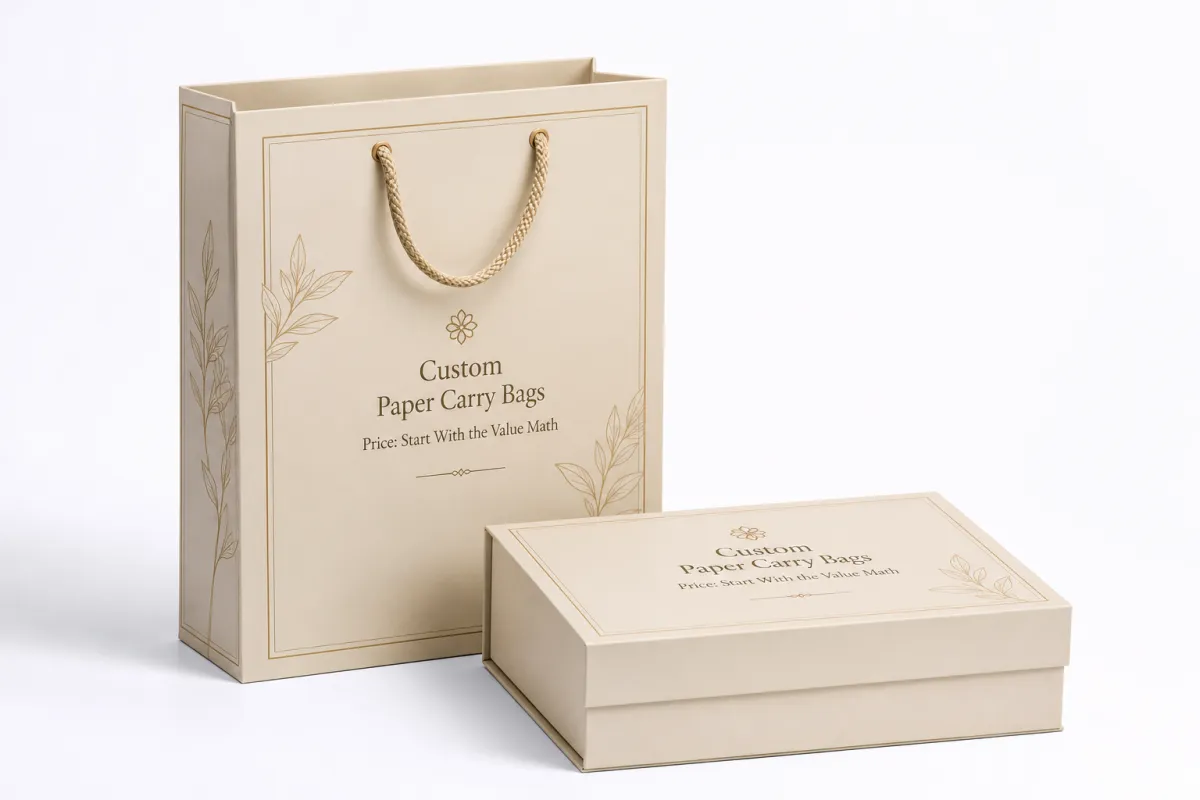
Ask a retailer what a bag is supposed to do and the answer usually goes well beyond transport. A custom Paper Carry Bags price can look modest on a first quotation, then rise once print coverage, handles, inserts, and finishing enter the picture. That shift is not a red flag by itself. If the bag is carrying brand identity out into the street, into offices, kitchens, and cars, then it is doing work long after the sale is complete. For a packaging buyer, the real question is never only unit cost; it is how much visibility, consistency, and physical performance each bag buys.
The practical rule is simple: compare total landed cost, not just the headline number. Freight, setup, packing format, samples, and carton configuration can move the final figure in a meaningful way, especially on smaller runs. A custom paper carry bags price that looks attractive at first can lose its edge once plate charges, die fees, packing labor, or long-distance delivery are added. A quote that lays out those assumptions clearly is far more useful than a low number with half the details hidden away.
When two bags share the same dimensions, the value math becomes much easier to read. A basic kraft bag with one-color printing, twisted paper handles, and no extra finish may sit near the lower end of the market. Add rope handles, lamination, foil, heavier board, or a reinforced top fold, and the same bag can move into a different bracket altogether. That is why a custom paper carry bags price should always be read beside the spec, not in isolation.
Retail packaging is part of the storefront, even when the storefront is a shopping center bag in someone’s hand. It travels into parking lots, trains, kitchens, dorm rooms, and homes, carrying the brand into places a shelf display never reaches. It also sits alongside the rest of the package branding system, including labels, tissue, inserts, and Custom Packaging Products such as presentation boxes. If the bag is the first object a customer sees after purchase, it deserves more than commodity treatment. The cheapest bag is only cheap if it still carries the load, holds up in transit, and reflects the brand well.
A bag is a moving signboard. If the structure fails, the print detail does little to save it.
That is the lens I use when reading a custom paper carry bags price. The question is not only, "What is the lowest unit rate?" It is, "What is the right rate for the performance I need?" A bakery may need grease resistance and dependable handles. A boutique may be better served by thicker paper and cleaner print. A trade show bag may need generous gussets and a cost structure that supports distribution instead of luxury display. Once that use case is clear, the price conversation turns into something useful, and the custom paper carry bags price starts to read as an investment rather than a number to squeeze.
Product Details That Move Custom Paper Carry Bags Price
Bag style is often the first driver. Square-bottom shopping bags, SOS grocery bags, boutique bags, and luxury rope-handle bags all use different structures and different material inputs. A flat SOS design can be efficient to produce, while a rigid boutique shape needs more board strength, more finishing, and often more manual assembly. That is why a custom paper carry bags price can change sharply before artwork is even discussed.
Paper grade matters just as much. Recycled kraft is often the most economical option, especially when the print is simple and the bag is built for practical retail packaging. Virgin kraft costs more, but the finish is cleaner and the fiber length can improve strength. Coated art paper sits in a different category again; it gives sharper print reproduction and a more polished shelf appearance, yet the material cost is higher and the weight can increase shipping expense. If the brief does not call for that level of finish, a higher-spec board can push the custom paper carry bags price upward without adding much real value.
Printing is another major lever. One-color logos are usually the easiest to price because they reduce press setup and ink use. Two-color work, full-bleed coverage, and double-sided print each add complexity. Multiple press passes increase labor and can slow output. In practice, a custom paper carry bags price often rises not because the design is more premium, but because the print path takes more time. A clean logo on the right stock can look stronger than a crowded design on an expensive bag.
Finishing is where many buyers spend more than they need. Matte or gloss lamination can improve scuff resistance and color depth, but it is not always necessary. Foil stamping creates a strong luxury signal, yet it adds setup and finishing cost. Embossing gives tactile depth, but it needs tooling and careful alignment. Die-cut windows work for some product packaging, though they make less sense on a carry bag unless there is a clear merchandising reason. Every extra operation has to earn its place in the brief, or the custom paper carry bags price will climb faster than expected.
The use case should decide the spec. A food carry bag needs practical strength, grease resistance, and predictable performance in the hand. A gift bag may need richer texture, better print, and more elegant handles. A trade-show bag may need generous gussets and a lower-cost structure because the job is distribution, not luxury presentation. Overbuilding is one of the easiest ways to overspend. Underbuilding is worse. The right custom paper carry bags price comes from matching the product to the job, not from copying the most expensive sample on the table.
For sustainability-led brands, paper choice can also affect compliance and messaging. FSC-certified paper gives a clearer traceability story, and recycled content can support circularity claims when those claims are documented properly. If that matters to your packaging design, ask for the paperwork instead of relying on a verbal promise. The FSC website explains chain-of-custody principles in plain terms, which helps when a supplier says a stock is "eco" but offers no proof. A transparent custom paper carry bags price is easier to defend internally when the material story is clean too.
Specifications: Sizes, Paper Grades, Handles, and Finishes
The fastest way to get an accurate custom paper carry bags price is to define the bag properly. Width, gusset, and height are the starting point. A 250 x 120 x 320 mm bag uses less material than a 320 x 140 x 420 mm bag, and that difference shows up in both paper consumption and freight. If the bag needs an insert, a reinforced top fold, or a special bottom structure, those details should be on the first quote request. Guessing the size usually leads to revisions, and revisions slow down the buying process.
Paper weight comes next. Lightweight kraft can be fine for bakery items or smaller accessories. Medium-weight kraft is common for retail packaging because it gives a useful balance of strength and cost. Heavy board or coated stocks are better for premium presentation, but they push the custom paper carry bags price higher in material and shipping. If the bag has to support bottles, boxed goods, or multiple purchases, the stock should be tested against real load expectations rather than chosen only for appearance.
Handle type changes both the feel and the cost. Twisted paper handles are usually the most economical and work well for high-volume grocery or takeaway runs. Rope handles add a more polished look and feel, but they cost more to source and attach. Ribbon and cotton handles sit further up the ladder. Die-cut handles can be economical on some styles, though they may need reinforcement to avoid tearing under load. The handle is not a minor detail; it can move the custom paper carry bags price just as much as the paper grade.
What buyers should confirm before requesting a quote
A quoting checklist saves time and money. Include the exact dimensions, quantity, artwork coverage, number of print colors, paper grade, handle type, finish, delivery destination, and packing method. If the bags need to be bulk packed for warehouse use, say so. If they need retail-ready carton packs, state that too. The more precise the brief, the more accurate the custom paper carry bags price will be on the first pass.
Durability details matter in production. Reinforced top folds can improve grip strength. Bottom boards help with weight distribution. Glue quality affects how well the bag survives temperature swings and long transit. These are not glamorous details, but they decide whether the bag performs or tears in a store aisle. A buyer focused on retail packaging should ask how the bag will be tested, not only how it will look on a shelf.
Printing quality has a cost side too. Dense solids, metallic inks, and small reversed-out text can all influence make-ready time and reject rates. A simple one-color mark on kraft is usually the most predictable route. Full-color package branding on coated stock is more demanding, yet it may be justified for Premium Product Packaging. The aim is not to avoid complexity entirely. It is to choose the level that improves the end result without inflating the custom paper carry bags price unnecessarily.
If the bags will travel through distribution centers or parcel networks, transport testing becomes relevant. The ISTA testing framework is a practical reference point for pack testing, especially for vibration, compression, and drop risk. A carry bag is not a corrugated shipper, though the discipline is the same: know how the package will be handled before paying for a decorative finish that cannot survive the journey.
It also helps to ask whether the artwork can be reused across multiple formats. A strong logo layout may work on bags, tissue, labels, and custom printed boxes with only minor adjustments. That saves design time and keeps brand consistency tighter. A consistent look across product packaging usually performs better than one-off pieces that do not match the rest of the retail packaging system. If a supplier can help you see that bigger picture, the custom paper carry bags price becomes easier to justify.
Custom Paper Carry Bags Price, MOQ, and Volume Breaks
MOQ is where many buyers first feel the gap between brochure language and production reality. A lower minimum order quantity usually means a higher unit price because setup, press time, and labor are spread across fewer bags. That is the basic economics behind custom paper carry bags price. A supplier may be willing to run a small order, but the per-bag cost will almost always reflect the fixed work needed to get the line moving.
Volume breaks can matter even more than design tweaks. A quote at 500 units often looks very different from a quote at 1,000 units, and 3,000 units can unlock another step down. The best way to read a custom paper carry bags price is to ask for two or three quantity options in the same response. That reveals whether the jump to a higher tier is worth it. Often it is, especially if the bags support a long promotion or a full retail season.
| Bag Type | Spec Snapshot | Typical MOQ | Indicative Unit Price at 1,000 | Indicative Unit Price at 5,000 | Best Fit |
|---|---|---|---|---|---|
| Plain kraft SOS bag | 120gsm kraft, one-color logo, twisted paper handle | 500-1,000 | $0.22-$0.38 | $0.12-$0.22 | Grocery, takeaway, high-volume retail |
| Recycled retail carry bag | 130gsm recycled kraft, two-color print, reinforced top fold | 1,000 | $0.30-$0.55 | $0.18-$0.32 | Branded packaging with practical durability |
| Boutique rope-handle bag | 157gsm art paper, matte lamination, rope handles | 1,000-3,000 | $0.55-$0.90 | $0.28-$0.50 | Fashion, gifting, premium product packaging |
| Luxury laminated gift bag | 210gsm art paper, full-color print, foil accents, ribbon handles | 3,000+ | $1.10-$2.20 | $0.55-$1.20 | High-end retail packaging and launches |
The table is illustrative, not a promise. Paper market conditions, freight distance, print coverage, and packing format all affect the final custom paper carry bags price. Still, it shows the pattern most buyers see in practice: a simpler structure with fewer finishes prices better, and a more premium build only earns its keep if the bag plays a visible role in the brand experience.
Hidden charges are where budgets get distorted. Plate or die fees, sample charges, custom inserts, special carton packing, and split shipment requests can all appear late if the buyer does not ask early. Requesting a line-by-line quote that separates material, printing, finishing, handles, packing, and freight makes the custom paper carry bags price far easier to evaluate and compare across suppliers.
One smart habit is to ask for the "best value" option and the "lowest cost acceptable" option in the same conversation. Those two numbers create a useful corridor. If the premium version is only a little more expensive, the stronger handles or better finish may be justified. If the premium version doubles the budget, the buyer can decide whether the brand benefit is real or just decorative. That kind of comparison is one of the fastest routes to a defensible custom paper carry bags price.
Shipping matters more than many first-time buyers expect. Flat-packed bags are efficient, but heavy stocks and large formats still add volume. International freight can change the landed figure by a meaningful margin, especially when orders move by air to meet launch dates. A supplier who understands the full logistics picture will quote a more honest custom paper carry bags price because they know the shipment, not only the bag, affects the budget.
Process and Timeline: Quote, Proof, Production, Delivery
A clear process keeps the custom paper carry bags price from drifting after approval. The right flow is straightforward: send the spec, receive a structured quote, confirm artwork, approve the proof, and move into production. Each step should close one set of questions before the next begins. If the design team is still changing files after the order is placed, the schedule becomes harder to protect and the quote can become unstable.
The fastest quotes arrive when the buyer provides the essentials up front. Dimensions, quantity, paper grade, handle type, number of print colors, finish, and delivery location are the minimum. If the bags need a special bottom board or a heavier load rating, mention that too. A supplier can only produce an accurate custom paper carry bags price if the brief reflects the real use case.
Timing depends on complexity. Simple kraft bags with a single-color logo often move faster because the prepress work is light and the production path is straightforward. Bags with foil, embossing, lamination, or custom handles take longer because each added operation creates another checkpoint. For planning, simple runs often sit around 10-15 business days from proof approval, while more complex builds can need 15-25 business days or more. That range does not include transit. It also does not include delays caused by late artwork sign-off. A realistic custom paper carry bags price should be paired with a realistic schedule.
Where do delays usually appear? Artwork is the biggest one. Colors need approval. Sizes change. Pantone references arrive late. Sometimes the freight address is revised after production starts, which can force a rebook. Those are avoidable problems, and they tend to cost more than the actual printing decision. If the buyer wants a clean custom paper carry bags price, the proof path needs to move first.
Sampling deserves a separate decision. Digital proofs are commonly included, while physical samples may carry a charge depending on the bag style and how much customization is involved. That fee is often justified when the run is large, the launch is sensitive, or the bag is part of a premium retail packaging rollout. Before approving the sample path, ask whether the cost can be credited against production. That one question can change the effective custom paper carry bags price more than a minor paper upgrade.
Good planning works backward from launch. If a store opening or campaign date is fixed, the bag order should be placed early enough to absorb proof revisions, production, and shipping. It also helps to hold a small replenishment buffer, because reorders are rarely identical to the original brief and lead time can stretch during busy periods. In packaging design, the cheapest emergency is the one you never have to create. A stable custom paper carry bags price helps, but a stable launch schedule helps even more.
Transport standards can inform the decision, especially for heavier or more delicate bag formats. For teams that want more confidence in distribution performance, it is sensible to align pack-outs and transit assumptions with recognized test methods. That is one reason serious buyers keep an eye on ISTA procedures while finalizing their packaging design. It keeps the conversation grounded in what the bag must survive, not only what it looks like in a mockup.
Why Choose Us for Custom Paper Carry Bags Price Clarity
Price clarity is a service, not a slogan. Buyers Need to Know what sits behind the number: paper grade, print method, handle choice, finish, setup, packing, and freight. A useful custom paper carry bags price should explain assumptions clearly so no one is surprised later. That matters even more for seasonal retail packaging, where a delayed re-quote can damage the margin model.
Consistency matters as much as cost. A low quote is not useful if the paper tone shifts between runs, the handles vary in strength, or the finish changes appearance after approval. Strong suppliers understand that brand trust is built through repeatability. The bag should look and feel the same every time it reaches the shopper. That is especially true for package branding, where the bag often carries the first visible impression of the business. A credible custom paper carry bags price should buy consistency, not only paper and ink.
A good packaging partner also saves money by recommending simpler specs where they make sense. Sometimes a heavier paper is unnecessary. Sometimes one color prints better than four. Sometimes a rope handle is the right signal, and sometimes a twisted handle is enough. The best answer depends on the use case, not the most expensive sample. If you need a wider view of the rest of the range, start with our Custom Packaging Products line and see how the bag can sit alongside custom printed boxes, inserts, and other branded packaging pieces.
Many buyers get into trouble when the bag becomes a vanity project. A bag should support product packaging, retail packaging, and customer experience at the same time. That does not mean it has to be ornate. It means the structure, finish, and print need to earn their place. If your brief is clear, the resulting custom paper carry bags price will be easier to defend internally and easier to compare against other suppliers.
Before you request a quote, gather the basics: size, quantity, paper grade, print colors, handle type, finish, and delivery details. Then ask for two quantity tiers and a clear sample path. That approach exposes the real tradeoffs quickly and prevents a vague estimate from turning into a budget problem later. If you want an exact custom paper carry bags price, give the supplier enough detail to price the real job, not an assumption.
The final decision should be simple. Choose the bag that carries the product safely, reflects the brand honestly, and fits the margin target. Compare at least two quantities, confirm the proof process, and request a line-item quote before signing off. That is the cleanest way to evaluate custom paper carry bags price and the surest way to avoid paying for features that do not improve performance. For most buyers, the right price is the one that balances presentation, durability, and volume with no surprises.
What affects custom paper carry bags price the most?
Size and paper weight are the biggest baseline drivers because they determine how much material each bag uses. Print coverage, number of colors, and premium finishes such as foil or lamination can add noticeable cost. Quantity matters just as much as design complexity, since setup cost is spread across more units at higher volumes. In practice, a custom paper carry bags price usually moves most sharply when those three variables change together.
What is the usual MOQ for custom paper carry bags?
MOQ depends on bag style, print method, and finishing, so there is no single universal number. Smaller runs are possible, but the per-bag price is usually higher because setup costs are diluted over fewer bags. Ask for tiered pricing so you can see the tradeoff between a lower MOQ and a better unit price. That is the fastest way to judge whether the quoted custom paper carry bags price fits the order plan.
How can I lower the custom paper carry bags price without changing size?
Choose a standard paper grade, simplify the print to one or two colors, and avoid premium finishes unless they serve a clear purpose. Use a more economical handle style when the bag does not need a luxury look. Increase quantity if possible, because volume often reduces the price more efficiently than cutting features. Those are the cleanest levers for improving custom paper carry bags price without changing the bag dimensions.
How long does production usually take after artwork approval?
Simple bags often move faster than complex bags with special finishes or custom handles. Production time starts after proof approval, so slow artwork sign-off can push the schedule back. Add transit time separately, especially for international shipping or peak-season orders. A realistic custom paper carry bags price quote should always be read alongside the lead time.
Do you charge for samples before final ordering?
Digital proofs are commonly included, while physical samples may carry a fee depending on the product and customization level. Sample cost is often worth it when the order is large, brand-sensitive, or tied to a launch date. Ask whether the sample charge can be credited back on production orders before you approve the sample path. That keeps the true custom paper carry bags price easier to compare.

