A custom Logo Patch Beanies bulk order is one of the cleaner ways to put branding on winter headwear because the patch gives the logo a stable face on a fabric that naturally stretches, rolls, and shifts. That sounds minor until you compare it with direct decoration on knit goods: a tiny letter can disappear into the rib, a thin stroke can warp, and a logo that looked crisp in a mockup can arrive looking softer than expected.
For teams, promotions, retail programs, and onboarding kits, the real value is consistency. The same logo sits in the same place across 200, 500, or 5,000 pieces. The beanie becomes a repeated object, not a series of small accidents. That matters more than people think, especially if the order is going out with other branded packaging or folded into a larger seasonal campaign.
There is also a practical reason buyers keep coming back to patch beanies: the format tolerates a wider range of artwork. A patch can carry bold type, a small emblem, a heritage mark, or a premium leather-look finish without relying on the knit itself to do the visual work. The result is usually easier to approve and easier to reorder.
Why custom logo patch beanies work well for bulk team orders
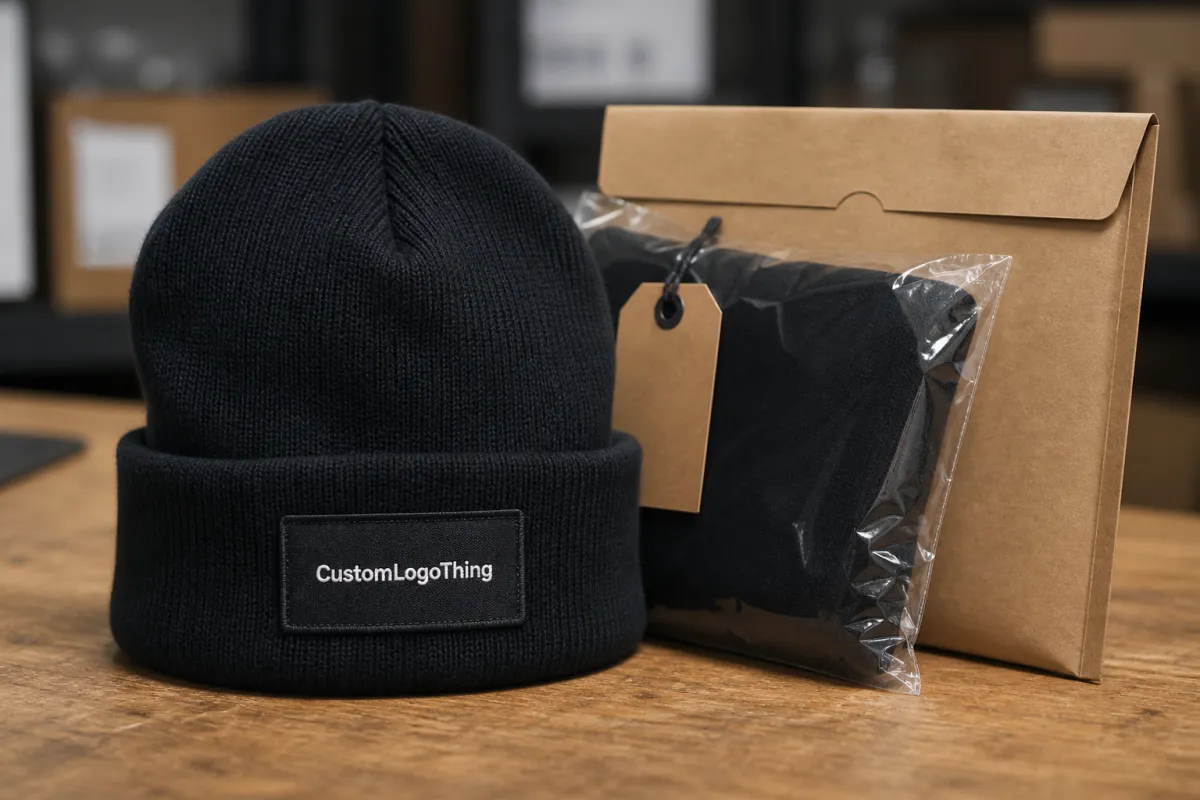
On a beanie, direct embroidery can look excellent if the mark is bold and the stitches have room to breathe. The problem starts when the logo is small, detailed, or built with fine lines. Knit fabric is not a flat canvas. It flexes under the needle, and that movement affects edge sharpness. A patch solves that by creating a controlled surface first, then applying the branding to that surface.
That makes patch beanies useful for uniforms, contractor crews, event staff, school stores, winter campaigns, and gift programs. Bulk orders need more than a nice sample. They need a result that survives repeated handling, packing, and wear without drifting out of alignment. A patch keeps the shape of the logo more predictable from one piece to the next.
Different buyers care about different things, and the best orders usually reflect that. A utility crew may want the simplest sewn patch possible. A retail brand may care more about texture, contrast, and shelf appeal. A client gift may need a more polished finish that reads as premium the moment the box opens. The common denominator is not hype; it is repeatability.
The best beanie order is the one that still looks right after the knit stretches, the carton gets handled, and the wearer has had it on for a full day.
That is why patch beanies keep showing up in procurement lists. They balance readability, cost control, and production stability better than many buyers expect. When the artwork is clean and the blank is chosen carefully, the finished item usually looks more expensive than it is.
Patch styles and beanie builds that change the final look
The patch material sets the tone immediately. Embroidered twill is the most familiar option and remains a strong all-around choice because it balances cost, texture, and durability. Woven patches are better when the logo includes small text or narrow elements that need a flatter, sharper read. Leather and suede push the piece toward premium retail presentation. Felt gives a softer, more casual look. PVC adds depth and a rugged feel that fits outdoor or workwear programs.
Beanie construction matters just as much as patch type. A cuffed beanie usually gives the easiest placement and the flattest front area. A slouch beanie looks more relaxed, but the surface beneath the patch tends to move more. Ribbed knits are common because they stretch well and hold shape reasonably, while a fisherman fit sits shorter and can read more fashion-forward. If the logo has fine type, the safest layout is still a cuffed style with a patch area that does not fight the knit underneath it.
| Patch style | Look and feel | Detail level | Typical use | Ballpark add-on at 1,000 pcs |
|---|---|---|---|---|
| Embroidered twill | Classic, textured, dependable | Good | Uniforms, giveaways, general branding | $0.20-$0.45 |
| Woven | Flat, crisp, logo-focused | Very good | Small text, detailed marks, retail merch | $0.25-$0.55 |
| Leather or suede | Premium, warm, tactile | Moderate | Gift sets, lifestyle brands, higher-end retail | $0.35-$0.75 |
| Felt | Soft, casual, seasonal | Moderate | Winter promotions, relaxed apparel lines | $0.18-$0.40 |
| PVC | Bold, dimensional, rugged | Moderate | Outdoor brands, workwear, heavy-use programs | $0.30-$0.65 |
Attachment changes the outcome too. A fully sewn edge usually gives the best long-term hold and the most reliable wash performance. A heat-applied backing can speed assembly, but it depends on fabric compatibility and temperature control. Some programs use a hybrid finish: light tack placement plus perimeter stitching. That keeps the patch more secure on a knit that will be folded, pulled, and worn hard.
The mistake buyers often make is asking which patch looks nicest in hand. The better question is which one still looks clean after wear, shipping, and storage. That is the difference between a sample that photographs well and a product that survives production.
Specifications that affect fit, durability, and decoration quality
The blank beanie drives a large part of the result. Acrylic remains the most common base because it is affordable, easy to source in volume, and consistent across colors. Wool blends feel warmer and more premium, but they usually cost more and can require more careful handling. Polyester blends can improve stability and snag resistance. A heavier gauge knit generally holds shape better than a loose, lightweight one, particularly after repeated wear.
Fit is not a side note. It changes the visual layout. Cuff height controls where the patch lands. Crown depth affects whether the beanie sits shallow or pulled lower. Stretch matters because too much give can distort the patch outline. Rib structure also matters; some ribs create a cleaner front panel, while others add more movement across the face of the hat.
Patch size needs discipline. Many logos read well on a patch roughly 2.5 to 3.25 inches wide, but the real ceiling depends on the beanie style and the amount of detail in the mark. Keep the patch away from heavy seams and high-stretch transition points. Otherwise the edge can pucker or twist after stitching. A good sample should sit flat without looking forced onto the knit.
Durability is where cost either pays off or leaks away. If the beanies will be worn at work or laundered often, ask about snag resistance, pilling, and whether the decoration can handle repeated wash cycles. If the order is for retail packaging or a gift set, the beanies may never see aggressive laundering, but they still need to survive folding, carton packing, and transit. For shipping-sensitive programs, many buyers think in the same terms they use for packaged goods and look at ISTA handling principles for carton integrity and transit stress.
Size planning matters as well. Adult, youth, and unisex assumptions can change the whole order mix, especially if the beanies will be sold in a store, packed into onboarding kits, or folded into custom printed boxes with other branded packaging elements. A solid spec sheet should state who will wear the beanie, how it will ship, and whether package branding is part of the final presentation.
Cost, MOQ, and unit pricing for custom logo patch beanies bulk order projects
Pricing starts with the blank, then moves to the patch, then to labor, and then to the extras that are easy to miss in the first quote. The main drivers are beanie quality, patch material, patch size, stitch count, logo color count, and finishing details such as woven labels, hangtags, folding, or custom packaging inserts. If retail packaging or a presentation carton is part of the plan, it should be quoted from the beginning.
MOQ is not a fixed number. It changes with the patch style, the beanie color, and whether the blank is stocked or special order. A simple embroidered twill patch on a stocked black acrylic beanie may have a manageable minimum. A leather patch on an uncommon color, with custom printed boxes or retail packaging, may need a larger run to keep the numbers practical.
| Order size | Typical quoted unit price before freight | What usually drives the price |
|---|---|---|
| 100-249 pcs | $6.50-$12.00 | Setup and sampling weigh heavily; best for pilot runs |
| 250-499 pcs | $5.25-$9.00 | Good balance of setup cost and volume |
| 500-999 pcs | $4.25-$7.50 | Common range for teams, events, and dealer programs |
| 1,000-2,499 pcs | $3.50-$6.50 | Setup gets spread out; the per-piece price starts to improve |
| 2,500+ pcs | $3.00-$5.75 | Best value for recurring programs and large seasonal drops |
That table is a working range, not a promise. Woven patches with very tight detail usually cost a little more than embroidered twill. Leather and PVC often sit higher. Wool blend blanks can push the unit price above acrylic before decoration is even added. If a quote does not say what is included, ask for line-item clarity on artwork, sampling, packaging, carton packing, and shipping. That is the easiest way to compare offers fairly.
For a custom logo patch Beanies Bulk Order, the most useful pricing conversation is about tradeoffs. A buyer can lower cost by simplifying the patch shape, choosing a stocked beanie color, and keeping the artwork clean. A buyer can raise perceived value by choosing a better knit, a tighter woven patch, or a presentation method that supports package branding across the wider program.
Process and timeline from artwork to delivery
The workflow is straightforward, but every step depends on the buyer answering quickly. It usually runs like this: logo intake, digital mockup, sample or proof review, production, quality check, packing, and delivery. If the artwork is clean and the beanie color is in stock, proofing can move fast. If the logo needs cleanup or the patch style is still undecided, the schedule stretches.
Most delays come from artwork revisions, patch approval, blank inventory gaps, seasonal demand, and transit distance. A normal proof cycle takes 1 to 3 business days. A physical sample can add 5 to 7 business days, sometimes longer if the patch is complex or the blank has to be sourced first. Production for a standard bulk run often lands around 10 to 20 business days after approval, with freight added on top.
Rush orders are possible, but only if the approvals are fast. That is where buyers often lose time. If a proof sits for three days waiting for internal sign-off, the rush stops being a rush. For a custom Logo Patch Beanies bulk order tied to a launch date, winter event, or onboarding calendar, it helps to get every decision maker aligned before the proof arrives.
Fast schedules depend on fast answers. The production floor can move quickly when the artwork is final, the patch is approved, and the quantity split is clear.
If the beanies will ship alongside branded packaging, gift inserts, or product packaging items, those details belong in the timeline too. Carton labeling, folding style, and bundle counts can add handling time, but they also prevent mistakes when the order reaches the warehouse or event team. For buyers who manage apparel and accessory programs regularly, the right starting point is often our Wholesale Programs page.
How to avoid artwork and production mistakes before you order
The cleanest production files are vector files: AI, EPS, or a properly built PDF. They keep patch edges sharper and make small text easier to judge. If vector art is not available, send the highest-resolution file you have and expect a proofing conversation before anyone starts production. Low-resolution screenshots waste time, and on a knit accessory they can hide problems that only become obvious after the patch is made.
Thin lettering, low-contrast color choices, gradients, and tiny taglines are the most common trouble spots. A logo that looks fine on a monitor can fail once it is translated into thread, twill, leather grain, or molded PVC. The safer move is to simplify. If the main symbol carries the brand, lead with that and keep the secondary text out of the patch unless the letters are large enough to read from arm's length.
Exact references help too. Give the vendor the beanie color, the patch outline, the logo proportions, and any placement note you care about. If the patch should sit centered on the cuff, say so. If it needs to ride a little higher for a slouch fit, say that as well. Good notes reduce back-and-forth and keep the first proof closer to approval.
Before production starts, review a simple checklist:
- Spelling and punctuation in the logo
- Patch shape and edge finish
- Beanie color and knit style
- Quantity split by color or size
- Shipping address and deadline
- Any packaging notes for retail packaging or custom printed boxes
Small fixes before production are cheaper than rework after the run starts. A wrong edge color, a misread spellout, or a patch that sits too low on the cuff can turn a clean order into a corrective project. In packaging and apparel alike, clarity in the proof saves money on the floor.
What to send for a fast quote and a clean reorder
A fast quote starts with a complete request. Send the quantity, beanie style, patch type, color choices, logo file, target delivery date, and destination zip code. If you know whether the order is for retail merch, employee uniforms, or an event giveaway, include that too. The intended use helps the supplier recommend a better blank, a better patch, and the right level of finishing.
For repeat programs, save the approved art, patch measurements, color references, and packing notes. That makes reorders much easier because the next run can match the first one without re-litigating every detail. If the order also includes package branding, hangtags, or branded packaging inserts, keep those specs in the same folder so the whole kit stays consistent from one cycle to the next.
These links are worth keeping handy if you are building a broader program:
- Custom Packaging Products for presentation pieces that travel with the beanies
- FAQ for quick answers on file prep, minimums, and common order questions
- Wholesale Programs for recurring or larger-volume purchasing
If you need paper components for the same campaign, FSC is the reference many buyers use for responsibly sourced paper and board, especially when the project includes hangtags or retail packaging materials. That kind of detail matters in a full package presentation, even when the main item is a beanie.
For a custom logo patch Beanies Bulk Order, the cleanest path is simple: send the specs, review the proof, approve the sample if needed, then lock the schedule. A prepared request gets cleaner pricing, fewer surprises, and a finished beanie that looks planned from the start rather than assembled at the last minute.
Frequently asked questions
What is the usual minimum for a custom patch beanie bulk order?
Minimums usually depend on the patch type, beanie style, and whether the blanks are stocked in the color you want. Higher-complexity patches often need larger runs to keep the unit price practical. Ask for the minimum by decoration method, not just by product category, because the numbers can differ from one patch style to another. For a custom logo patch Beanies Bulk Order, that distinction matters more than most buyers expect.
Which patch type gives the best logo clarity on beanies?
Woven and embroidered twill patches usually handle fine detail better than textured or highly raised options. Leather and PVC can look premium, but they are not always the best choice for tiny text or very thin lines. The best option depends on whether the logo needs crisp detail, a rugged look, or a softer retail feel.
Can I mix colors in one custom beanie patch bulk order?
Yes, many orders can be split across several beanie colors if the factory has those blanks available. Color splits may change the MOQ, setup workflow, or unit price depending on the total quantity per color. Provide the exact color breakdown early so the quote reflects the real production plan.
How do you price large patch beanie orders?
Pricing is usually based on blank cost, patch complexity, decoration labor, and order volume. Larger quantities reduce the unit price because setup and production overhead are spread across more pieces. Ask whether the quote includes artwork, sampling, packaging, and freight so you can compare vendors accurately.
What files speed up a custom beanie patch quote?
A vector file such as AI, EPS, or PDF usually gives the fastest and cleanest proofing result. If vector art is not available, send the highest-resolution file you have along with any brand color references. Include quantity, beanie style, patch type, and deadline in the first message to avoid delays.
A well-planned order is easier to approve, easier to produce, and easier to reorder. Send clear specs, keep the artwork simple, and give the production team enough information to build the first sample correctly; that is how a custom logo patch beanies bulk order stays on budget and arrives looking like the brand intended.

