Bulk cap programs fail for a familiar reason: the buyer shops for the logo, not the wearer. A custom performance golf Caps Bulk Order has a different job. It needs to protect against sun, handle sweat, hold its shape in heat, and still look credible after the event is over. That combination is why the cap usually gets more mileage than a tee shirt or a one-time giveaway. It is visible at address, on the cart, on the range, and often on the drive home.
That extra wear matters because the economics of promo gear are not mysterious. One item worn twenty or thirty times has a better chance of paying for itself than five items tossed into a drawer. The buyer who ignores that tends to end up with a stack of cheap headwear and a weak brand impression. The buyer who starts with durability, fit, and decoration limits usually gets a better result.
The cap also sits in a strange middle ground between apparel and packaging. It is functional first, but presentation still matters. A crisp front panel, clean stitching, and consistent carton counts tell the recipient the program was managed with care. When the order is part of a tournament kit, pro shop display, or sponsor gift, that attention shows.
Why custom performance golf caps bulk order beats generic event swag
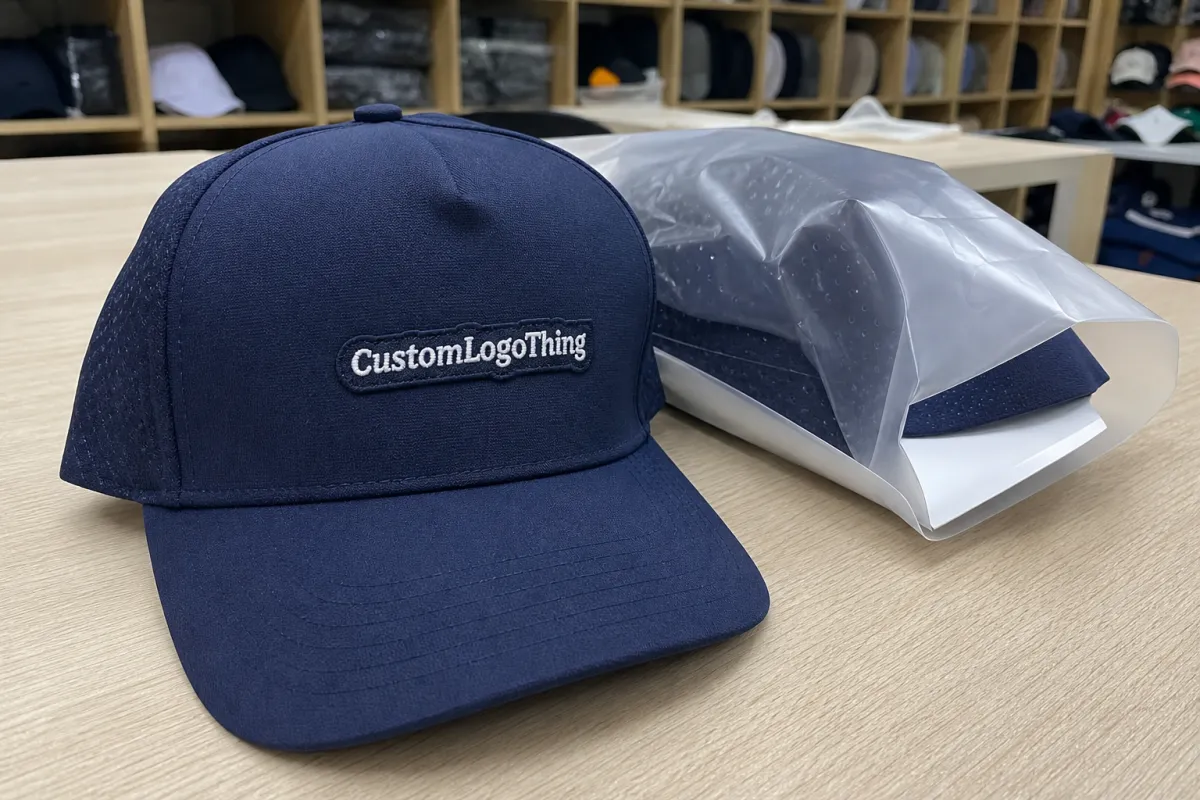
Most generic swag competes for the same problem: it must be cheap enough to hand out, but useful enough to keep. Performance Golf Caps do better than most because golfers actually need them. They are not asking the item to invent a use case. They are asking whether it fits, breathes, and stays comfortable for four or five hours outdoors.
That is a measurable advantage. In many promo programs, the average giveaway has one visible use and then disappears. A cap can show up in practice sessions, travel days, and weekend errands. One unit can generate dozens of impressions. That is why seasoned buyers think in terms of cost per wear, not just unit price.
There is also a weather argument. Polyester blends dry faster than cotton and usually hold shape better when sweat builds up. Mesh backs improve airflow. Moisture-wicking sweatbands help prevent that heavy, damp feeling that makes a cap stay in the closet after the first hot round. If the hat is uncomfortable, the logo has no future.
For sponsors, shops, and event planners, the practical upside is straightforward: a performance cap is a repeatable item with real utility and enough visible surface area for brand recognition. It is more likely to be worn long after the event than a novelty item, and that gives it a wider return window than most promo purchases.
Bottom line: a cap that feels right will be worn; a cap that merely looks right in a mockup often will not.
Performance cap styles, fit profiles, and material choices
Style choice sets the ceiling for comfort and decoration. The most common builds are structured, unstructured, and semi-structured. Structured caps keep the crown firm and give embroidery a stable front panel. Unstructured caps feel softer and more casual. Semi-structured caps sit between the two, which is why they often work for mixed audiences.
Material choice matters just as much. A polyester performance blend is the standard starting point because it dries quickly and resists sagging. A 5-panel or 6-panel build with a lightly padded sweatband is often the best all-around option for tournament use. Mesh-backed caps increase airflow, but they do not suit every brand presentation. A solid front with breathable side or back panels usually strikes the better balance.
Fit profile is where many bulk orders go sideways. The wrong closure can create returns, complaints, or slow-moving retail stock. Common options include:
- Snapback for broad size flexibility and easy distribution.
- Strapback for a cleaner retail look and less visible adjustment hardware.
- Hook-and-loop for fast sizing and tighter budgets.
- Fitted for programs where sizing is controlled and a premium feel matters.
Crown height and bill shape also change the feel of the cap. Low-profile caps sit closer to the head and usually read as more modern. Mid-profile caps give more front-panel space and are easier to decorate cleanly. Pre-curved bills are broadly wearable. Flat bills can work for a younger retail audience, but they are less universal. For a general golf audience, mid-profile and pre-curved still wins most comparisons.
If the cap program is being paired with inserts, sleeves, or a broader presentation system, those decisions should happen early. Cap style, packaging format, and carton configuration need to align or the order starts to feel patched together. That is especially true for retail-facing sets, where the unboxing matters almost as much as the product.
Decoration specs that protect brand accuracy on the course
Decoration is where good intentions often become expensive mistakes. A logo that looks balanced on screen can become crowded, distorted, or unreadable once it is stitched onto performance fabric. The safest methods are the ones that respect both the garment and the artwork.
Flat embroidery remains the most reliable choice for most performance caps. It is durable, clean, and easy to read from a few feet away. 3D puff can look strong on bold, simple marks, but it does not suit small type or fine detail. Woven patches work well when a logo has thin lines or multiple colors that would blur in stitching. Sublimated graphics are more useful for all-over pattern work or fabric panels than for a small front mark.
Placement matters as much as the method. A front-panel mark has the strongest visibility. A side placement can support a sponsor hierarchy without crowding the crown. Back decoration works when the front is already occupied or when the brand wants a quieter look. More locations mean more setup, more stitch time, and more room for error.
A cap quote without artwork rules is not a quote; it is a guess.
That is why proofing deserves more attention than it usually gets. Vector art is best. Pantone references help if color accuracy is part of the brief. Logo width, height, and exact placement should be approved before production begins. Tiny text, thin outlines, and sharp corners often need adjustment because embroidery has physical limits. A strong digitizing step turns an artwork file into something the machine can actually reproduce without losing the mark.
For brand-sensitive programs, ask for a proof that shows the crown angle, logo size in inches, thread colors, and any secondary marks. If the caps will sit beside custom printed boxes or other retail packaging, check that the colors still work together. A cap is a small item, but the brand equation is not small.
Pricing, MOQ, and unit cost drivers buyers should compare
A custom performance golf Caps Bulk Order gets cheaper per unit as volume rises, but quantity is only one part of the price. Decoration method, number of locations, artwork complexity, packaging, and shipping timing all affect the quote. Minimum order quantities often begin around 24 to 50 pieces per style or color, then improve at 100, 250, and 500 units. If you split colors, the total quantity may still qualify for a better tier, but that depends on the factory's setup rules.
For planning purposes, a decorated performance cap often falls into these ranges: about $5.50 to $8.50 per unit at 100 pieces for a simple single-location embroidery run, $4.25 to $6.75 at 250 pieces, and $3.50 to $5.75 at 500 pieces when the artwork is straightforward. Add patch work, 3D puff, or extra placement and the price rises. Blank cap cost is only part of the story; landed decorated cost is the number that matters.
| Program type | Typical MOQ | Typical decorated unit cost | Best fit |
|---|---|---|---|
| Single-location flat embroidery | 24-50+ | $5.50-$8.50 at 100 pcs | Team orders, charity scrambles, straightforward sponsor marks |
| Patch plus embroidery | 48-100+ | $6.50-$10.00 at 100 pcs | Retail-minded pro shops, logos with finer detail |
| 3D puff or multi-location decoration | 100-250+ | $7.00-$12.00 at 100 pcs | Premium launches, bold marks, elevated presentation |
| Rush or mixed-color runs | Varies by style | Usually above standard pricing | Fixed event dates with limited production window |
The quote should always separate blank cap cost, decoration cost, setup charge, shipping estimate, and any artwork cleanup fee. That is where the hidden variance usually lives. A low headline price can become a higher final bill once the buyer adds split shipments, carton labeling, or individual polybags. If the order also needs support materials, our Custom Packaging Products page is a useful reference for the kinds of materials that keep the broader shipment organized.
- Request the price by colorway if the run is split.
- Confirm whether digitizing is included or billed separately.
- Ask if individual polybags or dozen packs change the price.
- Verify whether freight is prepaid, collect, or estimated.
Production steps, timeline, and turnaround checkpoints
A clean order moves through a predictable sequence: quote, artwork review, proof approval, digitizing, pre-production check, bulk production, packing, and shipment. A custom Performance Golf Caps bulk order is manageable when every handoff is documented. It becomes messy when approvals happen by casual email thread and nobody knows which version is final.
- RFQ and quote: quantity, style, logo file, delivery ZIP, and due date.
- Art review: confirm vector format, logo dimensions, and color references.
- Proof approval: lock the placement, thread colors, and decoration method.
- Digitizing: convert the art into stitch data and clean up weak details.
- Sample or pre-production check: verify scale and appearance before the full run.
- Bulk production: run the order, inspect in process, and correct defects early.
- Packing and freight: label cartons, confirm counts, and book transit.
Most delays come from the same sources: missing files, logo changes after approval, color corrections, and slow internal sign-off. For a simple decorated cap, standard turnaround often runs 12 to 18 business days after proof approval. Patch-heavy programs or multi-location decoration can push longer. Rush schedules are possible, but only if the artwork is final and the ship date is realistic before production begins.
Milestone updates matter more than many buyers admit. If procurement, marketing, and event staff all need visibility, ask for checkpoints at proof approval, digitizing completion, production start, packing, and dispatch. That reduces the chance of an order drifting while someone waits on a signature.
Quality control, packing, and delivery details that reduce problems
The best cap programs are checked before they leave the facility. Inspection should cover stitch quality, logo placement, crown shape, bill consistency, sweatband finish, and color variation across the run. A crooked logo on a few units is not a small defect; it is a brand-trust problem. In a decorated product, the standard is closer to product packaging than to plain apparel because the presentation carries part of the value.
Packing choices affect both efficiency and damage risk. Bulk cartons are fine for warehouse programs. Individual polybags help when the caps are being distributed through retail channels or player kits. Dozen packs simplify counting. Labeled case counts reduce sorting errors when an order is split across event sites. For larger shipments, palletizing and carton labels save receiving teams from opening every box to figure out where it belongs.
Shipping resilience is worth thinking about before the run starts. The same logic that applies to cartons and retail packaging applies to cap cartons. The ISTA guidelines are useful when you want shipping expectations to be measurable instead of vague. If the program includes paper hang tags, inserts, or carton sleeves, ask whether FSC-certified stock is available through FSC options. That becomes more relevant when the order includes recycled content claims or other sustainability language.
On receipt, check three things immediately: count, decoration, and damage. Open at least one carton from each style or colorway. Compare the sample against the approved proof. If there is a problem, document it with photos before distribution starts. For multi-destination orders, confirm that the shipping labels match the event site list. A single misrouted carton can become an avoidable sorting problem.
Which buyers benefit most from this cap program
This cap format works for several buyer groups, but the priorities are not the same for each one. Tournament organizers want timing and simple distribution. Pro shops care about presentation and sell-through. Corporate buyers want a logo that feels polished enough to wear outside the event. Charity scrambles need sponsor visibility and a price that still leaves room for fundraising. Resorts need a style that tourists will actually buy and wear again.
The cleanest way to match the program to the buyer is to focus on the use case:
- Sponsors: maximize front-panel visibility and choose a color that reads from a distance.
- Retailers: prioritize fit, finish, and presentation because the cap has to move off the shelf.
- Event planners: focus on lead time, carton counts, and straightforward distribution.
- Employee gear buyers: choose comfort first, then keep decoration clean and low-drama.
Compared with visors, trucker caps, and standard cotton hats, Performance Golf Caps usually offer the best blend of wearability and brand exposure. Visors carry less branding surface. Trucker caps can feel too casual or too warm depending on build quality. Cotton hats are familiar, but they do not always dry fast enough or hold shape well after repeated use. If the goal is a cap that feels like part of the golfer's kit rather than a throwaway giveaway, performance material usually wins.
Retailers understand the same logic. A cap that looks considered belongs in the same conversation as shelf presentation and retail packaging. If it feels generic, it sells like a generic item. If the finish is clean and the fit is believable, the price point has a better chance of holding.
Next steps to launch a quote without slowing approval
The fastest quotes start with a complete brief: quantity by color, preferred cap style, logo file, delivery ZIP, and target date. For a custom performance golf caps bulk order, that first package of information is the difference between a useful estimate and a long back-and-forth. If the closure type, decoration method, or packaging format is already known, include it from the start.
Before final pricing, confirm whether you want flat embroidery, a patch, or another method; whether the cap should be snapback, strapback, hook-and-loop, or fitted; and whether the order needs bulk cartons, individual polybags, or split shipments. If the program is going to several destinations, say so early. Split shipping changes freight, labels, and packing counts, which changes timing and total cost.
For internal approvals, the best workflow is simple: review the mockup, verify the proof, approve production, and lock the ship date. That keeps the order from drifting while someone waits on a signature. If the order is part of a larger purchasing plan, our Wholesale Programs page can help frame bigger-volume buying, and the FAQ covers common proof and shipping questions.
What makes this category worth the effort is not novelty. It is that the cap solves a real use case and keeps carrying the brand long after the first event. That is a better test than a one-day giveaway, and a far more honest one.
What is the minimum custom performance golf caps bulk order you can run?
Minimums usually depend on the cap style, decoration method, and whether colors are mixed. Many decorated programs start around 24 to 50 pieces, but the better pricing tiers usually begin at 100 units and up. Ask for the MOQ by colorway and logo location before artwork approval, because those details can change the break point.
Can I mix cap colors in one performance golf cap order?
Yes, but the pricing may change if each color needs its own setup or if the quantity per color is small. Keep the decoration identical across colors when possible because that reduces extra production steps. The cleanest quote shows the price per color, not just the total order, so you can see whether the split still qualifies for a strong tier.
Which decoration method lasts longest on performance golf caps?
Flat embroidery and well-made woven patches are usually the strongest long-term choices. The best option depends on logo detail, fabric stretch, and how often the cap will be worn in heat or washed. A proof that shows stitch density, logo scale, and placement is the fastest way to judge durability before production starts.
How long does production take after proof approval?
Lead time depends on quantity, decoration complexity, and whether the order needs digitizing or a sample step. For a straightforward run, 12 to 18 business days after proof approval is a common planning window, but patch-heavy or multi-location orders can take longer. If the event date is fixed, confirm rush options and freight timing before you place the order.
What do I need to send for an accurate quote?
Send the cap style, quantity, logo file, preferred decoration, color choices, and delivery location. Include your deadline and whether you need individual packaging, bulk cartons, or mixed sizes. A complete brief reduces revisions, speeds up proofing, and usually leads to a cleaner price. If you want the fastest path, send the quantities by color and the final logo file together.
Final thought: the strongest custom performance golf caps bulk order is not the lowest quote on paper; it is the one that fits the audience, production window, and brand standard without creating avoidable problems.

