Buyer Fit Snapshot
| Best fit | Custom Photo Mailers with Logo projects where brand print, material claims, artwork control, MOQ, and repeat-order consistency need to be specified before quoting. |
|---|---|
| Quote inputs | Share finished size, material target, print colors, finish, packing count, annual reorder estimate, ship-to region, and any compliance wording. |
| Proofing check | Approve dieline scale, logo placement, barcode or warning zones, color tolerance, closure strength, and carton packing before bulk production. |
| Main risk | Vague material claims, crowded artwork, missing packing details, or unclear freight terms can make a low unit price expensive after revisions. |
Fast answer: Custom Photo Mailers with Logo: Film, Print, MOQ, and Carton Packing should be specified like a repeatable production item. The safest quote records material, print method, finish, artwork proof, packing count, and reorder notes in one written spec.
Production checks before approval
Compare the actual filled-product size with the drawing, then confirm tolerance on folds, seals, hang holes, label areas, and retail display edges. Reserve space for logos, QR codes, warning copy, and material claims before decorative graphics fill the panel.
Quote comparison points
Review material grade, print process, finish, sampling route, tooling charges, carton quantity, and freight assumptions side by side. A quote is only useful when the supplier can repeat the same color, closure quality, and packing count on the next order.
Custom photo Mailers with Logo change the feel of a modest shipment the moment it lands on a desk, in a lobby, or on a porch, because the outer package is usually the first thing a customer touches. I have watched brands spend heavily on the product itself, then overlook the package that carries it, and that is a missed opportunity that shows up fast. The right mailer makes the order feel intentional, polished, and worth remembering without adding a lot of weight or complication.
From a packaging buyer's point of view, custom photo mailers with logo sit in a useful middle ground: they are more expressive than plain kraft mailers, lighter and usually less expensive than custom printed boxes, and much more brand-forward than generic shipping materials. If you are building branded packaging for direct-to-consumer orders, sample packs, subscription shipments, or launch kits, the right mailer can do a lot of work without creating extra strain on fulfillment. That balance matters, especially for smaller teams that are already juggling product, inventory, and shipping deadlines.
For brands comparing formats, it helps to look at the broader mix of Custom Packaging Products and decide whether a paperboard mailer, a rigid box, or even Custom Poly Mailers is the better fit for the product, the transit lane, and the customer experience. The strongest choice is usually not the flashiest one; it is the one that balances appearance, structure, price, and timing without creating headaches for the warehouse crew. A package that looks great but slows the line down is gonna cost more than it saves.
What Custom Photo Mailers with Logo Really Are
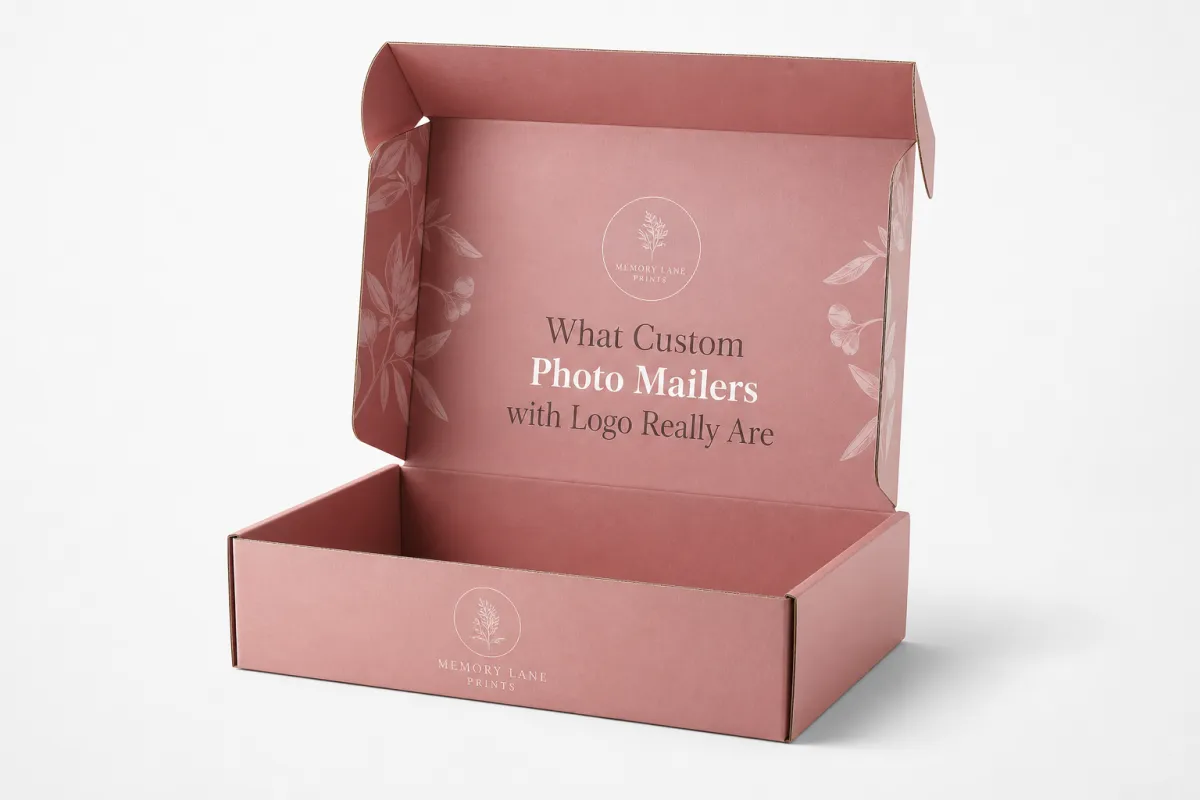
At the simplest level, custom photo mailers with logo are printed folding mailers or paperboard mailers designed with photo-quality graphics, strong logo placement, and brand colors that stay consistent from the first proof to the final shipment. They are often built from paperboard, SBS, or recycled board, then converted into a folding structure that ships flat and assembles quickly. When the art is handled well, the result feels closer to retail packaging than to a basic shipper, even if the structure is still lightweight and economical.
One reason buyers keep coming back to this format is the way it shapes the first physical interaction. A customer opening a gift, a launch sample, or a subscription shipment is not studying the board grade at first glance; they are reacting to the tone, the clarity of the print, and the sense that the brand paid attention. Custom photo mailers with logo help turn that first touchpoint into part of the product story, which is a big deal for categories that depend on presentation.
In business terms, the value is easy to understand. The mailer protects the contents, reinforces recognition while it moves through the carrier network, and helps smaller brands look established without stepping up to a bulky box structure. Good package branding is not just about decoration; it is about making the package feel aligned with the product value, the audience, and the promises the brand has already made. In that sense, custom photo mailers with logo are a practical branding tool, not just a design exercise.
They are especially useful when the shipment does not need the crush resistance of a corrugated shipper, but still needs better presentation than a plain envelope or generic carton. A beauty sampler, apparel accessory, stationery set, or lightweight accessory can all benefit from a mailer that carries strong visual identity. If you think about product packaging as a system, this format often bridges the gap between plain shipping and retail packaging in a tidy, cost-aware way.
I think many brands underestimate the power of the first physical touchpoint. A customer may never remember the exact board construction, but they will notice whether the package looks sharp, whether the folds are clean, and whether the logo reads clearly before the mailer is even opened. Custom photo mailers with logo make that first touchpoint easier to control, and that control matters more than people realize.
Here is the core decision: the mailer should support the product, not fight it. If the item is light, flat, and presentation-sensitive, custom photo mailers with logo can be a smart answer. If the item is heavy or breakable, a different structure may be better. That kind of practical fit is where good packaging design starts.
How Custom Photo Mailers with Logo Work
Most custom photo mailers with logo are built from a flat dieline that is scored, folded, and locked into shape during packout. The structure usually includes a mailer body, side or front flaps, a closure system, and sometimes internal features that help maintain shape in transit. The more thoughtful the structure, the less likely the package is to warp, pop open, or create a sloppy fit around the product.
The print method matters just as much as the structure. Offset printing is often chosen for larger quantities because it handles rich color and detailed imagery very well once the setup is in place. Digital printing can be a strong option for shorter runs, versioned artwork, or fast-turn programs where setup simplicity matters. Flexographic printing can work well for certain board and mailer applications, especially when the artwork is simpler and the run is long enough to justify the process. Each method changes how color is built, how long setup takes, and how consistent the final run will be.
| Print Method | Best Fit | Main Strength | Watch-Out |
|---|---|---|---|
| Digital | Short runs, test launches, frequent artwork changes | Low setup, quick proofing, easier versioning | Can cost more per unit at scale |
| Offset | Medium to large runs with high image quality needs | Strong color control and crisp photo reproduction | Setup work is heavier, so small quantities cost more |
| Flexographic | Long runs with simpler graphics or repeated designs | Efficient on volume and straightforward artwork | Fine detail and tonal richness can be more limited |
Artwork placement is where custom photo mailers with logo either feel premium or feel crowded. Some brands use full-coverage graphics so the entire mailer becomes part of the brand story. Others keep the outside cleaner and use the interior for surprise messaging, pattern work, or a secondary logo hit. Both approaches can work, but the decision should follow the product and the audience, not just the temptation to fill every square inch.
There are also practical variables that change the final result: size, board thickness, seal style, coating, and whether the shipment needs inserts or edge protection. A mailer that looks great on a screen may behave very differently once it is folded, packed, and stacked with other cartons. That is why custom photo mailers with logo should always be reviewed as a physical object, not just a design file.
Color accuracy is especially important in photo-style packaging. Black should stay black, whites should stay clean, and skin tones or product imagery should not drift into muddy or washed-out territory. If your brand relies on recognizable imagery, the mailer becomes part of the visual standard. That is one reason buyers often ask for press proofs or print references before they approve custom photo mailers with logo for a full run.
A mailer that looks expensive but collapses in transit is not premium packaging; it is a liability. Good custom photo mailers with logo have to earn their keep in the warehouse, on the truck, and on the customer's table.
If you want a practical reference point for transit thinking, the testing language used in ISTA procedures is useful even when you are not certifying a package formally. The point is not to over-engineer every mailer; the point is to understand how the structure behaves under vibration, compression, drops, and handling. That mindset keeps custom photo mailers with logo closer to real shipping conditions instead of idealized mockups.
After the structure is set, the package should still be easy to build on the line. A good folding mailer opens cleanly, accepts the product without fighting the operator, and closes without requiring a lot of extra tape or void fill. That is where efficient product packaging and good package branding finally meet.
Custom Photo Mailers with Logo Cost, Pricing, and MOQ
Cost is where a lot of decisions get real very quickly. The Price of Custom photo mailers with logo depends on dimensions, board grade, print coverage, color count, finishing, quantity, inserts, packaging format, and freight from the converter or supplier. The same design can land at very different price points depending on whether it is a simple logo treatment on kraft board or a full-bleed photo job with specialty coating and interior print.
MOQ, or minimum order quantity, is one of the biggest tradeoffs. Smaller runs usually carry a higher unit price because setup, plates, proofing, and changeover effort are spread across fewer pieces. Larger volumes bring the per-piece price down, but they also increase storage needs and tie up cash. For a growing brand, that tradeoff matters more than a headline unit price because packaging that sits in inventory for too long can become a burden instead of an asset.
Here is a useful way to read quotes for custom photo Mailers with Logo: separate the fixed costs from the variable ones. Setup charges, tooling, plate costs, proofing, and any structural design work usually behave like fixed costs. Board, print coverage, finishing, packing, and freight drive the variable side. If a quote looks unusually low, check whether any of those pieces are missing, because the cheapest unit price is not always the real cost.
Directional pricing can help with budgeting, although every project depends on the actual spec. For a straightforward full-color mailer on standard paperboard, many programs land in ranges like these before freight and taxes:
| Order Size | Typical Unit Range | What Usually Drives the Cost |
|---|---|---|
| 500 units | $0.85-$1.60 | Setup is spread over a small quantity |
| 5,000 units | $0.35-$0.95 | Better amortization of print and conversion costs |
| 10,000 units | $0.28-$0.55 | Volume helps, but artwork and finishing still matter |
Those numbers are not universal, and they should never replace an actual quote, but they do show the pattern: quantity lowers unit cost, while complexity pushes it back up. A higher-end finish such as soft-touch lamination, aqueous coating, matte varnish, or foil accent can move custom photo mailers with logo into a more premium price band. The same is true for heavier board, richer graphics, or dual-sided printing.
When premium options are worth it, I usually look at the value of the shipment. If the mailer is carrying an influencer kit, a launch sample, or a high-margin product, a little more spend on print quality and coating can be justified because the package itself is doing marketing work. If the item is low-margin and high-volume, a simpler structure may protect profitability better. That is where smart packaging design pays off.
A practical budgeting rule helps: match packaging spend to the value of the shipment, the expected reorder frequency, and how much brand lift the mailer is expected to create. A brand with frequent repeats may want a lower unit cost and more predictable supply. A campaign-driven brand may accept a higher unit cost if the presentation supports the launch. Either way, custom photo mailers with logo should be budgeted as part of the customer experience, not treated as an afterthought.
If you are comparing formats, the question is not always whether the mailer is cheapest. Sometimes the better question is whether a paperboard mailer, a rigid carton, or Custom Poly Mailers gives the best total fit for protection, appearance, and fulfillment speed. The answer changes by product category, but the discipline is the same: compare full landed cost, not just the print quote.
Production Steps, Timeline, and Lead Time
The production path for custom photo mailers with logo usually starts with a brief, a size target, and a dieline. From there, the artwork is built or adjusted, proofed, and checked for bleed, safe zones, fold locations, and closure alignment. Once the art is approved, the order moves into printing, finishing, converting, packing, and shipment. That sounds straightforward, but a lot of the hidden delay comes from small revisions that stack up one after another.
Artwork approval is one of the most common bottlenecks. If the files arrive without bleed, if the logo is in the wrong format, or if the color profile is not suited to print, the job slows down before it even reaches the press. The same is true when structural changes are requested late. A small shift in size can affect the dieline, the fit, the box count, and sometimes the production tooling. Custom photo mailers with logo reward clear decisions early.
In many packaging programs, a simple digital job can move faster than a complex offset run. A realistic planning frame for a standard order is often 7-10 business days after proof approval for straightforward short runs, and 12-18 business days or more when the job includes larger volumes, specialty finishes, or structural changes. If the order needs more than one proof round, or if shipping mode is less direct, the calendar expands quickly. That is normal, not a failure.
The material and finishing choice also affects lead time. Aqueous coating, spot varnish, foil, soft-touch lamination, and custom inserts all add process steps. Even if the print itself is fast, the finishing line may become the pacing item. With custom photo mailers with logo, it is wise to assume the calendar is only as good as the longest step in the chain.
The best scheduling habit is to build buffer time for proofing, sample approval, and receiving inventory so packaging never becomes the bottleneck for launch. If product arrives late and the mailers arrive on time, that is a warehouse problem. If the mailers arrive late, the launch stalls for reasons that are easy to avoid. Good packaging planning keeps custom photo mailers with logo aligned with product arrival, campaign approvals, and storage space.
Operationally, this matters because the mailer should fit into the fulfillment flow without slowing down the team. A package that assembles in a single motion, closes reliably, and stacks neatly is far easier to manage than one that requires hand correction. The shipping lane, not just the design review, should be part of the decision.
For brands that care about test discipline, it helps to think in terms of ship-ready performance rather than just visual approval. You do not need to overcomplicate the process, but it is smart to confirm that the mailer can survive the normal handling path, especially if the shipment will move through parcel networks or frequent sortation events. That is where custom photo mailers with logo need to earn confidence, not just compliments.
Key Factors That Change the Final Result
Material choice is one of the biggest levers in the final look and feel of custom photo mailers with logo. SBS board tends to give a bright, clean print surface with good image sharpness. Kraft board brings a warmer, more natural look that can support sustainability messaging and a less polished aesthetic. Recycled board can work very well if the print strategy is adjusted for the surface. Corrugated options add more strength, but they also change the feel in hand and usually make the structure bulkier.
For photo-style packaging, the board surface matters a great deal because image detail, skin tones, brand blacks, and white space all respond to the substrate. A smoother board usually prints cleaner. A more textured board can look charming, but it may soften fine detail. That is not a defect; it is just how the material behaves. Custom photo mailers with logo are strongest when the creative team understands the material, not when they fight it.
Structural performance is another major factor. A good mailer should have edge strength, fold memory, and a closure that stays reliable under handling. If the product is even slightly heavy, the board caliper and geometry matter more than most buyers realize. A light cosmetic set can ride well in a slim mailer, while a denser accessory may need thicker board or extra support. In other words, the best custom photo mailers with logo are chosen for the product, not for a trend.
Brand fit is where a lot of packaging design decisions succeed or fail. The package should match the product category, the price point, and the audience expectation. A luxury or premium feel may call for softer finishes, tighter image control, and a more restrained graphic layout. A youth-focused or promotional shipment may benefit from bolder color and more energetic visual movement. The wrong style can make the product feel mispriced, which is why package branding has such a direct commercial effect.
Sustainability claims deserve careful handling too. If recycled content, FSC certification, or responsible sourcing matters to the brand, ask specifically about board source and chain-of-custody. You can review FSC information at FSC, which is useful when buyers need a credible reference point for paper sourcing. A clean sustainability story is strongest when the board, inks, and coatings are selected with the end-of-life path in mind, not just the marketing line.
Logistics can quietly change the success of the project. A beautiful mailer that takes too much warehouse space is a problem. A package that slows down packout is a problem. A format that pushes the shipment beyond a preferred postal size band is a problem. These are unglamorous details, but they matter. The best custom photo mailers with logo protect profitability as well as the product.
For heavier transit lanes, it can also be useful to compare the package against testing principles tied to compression, vibration, and drop behavior. Even if you are not running formal certification, the logic behind ASTM-style and ISTA-style thinking helps keep the package honest. That is especially true when you are deciding whether a mailer is enough or whether a stronger shipper is the safer choice.
Good branded packaging is rarely about one dramatic feature. It is usually a balance of board, print, closure, and handling efficiency. When those pieces line up, custom photo mailers with logo feel natural, not forced.
Common Mistakes Brands Make With Photo Mailers
The first mistake is approving a mockup without checking how the artwork will actually behave on the finished board. Fold lines, seams, texture, and edge wraps can all change the look. A logo that sits beautifully in a digital rendering may land across a score line in production, which can make the final package feel off by a surprising amount. Custom photo mailers with logo should always be reviewed in a layout that reflects the real dieline.
The second mistake is ignoring safe zones, bleed, and internal messaging space. These are not minor technicalities. They prevent missing art, cropping issues, and awkward text placement. If the barcode, shipping zone, or required regulatory copy is planned late, the artwork can become crowded and the overall package loses balance. A strong production file respects the printing process before it ever reaches the press.
The third mistake is choosing a finish because it looks nice on screen, then discovering it scuffs easily, reflects badly in photos, or resists folding too much. That happens with glossy surfaces, some soft-touch options, and certain heavy coatings if they are not matched to the use case. A finish should support the package, not create a maintenance issue for the packing team. That is especially true for custom photo mailers with logo that will travel through multiple handling points.
The fourth mistake is picking the wrong size. A mailer that is too tight can crush corners or wrinkle the product. A mailer that is too loose can let the contents move around and may require filler or extra protection. Either way, the process slows down. Good sizing makes the shipment easier to build and easier to trust. Bad sizing turns a tidy design into a fulfillment headache.
The fifth mistake is thinking only about the first order and not about the next one. Storage, reorder planning, color consistency, and production repeatability matter a lot once the program starts running. If the first batch is approved from a rushed file and the second batch is not perfectly matched, the brand experience drifts. Custom photo mailers with logo work best when they are treated like a repeatable operating asset, not a one-off marketing item.
Another mistake shows up in the comparison stage. Some buyers focus so hard on the visual mockup that they overlook whether the package is the right format at all. In some cases, custom printed boxes may be the better fit. In others, a lighter mailer or even Custom Poly Mailers may handle the product and the shipping lane more efficiently. The right answer depends on the product packaging problem you are actually trying to solve.
Here is a practical rule: if the packaging will be handled by a warehouse team every day, then assembly speed and stackability deserve as much attention as graphics. If the packaging is customer-facing and gift-like, then image quality and tactile finish deserve more attention. Custom photo mailers with logo can succeed in both settings, but only if the operational realities stay in the conversation.
The smartest packaging buyers are usually not the ones who ask for the flashiest mockup; they are the ones who ask how the mailer behaves after the proof is approved.
Expert Tips and Next Steps for a Better Order
Start with a one-page spec sheet before you request quotes. Include the product size, product weight, finish preference, logo placement, expected quantity, and target ship date. That one page saves time, reduces back-and-forth, and makes custom photo mailers with logo easier to price accurately. It also helps suppliers compare apples to apples, which is where most quote confusion starts.
Ask for both a blank sample and a printed proof if the project matters. A blank sample tells you about fit, board feel, closure behavior, and stackability. A printed proof tells you how the artwork lands, how the brand colors behave, and whether the visual balance holds up under real lighting. In my experience, the best approval process uses both because each one catches a different kind of problem.
Request at least two quantity options so you can compare unit cost, storage impact, and overbuy risk. A 1,000-unit quote may look higher on paper, but if it matches the launch reality better than a 5,000-unit buy, the smaller order can actually be smarter. That is one of the reasons custom photo mailers with logo should be reviewed with finance, operations, and marketing in the same conversation.
Coordinate packaging timing with the product launch calendar, approval windows, and inbound inventory. If the product arrives after the packaging, storage space becomes the issue. If the packaging arrives after the product, the shipment schedule becomes the issue. Either way, the program slows down for preventable reasons. A clean timeline keeps custom photo mailers with logo ready when the orders are ready.
Look at the package as part of the full customer journey. For ecommerce, that means the mailer has to survive shipping, open cleanly, and reflect the brand promise the moment the customer touches it. For retail packaging or PR use, it has to look deliberate enough to justify the extra attention. That is where good branded packaging pays back.
If you are comparing options right now, gather your artwork, check your target dimensions, and review your current packaging against the product value and shipment type. Then compare suppliers on material, print method, lead time, and freight instead of chasing the lowest line item. The most effective custom photo mailers with logo are the ones that make the product easier to ship, easier to remember, and easier to reorder.
Handled well, custom photo mailers with logo protect the contents, sharpen the unboxing moment, and keep the brand presentation consistent from warehouse shelf to customer hands. That combination is why they remain such a practical choice for growing brands that want polished packaging without stepping into unnecessary complexity. The next move is simple: lock the product dimensions, choose the print method that fits the run, and approve only after the blank sample and proof both make sense together.
FAQ
What are custom photo mailers with logo best used for?
They work best for ecommerce shipments, sample packs, subscription kits, and promotional mailings where presentation matters as much as protection. They are a strong fit when you want a lightweight package that still looks branded and polished on arrival. They are especially useful for launches, influencer outreach, and seasonal campaigns that need a memorable first impression.
How much do custom photo mailers with logo usually cost?
Pricing depends on size, board thickness, print coverage, finish, quantity, and freight, so the unit cost can vary widely. Smaller orders usually cost more per piece because setup and proofing are spread over fewer mailers. The most useful comparison is a full quote that includes production, tooling, and shipping, not just the headline unit price.
What artwork files are best for custom photo mailers with logo?
Vector files are ideal for logos because they stay crisp at any size, while high-resolution raster files are better for photo-heavy layouts. Ask for the supplier's dieline and build artwork with bleed, safe zones, and fold areas in mind. Before approving, confirm color mode and any file naming or proofing requirements so production starts cleanly.
How long does it take to produce custom photo mailers with logo?
Lead time depends on quantity, print method, finishing, and how quickly artwork and proofs are approved. Simple jobs move faster, while custom sizes, special coatings, or detailed color matching usually add time. Build extra time into the schedule for revisions and receiving so the mailers arrive before the launch or shipment date.
What should I ask before approving custom photo mailers with logo?
Ask for the exact material, print method, finish, and closure style so you know what is being produced. Confirm MOQ, unit cost at different volumes, and any added charges for samples, tooling, or freight. Request a production timeline and proof review process so there are no surprises once the order is underway.

