Buyer Fit Snapshot
| Best fit | Custom Plastic Envelopes for Apparel projects where brand print, material claims, artwork control, MOQ, and repeat-order consistency need to be specified before quoting. |
|---|---|
| Quote inputs | Share finished size, material target, print colors, finish, packing count, annual reorder estimate, ship-to region, and any compliance wording. |
| Proofing check | Approve dieline scale, logo placement, barcode or warning zones, color tolerance, closure strength, and carton packing before bulk production. |
| Main risk | Vague material claims, crowded artwork, missing packing details, or unclear freight terms can make a low unit price expensive after revisions. |
Fast answer: Custom Plastic Envelopes for Apparel: Material, Print, Proofing, and Reorder Risk should be specified like a repeatable production item. The safest quote records material, print method, finish, artwork proof, packing count, and reorder notes in one written spec.
Production checks before approval
Compare the actual filled-product size with the drawing, then confirm tolerance on folds, seals, hang holes, label areas, and retail display edges. Reserve space for logos, QR codes, warning copy, and material claims before decorative graphics fill the panel.
Quote comparison points
Review material grade, print process, finish, sampling route, tooling charges, carton quantity, and freight assumptions side by side. A quote is only useful when the supplier can repeat the same color, closure quality, and packing count on the next order.
Custom Plastic Envelopes for apparel sit at a useful intersection: they protect the garment, move quickly through fulfillment, and carry the first branded impression a customer sees after checkout. That first touch matters. A mailer that feels tidy and intentional can make a basic tee feel considered; a flimsy one can make a premium piece feel a little cheap, even before the customer opens it.
That is why Custom Plastic Envelopes for apparel show up so often in e-commerce and retail logistics. They keep weight low, resist dust and light moisture, and offer a printable surface without the bulk of a carton. For brands comparing formats, the smartest way to think about packaging is as a system, not a single item. A coordinated set of Custom Packaging Products can support product packaging, retail packaging, and package branding without turning the pack-out line into a mess.
Teams use Custom Plastic Envelopes for apparel for tees, leggings, loungewear, intimates, socks, and folded accessories. The format looks simple from the outside, but the details decide whether it performs well. Film thickness, seal strength, print coverage, and bag dimensions all shape how the package survives the trip from warehouse to doorstep. Get those variables right and the envelope does its job quietly. Miss them, and the savings vanish into returns, damage claims, and slower packing.
I've watched fulfillment teams spend more time fixing packaging problems than actually packing orders. Usually the issue is not dramatic. It is a bag that is 20 mm too narrow, an adhesive strip that gives up in a warm trailer, or artwork that looked fine on screen but disappeared on film. Small things. Big consequences.
"A good mailer disappears into the workflow until the day it does not. That is when the specification becomes the story."
What Are Custom Plastic Envelopes for Apparel?
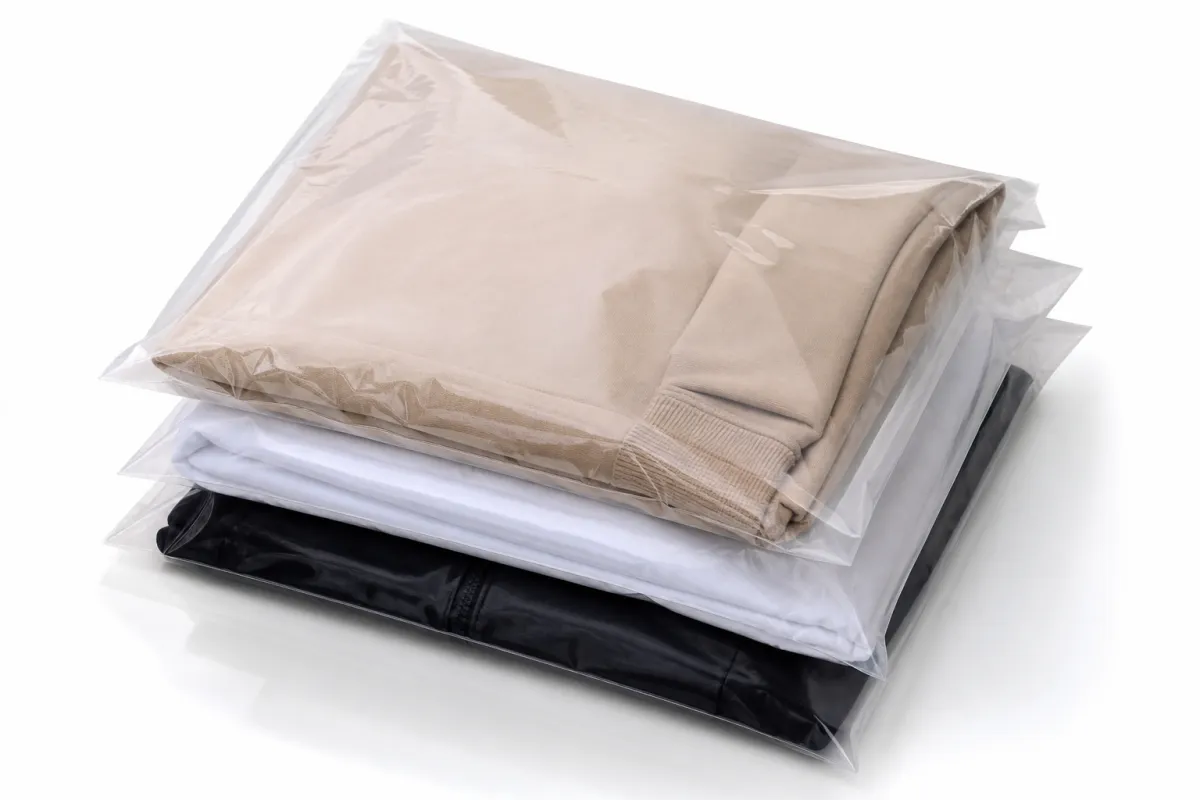
Custom plastic envelopes for apparel are lightweight protective mailers designed to ship clothing and folded soft goods while carrying brand graphics on the outside. Most people call them poly mailers, though that label hides a lot of variation. Some are simple single-layer bags. Others use co-extruded film with separate layers for print quality, toughness, and closure reliability.
That construction solves a practical problem. Garments compress easily, do not usually need rigid walls, and still need protection from grime and light moisture. A box can be overkill for a tee or a pair of leggings. A well-chosen envelope reduces shipping weight, uses less material, and often lowers freight costs. It also gives the customer a cleaner first impression than a plain shipping bag, which matters more than some teams want to admit.
From a buying standpoint, custom plastic envelopes for apparel are attractive because they fit standard folding routines and speed up insertion. A folded shirt that lands around 10 by 12 inches, for instance, moves through a properly sized mailer far faster than it does through an oversized carton. That difference shows up in labor reports. So does the reduction in dimensional weight. Across thousands of orders, a few ounces per parcel can become real money.
They also fit different brand positions. A value-focused basics label may choose a simple printed mailer with a one-color logo. A premium activewear brand may specify a matte finish, opaque film, and a stronger adhesive strip for a more refined feel. Either way, custom plastic envelopes for apparel become part of the brand language, not just a shipping consumable. Good packaging should stay recognizable, stay consistent, and stay out of the way until the customer opens it.
There is another reason they remain common: they work well in transit. Parcels move through sortation centers, delivery trucks, mailrooms, and apartment lobbies. A light envelope keeps the package compact through every handoff. It will not protect a structured blazer the way a box might, but for tees, joggers, intimates, and accessories, custom plastic envelopes for apparel often deliver the best balance of cost, protection, and presentation.
How Custom Plastic Envelopes for Apparel Work
The basic layout of custom plastic envelopes for apparel is straightforward, but the structure still matters. A typical mailer includes the film body, a seal area, a closure strip or adhesive flap, and a printed outer surface. Some versions add a tear strip, a tamper-evident seal, or a second adhesive strip for returns. Those details may seem minor on paper. In a warehouse, they change packing speed, seal reliability, and the way the customer reads the package.
The shipping flow is simple enough to describe. The garment is folded, checked, inserted, and sealed. Then a label is applied or printed, and the parcel moves into the sortation stream. Fit changes the whole experience. If the envelope is too small, the packer fights the item, the seal line takes a beating, and the finished parcel looks compressed or wrinkled. If it is too large, the contents shift in transit and the package loses the tidy appearance customers expect from custom plastic envelopes for apparel.
Compared with paper envelopes, plastic mailers often offer stronger moisture resistance and better puncture resistance at lower weight. Compared with boxes, they usually take less storage room and pack faster. Paper can make sense in sustainability programs, especially when a brand wants fiber-based curbside recyclability and ships products with a controlled shape. Even then, paper often gives up stretch, weather resistance, and cost efficiency. For many apparel shipments, custom plastic envelopes for apparel still win the tradeoff.
That tradeoff shows up in real shipping conditions. A box handles crush better than a bag. A paper envelope can feel more tactile and may fit some recycling narratives more naturally. A plastic mailer usually wins on cube efficiency and speed at the pack station. The right choice depends on the garment mix, the damage tolerance, and the route the parcel follows. That is why closure method matters so much. Weak adhesive can fail in hot trailers or after repeated handling. A stronger closure, matched to film thickness, makes custom plastic envelopes for apparel more dependable.
Industry groups and transit-testing bodies are useful references when teams want to move beyond guesswork. Resources from packaging.org and the guidance at ISTA help frame material selection, handling, and distribution testing. They will not choose the mailer for you, but they do show why transit performance should be measured instead of assumed.
How do custom plastic envelopes for apparel improve shipping efficiency?
Custom plastic envelopes for apparel improve shipping efficiency by reducing package weight, simplifying packing, and shrinking the amount of empty space that travels through the warehouse and carrier network. That matters because apparel parcels are judged on speed and cost at the same time. A bag that closes quickly, fits the SKU cleanly, and stacks well in a tote can save seconds per order. Across thousands of shipments, seconds become labor savings. That is not hype. It is arithmetic.
The effect is bigger than it looks. A compact envelope helps reduce dimensional weight, which can lower freight charges when the shipment would otherwise bill at a larger size. It also reduces the chance that a folded garment moves around inside the parcel and arrives with a tired, misshapen look. In other words, custom plastic envelopes for apparel are not just a format choice. They are a workflow choice.
There is also an operational side that brands often miss. Faster inserts, fewer box build steps, and simpler sealing all help the fulfillment line stay predictable. That predictability is valuable during peak demand, when the difference between a smooth flow and a clogged packing station shows up in missed cutoffs and overtime. For apparel brands shipping at scale, custom plastic envelopes for apparel can make the entire pack-out process feel lighter and more controlled.
On one project I reviewed, a team shaved only four seconds from each pack after switching to a better-sized mailer. Four seconds does not sound like much. Multiply it across 12,000 weekly orders and the picture changes fast. That is the sort of change operations people notice, even if marketing never sees it.
Key Factors That Affect Fit, Protection, and Branding
Fit is the first decision point for custom plastic envelopes for apparel. The envelope has to match garment volume, folding style, and whether the order ships as a single item or a bundled set. A slim tee needs different clearance than a sweatshirt or a two-piece outfit. Many teams get this wrong because they think in flat dimensions alone. Folded thickness is what stresses the closure and determines whether the package looks crisp or overstuffed.
Material choice comes next. LDPE is common because it is flexible, cost-effective, and familiar in mailer production. Co-extruded films can improve strength and print performance by separating the layers for toughness, opacity, and graphic quality. Recycled content can support a sustainability claim, but the claim needs proof. The blend has to match supplier documentation. That is especially true for custom plastic envelopes for apparel that carry visible eco language on the package itself.
Printing choices matter more than many brand teams expect. A glossy film can make colors feel brighter, while a matte finish often reads as more restrained and premium. An opaque or white base gives stronger logo contrast. Transparent or semi-transparent areas can reveal garment color, which may fit some brand systems and clash with others. A good packaging design also decides where the logo sits, whether sizing notes belong on the front, and whether a QR code should live on the flap or the back panel. For package branding, too much information usually creates more friction than value.
The envelope also has to fit the way the warehouse works. If the pack station uses one motion to fold, insert, and seal, the adhesive strip has to open cleanly and close on the first try. If the SKU mix includes returns, a second adhesive strip can save time during repacking. The extra few cents are often justified by lower labor cost and fewer customer service issues. That is one reason custom plastic envelopes for apparel are often specified with return-use features for online apparel programs.
Durability matters just as much as graphics. Puncture resistance, seal strength, and weather tolerance should match the route the parcel actually travels. A package that looks fine on a desk can behave very differently in a summer trailer or a cold hub. ASTM D882 is commonly referenced for tensile properties in plastic films, while ASTM D1709 is often used in impact and dart testing discussions. Those standards do not replace real-world pack tests, but they give buyers a better way to compare custom plastic envelopes for apparel.
Sustainability deserves the same level of discipline. The EPA's guidance on plastics and recycling is a reminder that not every format is curbside recyclable everywhere, and local infrastructure varies a lot. If a brand wants to make a recycling claim, the claim needs to be specific and accurate. A clear statement earns more trust than a broad promise that cannot be verified. In that sense, custom plastic envelopes for apparel should support the brand story, not stretch it past the facts.
Visual consistency matters too. A garment that leaves in a branded mailer should arrive looking deliberate. That influences brand equity, repeat orders, and the kind of social sharing that sells without a media buy. The envelope does not need to shout. It does need to feel cohesive. A strong logo, a sensible color palette, and a clear closure zone usually do more for package branding than trying to turn the mailer into a billboard.
Cost and Pricing: What Drives the Per-Unit Price
Pricing for custom plastic envelopes for apparel looks simple at first glance, but the actual cost comes from several variables. Material thickness is a major one. A thinner film may cost less, but it can also increase puncture risk or make the bag feel cheap. Size matters too. A larger envelope uses more resin and usually costs more to print and ship. Add features like perforation, tear strips, dual adhesive strips, or Custom Die Cuts, and the unit price rises again.
Order quantity changes the math sharply. At smaller volumes, setup and tooling are spread across fewer pieces, so the unit price climbs. At larger volumes, the per-unit price drops, sometimes dramatically. That is why custom plastic envelopes for apparel can look inexpensive in a quote and still be expensive in practice if the run is too small or the spec is heavier than the application needs. Buyers should compare landed cost, not just factory price.
Here is a realistic way to think about it. A basic one-color mailer in a standard size might land in the range of $0.18 to $0.32 per unit at 5,000 pieces, depending on thickness, print coverage, and closure style. At 10,000 pieces, that same spec may move closer to $0.12 to $0.24 per unit. Heavier films, custom dimensions, and multi-color graphics can push the number higher. With custom plastic envelopes for apparel, the cheapest quote rarely tells the whole story.
| Option | Typical Unit Price | Best For | Watchouts |
|---|---|---|---|
| Standard LDPE mailer, one-color print | $0.12-$0.24 at larger runs | Basic apparel shipments, high-volume basics | Limited finish options, simpler branding |
| Co-ex film with matte finish and stronger adhesive | $0.18-$0.32 | Mid-tier branded packaging programs | Higher material cost, longer proofing |
| Recycled-content mailer with custom print and return strip | $0.22-$0.42 | Retail packaging and premium e-commerce | Documentation and sample approval matter more |
| Specialty oversized or multi-feature mailer | $0.30-$0.55+ | Bundles, sets, or controlled presentation needs | Can affect packing speed and freight |
There are hidden costs as well, and these are the ones that often catch teams off guard. Freight can be significant, especially if the bags are bulky or the supplier ships in small lots. Storage space matters because flat-packed mailers still consume warehouse volume. Artwork setup and plate or cylinder charges can add up if the design changes often. Sample revisions cost time, and rush production usually comes with a premium. For custom plastic envelopes for apparel, the landed cost depends as much on process discipline as on resin price.
The other side of the ledger matters just as much. If the right mailer cuts damage, reduces re-ships, and speeds packing by even a few seconds per order, the return can be real. That is especially true for brands shipping thousands of units each week. A half-cent difference in material price does not matter much if the cheaper option slows the line or increases returns. For that reason, custom plastic envelopes for apparel should be treated as an operations tool, not merely a commodity bag.
If your team is comparing options, ask for a quote that separates unit price, freight, setup, and sample charges. Then compare that against the packaging format you use now. A plain poly mailer, a printed bag, and a carton behave differently on the fulfillment line. The best choice may not be the cheapest on paper; it may simply be the one that keeps product packaging predictable and labor efficient.
Process and Timeline: From Spec Sheet to Shipment
The cleanest way to source custom plastic envelopes for apparel is to treat the project like a spec-led job. Start with garment dimensions and folding style. Define the closure type, film thickness, print area, and order volume. Once those pieces are set, artwork can be prepared with the correct bleed, color counts, and placement rules. That sounds obvious, yet many delays happen because the spec is still changing after design work begins.
A typical sequence runs like this: define the size, confirm the material, submit the artwork, review the proof, approve a sample, then move into production. Each step depends on the one before it. If the proof changes late, or if the sample exposes a fit issue, the schedule stretches. For custom plastic envelopes for apparel, that can be the difference between launching on time and missing a seasonal drop.
Timing varies with complexity. Simple runs with finalized specs and one proof cycle may move through design, approval, and manufacturing in roughly 12 to 20 business days before shipping transit is added. More complex jobs, especially those with custom dimensions, multi-color print, recycled-content documentation, or multiple revision rounds, can take longer. That is manageable when the brand plans ahead. It becomes a problem only when the order starts too close to a product launch or promotional push.
Most delays come from a few predictable sources. Artwork changes after proof approval are a common one. Unclear measurements are another, especially when teams provide flat dimensions but leave folded thickness out of the spec. Sample revisions also slow projects down, particularly when the design team and operations team disagree on what counts as acceptable finish quality. For custom plastic envelopes for apparel, the fastest projects usually begin with a complete spec sheet.
One practical way to shorten lead time is to build an internal packaging brief that lists SKU dimensions, target print area, closure preference, storage constraints, and expected monthly volume. Keep it compact, but complete. If your team also ships some items in Custom Packaging Products beyond mailers, use the same brief structure there too. Consistent documentation makes it easier to compare product packaging options across garments, accessories, and seasonal bundles.
It also helps to align the packaging calendar with sales forecasts. Apparel demand spikes around launches, promotions, and seasonal resets. If the mailer order starts after the spike is already visible, lead time turns into a bottleneck. Brands that handle custom plastic envelopes for apparel well usually plan one or two cycles ahead, not one or two weeks ahead. That is not glamorous advice, but it is the practical kind that keeps a warehouse from getting squeezed.
From a quality-control standpoint, the sample is not a formality. It is the cheapest place to catch mistakes. Check seal hold, print clarity, scuff resistance, fold fit, and how the envelope feels after packing. Then run a small transit test with actual garments. If the mailer passes that test, you have a better chance of avoiding returns and damaged goods later. Many teams borrow ISTA-style thinking here even if they do not run a formal lab protocol on every project.
Common Mistakes That Hurt Product Protection and Margins
The first mistake is choosing the wrong size. Custom plastic envelopes for apparel that are too tight create problems immediately. Garments wrinkle more, the adhesive strip takes a beating, and packers lose time forcing the item into place. Too much extra space is a problem too, because the item shifts and the finished parcel looks loose or sloppy. Fit is not just an aesthetic issue; it affects labor and damage rates.
The second mistake is chasing the lowest quote without asking what the film can actually do. A thin bag may look cheap, but if it tears more often or fails in transit, the real cost rises through returns and re-ships. That matters even more for e-commerce apparel, where expectations are high and every damaged parcel creates service work. In that sense, custom plastic envelopes for apparel should be judged on performance and price together.
Branding mistakes show up often as well. A design can look strong on a screen and still fail on plastic because the contrast is too weak or the layout is too busy. Small logos disappear. Light text on translucent film can become hard to read. QR codes placed too close to folds may not scan well. Good package branding keeps the design simple enough to print cleanly and clear enough to read at arm's length.
Process mistakes can cost even more. Some brands skip sample testing because they assume the proof is enough. Others ignore storage conditions and forget that film behaves differently in hot, humid, or tightly packed warehouse environments. Another frequent issue is failing to align packaging specs with the fulfillment workflow. A mailer that looks fine in a creative mockup may slow down a two-person packing line if the closure is awkward or the garment fit is inconsistent. For custom plastic envelopes for apparel, the pack station belongs in the spec.
Sustainability mistakes deserve a mention too. Brands sometimes make broad eco claims because a mailer contains recycled content or uses less material than a box. That may be directionally true, but it is not the same as a verified environmental claim. If the company wants to talk about recycled content, curbside recyclability, or reduced material use, it should be precise and document the claim. A trustworthy sustainability story usually performs better than a vague one, especially in branded packaging.
Customer experience closes the loop. A parcel that arrives with scuffed print, a weak seal, or a sloppy fold can make the brand feel less careful than it really is. That perception sticks. For many apparel buyers, packaging is a proxy for how the company handles the product itself. Custom plastic envelopes for apparel are not a cure-all, but they can support a clean, disciplined presentation when the spec is right.
Expert Tips and Next Steps for Apparel Brands
My first recommendation is practical: test the mailer with the garments you ship most often. Not one polished sample. Real product. Fold a tee, a legging set, and your bulkiest lightweight SKU, then see how custom plastic envelopes for apparel behave under actual pack-out pressure. One afternoon of hands-on testing will tell you more than three rounds of generic mockups.
Build a one-page packaging spec sheet and keep it current. Include dimensions, film thickness, finish, closure type, print file notes, and target order volume. Add the SKU list that will use the mailer. Add storage constraints if your warehouse is tight. That small amount of structure makes supplier conversations faster and helps you compare custom plastic envelopes for apparel against alternatives like paper mailers, poly bags, and Custom Printed Boxes.
Always request samples and inspect them under ordinary warehouse conditions, not only on a clean table. Try the closure with gloved hands if the team uses gloves. Check whether the adhesive holds after the envelope is opened once. Look at print clarity under bright light and lower light. Then ask a blunt question: would this package still feel intentional after a rough transit lane? If the answer is shaky, the spec is not ready.
Comparing total landed cost helps too. Include freight, sample charges, setup fees, and any extra storage or handling cost. A supplier with a lower sticker price but higher freight or a longer timeline may not be the better deal. For custom plastic envelopes for apparel, the cheapest quote can become the most expensive mistake if it leads to weaker seals, slower packing, or more customer complaints.
Here is a useful rule of thumb: start with one or two core apparel SKUs, validate the fit, then roll out to the rest of the line. That staged approach limits risk and gives the team room to refine the packaging design before a wider launch. It also creates a stronger base for package branding because the visual system is tested before it reaches a larger audience. Once the format is proven, custom plastic envelopes for apparel can scale across the assortment with less friction.
For brands ready to make a decision, the path is straightforward. Audit the packaging in use now. List the apparel items that ship most often. Compare mailer types, including any Custom Packaging Products that may fit some SKUs better than others. Then pilot the best option on a small order and watch how it performs in real packing and transit conditions. That route is not flashy, but it tends to produce the cleanest result.
Used well, custom plastic envelopes for apparel can do several jobs at once: protect the garment, reduce shipping weight, speed fulfillment, and strengthen brand presentation. Used poorly, they become another line item with hidden friction. The difference rarely jumps out on a spec sheet. It shows up in the warehouse, in transit, and in the customer's hands. That is where the packaging decision gets made.
FAQs
Are custom plastic envelopes for apparel good for lightweight clothing?
Yes. Custom plastic envelopes for apparel are a strong fit for folded lightweight garments such as tees, leggings, basics, socks, and accessories. They keep shipping weight low, take up less storage space than boxes, and usually move faster through the packing line. The key is matching the size and thickness to the garment so the seal stays secure and the item does not shift in transit.
What thickness should I choose for custom plastic envelopes for apparel?
The right thickness depends on garment weight, handling risk, and whether the parcel ships singly or in a bundle. Thicker films usually improve puncture resistance, but they can raise material cost and change the hand feel. For custom plastic envelopes for apparel, request samples with the real product inside before you approve the final spec.
How long does it take to produce custom plastic envelopes for apparel?
Timeline usually depends on artwork approval, sample sign-off, production capacity, and shipping distance. Simple jobs move faster when specs are locked early and proofs are approved quickly. Build extra time into the schedule if you need custom printing, special features, or multiple revision rounds for custom plastic envelopes for apparel.
What affects the price of custom plastic envelopes for apparel the most?
The biggest pricing drivers are material choice, size, print complexity, order quantity, and special features such as perforation or dual adhesive strips. Freight and setup fees can matter almost as much as the bag itself on smaller orders. With custom plastic envelopes for apparel, the lowest unit price is not always the best value if it leads to damage or slower packing.
Can custom plastic envelopes for apparel be branded without hurting performance?
Yes. Branding works well when the print system, finish, and material are matched correctly. Keep the design clean so the logo stays readable and the closure area remains functional. Always test a printed sample to confirm the finish, color, and sealing performance all work together on custom plastic envelopes for apparel.
Custom plastic envelopes for apparel work best when they are treated as a packaging system, not a generic bag. Get the fit right, choose the material with care, and test the closure under real warehouse conditions. That combination usually gives apparel brands the best balance of protection, speed, and presentation, which is exactly what good product packaging should do. If there is one takeaway to carry into the next sourcing round, it is this: match the mailer to the garment, not the other way around.

