Buyer Fit Snapshot
| Best fit | Custom Plastic Envelopes for Brands projects where brand print, material claims, artwork control, MOQ, and repeat-order consistency need to be specified before quoting. |
|---|---|
| Quote inputs | Share finished size, material target, print colors, finish, packing count, annual reorder estimate, ship-to region, and any compliance wording. |
| Proofing check | Approve dieline scale, logo placement, barcode or warning zones, color tolerance, closure strength, and carton packing before bulk production. |
| Main risk | Vague material claims, crowded artwork, missing packing details, or unclear freight terms can make a low unit price expensive after revisions. |
Fast answer: Custom Plastic Envelopes for Brands: Material, Print, Proofing, and Reorder Risk should be specified like a repeatable production item. The safest quote records material, print method, finish, artwork proof, packing count, and reorder notes in one written spec.
Production checks before approval
Compare the actual filled-product size with the drawing, then confirm tolerance on folds, seals, hang holes, label areas, and retail display edges. Reserve space for logos, QR codes, warning copy, and material claims before decorative graphics fill the panel.
Quote comparison points
Review material grade, print process, finish, sampling route, tooling charges, carton quantity, and freight assumptions side by side. A quote is only useful when the supplier can repeat the same color, closure quality, and packing count on the next order.
Custom Plastic Envelopes for Brands: Smart Buying Guide
Custom Plastic Envelopes for brands get brushed off all the time by people who have never opened a package that arrived crumpled, damp, or just plain tired-looking. That first physical impression matters more than most teams admit. A good product can still feel cheap if the mailer looks like it lost a fight in transit. Customers notice that stuff fast. They just do not always say it out loud.
I have seen brands spend thousands on product development, then ship the final piece in a sad, wrinkled poly bag and wonder why the launch felt flat. The packaging did not break the product. It quietly undercut it. That is a different kind of failure, and honestly, a more annoying one.
These envelopes sit in the poly mailer category, but that label undersells them. Custom plastic envelopes for brands protect against moisture, reduce shipping weight, and carry branding in a way plain mailers never bother to do. Apparel, accessories, beauty samples, inserts, and other flat goods all fit neatly into that lane. For the right product, they beat custom printed boxes on speed, cost, and simplicity.
That does not make plastic the answer to everything. Sharp hardware, fragile products, and bulky kits still need more structure. Packaging works best when it respects the product instead of trying to flatter it. Cute packaging is nice. Functional packaging pays the bills.
For a branded mailer program, the real test is always the same: what is shipping, how does it travel, and what should the customer feel when it lands? Get those answers right and custom plastic envelopes for brands stop being a background item. They start doing real work for the brand story.
Custom Plastic Envelopes for Brands: What They Are and Why They Matter
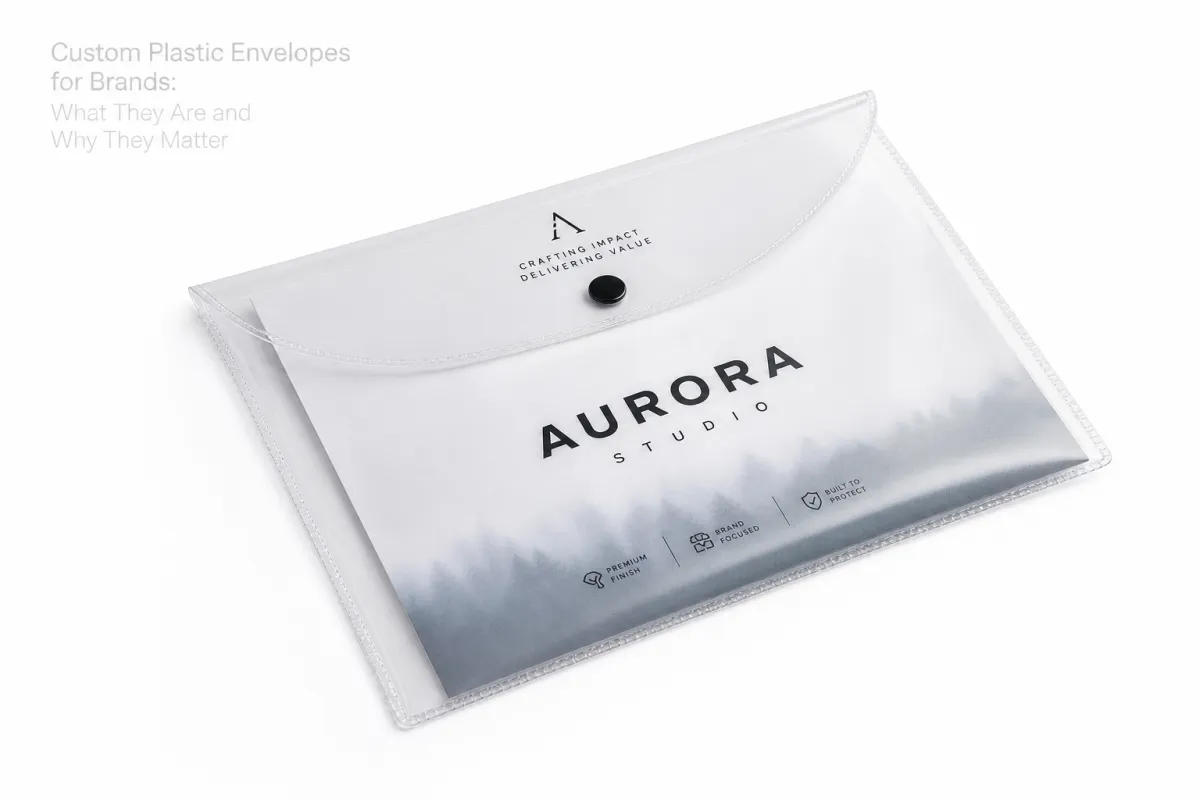
Custom plastic envelopes for brands are lightweight shipping pouches made from plastic film, usually polyethylene, with a logo, pattern, message, or full-surface design printed on them. The format is intentionally simple. A flap. An adhesive strip. A printed exterior. A bag that closes without a fight. That simplicity is why they scale so well in branded packaging programs.
They also land in a useful middle zone. They are more polished than a stock poly mailer, but they cost less and weigh far less than rigid retail packaging. For Brands That Ship flat inventory in volume, that middle zone is where the numbers start behaving themselves. In packaging terms, that is the sweet spot people keep rediscovering after overcomplicating the brief.
From a buyer's point of view, custom plastic envelopes for brands make sense for:
- Apparel like tees, socks, swimwear, and leggings.
- Accessories such as belts, hats, scarves, and small leather goods.
- Beauty items, sample kits, and subscription inserts.
- Event packs, influencer mailers, and promotional flat goods.
The logic is practical. These products do not need a corrugated box to survive routine shipping, but they do need protection from scuffs, damp storage, and rough handling. Custom plastic envelopes for brands do that well. They also help with privacy. Nobody wants a flimsy or transparent package advertising its contents before it reaches the porch. That is just awkward.
There is a branding side too. Package branding works best when the package suits the product. A premium apparel label sending a clean, logo-printed envelope feels deliberate. A beauty brand using a matte pouch can make a tiny order feel more considered without paying for a heavy structure. Custom plastic envelopes for brands do not need a huge design budget to look intentional. They need clear decisions and enough restraint to avoid visual noise.
The limits matter just as much. Thin film does not forgive poor product choices. If the item has hard edges, piercing points, or an awkward shape, the envelope will show every bad decision in the spec. That is why I treat custom plastic envelopes for brands as a fit check first and a branding tool second. If the fit is wrong, the print is decoration on top of a problem. The package will look strained, and strained packaging never reads premium.
A mailer only feels premium if it survives the trip and still looks planned when it arrives. A split seam or lifted flap kills the story fast.
There is another reason brands keep ordering custom plastic envelopes for brands: they reduce dead weight. A box, void fill, and extra inserts can push dimensional weight up quickly. A flat envelope can trim a surprising amount from shipping costs, especially for DTC apparel and campaign mailings. That is not glamorous. It is just profitable, which has its own charm.
One more practical reason: they are easy to pack. A fulfillment team can move through them quickly, and that matters when the warehouse is already busy and nobody is trying to add more drama to the day. Simple packaging is underrated because it does not get applause. It just gets the job done.
How Custom Plastic Envelopes for Brands Work in Shipping
Custom plastic envelopes for brands usually include an outer film, a sealing flap, and an adhesive strip. Some versions add a second seal, opaque layers for privacy, tamper-evident features, or gussets for a bit of extra room. The construction sounds plain because it is. The difference lives in the details most buyers only notice after something fails.
The outer film affects strength, stiffness, and print quality. The adhesive strip affects how cleanly the bag closes and whether it reopens in transit like a very rude surprise. The seal area matters more than many people expect, because print that crosses a fold or sits too close to the flap can distort once the mailer is filled. For custom plastic envelopes for brands, print placement is not decoration. It is part of production planning.
The usual shipping flow is simple enough:
- Pack the product with any insert, tissue, or inner pouch.
- Slide it into the envelope without forcing the corners.
- Seal the flap with firm pressure across the full width.
- Apply the label where it stays flat and readable.
- Ship it and let the package prove the spec was worth approving.
That last step gets ignored too often. A package can look great on the warehouse table and still fail in transit if the film is too thin or the adhesive is weak. If you want to judge custom plastic envelopes for brands properly, test them the way shipping actually happens. The International Safe Transit Association has useful performance methods at ISTA. Those tests are not decorative paperwork. They show whether a package survives vibration, drops, compression, and rough handling without falling apart.
The tradeoff between lighter and heavier constructions is straightforward. Thin mailers cost less and ship lighter, but they tear more easily and can feel casual in hand. Heavier versions cost more and weigh a bit more, but they hold shape better and often look more premium. For custom plastic envelopes for brands, that tradeoff deserves attention. A few cents saved per unit can vanish the moment a cheaper bag triggers a return or a customer complaint.
Different brands use them for different reasons. A DTC clothing label may want a slick outer finish and a bold logo. A subscription brand may want a plain face with a printed message inside. A beauty brand may care more about opacity and tamper evidence. The product changes the brief, and the brief changes the envelope. That is why custom plastic envelopes for brands should never be chosen by instinct alone.
They also do not replace inner protection. Weather resistance is better than paper, yes. A film envelope is still not a foam insert, a molded tray, or a rigid carton. If the product needs structure, give it structure. If the item is delicate, add a sleeve, tissue wrap, or inner pouch before it goes into the mailer. The best custom plastic envelopes for brands are the ones that support the product instead of pretending structure is optional.
I usually tell teams to think in layers. The envelope is the outer shell, not the whole plan. If the inside is sloppy, the outside can only do so much. Packaging is not magic. It is a set of tradeoffs wearing a clean surface.
Materials, Sizes, and Print Choices That Shape the Result
The material choice behind custom plastic envelopes for brands is usually polyethylene, though recycled-content options and blended films show up often too. The real question is not whether plastic belongs in the spec. It is how much strength, opacity, and print quality the job needs without wasting material. Packaging gets interesting right around the point where practical decisions start outranking mood boards.
Thickness is a better buying signal than hype. A thinner film, often around 2.25 to 2.5 mil for lighter use, saves money and keeps shipping weight down. A thicker film, often around 3 to 4 mil or more for heavier or premium use, resists punctures better and holds its shape more confidently. For custom plastic envelopes for brands, that extra body can make the package feel less disposable. You notice the difference immediately when you pick it up.
Size matters just as much. Measure the product with all packaging included, not the item alone. Add room for tissue, inserts, or a thin inner pouch. Too tight, and the package wrinkles or bursts at the seam. Too loose, and the mailer looks sloppy and wastes material. A solid spec leaves enough room for a flat product to slide in without force, but not so much room that it rattles around like it has nowhere to be. That balance matters a lot for retail packaging and subscription shipments.
Here is the part many teams miss: custom plastic envelopes for brands should be sized for the actual pack-out, not the concept deck. The product, the insert, the label, and the closure all change the final footprint. If the item ships with a thank-you card or barcode slip, account for it. A mailer that looks perfect in a mockup but fights the warehouse team is not a good purchase. It is just a pretty problem.
Print options also shape cost and perception. Single-color logos are the cheapest route and often the cleanest. Two-color prints add more visual punch without getting expensive too quickly. Full-surface branding can look strong, but it usually demands tighter artwork control and higher print cost. For many custom plastic envelopes for brands, a restrained design does more than a loud one. One clean logo, strong contrast, and thoughtful spacing often look more premium than a crowded surface fighting for attention.
Finish matters too. Glossy films catch light and look bold. Matte films feel quieter and more current. Clear films show the product, which works for some retail packaging or accessories. Opaque films hide contents and create a stronger privacy signal. There is no universal best option. There is only the best fit for the brand and the product.
Branding Details That sound minor can change the result a lot:
- Logo scale: too small reads accidental, too large can look cheap.
- Contrast: dark ink on dark film wastes money and sends the wrong signal.
- Seam clearance: keep artwork away from folds and closures.
- Label space: leave a clean zone for shipping labels and barcodes.
- Copy restraint: a short message usually works better than a wall of text.
If you want to compare packaging choices beyond mailers, browse our Custom Packaging Products page. It helps to see the full mix before you lock one format in. Not every brand needs the same structure, and custom plastic envelopes for brands are only one part of a larger product packaging strategy.
There is also the question of ink behavior. Some films take printed color cleanly; others can shift tone a bit, especially under gloss or on darker substrates. If color accuracy matters, ask for a physical proof instead of trusting a screen. Screens lie all the time. Very confidently, too.
Cost and Pricing for Custom Plastic Envelopes for Brands
Custom plastic envelopes for brands are usually priced by size, film thickness, print coverage, number of colors, order quantity, and finish. That is the honest answer. Anyone promising a single average price without those details is guessing, or trying to sell the cheapest thing on the shelf and hoping you do not ask questions.
Small runs cost more per unit. Larger orders bring the unit price down, but they lock up cash and storage space. That is the tradeoff. With custom plastic envelopes for brands, the savings curve can get steep once you move from a tiny test run to a mid-volume order. The catch is that inventory sitting on a shelf is not free. It takes space, handling, and attention from people who already have enough to do.
For a practical reference point, many brands see numbers around the following for a 5,000-piece order, depending on print coverage and thickness:
| Option | Typical Spec | Approx. Unit Price | Best Use |
|---|---|---|---|
| Economy mailer | 2.25-2.5 mil polyethylene, 1-color print, matte or gloss | $0.18-$0.28 | Light apparel, inserts, promo packs |
| Recycled-content mailer | 2.5-3 mil blended film, 1-2 colors, clean logo placement | $0.24-$0.38 | Brands wanting a lower-material story without giving up strength |
| Premium opaque mailer | 3.5-4 mil film, full-coverage print, stronger adhesive | $0.34-$0.58 | Heavier products, privacy-sensitive orders, higher presentation value |
Those numbers move with quantity, supplier region, resin costs, and freight. They also move when artwork gets complicated. Setup or plate fees can apply, often somewhere in the $50-$250 range depending on print method and color count. If you are comparing suppliers for custom plastic envelopes for brands, ask whether the quote includes setup, proofs, shipping, and cartons. A low unit price can be a very charming lie if the rest of the bill is hiding somewhere else.
There is also the real cost of bad spec choices. A cheaper bag that tears, scuffs, or leaves the customer with a poor first impression can cost far more than the savings. Return processing, customer service time, replacement shipping, and lost repeat orders all chew through margin. That is why I treat custom plastic envelopes for brands as a value decision, not a pure unit-price decision. If the better bag reduces damage and supports repeat purchase behavior, the math changes quickly.
Shipping and storage deserve a line in the budget too. A mailer that costs a little more but ships in a smaller carton can be more efficient overall. A heavier mailer can also add a bit to freight if you are moving huge volumes. That does not sound dramatic, but a few cents per unit across tens of thousands of shipments is not pocket change. It is a line item with a personality.
If your brand uses a mix of custom plastic envelopes for brands and other formats like custom printed boxes, compare them honestly on landed cost, damage rate, and pack-out time. Box programs often win for rigid, gift-like, or high-protection products. Mailers win for flat goods and speed. Good product packaging is the one that fits the use case without padding the budget with drama.
For brands tracking sustainability claims or recycled content, the U.S. EPA's recycling resources at EPA recycling guidance are a decent reference point. Do not confuse general recycling advice with a guaranteed end-of-life path for every film. Local recycling rules vary. So do collection systems. The packaging should still work first, then fit the environmental story honestly.
And yes, someone always asks whether a cheaper mailer is "good enough." Sometimes it is. Sometimes it is kinda false economy. The honest answer depends on the product, the route, and how often your team wants to deal with damage claims. Packaging math is boring until it isn't.
Step-by-Step Process and Timeline for Ordering
Ordering custom plastic envelopes for brands is not hard, but it rewards people who gather the right details before they start emailing suppliers. The smoothest projects move through the same sequence: product sizing, material selection, artwork prep, quote review, sample approval, production, and shipment. Skip one step, and the delay shows up later, usually right when someone says the launch cannot move. Funny how that happens.
The first thing a supplier needs is a real spec. That means product dimensions with packaging included, quantity, print colors, finish, flap style, and delivery location. For custom plastic envelopes for brands, a rough dimension scribbled on a note is not enough. Measure the product, measure the insert, and think about how the item will sit inside the bag. If there is a sleeve or a folded garment, include it in the math instead of assuming everyone will guess correctly.
Artwork matters too, but not in a vacuum. A great logo can still fail if the print zone is wrong or the contrast disappears on the chosen film. Good suppliers should show a proof with placement, safe margins, and label space. That is the difference between a proof and a hopeful screenshot.
A good quote for custom plastic envelopes for brands should spell out the film, thickness, print count, flap style, setup fees, and freight separately. If it does not, expect surprises. Packaging rarely gets cheaper after the surprises show up.
Typical timing looks something like this:
- Day 1-2: Send dimensions, quantity, artwork, and delivery destination.
- Day 2-4: Receive pricing and spec options.
- Day 4-7: Review digital proof or request a sample.
- Day 7-10: Confirm final artwork and approve production.
- Day 10-25: Production, inspection, and packing.
- After production: Transit time depends on location and shipping mode.
For a standard order, production often lands around 12-15 business days after proof approval. Rush work can cut that down, but speed usually costs more and narrows the choices. You might lose finish options, color complexity, or even your preferred film grade. That is normal. Fast and flexible rarely live in the same box.
Samples are not a luxury. They are cheap insurance. A physical sample or at least a solid pre-production proof can catch sizing mistakes, color drift, seal issues, and print placement errors before a full run starts. That matters a lot for custom plastic envelopes for brands, because a bad mailer order does not fail quietly. It fails in front of the customer.
One more detail: do not let artwork approval drag. Late changes to copy, logo size, or legal text are a common cause of missed launch dates. If the team keeps moving the goalposts, the packaging schedule slips. Simple as that. The smartest custom plastic envelopes for brands projects have one person owning the final spec and one final approval date. Everything else is noise.
If you have not built a packaging checklist before, build one now. Put the product dimensions, thickness, print method, closure type, and deadline in one place. That tiny bit of discipline saves a lot of back-and-forth later. Boring, yes. Useful, absolutely.
Custom Plastic Envelopes for Brands: Common Mistakes and Better Buying Habits
The biggest mistake with custom plastic envelopes for brands is sizing them too tightly. People try to save a little material, then force the product into the bag. The result is a wrinkled panel, a stressed seam, and a package that looks like it lost a fight. Not ideal. A mailer should accept the product without strain, not wrestle it into submission.
Another common problem is overbranding. I know, the temptation is strong. There is a blank surface and a logo, so suddenly every inch gets filled with copy, icons, taglines, social handles, and claims. That usually makes the package feel busier, not better. For custom plastic envelopes for brands, a simpler layout often looks more premium and costs less to produce. One strong mark can beat six competing messages without trying very hard.
Choosing the thinnest film purely to save money is another easy mistake. It looks clever in the quote stage and annoying in the warehouse. Thin mailers can crease harder, puncture more easily, and make the brand feel less considered. For many custom plastic envelopes for brands, moving up one thickness step pays for itself through fewer problems and better presentation. Cheap on paper is not the same as cheap in practice. The math has a way of collecting its due later.
Adhesive testing matters more than teams expect, especially if the product ships in colder weather, humid conditions, or with heavy labels. A flap that seals fine in the office can behave differently in transit or storage. If the adhesive lifts, the package loses both security and trust. That is not a good trade.
Skipping sample approval is a classic shortcut that usually costs more later. Digital mockups are useful, but they do not show the way a film reflects light, how a seam sits, or whether the print reads well on the actual surface. For custom plastic envelopes for brands, a sample can save you from a hundred slightly annoying mistakes and one very expensive one.
Here are the habits that usually lead to better results:
- Compare two specs side by side: one cost-focused, one slightly upgraded for strength or finish.
- Test the packed product: not just the envelope by itself, but the real item with inserts.
- Check the label zone: make sure shipping labels land flat and readable.
- Review seam margins: keep artwork away from folds, edges, and flap closures.
- Ask for a printed sample: especially if color accuracy or brand tone matters.
If you want proof that packaging choices affect how a brand feels, browse a few Case Studies. You will see how different packaging design choices change the experience of the same type of product. That is the reality of package branding. It is rarely one dramatic move. It is usually a stack of correct little decisions that add up to something that looks intentional.
My practical advice is simple: write the decision order down Before You Buy. Product dimensions first. Material second. Print third. Quantity fourth. Delivery deadline last, because deadlines have a bad habit of bullying good judgment. Custom plastic envelopes for brands work best when the team chooses the spec on purpose instead of guessing and hoping the warehouse can rescue it later.
If the product line is seasonal or still in testing, start with a smaller run and compare it against a slightly upgraded spec. That extra comparison is cheap. The mistake you catch before volume production is the cheapest mistake in packaging. For custom plastic envelopes for brands, that is usually where the smartest money goes.
There is one more thing that gets glossed over in too many packaging conversations: the warehouse team has to live with the choice. If the mailer sticks, tears, or seals inconsistently, the people packing orders will know within a day. They always know. And they will have opinions. Usually fair ones.
What are custom plastic envelopes for brands best used for?
They work best for flat or lightly bulky products like apparel, accessories, inserts, subscription items, and promotional packs. They fit well when you want moisture resistance, lightweight shipping, and a branded first impression. They are a weaker fit for sharp, fragile, or very rigid items unless you add inner protection.
How much do custom plastic envelopes for brands usually cost?
Price depends on size, thickness, print coverage, color count, quantity, and any special finish. Small runs usually have a higher unit cost; larger orders lower the per-piece price but increase upfront spend. Ask about setup fees, shipping, and sample costs so the quote does not look cheaper than it really is.
What should I check before ordering custom plastic envelopes for brands?
Confirm product dimensions with packaging included, not just the item size alone. Check seal strength, print placement, and whether the bag still closes cleanly when fully packed. Request a sample or proof before production, especially if color accuracy or durability matters.
How long does it take to produce custom plastic envelopes for brands?
Timelines usually depend on artwork approval, sampling, and production volume. Fast orders are possible, but they often cost more or limit customization options. The smoothest projects are the ones where specs are finalized early and approvals do not drag.
Can custom plastic envelopes for brands be eco-friendlier?
Yes, some options use recycled content or reduced material thickness to lower material use. The best choice depends on your product weight, shipping conditions, and brand standards. Do not chase the greenest-sounding option if it fails in transit and creates waste elsewhere.
For brands balancing cost, presentation, and shipping performance, custom plastic envelopes for brands are hard to beat when the spec is chosen with care. Measure the product, test the closure, compare two material options, and insist on a sample before production. If you need one clear rule to carry forward, make it this: choose the mailer for the real pack-out, not the mockup. That is how custom plastic envelopes for brands stop being a guess and start doing actual work for the business.

