Custom Plastic Shopping Bags Wholesale for Bulk Orders
Buying custom Plastic Shopping Bags wholesale is not really about bags. It is about how fast a checkout moves, how the product lands in a customer’s hand, and whether the brand still looks intentional after a rush order, a busy weekend, or a bad weather day when everyone carries more than usual. A bag that stretches too far, splits at the handle, or opens awkwardly turns a small purchase into a small headache. Cute. Expensive, too.
The right order starts with use case, not with a price quote. A pharmacy, a boutique, a convenience store, and an apparel counter all need different load capacity, handle style, print area, and film feel. If the bag spec is being considered alongside a wider Wholesale Programs purchase or a larger Custom Packaging Products lineup, the bag should fit the rest of the retail packaging system instead of being treated like an afterthought.
A good wholesale shopping bag moves quickly at the register, carries the product without strain, and keeps the logo readable after the customer leaves the store.
Why custom plastic shopping bags wholesale lower checkout friction
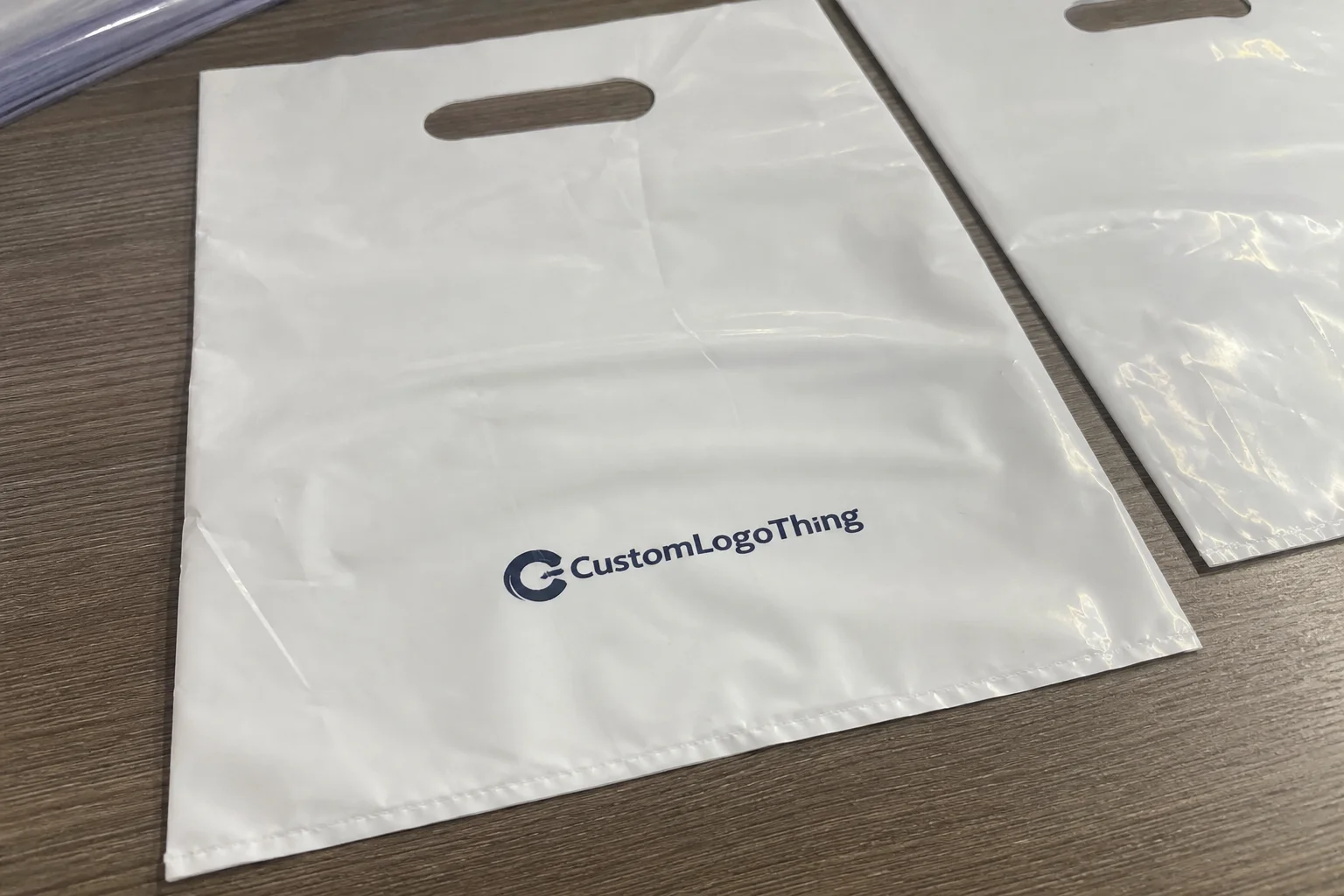
The cheapest bag on paper can become the most expensive bag in the building if it slows down the line. That happens more often than buyers expect. A thin film that sticks together, a handle that feels flimsy, or a gusset that collapses under a box adds seconds to every transaction. Multiply that by a full shift and the labor cost starts doing its own little revolt.
custom plastic shopping bags wholesale makes sense where speed and consistency matter. High-volume retail is the obvious use, but the real list is broader: convenience stores, pharmacies, boutiques, gift shops, hardware counters, pet stores, and service businesses that hand out multiple bags every hour. The bag needs to open easily, fill predictably, and hold its shape long enough for the associate to keep moving.
Before asking for quotes, define three things: the heaviest typical load, the fill speed needed at the register, and how visible the branding needs to be. A 5 lb apparel order and a 10 lb boxed-goods order do not belong in the same spec. One may work with lighter film and a simple print. The other usually needs a stronger structure, better seals, and a more careful handle choice.
From a buyer’s point of view, the purchase should be treated as a specification decision first and a price decision second. Once the structure is right, unit cost becomes meaningful. Before that, it is just a number with excellent marketing. For packaging terminology and transport basics, resources from the Packaging industry and transport-testing groups like ISTA are useful references.
In practice, the cleanest orders come from fewer assumptions and more specifics. Give the supplier the bag dimensions, load type, print goal, and receiving location upfront. That reduces revision rounds and keeps the final bag looking deliberate instead of improvised.
Bag Materials, Gauges, and Carry Strength
The two common film families in retail bags are LDPE and HDPE. They do not behave the same way, and that matters more than most first-time buyers expect. LDPE feels softer and more flexible, with better stretch and a smoother hand feel. HDPE is lighter for its stiffness, crisper in the hand, and often used for vest-style bags because it opens quickly and packs efficiently at the counter.
Thickness is usually described in mils or gauge. That number is not just technical decoration. It affects puncture resistance, tear behavior, and how the bag holds up once a boxed item or a product with edges gets dropped inside. A thin bag can look fine in a sample and still fail in real use if the load is less forgiving than the sample contents.
Gusset depth changes carry behavior. A wider gusset helps the bag stand open, gives more room for irregular items, and reduces stress on the seams. Seam quality matters just as much as film weight. Strong film with weak seals is still a weak bag. Handle reinforcement matters too, especially on die-cut and loop-handle styles where the lift point takes repeated strain every time the bag is picked up, carried, and set down again.
The useful rule is simple: match the film to the worst-case load, not the average one. If most purchases are light but a meaningful share includes boxed goods or harder edges, the bag spec should reflect the heavier case. That is how buyers avoid the one bag that fails during the exact transaction customers remember.
If the bag is part of a wider retail packaging program, the same discipline should be applied across the whole set, whether that includes labels, inserts, or custom printed boxes. Strength matters. So does how the package feels at handoff and how consistently it presents the brand.
One practical point buyers sometimes miss: if customers are likely to reuse the bag, the structure should still look decent after several carries. That does not mean overspecifying every order. It means being honest about how the bag will be used after it leaves the store. Light apparel can live with a lighter spec. A heavier gift set, a boxed purchase, or a multi-item order usually cannot.
Handles, Gussets, Print Coverage, and Size Specs
Handle style affects comfort, packing speed, and how polished the bag feels. Die-cut handles are compact and clean, but the opening and load distribution need to be right or the carry feel gets awkward fast. Vest-style bags are fast at checkout and familiar to shoppers, which is why they remain common for high-volume service. Loop handles carry more like a small tote and often work better for higher-value branded packaging or heavier handoffs.
Dimensions matter more than many buyers expect. Width, height, and gusset all work together. A bag that is too narrow compresses the product and slows the fill. A bag that is too short leaves handles or closures under strain. If the gusset is undersized, the pack-out becomes clumsy and the walls fight the merchandise instead of supporting it. That is not a design feature. That is a line problem.
Print coverage should be decided with the same level of discipline. A one-color logo on one side is straightforward and usually the most economical path. Two-color or multi-color branding gives more visual presence, but it also tightens registration tolerances and raises the chance of small alignment variation if the artwork is not prepared well. Full-panel coverage can look strong, but only if the logo, background, and copy are planned for the bag dimensions instead of being dragged over from another format and hoped for the best.
Artwork prep matters. Clean vector files, correct color callouts, and a basic understanding of bleed and live area keep the result sharp. If the design is being adapted from labels, inserts, or custom printed boxes, the bag still needs its own layout. Shrinking a box design onto a shopping bag usually produces a crowded mess with no visual hierarchy.
- Die-cut handles suit compact, polished retail presentation and fast handoff.
- Vest-style handles work well for speed and lower-cost high-volume service.
- Loop handles improve carry comfort for heavier or more premium product packaging.
- Wider gussets help with boxed items and mixed-shape purchases.
- Simpler print layouts usually give better readability and cleaner production control.
The size spec should be built around the heaviest typical purchase, not the average sale. That one decision prevents a lot of trouble. Buyers often size a bag for the most common item, then discover it cannot handle the occasional larger order. Once the store is busy, that mistake is visible immediately.
Pricing, MOQ, and Unit Cost Drivers
For custom plastic shopping bags wholesale, the main price drivers are easy to identify, but people still miss them when they compare quotes side by side. Film weight, bag size, handle style, print color count, packaging count, and total quantity all affect the unit price. A simple bag in a large run can be efficient. A complex bag in a small run rarely is.
MOQ exists because setup time is real. Printing plates, press setup, film conversion, cut-and-seal adjustments, and packing all need to be absorbed by the order. Lower quantities spread those fixed costs across fewer pieces, so the unit price rises. That is not a sales trick. It is production math, the boring sort that still decides the budget.
Freight matters too. Carton count, palletizing, destination distance, and rush handling can change the landed price enough to alter the decision. A quote that looks attractive at the factory gate may not be the best value once it reaches the receiving dock. Buyers should compare delivered cost, not just ex-works pricing. Otherwise the “cheap” quote gets weirdly expensive in the back half.
| Option | Typical Use | Relative Unit Cost | What Drives Cost |
|---|---|---|---|
| Light HDPE vest-style bag | High-volume retail with light purchases | Lower | Simple construction, fast conversion, one-color print |
| Heavier LDPE die-cut bag | Boutique, gift, or premium retail packaging | Medium | Thicker film, stronger feel, cleaner print presentation |
| Loop-handle printed bag | Higher-end branding or heavier handoff loads | Higher | More material, more assembly steps, stronger carry structure |
| Large multi-color branded bag | Brand-forward retail and promotional use | Highest | Color count, registration control, larger print area, setup time |
As a rough planning range, simpler wholesale runs at higher volumes often land around $0.08 to $0.22 per unit. More complex printed bags with heavier film or multiple colors can move into $0.18 to $0.40 per unit or more, depending on quantity and specification. Those are not fixed rates. They shift with film weight, print coverage, order size, and freight, but they are useful for early budgeting.
To compare quotes properly, keep the spec identical across vendors. Same dimensions, same gauge, same print colors, same packaging count, same delivery ZIP code. If any one of those changes, the comparison gets noisy and the lowest number may not be the best value.
Production Steps, Lead Time, and Approval Milestones
A clean order flow cuts mistakes. The usual sequence starts with artwork submission, then the digital proof, then any sample or preproduction approval, followed by printing, cutting, sealing, packing, and shipment. Delays usually happen at the front end. If artwork is incomplete or the proof gets reviewed half-asleep, the run can stall before production begins.
The digital proof is not a courtesy email. It is the point where dimensions, logo placement, copy, and color expectations get locked in. If the proof is wrong, the finished bags will be wrong at scale. For branded packaging, that mistake is expensive. A preproduction sample can help on larger or more sensitive runs, especially if color matching or handle performance matters a great deal.
Lead time depends on several variables: artwork readiness, tooling requirements, order size, current production queue, and shipping method. A straightforward order may move in roughly 12 to 18 business days after approval, while a more complex run can take longer. Transit time is separate. Buyers often forget that the factory window is not the same thing as the full calendar timeline.
Planning should include revision time, production time, transit time, and receiving time. That matters most for stores with weekly reorders or seasonal traffic spikes. If the bag supports a wider retail packaging program, the schedule should also align with promotions, store resets, or product packaging launches so the presentation stays consistent across channels.
From a distribution standpoint, carton count and pallet configuration matter more than people think. Strong master cartons reduce damage, speed receiving, and make multi-store allocation easier. If you want a reference point for transport handling and packaging testing, ISTA provides clear test language, while EPA resources are useful when material use and waste reduction are part of the discussion.
Approval milestones are not paperwork for the drawer. They are control points. A buyer who reviews the proof carefully, confirms the pack count, and checks the ship-to details usually avoids the problems that eat the most time later.
What to Compare Before You Choose a Wholesale Supplier
Sample quality is the starting line, not the finish. One good mockup does not guarantee that the full run will match it. Buyers should ask how the supplier controls consistency across the lot, especially for seam strength, color match, handle performance, and print registration. Those details separate a dependable run from one that only looks fine in a photo.
Written records matter for reorders. If the supplier keeps a clean spec history, future orders are much easier to repeat. That record should include dimensions, gauge, artwork files, carton count, and special packing instructions. Without documentation, repeat orders can drift in size or finish, and the buyer ends up redoing work that should already have been settled.
Communication quality says a lot. A supplier who can explain substitutions, artwork corrections, and shipping timing clearly is usually easier to work with on the next order. A low quote is not useful if the process turns vague the moment something changes. That matters even more for buyers who order across multiple locations and need reliable retail packaging arrivals.
Ask about carton pack-out and pallet strategy if the bags are going to several store locations. Clean receiving saves labor at destination. A case pack that is too heavy, too loose, or badly labeled creates extra work on the floor. That hidden labor can matter as much as the unit price, which is inconvenient, but facts rarely ask permission.
- Ask for a spec sheet tied to the exact bag dimensions and gauge.
- Confirm whether the artwork file will be stored for future runs.
- Review the supplier’s handling of proof corrections and substitutions.
- Check carton pack-out, pallet count, and receiving requirements.
- Make sure the quote includes freight and any setup fees that apply.
A solid wholesale partner should give clear answers, consistent product, and a reorder process that does not require rebuilding the spec every time. That is the difference between a one-off purchase and an actual supply relationship.
Next Steps to Lock the Right Bag Spec and Reorder Plan
The fastest way to get a useful quote is to build a one-page spec sheet. Include bag width, height, gusset depth, film thickness, handle style, print colors, quantity, and delivery location. Add the artwork file if it is ready. If the supplier has everything in one place, the quote will be tighter and the approval cycle will move faster.
Request a written quote that separates unit cost, freight, proof charges, and any setup fees. That kind of clarity makes it easier to compare suppliers without guessing. It also helps identify which part of the order is actually driving cost. A small change in print coverage or film weight can shift the total more than buyers expect.
If the bags will be reordered, define a reorder trigger based on sales velocity and transit time. Running out of bags is a preventable problem. The trigger should leave enough room for proof review, production, and freight, not just the factory window. That matters even more if the bag is tied to a seasonal promotion or a tightly scheduled store rollout.
Repeatability is the real value in custom plastic shopping bags wholesale. A bag that performs the same way on the next order protects the store workflow, preserves the brand look, and keeps the purchasing process simple. That is the goal: a spec that can be reused, reordered, and trusted without starting from scratch every time.
What details do I need for a custom plastic shopping bags wholesale quote?
Provide bag width, height, gusset depth, film thickness, handle style, print colors, and total quantity. Add the delivery ZIP code and your artwork file if you have it, since those two details help with freight and proofing.
How do I choose the right thickness for wholesale plastic shopping bags?
Match the gauge to the heaviest typical load, not just the average sale. Heavier or sharper merchandise usually needs stronger film, better seals, and a wider gusset so the bag stays stable in normal use.
What raises the price of custom shopping bags the most?
Lower quantities, heavier film, more print colors, and larger bag sizes usually move the unit cost up fastest. Rush timing, special packaging, and freight distance can also change the landed price more than buyers expect.
How long does production usually take after artwork approval?
The schedule depends on order size, current production queue, and whether tooling or sample approval is needed. Shipping method matters too, so the full calendar timeline should include transit and receiving time, not just factory time.
Can I reorder the same wholesale bag spec later without starting over?
Yes, if the supplier keeps a clear record for dimensions, gauge, artwork, and carton pack-out. Before reordering, confirm that the printed file, color standard, and bag measurements still match the approved version.


