Custom Poly Mailer Bags Bulk Order: The Margin Case
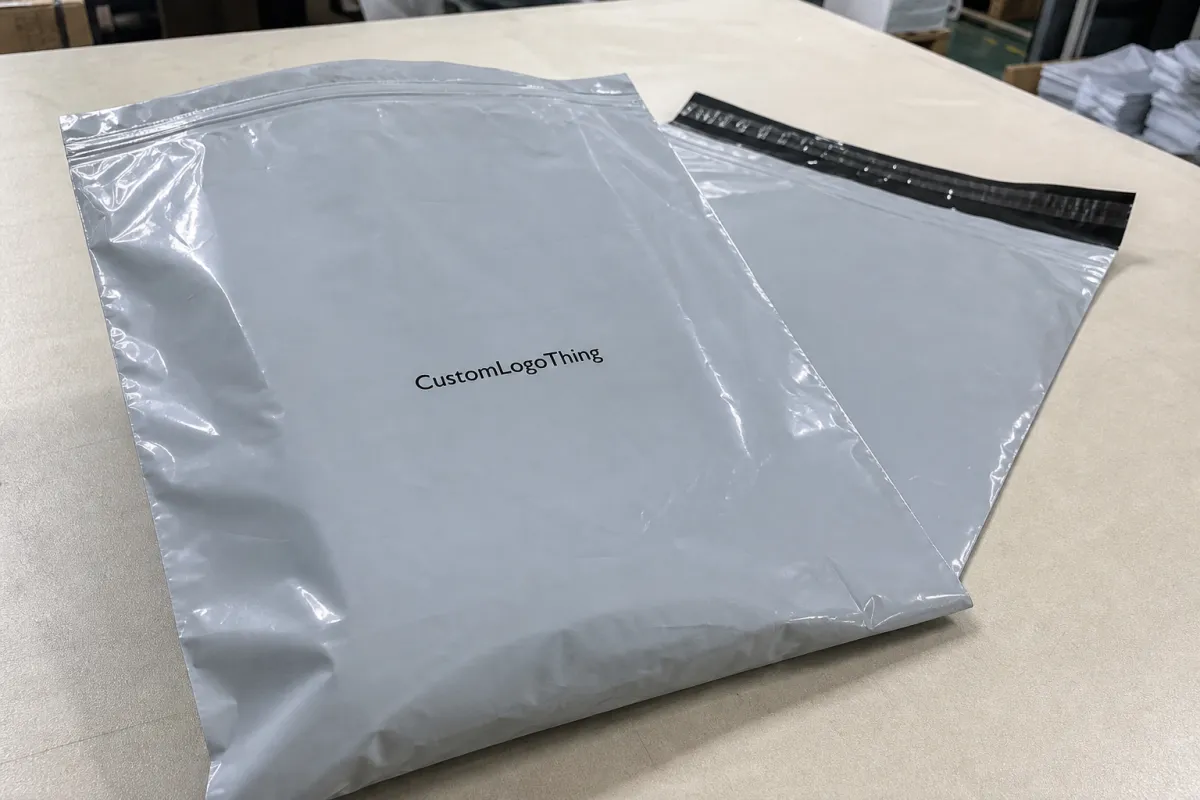
A brand can save three cents on a mailer and lose six dollars on the shipment. That is the ugly math behind split seams, peeling labels, double-bagged apparel orders, and customer service tickets that start with, “My package arrived damaged.” A custom Poly Mailer Bags bulk order is not just a print purchase. It affects shipping cost, damage rate, pack speed, storage space, and whether the package looks intentional when it lands on a doorstep.
Poly mailers compete against corrugated boxes on weight and handling. For soft goods, accessories, documents, refill pouches, subscriptions, and lightweight ecommerce items, a flexible shipping bag often makes more financial sense than a box. A 10 x 13 inch mailer weighs far less than a small carton, and it avoids some of the dimensional-weight pain that shows up when a mostly empty box moves through a carrier network.
Boxes still win for rigid goods, glass, crush-sensitive products, sharp corners, and premium packaging programs that need structure. Nobody should ship a candle in a floppy bag and act surprised when it arrives like evidence. But for a folded hoodie, a knit set, or a document kit, corrugated can be overbuilt. It takes more warehouse space. It needs tape. It often needs void fill. A packer can usually close a self-seal poly mailer faster than forming, filling, taping, and labeling a box.
The margin case has three parts. Custom sizing reduces excess material and cuts the “pillow effect” that makes bags snag on conveyors. Branded printing turns every parcel into a moving packaging impression before the customer opens it. Bulk ordering spreads setup costs across 5,000, 10,000, or 25,000 pieces instead of punishing the buyer on every unit.
The useful variables are not mysterious. They are thickness, film structure, adhesive strength, opacity, print coverage, quantity breaks, carton packing, and freight method. Custom Logo Things approaches Custom Poly Mailers from that angle: specify the right bag, avoid unnecessary gauge, and do not pay for four-color artwork when one sharp logo does the job.
Where Branded Poly Mailers Outperform Plain Shipping Bags
Flexible plastic mailers work best for non-fragile, lightweight, compressible products. Think T-shirts, leggings, scarves, flat textiles, soft accessories, beauty refill packs, catalogs, influencer kits, sample bundles, and returns. The product has to tolerate pressure. If an item can crack, bend permanently, puncture the bag from inside, or lose value from crushed retail packaging, use reinforcement or choose a box.
The operational advantage is blunt: fewer steps. A picker inserts the item, removes the release liner, seals the flap, applies the carrier label, and moves on. No carton forming. No tape gun. No kraft paper. No air pillows. Warehouses shipping 300 to 3,000 daily parcels can feel that difference in labor hours, especially during sale periods and subscription drops.
Storage is another number buyers underestimate. Flat poly mailers can be packed in cartons of hundreds or thousands, while corrugated boxes take up pallet space before a single order ships. For brands working from a small fulfillment room or a 3PL account with storage fees, the difference between 20 cartons of mailers and multiple pallets of boxes is not cosmetic. It is rent.
Branding changes the calculation again. A printed mailer is seen by warehouse staff, parcel carriers, apartment reception desks, mailroom teams, customers, and sometimes social media audiences. Plain bags disappear. Branded packaging repeats the name. That does not mean every brand needs edge-to-edge artwork; a clean one-color logo can carry plenty of weight.
Practical callout: A lower-cost bag can be the smarter financial choice if it reduces dimensional weight and speeds fulfillment. The condition is performance. Seal strength, opacity, and puncture resistance still have to match the product and shipping route.
There are clear limits. Poly mailers are usually wrong for candles, boxed electronics with sharp corners, glass bottles, collectible packaging, framed goods, and high-end unboxing programs that rely on structure. In those cases, Custom Packaging Products such as custom printed boxes, inserts, padded mailers, or rigid mailers may protect the product and the brand perception better.
Common upgrades include co-extruded film for better opacity, opaque white or colored film, returnable dual adhesive strips, hang holes for warehouse handling, tear perforations, and suffocation warnings where required. Each feature should solve a real problem. If it does not reduce labor, returns, damage, or compliance risk, it may be decoration wearing a strategy costume.
Film, Thickness, Closure, and Print Specifications Buyers Should Lock First
Material language gets slippery fast, so start with function. LDPE is common for flexible mailers because it has good tear resistance and a softer feel. HDPE blends can add stiffness or strength characteristics. Co-extruded film uses multiple layers to balance opacity, toughness, and print surface. Recycled-content options may be available depending on size, color, strength target, and order volume, but they are not automatically identical to virgin film in appearance or handling.
Thickness should follow the product, not the buyer’s anxiety. Lightweight T-shirts, documents, and small textile pieces may work in lighter gauges around 2.0 to 2.5 mil. Denim, multi-item apparel orders, shoes in soft pouches, or rough carrier routes may justify 3.0 mil or more. Many buyers overbuy thickness because “heavy-duty” sounds safer. Sometimes it is. Sometimes accurate sizing and a better seal matter more.
Closure design deserves more attention than it usually gets. A permanent self-seal adhesive is standard for one-way shipments. Tamper-evident closures help show if a bag has been opened. Dual peel-and-seal strips support returns by giving the customer a second adhesive line after the first flap is opened. Liner quality also affects packing speed; if staff fight the release strip all day, a cheap closure becomes a labor cost.
Sizing is where small errors multiply. Measure the folded product stack, not the flat garment before folding. Add enough room for insertion and sealing, often 0.5 to 1.5 inches depending on product thickness, but avoid oversized bags that wrinkle, catch in handling, or inflate shipping cost. For multi-SKU brands, test the largest likely bundle and the most common order, not just the prettiest sample.
Print specifications should be realistic for flexible plastic. One-color logos are efficient. Spot color artwork gives stronger brand control. Heavy coverage increases ink use and can raise cost. Inside print can create a premium reveal, but it needs planning. QR codes and barcodes need quiet zones and scannability testing because flexible film bends, stretches, and reflects light differently from paperboard.
- Privacy: Choose opaque film for apparel, documents, medical-adjacent items, or any shipment where contents should not show through.
- Compliance: Add suffocation warnings when required by bag size, sales channel, or distribution policy.
- Labeling: Preserve a clean label zone so carrier barcodes scan without dark ink, seams, or heavy texture underneath.
- Claims: Use recyclable marks only when the material and collection reality support the claim.
For broader environmental claim guidance, the U.S. Environmental Protection Agency has packaging and recycling resources at epa.gov/recycle. Sustainability language is not harmless filler. It can affect retailer approval, customer trust, and the awkward email nobody wants from a marketplace compliance team.
Pricing, MOQ, and Unit Cost Drivers for Bulk Mailer Orders
Pricing for a bulk poly mailer order is driven by quantity, size, film gauge, material type, film color, print colors, ink coverage, closure style, packing method, and delivery address. Freight can shift the final landed cost more than buyers expect, especially on large cartons or palletized orders.
Minimum order quantities exist for a reason. Film setup, plate or cylinder preparation, ink calibration, machine changeover, and converting time all carry fixed costs. A 1,000-piece run may be possible for some specifications, but the unit cost can be painful because setup has nowhere to hide. At 5,000 or 10,000 pieces, the math often improves.
That does not mean bigger is always better. Excess inventory ties up cash, consumes storage space, and becomes obsolete after a rebrand, size change, return address update, or packaging design refresh. Procurement should compare unit cost against usage rate. A bag that saves $0.025 per unit is not a win if 8,000 pieces sit unused after a logo change.
| Order Factor | Typical Cost Effect | Buyer Watchpoint |
|---|---|---|
| Quantity | Higher volume usually lowers unit cost by spreading setup charges | Compare launch volume, quarterly usage, and warehouse-capacity maximum |
| Film gauge | Thicker film increases material cost | Do not pay for 3.5 mil if 2.5 mil passes real product testing |
| Print coverage | Full coverage and multiple colors raise ink and setup costs | Use strong brand marks before assuming edge-to-edge print is required |
| Closure style | Dual adhesive strips cost more than single self-seal closures | Choose dual strips for returns, not because they sound premium |
| Freight method | Air freight can erase savings from a low unit price | Plan reorder points before inventory reaches panic level |
As a rough planning reference, simple Custom Printed Poly shipping bags in moderate sizes may land around $0.12 to $0.35 per unit at common bulk quantities. Larger, thicker, multi-color, returnable, or specialty mailers can move higher. Freight, packing, and material availability matter. So yes, it is a quote exercise, not a universal price list pretending to be helpful.
Hidden cost traps are predictable: oversized bags, unnecessary thickness, full-coverage ink, rush freight, multiple small artwork versions, and late proof changes after production setup. The cleanest quote requests include dimensions, quantity, film color, thickness, print colors, artwork file, delivery ZIP code, packing preference, and required in-hands date. For brands ordering across multiple SKUs, Wholesale Programs can help organize tiers instead of quoting one random number and hoping it fits the budget.
Artwork Review, Proofing, and Production Steps Before the Press Runs
The buyer journey is straightforward on paper: submit specs, receive a quote, confirm artwork, review the digital proof, approve production, manufacture, inspect, pack, and ship. The delays usually appear between quote and proof approval, not during the mechanical act of making bags.
Vector artwork is preferred. AI, EPS, or production-ready PDF files give the prepress team clean edges and scalable logos. Fonts should be outlined. Brand colors should be specified, ideally with Pantone references where color matching matters. A low-resolution screenshot pulled from a website is risky because flexible packaging magnifies fuzzy edges and uneven curves.
A digital proof confirms layout, size, orientation, print area, warning copy, and general placement. It does not guarantee that a color on a laptop screen will match ink on polyethylene. Screens glow. Film reflects. Ink behaves differently on plastic than it does on coated paperboard. If exact color is critical, discuss available proofing or sampling options before approving a large run.
The most common delay is revision churn. Missing logos. Unclear Pantone references. Artwork placed too close to a seal. New copy added after the estimate is approved. A QR code supplied without testing. These small issues can stall a custom poly mailer Bags Bulk Order because production should not start while core details are still moving.
Pre-production checks should include seal placement, bag opening direction, artwork orientation relative to the adhesive flap, carton labeling, and scannability of any barcode or QR code. If the mailer includes a suffocation warning, confirm text size and placement. If carrier labels will be applied over printed areas, preserve a light, quiet zone.
Custom Logo Things pressure-tests these details before production because a tiny proofing error becomes a very large error at 10,000 pieces. That is not drama. It is multiplication.
Lead Time, Turnaround, and Shipping Timeline From Approval to Delivery
The clock starts after final proof approval and payment or deposit confirmation. Not at the first inquiry. That distinction matters when a launch date is attached to a packaging order and three internal reviewers still need to approve logo placement.
A typical schedule includes quoting and spec confirmation, artwork preparation, proof approval, material setup, printing, converting, quality inspection, carton packing, and freight transit. For many Custom Poly Mailer programs, production may take roughly 12 to 25 business days after proof approval, depending on quantity and complexity. Larger runs, custom film colors, heavier ink coverage, unusual closure features, or special packing requirements can extend that window.
Freight adds another layer. Ground parcel works for smaller carton quantities. LTL pallet shipments can be more efficient for large orders but require receiving capability, pallet space, and appointment coordination. Expedited air can save a launch date, but it can also wreck the landed cost of the order.
The cheapest freight method is not always the smartest one. If a subscription campaign needs mailers in the warehouse by a specific packing date, late freight can force overtime, split shipments, or temporary plain packaging. Those costs rarely appear on the original unit-price spreadsheet.
First-time orders need a buffer. Artwork setup, sampling decisions, legal review of sustainability language, and internal brand approvals often take longer than manufacturing itself. Reorders are faster because the size, film, print file, and carton configuration are already known, assuming nothing has changed.
Use a basic reorder formula: weekly usage plus safety stock plus expected production and transit time. If a brand ships 1,200 mailers per week and the reorder cycle is four weeks, waiting until only 1,500 bags remain is a problem. A practical trigger might be closer to 6,000 or 7,000 pieces, depending on demand swings and how painful a stockout would be.
Quality Checks That Separate Reliable Mailers From Cheap Film
Surface appearance sells the sample. Performance protects the margin. Reliable mailers should be judged by print adhesion, film consistency, side-seal strength, puncture resistance, opacity, adhesive tack, and carton count accuracy. A glossy logo cannot compensate for a flap that opens in a cold warehouse.
Cheap film creates expensive failures in familiar ways. Seams split under a bulky sweatshirt. Thin material turns semi-transparent under stretch. Adhesive loses tack after storage in low temperatures. Ink rubs during carrier handling. Carrier labels peel because the label zone sits across a crease or heavy ink field.
Sample evaluation is not complicated. Insert real products. Time the packing motion. Apply actual carrier labels. Bend the corners. Pull gently on side seams. Leave a sealed sample overnight in a cool room. If the mailer has a return strip, open and reseal it as a customer would. A test that takes 20 minutes can prevent thousands of bad shipments.
Inspection checkpoints should include dimensions, gauge tolerance, print registration, color consistency, closure function, warning text legibility, and packing count verification. For larger distribution programs, buyers can also ask how cartons are labeled, how counts are controlled, and whether pallet packing is suitable for warehouse receiving.
Industry performance thinking is not limited to boxes. Organizations such as the International Safe Transit Association publish transport testing frameworks at ista.org, and the mindset applies here: packaging should be tested against the hazards it will actually face. Compression, abrasion, temperature shifts, sorting belts, and human handling all matter.
A failed mailer can trigger refunds, reships, negative reviews, and warehouse workarounds. Double-bagging is a warning sign. So is taping every flap “just in case.” Those fixes erase the apparent savings from weak materials. Custom Logo Things emphasizes fit-for-use specifications and documentation for brands ordering Custom Plastic Bags at scale because consistency is what procurement is really buying.
Build a Quote-Ready Spec Sheet Before You Order
The fastest route to accurate pricing is a clean spec sheet. Buyers do not need to know every manufacturing detail, but they should define the commercial basics before asking for a quote. Vague requests produce wide estimates. Tight specifications produce usable numbers.
- Choose the target bag dimensions, including usable interior space.
- Estimate monthly or quarterly usage based on actual shipment volume.
- Confirm the preferred thickness range, such as 2.5 mil or 3.0 mil.
- Select film color, opacity requirement, and any recycled-content preference.
- Define print colors, logo placement, label zone, and warning text.
- Decide between a single self-seal strip and dual adhesive strips for returns.
- Set the required delivery deadline and receiving location.
Gather artwork files, brand color references, shipping address, receiving requirements, carton labeling preferences, and compliance text before requesting pricing. If the brand has an internal packaging design team, involve them early. If the mailer will be used by a 3PL, ask the warehouse about carton size limits, pallet receiving rules, and label placement preferences.
Ask for tiered pricing across two or three quantities. A smart comparison might include launch volume, expected quarterly use, and the maximum quantity the warehouse can store without congestion. Procurement then sees the tradeoff between unit cost, cash flow, and storage capacity. That is more useful than chasing the lowest possible MOQ.
Test the selected size with real products before approving a major run, especially for multi-SKU ecommerce brands or subscription bundles. A mailer that fits one folded shirt perfectly may fail when the order includes a sweatshirt, socks, and a promo card. Product packaging should support the actual order mix, not the neatest studio sample.
After a buyer contacts Custom Logo Things, the team reviews the specs, identifies practical cost-saving adjustments, prepares a quote, creates proof artwork, and schedules production after approval. The goal is not to make the most complicated bag. The goal is to make the right one, at the right landed cost, with fewer surprises.
If questions remain, the FAQ can help clarify artwork, ordering, and production basics. Once the spec sheet is complete, a custom poly mailer Bags Bulk Order can move from estimate to production with fewer revisions, cleaner pricing, and a more reliable delivery date.
FAQ
What information do I need for a custom poly mailer bags bulk order quote?
Provide bag size, quantity, film thickness, material or color preference, number of print colors, closure type, artwork file, delivery ZIP code, and required in-hands date. If size is uncertain, share product dimensions and how the item is folded or packed so the supplier can recommend a practical mailer fit.
What is the typical MOQ for custom printed poly mailer bags?
MOQ depends on size, print method, material, and production setup. Higher customization usually requires a higher minimum because setup costs must be spread across the run. Ask for tiered pricing because the lowest viable MOQ may not deliver the best unit cost for a brand with steady monthly shipping volume.
How long does a bulk order of custom poly mailers take to produce?
Lead time begins after quote approval, artwork proof approval, and payment or deposit confirmation. Production timing depends on order size, material availability, print complexity, proof revision speed, and freight method, so buyers should confirm the schedule before tying the bags to a launch or packing event.
Can I order recyclable or recycled-content custom plastic mailer bags?
Options may include recyclable polyethylene film or recycled-content blends depending on specification, quantity, and performance requirements. Claims should be used carefully; recycling marks and sustainability language must match the actual material and local disposal realities.
How do I reduce the unit cost on custom poly shipping bags without lowering quality?
Use accurate sizing, avoid unnecessary thickness, limit print colors where practical, consolidate artwork versions, and order at a quantity that spreads setup costs efficiently. Do not cut cost by choosing weak film or poor adhesive if the bags will face long transit routes, heavy apparel bundles, or return shipments.
