Buyer Fit Snapshot
| Best fit | Custom Poly Mailers for Artisans projects where brand print, material claims, artwork control, MOQ, and repeat-order consistency need to be specified before quoting. |
|---|---|
| Quote inputs | Share finished size, material target, print colors, finish, packing count, annual reorder estimate, ship-to region, and any compliance wording. |
| Proofing check | Approve dieline scale, logo placement, barcode or warning zones, color tolerance, closure strength, and carton packing before bulk production. |
| Main risk | Vague material claims, crowded artwork, missing packing details, or unclear freight terms can make a low unit price expensive after revisions. |
Fast answer: Custom Poly Mailers for Artisans: Film, Print, MOQ, and Carton Packing should be specified like a repeatable production item. The safest quote records material, print method, finish, artwork proof, packing count, and reorder notes in one written spec.
Production checks before approval
Compare the actual filled-product size with the drawing, then confirm tolerance on folds, seals, hang holes, label areas, and retail display edges. Reserve space for logos, QR codes, warning copy, and material claims before decorative graphics fill the panel.
Quote comparison points
Review material grade, print process, finish, sampling route, tooling charges, carton quantity, and freight assumptions side by side. A quote is only useful when the supplier can repeat the same color, closure quality, and packing count on the next order.
Custom Poly Mailers for Artisans: Brand Packaging Guide
A plain gray mailer can make a hand-finished scarf, print, or stationery set feel like an afterthought. Custom Poly Mailers for artisans do the opposite. They give the shipment a finished look before the customer even breaks the seal, trim shipping weight, and help a small studio pack orders with less friction. For makers who ship soft goods and low-breakage items, that mix matters more than people sometimes expect. It changes postage, it changes labor, and it changes the memory a buyer carries away from the unboxing moment.
There is a practical reason this format keeps turning up in artisan businesses. Custom Poly Mailers for artisans are light, compact in storage, and quicker to close than a box that needs tape on multiple seams. They also create a more deliberate piece of branded packaging than a generic white pouch, while avoiding the cost structure that comes with custom printed boxes for every order. If your product is flat, folded, or already protected inside a sleeve or insert, the mailer can handle much of the work on its own.
For many makers, the real question is not whether the packaging looks attractive. It is whether the packaging supports product packaging performance and still makes sense for the business model. Custom Poly Mailers for artisans often land in that middle space: less material than a box, more identity than a plain shipping bag, and a far better fit for retail packaging that has to move quickly through a studio, market booth, or small warehouse.
What custom poly mailers for artisans are
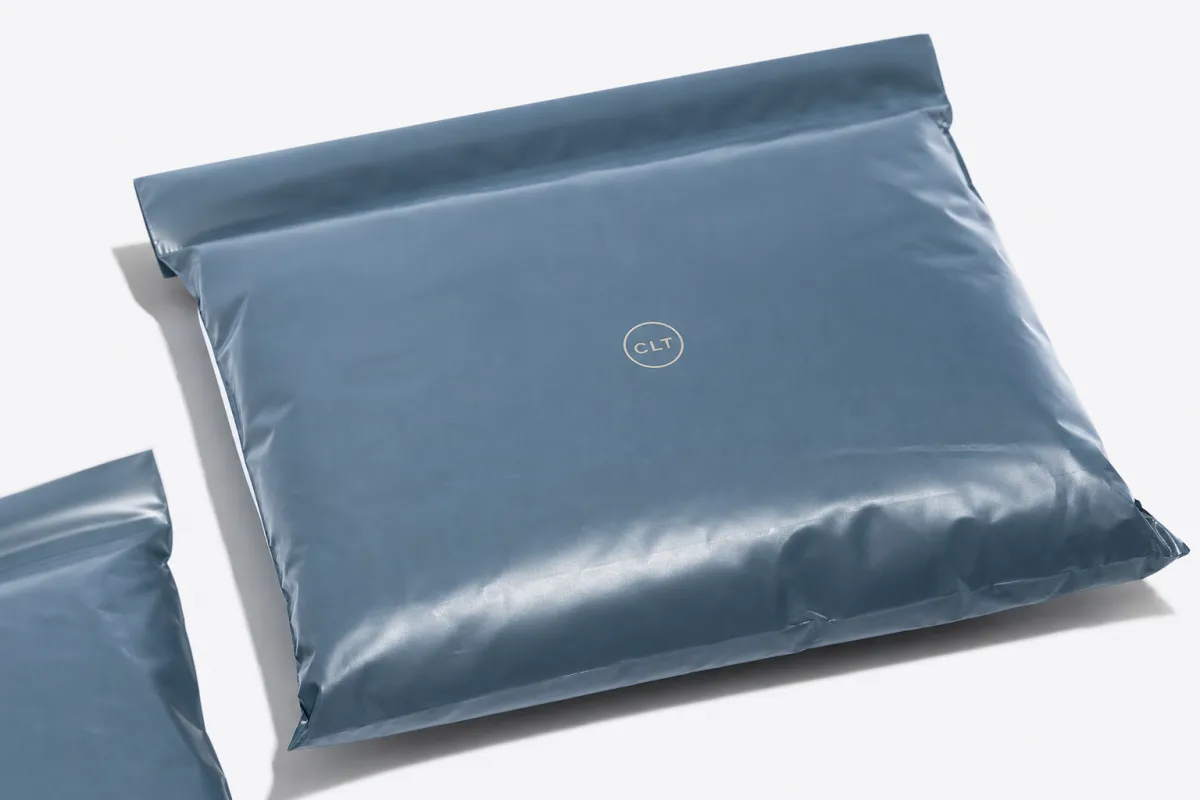
Custom poly mailers for artisans are lightweight plastic shipping bags printed with a brand name, logo, pattern, message, or full design. In plain terms, they are mailers built to carry a brand story as well as a product. The outer film is usually polyethylene-based, and the construction stays simple: a folded bag, a self-seal adhesive strip, and a printed exterior that turns shipping into a branding surface.
Picture two shipments leaving the same studio. One reaches the customer in a blank mailer that looks like every other parcel. The other arrives in a package that matches the brand palette, carries a short message, and feels intentionally finished. The product inside may be identical, yet the perceived value changes right away. That is why custom poly mailers for artisans are such a common choice for apparel, prints, stickers, stationery, accessories, and other non-fragile items.
They are popular for another reason as well: they solve an operational problem that rarely gets talked about. Small brands need packaging that is fast to pack, easy to store, and affordable to ship. A mailer usually checks all three boxes. It weighs far less than a corrugated carton, which can help trim postage on dimensional weight-sensitive services, and it takes less time to close than a box with tape, void fill, and an outer label. That matters on busy days, and honestly, it matters a lot when you are packing orders at a folding table after a market weekend.
From a packaging buyer's point of view, the value is not just visual. Custom poly mailers for artisans help align the shipping layer with the product itself. If the item is handmade, the outer package should not feel accidental. It should feel like the first chapter of the product experience.
"A good mailer should do three jobs at once: protect the shipment, reduce packing friction, and make the brand recognizable before the seal is broken."
That is the real reason custom poly mailers for artisans keep showing up in small-batch businesses. They are not trying to do everything. They are trying to do the right things well.
How custom poly mailers for artisans work
The structure is straightforward, yet the details still matter. Most custom poly mailers for artisans use a co-extruded film layer, a pressure-sensitive adhesive strip, and a printable outer surface. Some include a tear strip for easier opening; others rely on a peel-and-seal flap. Better versions use a film thickness in the 2.5 to 3 mil range for standard apparel and paper goods, while heavier items may benefit from 3.5 to 4 mil material.
Protection comes from the barrier the film creates. It keeps out dust, light moisture, and the scuffs that happen when parcels slide across conveyor belts, ride in sorting bins, or stack against other packages. A mailer is not a waterproof vault, and it should never be treated like one. For the right product category, though, custom poly mailers for artisans provide enough protection to keep an order clean and presentable through normal parcel handling.
The customer journey is part of the equation too. Packing starts at the worktable, not the carrier dock. A maker folds the item, slips in tissue or a card if needed, seals the mailer, and sends it out with a design that reinforces the brand message. That moment is where custom poly mailers for artisans become more than shipping supplies. They become part of the product story. A maker who sells botanical prints, for example, can echo the art style on the mailer exterior so the shipping package feels connected to the work inside.
There is also a clear operational edge when orders are simple. For a single-item order, a mailer often wins because it is faster, lighter, and easier to stack. For bundle orders, it can still work if the items are flat and the combined thickness fits comfortably. Once the shipment becomes irregular, breakable, or box-like, rigid packaging may be the better choice. Product mix matters more than branding preference at that point.
If you want to compare options in a broader lineup, the categories on Custom Packaging Products show how mailers fit alongside other packaging formats without forcing every business into the same setup. Custom poly mailers for artisans are one tool in a larger packaging system.
Key factors that shape the best mailer
Size is the first decision, and it is often the one buyers underestimate most. Custom poly mailers for artisans should fit the product after folding, wrapping, or inserting a backing board, not just the product by itself. Too much empty space creates a sloppy look and encourages movement inside the bag. Too little space can make sealing difficult and can stress seams or corners. A good rule is to measure the packed item, then add only the clearance needed for a clean seal and easy insertion.
Material thickness comes next. Thicker film usually improves puncture resistance and gives the mailer a more substantial feel in the hand, while lighter film may reduce cost and slightly lower storage bulk. For many handmade apparel lines, 2.5 to 3 mil is enough. For items with sharper edges, heavier zippers, or multiple inserts, 3.5 mil can be worth the extra spend. That is where custom poly mailers for artisans begin to separate from generic bulk packaging: the right spec depends on the actual product, not just the logo printed on the outside.
Print choice changes the entire tone. A one-color logo on a soft matte finish can feel refined and calm. A full-bleed graphic can feel louder and more retail-ready. Inside printing, which some suppliers offer, adds a surprise when the package opens, although it also adds cost and can extend production time. If your brand leans handmade and quiet, crowded graphics can work against the product. If your work is bold, patterned, or color-driven, then the mailer should meet that energy instead of muting it.
That is why custom poly mailers for artisans should be treated as part of packaging design, not as a separate afterthought. The color palette, iconography, typography, and message should feel like they belong to the same brand system as labels, tissue, inserts, and social imagery. A ceramicist, knitter, or printmaker may not need the same visual treatment as a jewelry brand or a home fragrance seller. Package branding should match the line, not fight it.
Brand choices that matter
Messaging matters more than many buyers expect. A short line such as "Made with care" or "Packed by hand" can feel authentic if it is restrained. A crowded wall of copy feels promotional and can weaken the premium effect. Custom poly mailers for artisans work best when the design system is clear: one dominant color, one accent, and one unmistakable mark that customers can recognize at a glance.
For artisans who want a product-specific look, the mailer can mirror the collection theme. A seasonal drop can use a limited colorway. A nature-based brand can add leaf motifs or contour lines. A studio selling minimal accessories might prefer a simple logo and a clean border. The strongest choice is usually the one that makes the package feel intentional rather than generic.
If you are deciding between mailers and a full carton system, the right answer depends on how fragile the product is and how much brand theater you need at the door. Custom poly mailers for artisans can be elegant, but they are not meant to replace every form of retail packaging. They are meant to be efficient and brand-aware at the same time.
Cost, pricing, MOQ, and unit cost for artisan orders
Pricing for custom poly mailers for artisans usually moves with five variables: size, film thickness, print coverage, number of colors, and order quantity. A simple one-color logo on a standard size mailer costs less than a full-bleed design with inside printing or a high-gloss finish. A larger run lowers the unit cost because setup and plate expenses spread over more pieces. That part is simple. The harder part is resisting the urge to over-order just because the per-unit price looks attractive.
For a small brand, MOQ matters as much as unit cost. Many suppliers set minimums around 500 to 1,000 pieces for simpler jobs and 1,000 to 3,000 pieces for more custom work, although this varies by print method and factory. If the studio ships steadily, that can be a manageable number. If demand is seasonal or unpredictable, a large MOQ can tie up cash and storage space. Custom poly mailers for artisans should support the business, not create a pile of inventory that sits for a year.
Here is a practical way to think about pricing. A 5,000-piece run of midweight custom mailers might land in a range such as $0.18 to $0.35 per unit for a simple design, with more complex artwork or thicker film pushing higher. A 1,000-piece order may cost more per bag, sometimes noticeably more, because the setup is spread across fewer units. Freight, import duties, and sample fees can change the total as well, so comparing only headline pricing can be misleading.
For readers who want a direct product starting point, the selection of Custom Poly Mailers gives a sense of how size, print style, and finish choices can affect the final build. That is often the quickest way to map the right spec before requesting quotes.
| Packaging option | Typical unit cost at 5,000 pieces | Best for | Main tradeoff |
|---|---|---|---|
| Plain poly mailer | $0.08-$0.14 | Pure shipping efficiency | No brand presence |
| Custom poly mailers for artisans | $0.18-$0.35 | Apparel, prints, stationery, accessories | Higher setup and artwork requirements |
| Custom printed boxes | $0.45-$1.20 | Fragile goods, premium unboxing, heavier items | More freight weight and packing time |
| Branded tissue plus sticker | $0.05-$0.18 | Layered presentation inside another package | Does not replace the outer shipper |
The table shows why custom poly mailers for artisans often hit a practical sweet spot. They cost more than a plain bag, less than many custom boxes, and they usually reduce pack time. That combination matters if your team is two people and a table, not a dedicated shipping department.
It also helps to compare total packaging spend, not just the outer mailer. A brand that uses a box, tape, tissue, and a branded sticker may spend more than a brand using a custom mailer plus a single insert. The right answer depends on the product class, the price point of the item, and how much of the unboxing experience you need to build into the shipment itself.
If you are trying to reduce shipping waste, the EPA's guidance on waste reduction is a useful reference point: EPA recycling and waste reduction resources. That does not mean every package should be minimal. It means the package should be justified by function, not habit. Poly mailers also deserve a practical recycling disclaimer here: local curbside rules vary a lot, and many programs do not accept flexible plastic film unless it is taken to a designated drop-off site.
Process, timeline, and production steps for a first order
A first run of custom poly mailers for artisans usually follows a predictable sequence: quote, artwork review, proof approval, sample check, production, and shipping. The quote stage is where the buyer shares dimensions, film thickness, print goals, and expected volume. The proof stage matters because it reveals layout issues before ink touches film. The sample stage, if offered, is where color and seal quality can be checked in real conditions.
Timelines vary, but a realistic planning window is often 12 to 20 business days after proof approval for standard orders, plus transit time. Faster jobs can happen if the design is simple and the factory is not overloaded. Slower jobs are common if the artwork needs revisions, if a specialty finish is involved, or if material supply is tight. Custom poly mailers for artisans are not difficult to make, but they do require the usual production discipline: accurate specs, quick approvals, and no last-minute changes that force a reset.
For a launch or seasonal drop, build a buffer. If the packaging needs to arrive before a sales spike, start the order earlier than feels comfortable. That is not pessimism; it is basic risk management. A buyer who waits until inventory is nearly gone often discovers that the packaging lead time is longer than the product lead time.
Testing also matters. Packaging performance can be checked against common transport expectations such as ISTA 3A or ASTM D4169 principles, especially if the item is sensitive to scuffing, compression, or handling abuse. See the standard-setting context at ISTA. You do not need a formal certification program for every artisan order, but the logic is useful: test the package the way carriers and customers will actually use it.
That is where custom poly mailers for artisans prove their value. If the mailer seals consistently, survives a drop test from desk height, and still looks tidy after transit, it is doing the job. If not, the failure shows up early, before the brand starts paying for replacements or handling complaints.
Common mistakes when ordering custom poly mailers for artisans
The biggest mistake is choosing a mailer that is too large. Oversized packaging wastes material, looks loose, and can invite higher postage if dimensional weight creeps up. It also makes the brand look less precise. Custom poly mailers for artisans should fit the packed product snugly enough to feel intentional without creating a crush point or making the seal awkward.
Another common error is weak artwork preparation. Low-resolution logos, thin lines, and pale colors can disappear against colored film. Artwork that looks fine on a screen can print poorly if it is not built for the substrate. This is where packaging design discipline pays off. Simple often wins. Clear contrast beats clever detail. A clean logo usually prints better than a crowded composition that tries to say too much.
Price-only buying creates its own problems. A low quote can hide flimsy film, weak adhesive, poor color accuracy, or minimums that do not fit the business. Some buyers focus on the unit price and ignore the total cost of damage, re-packing, and customer complaints. Custom poly mailers for artisans are meant to lower friction, not create a new pile of operational headaches.
Operational mistakes are common too. People forget to account for insert thickness, pack speed, and storage footprint. A mailer that folds beautifully but jams when a card and tissue are added is not a good fit. Nor is a design that looks premium but slows every order because the team needs to align the seal by hand. Packaging should work in the real tempo of the studio, not only in mockups.
Custom poly mailers for artisans should also be checked for adhesive consistency. A weak seal can create returns, while an overly aggressive seal can frustrate customers if the bag tears unpredictably. The best result is boring in the best possible way: easy to close, hard to fail, and predictable from one order to the next.
One more misstep shows up in growing studios: ordering a beautiful mailer before the line has settled. If product sizes, insert sets, or seasonal bundles are still changing, the packaging will get outdated fast. That is a pretty common trap, and it can be a costly one.
Expert tips to make custom poly mailers for artisans feel premium
Premium does not have to mean busy. In fact, custom poly mailers for artisans often look most expensive when the design system is restrained. One strong logo, one calm color field, and one well-chosen message can feel more intentional than a packed layout with every available corner filled. The eye reads restraint as confidence, especially in packaging where the opening moment is already doing emotional work.
One smart move is to tie the mailer to the product story. A textile brand might use a woven pattern inspired by fabric structure. A paper goods maker could use a fine line motif taken from the artwork style. A jewelry studio might keep the mailer minimal and let a metallic accent do the work. The goal is to create a coherent chain from product to packaging to social image. That chain is what makes custom poly mailers for artisans feel like part of the brand rather than a shipping afterthought.
Testing a small batch with real orders is better than guessing from a proof alone. Watch how customers respond. Do they post the package? Do they mention the design in reviews? Does the mailer survive transit with a clean surface? Those answers matter. A packaging choice that looks good in a render but gets crushed in practice is not a win, no matter how nice the mockup looked.
It also helps to think beyond the doorstep. Custom poly mailers for artisans can become a repeatable branding signal across reorder cycles, subscription shipments, and social shares. When customers recognize the package before they open it, the packaging is doing marketing work without trying too hard. That is a strong return on a small piece of film.
If you need a broader view of formats that support different retail packaging goals, the category mix on Custom Packaging Products can help position mailers alongside inserts, stickers, and other branded materials. In practice, the best systems are not one product; they are a set of packaging choices that speak the same visual language.
One more point: custom poly mailers for artisans can be premium and still sensible. The trick is deciding where to spend. A good print finish may be more valuable than an extra color. A slightly thicker film may be better than a flashy inside print. Better to improve the element that touches the customer and the carrier most often than to spend on a feature that hardly gets noticed.
Next steps: build, test, and refine your first run
Start with facts, not vibes. Before requesting quotes for custom poly mailers for artisans, gather three basics: exact packed dimensions, average monthly shipment volume, and a rough sense of what the package must achieve. Does the mailer need to be purely functional, or does it need to carry a strong brand moment? Will it ship soft goods only, or does it need to hold inserts and backing boards? Those answers shape the quote more than most buyers realize.
Next, decide what the first run should optimize. Speed? Durability? Visual impact? A launch order may prioritize visual clarity and fast turnaround. A steady reorder may prioritize unit cost and simpler print. If you are unsure, choose the safer path for the product class. Custom poly mailers for artisans should grow with the business, not force the business to compensate for a packaging mistake.
Then test the package in real conditions. Pack a sample order. Move it across your worktable. Stack it with other parcels. Ship it through the same service level your customers use. Track damage, packing time, and feedback from buyers. If the results are strong, scale up. If not, adjust size, thickness, or artwork before placing a larger order.
A short pilot run is usually cheaper than correcting a bad full run. That is especially true for artisan businesses, where inventory space is limited and cash flow matters. Custom poly mailers for artisans can become a standard part of the packaging system once the design, cost, and performance all line up. Until then, treat them like a controlled experiment with clear metrics.
Done well, custom poly mailers for artisans improve the economics of shipping and the quality of the brand experience at the same time. That is a rare combination. It is also why the right mailer can feel like a small decision that keeps paying off.
The clearest takeaway is simple: choose the smallest practical size, keep the artwork clean, and test the mailer with actual packed orders before you commit to a full run. If those three pieces hold together, your packaging will support the product instead of competing with it.
FAQ
What size custom poly mailers for artisans should I choose?
Measure the product after it is fully packed, including tissue, inserts, or backing boards. Leave just enough room for a clean seal without creating extra empty space. If you sell several item types, choose one or two versatile sizes instead of many narrow options. That keeps inventory simpler and makes custom poly mailers for artisans easier to reorder.
Are custom poly mailers for artisans strong enough for handmade products?
They work well for soft goods, apparel, prints, paper goods, and many non-fragile items. For products with sharp corners or breakable parts, add internal protection or choose a sturdier package. Strength depends on film thickness, seal quality, and how the product is packed inside. In other words, custom poly mailers for artisans are a fit for the right item mix, not every item.
How much do custom poly mailers for artisans cost in small quantities?
Pricing depends on size, print coverage, film thickness, and the number of colors in the design. Small orders usually carry a higher unit cost, while larger runs lower the price per mailer. Ask for quotes that separate setup, printing, and freight so you can compare options accurately. That makes it easier to judge whether custom poly mailers for artisans are the best spend for your order volume.
What do I need before ordering custom poly mailers for artisans?
Have your logo files ready, ideally in a high-resolution vector format. Know your product dimensions, typical order mix, and preferred mailer size. Decide on brand details such as color palette, finish, and whether you want a simple or bold design. The clearer your inputs, the better the first round of custom poly mailers for artisans will match your studio workflow.
How long does production usually take for custom poly mailers for artisans?
The timeline usually starts with proofing, then moves to production, then shipping to your location. Simple artwork and fast approvals shorten the schedule; revisions and sample changes extend it. Build in extra time before launches or busy sales periods so you are not waiting on packaging. For many buyers, that planning window is the difference between smooth fulfillment and a last-minute scramble for custom poly mailers for artisans.
For artisan brands, the best packaging decisions are usually the ones that hold up under real shipping conditions and still make the product feel intentional. That is why custom poly mailers for artisans remain such a practical option: they support speed, control costs, and turn ordinary transit into a more memorable brand moment.

