Buyer Fit Snapshot
| Best fit | Custom Poly Mailers for Candle Shipping projects where brand print, material claims, artwork control, MOQ, and repeat-order consistency need to be specified before quoting. |
|---|---|
| Quote inputs | Share finished size, material target, print colors, finish, packing count, annual reorder estimate, ship-to region, and any compliance wording. |
| Proofing check | Approve dieline scale, logo placement, barcode or warning zones, color tolerance, closure strength, and carton packing before bulk production. |
| Main risk | Vague material claims, crowded artwork, missing packing details, or unclear freight terms can make a low unit price expensive after revisions. |
Fast answer: Custom Poly Mailers for Candle Shipping: Film, Print, MOQ, and Carton Packing should be specified like a repeatable production item. The safest quote records material, print method, finish, artwork proof, packing count, and reorder notes in one written spec.
Production checks before approval
Compare the actual filled-product size with the drawing, then confirm tolerance on folds, seals, hang holes, label areas, and retail display edges. Reserve space for logos, QR codes, warning copy, and material claims before decorative graphics fill the panel.
Quote comparison points
Review material grade, print process, finish, sampling route, tooling charges, carton quantity, and freight assumptions side by side. A quote is only useful when the supplier can repeat the same color, closure quality, and packing count on the next order.
Custom Poly Mailers for candle shipping solve a problem that seems minor right up until it starts costing real money: the candle arrives unbroken, but the outer package looks tired, the label is wrinkled, or the jar has shifted enough to make the whole order feel careless. I have seen that happen with otherwise good products, and it usually traces back to a packout that was built for convenience instead of for the actual candle.
That is why Custom Poly Mailers for candle shipping are more than a nicer-looking pouch. They sit inside the shipping system, the brand system, and the damage-prevention system all at once. A well-sized mailer can reduce empty space, speed up fulfillment, and give the customer a first impression that feels considered rather than improvised.
For a brand like Custom Logo Things, the real question is not whether the mailer looks good on a sample table. It is whether it protects the candle, keeps labor under control, and still makes financial sense after freight, setup, and the occasional replacement order are counted. If the answer to any of those is no, the mailer is just decorative plastic.
And just to keep expectations grounded: a poly mailer is not magic armor. A lightweight soy candle in a snug inner sleeve or box can ship well in a printed mailer. A heavy glass jar with a loose lid, a metal tin with a sharp edge, or a bundled gift set may need a stronger structure. The right choice usually lives at the intersection of three things: fewer damages, faster packing, and shipping costs that do not eat the margin alive.
What Custom Poly Mailers for Candle Shipping Really Solve
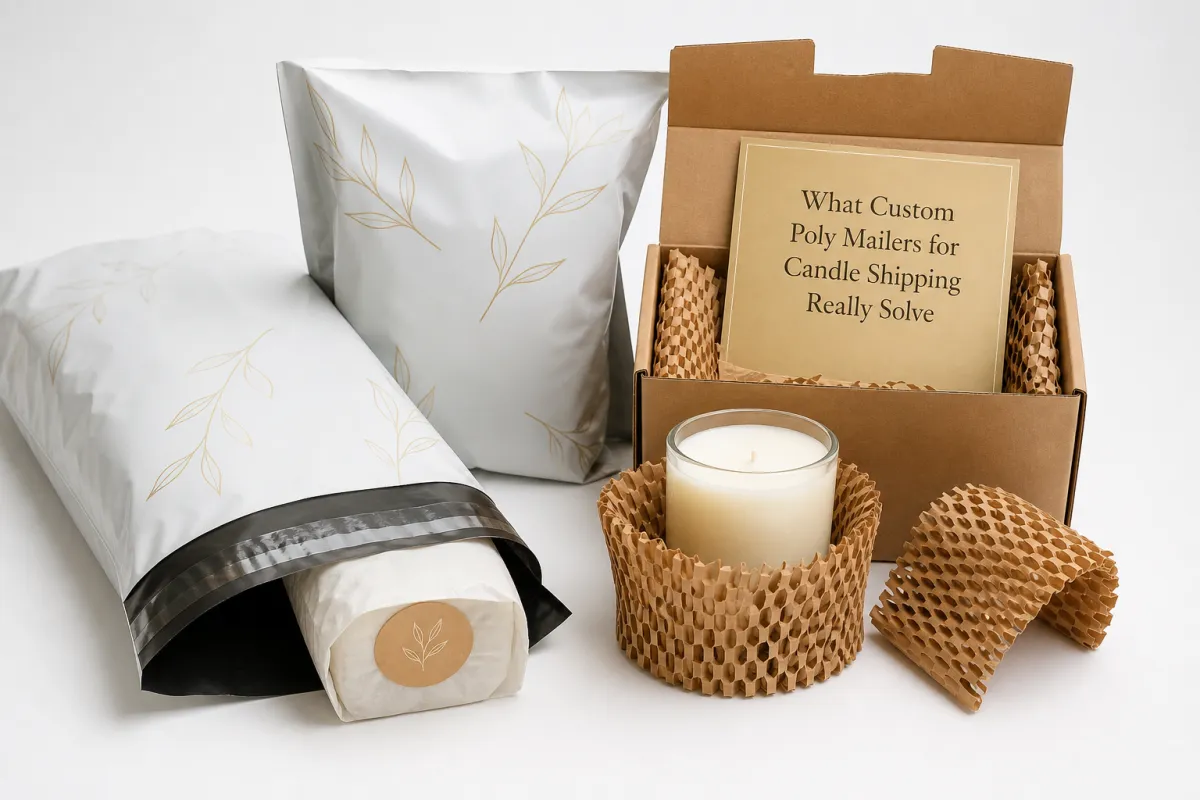
Custom Poly Mailers for candle shipping are meant to clean up the weak spots that generic packaging ignores. A plain bag can move the order, sure, but it usually leaves too much slack, too little branding control, and too much room for the package to look sloppy by the time it reaches the door.
The biggest win is fit. A mailer built around your candle SKUs cuts down on movement, and movement is what bruises boxes, loosens lids, crushes inserts, and rattles fragile pieces against hard edges in transit. When the outer package actually matches the item, the whole shipment behaves better.
There is also a warehouse benefit that gets overlooked. If the mailer is already sized for the candle line, packers spend less time stuffing voids, taping oversized cartons, or trying to force odd-shaped orders into a one-size-fits-all setup. Seconds matter in fulfillment. Multiply those seconds across a busy week and they turn into real labor savings.
I usually tell buyers to think of custom poly mailers for candle shipping as the outer layer of a system, not the system itself. They support the packout; they do not replace inner protection. If the candle can rattle around inside the bag, the carrier will eventually prove it. That is not a criticism of poly mailers. It is just how parcel handling works.
If the candle can move, the carrier will eventually prove it.
For lightweight and well-contained candles, custom poly mailers for candle shipping can be a very practical answer. For heavier jars or gift sets, they need help from inner wraps, inserts, or a small box. That distinction matters because the cheapest-looking option is not always the cheapest option once breakage, claims, and reships are included in the math.
These mailers can also fit nicely into a broader branded packaging system. They pair well with tissue, insert cards, and Custom Packaging Products that make the unboxing sequence feel deliberate. The customer might not name every piece, but they feel the consistency immediately.
One more thing: custom poly mailers for candle shipping are especially useful when a brand sells subscription kits, seasonal drops, or limited-edition scents. Those programs tend to move fast, and the packaging has to keep up without making the line slow or the parcel too bulky. That balance is where good packaging work really shows up.
How Custom Poly Mailers for Candle Shipping Work in Transit
Custom poly mailers for candle shipping work because they create a light, compact parcel that is less likely to shift around under stacking pressure. Most are made from polyethylene film, with a pressure-sensitive adhesive strip and, in some cases, a padded or bubble-lined interior if the candle needs more cushioning. Film thickness, seam construction, and closure quality matter more than many buyers expect.
Think about the shipping path in the order it actually happens. The candle is wrapped, sleeved, or boxed. Then it goes into the mailer. Then the seal is closed, the label is applied, and the parcel gets bounced through sorting belts, delivery trucks, wet porches, and the occasional rough handoff that nobody in the chain is going to apologize for. The mailer only works well if the package starts out stable.
That stability is the whole point. When the candle is held snugly, the outer mailer keeps the parcel compact and helps reduce the kind of movement that can crack a jar, loosen a lid, or scuff a printed insert. For many lighter candle orders, custom poly mailers for candle shipping avoid the need for a larger box, extra void fill, and higher dimensional weight.
But there are limits. Sharp glass rims, heavier tins, and loose-fitting closures can punch through lighter film if the packout is underbuilt. A strong mailer cannot rescue a candle that is already bouncing around inside it. If the item is sloppy before the seal goes down, the mailer usually just preserves the problem a little longer.
The fix is testing, not guessing. Run a shake test to see whether the candle shifts. Run a drop test from a realistic countertop height. Rub the label area and seal line to check whether the print and adhesive survive handling. Those are simple checks, but they tell you a lot more than a clean digital mockup ever will.
If you want a useful benchmark for parcel stress, start with the testing mindset used in ISTA methods. You do not need to turn every candle into a lab project, but the logic behind formal transit testing is worth following. It is better to know where the weak point is before a customer finds it.
If your brand uses paper inserts or fiber-based components, look at FSC guidance for paper sourcing. That does not make every material automatically sustainable, and it does not turn plastic into paper, obviously, but it does help teams make cleaner decisions about the parts of the package that can be responsibly sourced.
Moisture resistance matters too. Poly film handles damp warehouse floors, a wet porch, and the general mess of ecommerce shipping better than paper mailers usually do. That does not mean the bag is invincible. It just means custom poly mailers for candle shipping tend to keep their appearance and closure integrity better when the route gets ugly.
What most brands get wrong is assuming the outer mailer is doing all the protective work. It is not. The best results usually come from a simple stack: inner wrap or box, a mailer that fits the SKU, and a seal that stays closed from warehouse to doorstep. Custom poly mailers for candle shipping perform best when they are one layer in a controlled system, not the whole system trying to act tougher than it is.
Key Factors That Decide the Right Mailer Spec
The right spec starts with size and weight. A single 8 oz candle in a straight-sided jar is a very different shipper from a two-candle gift bundle, a luxury candle with a thick lid, or a seasonal set that includes a note card and tissue. Custom poly mailers for candle shipping need enough room for the finished packout to fit without crushing the product, but not so much room that the parcel slouches around in transit.
Material choice comes next. Standard poly is light and usually the lowest-cost option, while bubble-lined or reinforced mailers add an extra layer of protection for more fragile orders. Custom poly mailers for candle shipping can be made in different film thicknesses, often around 2.5 mil to 4.0 mil for many consumer applications, though the right number depends on jar weight, seal type, and how far the parcel has to travel.
Closure strength is a bigger deal than people want to admit. A weak adhesive strip can spoil the whole packout. If the seal pops in a hot truck, on a cold dock, or after a little pressure inside a carrier tote, the candle is exposed before it ever reaches the customer. So yes, custom poly mailers for candle shipping should be chosen with adhesive quality and seam construction in mind, not just print quality.
Branding matters too, but it should not take over the decision. Full-bleed print gives a strong visual hit. One-color logos can look cleaner and usually cost less. Matte finishes often feel more premium than glossy ones, especially if the candle line already leans toward retail-style presentation. If your packaging family already includes custom printed boxes for larger sets, the mailer should feel like part of the same system rather than a random add-on.
There is also a logistics angle. The right spec affects dimensional weight, storage footprint, and how many units fit in a case. If your team is pulling and packing orders all day, a mailer that stacks neatly and opens cleanly can save meaningful labor. Custom poly mailers for candle shipping are not just about protection. They are about making the shipment easier to move through the building without creating friction at every step.
- Light single candle: standard poly, snug fit, strong adhesive, lower print coverage.
- Premium jar candle: thicker film or bubble-lined mailer, tighter sizing, better seam strength.
- Gift set: mailer plus inner box or insert, especially if the set has multiple pieces.
- Long-distance shipping: stronger spec, more internal protection, and real transit testing.
That list is the short version. The longer version is this: custom poly mailers for candle shipping should fit the product, the carrier lane, and the labor model. If even one of those is ignored, the "cheap" option starts getting expensive fast.
Cost and Pricing: What Custom Poly Mailers Actually Run
Pricing for custom poly mailers for candle shipping is driven by size, thickness, print colors, order quantity, and finish. Simple one-color mailers in larger quantities cost far less per unit than small runs with full-bleed artwork and heavier film. The obvious part is unit price. The less obvious part is how much the bag changes total packout cost once labor, freight, and damage risk are included.
For many branded packaging programs, a plain Custom Poly Bag might land around $0.12 to $0.28 per unit at higher quantities, while a thicker or more fully printed version can move into the $0.20 to $0.45 range depending on the spec. Custom poly mailers for candle shipping with reinforced features or bubble lining can push higher. Short runs are the expensive end of the curve. That is just how the math behaves, and there is no point pretending otherwise.
Here is the comparison that matters more than the sticker price. A brand that buys the cheapest bag on paper can still spend more overall if the item shifts, damages, or requires extra labor to pack. Product packaging lives or dies on the full landed cost, not the bag cost sitting in a spreadsheet by itself.
| Option | Typical Unit Cost | Best For | Main Tradeoff |
|---|---|---|---|
| Standard poly mailer | $0.08-$0.18 | Light candles with snug inner protection | Lower protection and a more basic look |
| Printed custom poly mailer | $0.12-$0.30 | Branded candle orders and direct-to-consumer shipping | Setup and print complexity can raise cost |
| Bubble-lined mailer | $0.18-$0.40 | Fragile jars and items that need extra cushioning | More bulk and higher dimensional weight |
| Custom shipping box | $0.25-$0.65 | Heavy candles, sets, and premium retail packaging | Higher packout and freight cost, but better protection |
That table is why I tell buyers to compare formats, not just prices. If a mailer lets you skip a box, remove a layer of void fill, and save ten seconds of labor, the "more expensive" option can actually save money. That matters even more for smaller teams where order fulfillment time is as valuable as material spend.
Hidden costs deserve attention too. Samples, setup fees, freight, and warehouse storage can all surprise first-time buyers. If inventory runs tight, rush reorders hurt more than people expect. A candle brand that sells through a seasonal launch can lose more money from stockouts than from any bag upgrade, and that is before you count the headache of scrambling for replacements.
There is also a false-economy problem. The cheapest mailer is expensive the moment it starts creating claims, replacements, or refunds. A damage rate that creeps up even a little can erase the savings from a lower unit price. That is not dramatic. It is just the boring arithmetic of ecommerce shipping, and it is usually the arithmetic that wins.
For brands balancing multiple formats, it can help to compare custom poly mailers for candle shipping with Custom Poly Mailers for apparel and then check whether a subset of orders should move into Custom Shipping Boxes. Not every candle needs a box, but some absolutely do. Choosing the wrong format because it looked cheap is a classic packaging mistake that shows up later in the returns bucket.
And yes, branded packaging still needs discipline. A polished mailer that costs too much to ship is not a smart buy. A plain one that saves a penny but creates one damaged order every fifty shipments is not smart either. The right number sits in the middle, and custom poly mailers for candle shipping should be judged with that middle in mind.
Ordering Process and Timeline: From Artwork to Delivery
The ordering process for custom poly mailers for candle shipping should start with measurements, not artwork. Measure the candle SKU, the inner wrap or box, and the finished packout after everything is sealed. If the finished package is tight to the millimeter, you already have the real size. If you are guessing, the rest of the process is gonna wobble from there.
Once the size is locked, the print area and layout come next. Custom poly mailers for candle shipping usually allow enough room for a logo, pattern, website, warning copy, or a simple repeat print. Keep the artwork readable and avoid clutter. A mailer is not a billboard. It is part of the product packaging story, and the job is to support the candle rather than shout over it.
Timing varies by supplier and spec, but a realistic flow looks like this: sample or mockup review in a few business days, proof approval after edits, then production once artwork is frozen. Many domestic runs land around 10 to 15 business days after proof approval, while more complex or higher-volume programs can take longer. Freight adds its own clock, and that part tends to get ignored until pallets are already moving.
Delays usually come from avoidable stuff. Last-minute color changes. Incorrect measurements. Shipping addresses that were never confirmed. Proofs left sitting in someone’s inbox for three days because the brand owner was "about to look at it." Custom poly mailers for candle shipping are not difficult to order, but they do reward organized buyers and punish vague ones.
Inventory planning matters more than people think. A seasonal candle line can go from steady to frantic in a week, and the packaging has to keep pace. If the SKU is already proven, order ahead based on forecasted sales, not just current demand. That is one of the simplest ways to avoid emergency reorders that cost too much and arrive too late.
A smart ordering workflow usually looks like this:
- Confirm the candle SKU dimensions and packout method.
- Choose the mailer style and target thickness.
- Approve the print layout and branding details.
- Request a sample or pre-production proof.
- Test the package in real shipping conditions.
- Release the production order and buffer for freight time.
If your team is trying to move quickly, do not skip the sample stage. A sample reveals practical issues that a digital proof will never show, like seal feel, print contrast, and whether the finished package still looks clean after a little handling. Custom poly mailers for candle shipping can look perfect on a screen and still feel off in the hand. That is exactly why physical review matters.
For brands that sell through both ecommerce shipping and retail packaging channels, the mailer should also sit comfortably next to shelf-friendly materials like hang tags, inserts, and seasonal custom printed boxes. A connected package branding system is easier to maintain than a pile of one-off solutions assembled under deadline pressure.
Common Mistakes When Shipping Candles in Poly Mailers
The biggest mistake is buying custom poly mailers for candle shipping because they are cheaper than boxes and then stopping the decision there. Cheap is not a strategy. If the candle is heavy, oddly shaped, or vulnerable to impact, a mailer can be the wrong format no matter how good the print looks. The shape and weight of the candle should lead the decision.
The second mistake is weak internal protection. A mailer does not rescue a bad packout. If the candle is sliding around inside the bag, the package is underbuilt. Wrap it better, add an insert, or move to a stronger structure. Custom poly mailers for candle shipping work best when the item is already restrained before the seal is closed.
Seal failure is another common miss. The adhesive strip matters. The seam matters. The surface temperature matters. If the bag is stored somewhere too hot, too cold, or too humid, the closure can behave differently than expected. That is annoying, but it is also fixable with the right spec and storage discipline. Custom poly mailers for candle shipping should be tested under the same warehouse conditions they will actually face.
A pretty mailer that tears on the first sort line is just expensive confetti.
The branding trap is real too. Some brands over-focus on appearance and ignore function. A beautiful bag that hides barcodes, slows down the pack line, or wears out under friction does not help. Package branding has to support the warehouse and the customer at the same time. If it only helps one of them, the packaging system is incomplete.
There is also the testing mistake. Too many teams approve custom poly mailers for candle shipping from a mockup, then discover problems after customers do the testing for them. That is a rough way to learn. A small pilot run, a few drop tests, and a few shipments through normal carrier lanes will tell you far more than a neat digital render ever will.
Another error is using one mailer spec for every candle line. A 4 oz travel candle, an 8 oz jar, and a luxury two-piece set do not need the same structure. Good product packaging is segment-specific. That is true for retail packaging too. One format for everything usually means the worst fit for most things.
Finally, brands sometimes ignore sustainability pressure and customer perception. If a mailer is oversized, it wastes material. If it is paired with too much extra plastic or filler, it can feel sloppy. If sustainability matters to your audience, consider recycled-content strategies, better sizing, and paper components where appropriate. That does not mean every candle must ship in a fiber box. It means the overall system should be intentional, not lazy. Also, a quick honesty check: recycled-content film can reduce virgin resin use, but local recycling access for flexible plastic varies a lot, so do not promise curbside recyclability unless you have confirmed it in the market you sell into.
Expert Tips and Next Steps for Better Candle Shipping
Start with one hero SKU. Do not try to customize every candle size on day one. Pick the best-selling candle, define the exact packout, and test custom poly mailers for candle shipping against that one order type first. That gives you cleaner data and a much faster path to a spec you can actually use.
Use a real test batch, not a paper exercise. Order samples, pack the exact candle, add the exact insert, and ship a few units through normal ecommerce shipping routes. Track damage rate, seal performance, and how the package looks when it reaches the customer. Custom poly mailers for candle shipping should prove themselves in the hands of your actual team, not just in a design deck.
Then track the numbers that matter. Damage rate. Packing time. Customer complaints. Re-ship costs. Landed cost per shipped order. Those five metrics tell the truth faster than opinion ever will. If the mailer is too loose, size down or improve the inner wrap. If it feels overbuilt, simplify and save margin. Good packaging design is iterative. It gets sharper after the first round of data.
Here is the practical rule I use: if a custom poly mailer reduces a box, cuts two packing steps, and still protects the candle, keep going. If it only looks good in photos, cut it. Custom poly mailers for candle shipping are a business decision first and a design choice second. Brands that understand that usually make better buying calls, and they tend to have fewer awkward surprises in the warehouse.
That also means knowing when to stop pushing the mailer idea. Premium candles, heavier glass jars, or multi-piece gift sets may still need Custom Shipping Boxes for the outer shipper. The cleanest solution is not always the smallest one. Sometimes the smartest move is a box with a branded exterior and a mailer only for the lighter SKUs. That is not failure. That is range.
For buyers who want one clear next move, audit a single candle SKU, request samples, compare the finished packout against your current shipping cost, and choose the format that gives you the best balance of protection, presentation, and labor. If the numbers work, custom poly mailers for candle shipping can become a quiet but very useful part of the operation. If they do not, the box wins. Simple as that.
And if you are building a broader line of branded packaging, keep the system connected. Use the same visual language across inserts, mailers, and secondary packs. Customers notice consistency even if they never name it. They just feel that the brand handled the order like it was planned instead of improvised.
Are custom poly mailers for candle shipping safe for glass jars?
Yes, if the candle is wrapped tightly and the jar cannot move inside the mailer. Heavier jars usually need a stronger film, a secure seal, and some internal cushioning. Custom poly mailers for candle shipping should be tested with drop and shake checks before live orders go out.
What thickness works best for custom poly mailers for candle shipping?
Thicker is usually better for heavy jars, sharp edges, and long transit lanes. Lighter candles may work with standard film, but fragile glass often needs a stronger spec or added padding. Ask for thickness options and compare them against damage risk, not just price.
Do I still need a box inside custom poly mailers for candle shipping?
Sometimes yes, especially for premium candles, glass jars, or multi-piece gift sets. A poly mailer works best when the candle is already protected by an inner package or snug wrap. If the product shifts, a box may still be the smarter choice.
How much do custom poly mailers for candle shipping cost?
Pricing depends on size, thickness, print colors, and order quantity. Bulk orders usually cost less per unit, while short runs and premium finishes cost more. Always compare landed cost, not just the bag price, because custom poly mailers for candle shipping can change labor and damage rates too.
How long does production take for custom candle mailers?
Proofing and sample approval usually come first, then production after artwork is locked. Longer runs, more complex printing, and freight can stretch the timeline. Build in buffer time if you need custom poly mailers for candle shipping for a seasonal launch or promotion.

