Buyer Fit Snapshot
| Best fit | Custom Printed Corrugated Cartons projects where brand print, material claims, artwork control, MOQ, and repeat-order consistency need to be specified before quoting. |
|---|---|
| Quote inputs | Share finished size, material target, print colors, finish, packing count, annual reorder estimate, ship-to region, and any compliance wording. |
| Proofing check | Approve dieline scale, logo placement, barcode or warning zones, color tolerance, closure strength, and carton packing before bulk production. |
| Main risk | Vague material claims, crowded artwork, missing packing details, or unclear freight terms can make a low unit price expensive after revisions. |
Fast answer: Custom Printed Corrugated Cartons: Board, Finish, Dieline, and Unit Cost should be specified like a repeatable production item. The safest quote records material, print method, finish, artwork proof, packing count, and reorder notes in one written spec.
Production checks before approval
Compare the actual filled-product size with the drawing, then confirm tolerance on folds, seals, hang holes, label areas, and retail display edges. Reserve space for logos, QR codes, warning copy, and material claims before decorative graphics fill the panel.
Quote comparison points
Review material grade, print process, finish, sampling route, tooling charges, carton quantity, and freight assumptions side by side. A quote is only useful when the supplier can repeat the same color, closure quality, and packing count on the next order.
Custom Printed Corrugated Cartons: A Practical Packaging Guide
Custom Printed Corrugated Cartons do a lot more than carry a product from one point to another. A plain brown box can keep an item intact, sure, but a well-built printed carton can shape the first impression the moment someone lifts the lid, scans the shelf, or clears the packing paper off a workbench. That blend of protection and presentation is why custom printed corrugated cartons keep showing up in branded packaging, especially for businesses that care about product safety, shipping performance, and package branding in the same decision.
For packaging buyers, the print is only one part of the story. Structure, board grade, product fit, fold style, and how the carton behaves under real handling often matter more than the artwork alone. If you are comparing Custom Packaging Products or narrowing your options to Custom Shipping Boxes, it helps to know what custom printed corrugated cartons are built to do, where they perform best, and which choices actually move the needle on cost before you place an order.
I have seen plenty of packaging headaches start with artwork and end with disappointment. The stronger approach begins with the product, the shipping method, and the protection target, then builds the visual design around a carton that can survive the trip and still look polished at delivery. That sequence usually lowers waste, reduces damage, and keeps custom printed corrugated cartons from turning into a compromise between appearance and function.
What Are Custom Printed Corrugated Cartons?
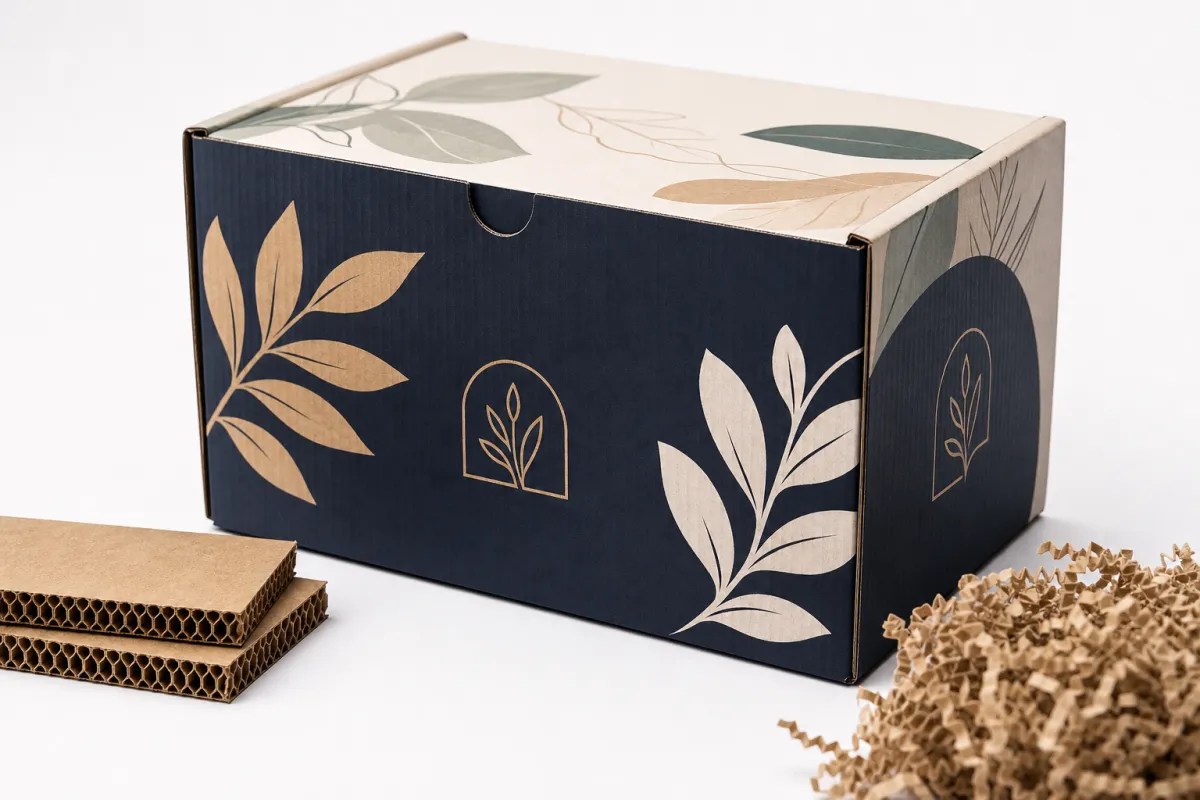
Custom printed corrugated cartons are shipping or retail-ready boxes made from corrugated board and finished with a brand-specific printed design. Corrugated board uses layered paper construction: an outer linerboard, a fluted medium in the center, and an inner linerboard that adds stiffness and crush resistance. Those layers work together to give the carton strength while keeping the package light enough for freight, fulfillment, and everyday handling. In practical terms, custom printed corrugated cartons are built to protect and present at the same time.
That combination matters because a carton often becomes the first physical touchpoint of a brand. A clear logo, a restrained message, or even a simple one-color print can make the packaging feel deliberate rather than generic. For e-commerce, that helps shape the unboxing experience. For retail packaging, it can change how a product reads on shelf. For subscription kits and product launches, custom printed corrugated cartons help a brand look organized and intentional before the product itself is even seen.
It also helps to distinguish corrugated cartons from other packaging formats. A folding carton usually uses lighter paperboard and often serves cosmetics, supplements, or smaller consumer goods. A mailer is often a corrugated or paper-based self-locking box built for direct shipment. A carton in the corrugated sense is the heavier-duty workhorse, especially for products that weigh more, ship in multiples, or need stronger edge protection. That is why custom printed corrugated cartons remain such a common choice for Shipping Boxes That need to do more than hold their shape on a shelf.
There is a practical reason they appear everywhere from direct-to-consumer fulfillment to industrial distribution. Products that are heavier, have sharp corners, or require better corner protection usually need corrugated board as the starting point. Brands that want a premium look can still achieve it through flexographic print, litho-lamination, or digital print, depending on the run size and the budget. Custom printed corrugated cartons give buyers room to match appearance with real-world performance, which is a pretty nice place to be if you are trying to keep both operations and marketing happy.
One useful way to think about it is this: custom printed corrugated cartons sit between structural packaging and brand expression. The best versions are not crowded with unnecessary decoration. They are sized correctly, printed clearly, and built around the way the product actually moves through packing, freight, and customer handling.
A carton that looks perfect on a sample table can still fail if the flute, fit, or score placement is off by a few millimeters. In corrugated packaging, details that small can decide whether the shipment arrives tidy or arrives damaged.
If you are shopping for custom printed corrugated cartons, the first question should not be “What artwork do we want?” It should be “What must this carton survive?” Once that answer is clear, the print and finish choices become much easier to make. That order of operations saves a lot of backtracking later.
How Custom Printed Corrugated Cartons Are Made
The production path for custom printed corrugated cartons starts with corrugating the medium, which means shaping the center paper into flutes and bonding it to linerboards. Those flutes create the air gap that improves cushioning and compression strength. Depending on the application, a manufacturer may use single-wall board, double-wall board, or a specialty construction that better fits a product's weight and stacking needs. The finished material becomes a sheet of corrugated board that can be printed, cut, scored, folded, and glued into a carton.
After the board is formed, the print method is selected based on design requirements and run size. Flexographic printing is common for higher-volume custom printed corrugated cartons because it is efficient and handles bold graphics, logos, and simple brand colors well. Litho-lamination is often chosen for a sharper, more retail-focused appearance because it bonds a printed top sheet onto corrugated board. Digital print can make sense for short runs, regional promotions, test launches, and projects where faster setup or variable artwork matters. Each method has its own practical range, and the right choice depends on cost, quantity, and how refined the final carton needs to look.
Once the printed board is ready, it moves into conversion. That is where die-cutting, slotting, scoring, and gluing turn flat sheets into carton blanks or ready-to-assemble boxes. A standard RSC shipping box, a tuck-style mailer, or a more custom structural design can all be made through this step. The dies and scores are not just mechanical details; they determine how the carton folds, whether the flaps meet cleanly, and how easy the box is to erect on the packing line.
Strong structural planning starts early. If the product needs inserts, internal dividers, or a tighter friction fit, those elements should be specified before the artwork is finalized. If the carton will ship flat, the panel geometry matters. If it will arrive pre-assembled, the glue points and locking features matter. Custom printed corrugated cartons are much easier to get right when the structure is settled before the press starts running. That sounds obvious, but it is one of those basics people still rush past.
Artwork, proofs, and samples
Artwork setup is where many avoidable problems begin. The dieline should guide the layout, not the other way around. Logos need room away from scores and seams. Barcodes need proper quiet space. Small type needs enough contrast to stay legible on corrugated texture. If the carton uses flexographic print, line weights and halftones need to stay within the practical limits of that process. For litho-laminated custom printed corrugated cartons, the artwork can carry more detail, but the file still needs to respect the structure underneath.
Proofing matters before a full run begins. A PDF proof can catch spelling errors, panel orientation mistakes, and copy placement issues. A sample or prototype can catch fit, fold, and closure problems that artwork alone will never reveal. For products that are fragile, valuable, or difficult to replace, I recommend at least one physical review before approving custom printed corrugated cartons for production. If the sample feels off in your hands, trust that instinct and dig deeper.
For broader industry guidance on packaging formats, materials, and performance terms, the resources at PMMI and ISTA are useful reference points. They will not choose the carton for you, but they do help explain how packaging is evaluated in real distribution conditions, which is exactly the kind of context buyers need.
Key Factors That Shape Performance and Price
Several variables affect how custom printed corrugated cartons perform and what they cost. Board grade is one of the biggest. A lightweight single-wall carton may be enough for apparel or small accessories, while heavier goods, bundled products, or fragile items may need stronger board with a higher edge crush rating. Flute profile matters too. Smaller flutes can improve printability and surface smoothness, while larger flutes often provide better cushioning and stacking strength. In practice, product weight and the shipping environment decide most of that conversation.
Print coverage changes cost as well. A single-color logo on kraft board costs much less than a carton with full coverage graphics, multiple spot colors, heavy ink laydown, or special coatings. Coatings and finishes can improve scuff resistance or visual impact, but they also add material and processing time. If the goal is premium retail packaging, a matte coating, aqueous coating, or specialty laminate may fit. If the goal is shipping efficiency, a simpler print build usually delivers better value.
Size is another major factor. Oversized cartons use more board, more ink, more freight space, and often more fill material. Worse, they can let the product shift, which increases the chance of damage. A tighter carton can reduce void fill, improve stacking, and lower shipping cost. With custom printed corrugated cartons, fit is not just a mechanical detail; it is one of the easiest ways to manage total packaging spend.
Order quantity changes the math dramatically. Printing, die-making, and conversion create fixed setup work, and those costs spread across more units as volume rises. A run of 500 cartons may carry a much higher unit price than a run of 5,000 or 10,000, even if the board stays the same. That is why custom printed corrugated cartons often become more economical once the design is stable and repeat orders are likely. A lot of buyers know this in theory, then get surprised when the numbers land on the quote sheet.
Performance variables buyers should check
- Moisture exposure: Humidity, condensation, and cold-chain handling can weaken board if the construction is not selected carefully.
- Stacking pressure: Warehousing and freight can crush cartons that lack enough edge strength or wall thickness.
- Handling distance: Longer shipments and more touch points usually call for tougher custom printed corrugated cartons.
- Temperature swings: Adhesives, inks, and board stiffness can behave differently in hot docks or cold trailers.
- Assembly labor: A carton that saves five seconds per pack can be worth more than a cheaper box that slows the line.
For buyers comparing packaging options, environmental responsibility can matter as well. Corrugated is widely recyclable in many markets, and fiber sourcing may be important for brand policy or retailer requirements. If that is part of your brief, ask whether the paper fiber carries FSC certification and what recycled content is available. The FSC site at fsc.org explains certification basics clearly, and it is worth checking if your brand has sourcing commitments tied to paper-based packaging.
One more point gets overlooked often: custom printed corrugated cartons do not exist in isolation. They interact with pallets, cartons per layer, warehouse shelving, and freight cube. A design that looks fine at the unit level may be inefficient at the pallet level. Good packaging design respects both the individual box and the larger logistics picture, because the carton has to work in the real chain, not just on a rendering.
Step-by-Step Ordering and Production Timeline
The cleanest way to order custom printed corrugated cartons is to follow a sequence that keeps structure, print, and logistics in the right order. Start with the product itself. Measure length, width, height, and weight accurately, then note whether the item is rigid, fragile, irregular, or bundled with accessories. Add the shipping method too. A carton for parcel carriers is not always the same as one built for palletized freight or retail distribution. Those details shape the board choice before any artwork is placed.
Next comes structure. Choose the carton style that matches the use case, whether that is a standard shipping box, a mailer, a roll-end style, or a die-cut retail pack. Confirm internal fit, closure type, and whether inserts, partitions, or protective corners are needed. At this stage, the supplier can provide a dieline or structural drawing. That drawing becomes the blueprint for the entire project, and for custom printed corrugated cartons it is often the point where the biggest savings are won or lost.
Artwork proofing follows. The branding team should provide logos, copy, color references, and any required regulatory or shipping marks. The file should be checked for panel placement, barcode contrast, bleed, safe zones, and print method limits. A carton printed by flexography is not built the same way as a digitally printed box, so the artwork should be adjusted for the process you actually plan to use. If the carton is part of a branded packaging moment for retail or an unboxing experience, ask for a proof that shows how the design wraps around the structure rather than only how it looks on a flat artboard.
Sampling is where real-world validation happens. A prototype can confirm that the product fits properly and that the closure tabs, inserts, or locking features behave as expected. If the carton will ship fragile items, a simple drop check or compression review can prevent a lot of trouble later. For more demanding shipments, it is reasonable to test against expectations informed by standard methods such as ASTM and ISTA procedures. The test level does not need to be excessive for every project, but it should match the risk. Skipping this step is kinda asking for a headache later.
Typical production flow
- Discovery: Gather dimensions, product weight, shipping method, branding goals, and target quantity.
- Structural design: Confirm box style, flute selection, inserts, and final carton dimensions.
- Artwork setup: Place graphics on the dieline and prepare files for the chosen print method.
- Proof review: Check color, copy, panel placement, and barcode readability.
- Prototype or sample: Validate fit, folding behavior, and protection performance.
- Production: Print, convert, finish, and prepare custom printed corrugated cartons for shipment.
- Delivery: Allow time for freight, receiving, and any final packing-line checks.
Lead times vary widely, but a straightforward project with approved artwork can often move through production in roughly 12 to 15 business days after sign-off, while more complex custom printed corrugated cartons may take longer if they require special coatings, intricate die-cutting, or larger press scheduling windows. Short-run digital jobs can move faster, while large litho-laminated projects often need more setup and queue time. The safest schedule always includes room for proofing and a sample review before full production is released.
If you want to keep the process organized, create a one-page specification sheet that includes carton style, product dimensions, board grade, print method, quantity, target ship date, and any compliance notes. Teams move faster when they are working from the same information, and custom printed corrugated cartons are much less likely to hit a snag when operations, marketing, and procurement all agree on the same brief.
Common Mistakes to Avoid with Custom Printed Corrugated Cartons
The costliest mistake is choosing a carton that is too light for the product. A design can look acceptable on paper and still collapse, split, or crush once it moves through parcel sorting or stacked warehouse storage. I have seen brands underestimate how much force even a moderate freight lane can place on custom printed corrugated cartons. If the product is heavy, awkward, or fragile, board selection should be conservative, not optimistic.
Artwork errors are another common problem. Low-resolution files, tiny type, thin lines, and poor contrast can all become visible once the design lands on corrugated board. Flexographic print can reproduce a strong brand mark very well, but it is not the place to depend on hairline detail or delicate gradients. Even digital print has limits if the design ignores fold lines, panel seams, or the physical shape of the carton. Good packaging design respects the substrate first and the artwork second.
Late ordering creates its own mess. Rushed approvals can force bad compromises, especially if a supplier has to use whatever board is immediately available. Freight may cost more, samples may get skipped, and the team may approve a proof before they have really checked the structure. That is not a great setup for custom printed corrugated cartons that need to perform on a production line or in customer shipping.
Fit problems deserve special attention. A carton that lets the product rattle around can damage both the product and the brand perception. Missing inserts, weak partitions, and poor internal clearances can also slow fulfillment because packers have to fight the box instead of working with it. In many cases, a slightly tighter carton with the right inserts is better than a larger box with extra void fill.
Watch for these red flags
- Artwork approved before the dieline is final.
- No sample checked against the real product.
- Box size chosen from a competitor's package without measuring the actual item.
- Expectations for premium print on a budget print process.
- No plan for how the carton will be assembled, stacked, or shipped.
Testing under real handling conditions matters more than visual approval alone. A carton that passes a desk review can still fail if it is dropped, stored in humidity, or packed at speed. If the product is valuable, fragile, or unusually heavy, ask for practical testing before signing off on final custom printed corrugated cartons. The result is usually a better box and fewer surprises later.
One more mistake to avoid is treating the shipping box as a separate project from the brand. The box is part of the product experience. It influences customer perception, damage rate, and labor efficiency all at once. That is why custom printed corrugated cartons should be treated as a working part of the business, not a cosmetic extra.
Pricing Insights for Custom Printed Corrugated Cartons
Pricing for custom printed corrugated cartons usually comes down to a handful of core variables: board grade, flute profile, carton size, print coverage, number of colors, finishing, and order quantity. Bigger cartons need more material. Stronger board costs more. More print coverage uses more ink and more process time. Special coatings, inserts, or unusual die-cut features increase complexity. None of that is mysterious, but it is easy to miss if you are only looking at a unit quote without the construction behind it.
Setup costs matter too. There may be charges for plates, dies, tooling, or press setup depending on the print method and structure. Those costs are fixed on the front end, which means higher quantities usually reduce the per-unit burden. A project that looks expensive at 500 units may look far more reasonable at 5,000 because the fixed setup gets spread across a larger run of custom printed corrugated cartons.
It also helps to think beyond the carton price alone. The real landed cost includes freight, storage, assembly labor, and the cost of damage. A slightly stronger box may reduce returns. A tighter size may save on carrier dimensional charges. A simpler design may pack faster. That is why the lowest quote is not always the lowest-cost option in practice.
Here is a practical comparison of common approaches buyers often review:
| Option | Typical Use | Relative Cost | Strength / Presentation | Best Fit For |
|---|---|---|---|---|
| Single-wall flexo-printed carton | Shipping and light retail use | Lower | Good strength, clean branding, efficient print | Apparel, accessories, lightweight e-commerce orders |
| Single-wall litho-laminated carton | Premium retail or branded shipping | Medium to higher | Sharper graphics and stronger shelf appeal | Subscription kits, launches, presentation-focused packaging |
| Double-wall printed carton | Heavier or more fragile shipments | Higher | Better crush resistance and stacking strength | Industrial parts, bulk packs, fragile goods, long freight lanes |
| Digital short-run carton | Test launches and smaller batches | Higher per unit, lower setup burden | Flexible artwork and faster changeover | Pilot programs, seasonal campaigns, small launches |
For rough budgeting, simple custom printed corrugated cartons can land in a wide range depending on size and volume, but a smaller run with modest print may sit near a much higher per-unit cost than a large run with similar specs. At 5,000 pieces, the difference between a plain single-color box and a more elaborate printed carton can be meaningful, especially once board grade and freight are included. The exact number depends on your structure, but the pattern stays the same: volume lowers unit cost, while complexity raises it.
If you are comparing quotes, ask suppliers for side-by-side versions that show the tradeoff between price and performance. A good supplier should be able to price a simpler print version, a stronger board option, and a premium presentation version so you can see where the dollars go. That is the easiest way to choose custom printed corrugated cartons without guessing.
There are also ways to control cost without weakening the carton. Tightening dimensions can reduce board usage and dimensional freight charges. Simplifying the number of ink colors can lower production cost. Choosing a box style that assembles faster can save labor every day. Even changing the internal fit slightly can remove unnecessary void fill. Small design choices add up, and they can make a surprisingly large difference on a full production run.
Here is the rule I keep coming back to: pay for the function you need, not for features you will never use. That mindset keeps custom printed corrugated cartons practical, especially for brands that need to balance branding, shipping, and margin at the same time.
Expert Tips and Next Steps for Better Results
Start with the product, not the artwork. That sounds simple, but it is the most reliable way to build custom printed corrugated cartons that actually work. Lock in the product dimensions, weight, handling risks, and shipping method before the creative team gets too far into layout. Once those basics are stable, the packaging design can support the brand instead of fighting the structure.
Build a checklist before you request final pricing. Include the carton style, board grade, flute choice, print method, quantity, internal fit, delivery window, and any special requirements like FSC paper, insert dividers, or outer-case labeling. The clearer the brief, the more accurate the quote. It also helps the supplier spot conflicts early, which is exactly what you want with custom printed corrugated cartons.
For fragile, premium, or unusually heavy products, order a sample or prototype. Do not skip this step just because the artwork looks good on screen. A physical sample reveals fold behavior, closure strength, print placement, and whether the carton protects the product under realistic conditions. Even a basic sample can prevent a costly mistake, and that little investment is often where projects get saved.
Align internal approvals before production starts. Operations, marketing, and fulfillment all need to agree on the carton because they each see a different part of the risk. Marketing cares about package branding. Operations cares about fit and assembly. Fulfillment cares about speed. If everyone signs off on the same custom printed corrugated cartons spec, the project usually moves more smoothly and the final result is much better.
Practical next steps
- Measure the product carefully and confirm the real shipping weight.
- Choose the carton style and request a dieline before final artwork.
- Ask for options on board grade and print method.
- Review a sample if the product is fragile, valuable, or heavy.
- Compare total landed cost, not just the carton unit price.
If you want a simple baseline, use the spec sheet, confirm the carton construction, and then treat custom printed corrugated cartons as the working standard for print, fit, and delivery planning. That keeps the process practical and gives your team a clear reference for future orders.
For buyers who want a reliable branded shipping format, custom printed corrugated cartons often sit at the right point between protection and presentation. They are strong enough for real distribution, flexible enough for useful packaging design, and adaptable enough to carry a brand message without making the box overly complicated. When the structure is right and the artwork is matched to the process, custom printed corrugated cartons can support the product, the shipping operation, and the customer experience all at once.
So the takeaway is straightforward: define the product, choose the carton structure that protects it, then build the print around the box instead of trying to force the box around the art. Do that, and custom printed corrugated cartons stop being a packaging expense and start acting like part of the product itself.
FAQ
What makes custom printed corrugated cartons different from standard shipping boxes?
They combine shipping protection with branded printing, so the carton does more than move a product. They can also be built around a specific product size, weight, and handling condition instead of relying on a generic stock format. In many cases, custom printed corrugated cartons use more deliberate structure planning, print control, and insert design to improve both presentation and transit performance.
How long do custom printed corrugated cartons usually take to produce?
Lead time depends on artwork approval, structural setup, print method, and order volume. Simple digital or short-run projects can move faster, while larger printed runs often need more setup and scheduling time. The safest timeline includes proofing, sample review, production, and freight delivery, especially if the carton is tied to a launch date or seasonal shipment.
What affects the price of custom printed corrugated cartons most?
The biggest factors are carton size, board grade, print coverage, number of colors, and quantity ordered. Special finishes, inserts, and structural complexity can raise both setup cost and unit cost. Freight, storage, and assembly labor also matter, especially for large or bulky cartons that take up more warehouse space or ship inefficiently.
Can custom printed corrugated cartons handle fragile or heavy products?
Yes, but the board grade and flute profile must match the product weight and shipping conditions. Double-wall construction, inserts, and a tighter internal fit can improve protection for heavier or more delicate items. Testing the carton under real handling conditions is the best way to confirm that custom printed corrugated cartons will perform as expected.
How should artwork be prepared for custom printed corrugated cartons?
Start with the supplier's dieline so artwork lands in the correct print areas and fold zones. Use high-resolution files, clear type, and approved color builds to avoid print surprises. Keep important elements away from scores, seams, and edges so the final box reads cleanly after conversion and the finished carton looks intentional in hand and in transit.

