Custom Printed Hang Tags Wholesale for Brand Buyers
Custom printed Hang Tags Wholesale is a practical packaging decision, not just a branding add-on. A tag can make a product feel finished, carry size or care information, and support retail presentation without changing the product itself. For buyers, the real value is that one spec can work across apparel, accessories, gifts, and seasonal launches if it is set up correctly.
The tag has to do more than look good. It needs to print cleanly, hang well, survive handling, and fit the rest of the packaging system. If the stock is too thin, the tag bends. If the finish is too busy, the design loses clarity. If the attachment details are ignored, the tag may hang poorly or interfere with barcodes and QR codes. Those are the details that decide whether the order is useful after delivery.
Repeatability is the main wholesale advantage. Once the size, stock, print method, and finishing are locked, the same tag can be reordered with less work and fewer surprises. That only works when the spec is simple enough to reproduce and the price structure is clear enough to scale.
Why custom printed hang tags wholesale matters
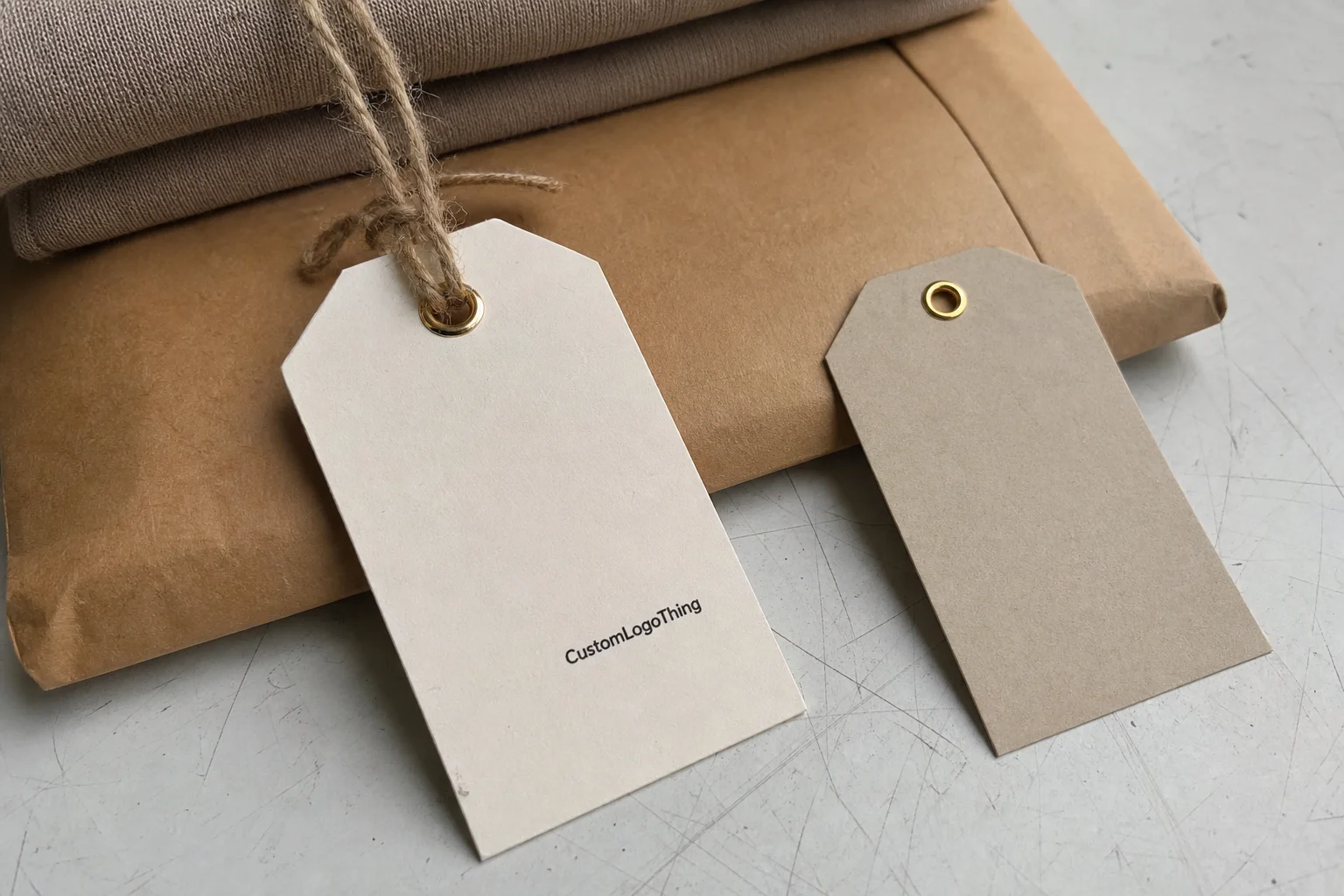
A hang tag affects perceived value quickly. A plain item with a well-made tag reads as deliberate. The same item with a weak tag can feel rushed or unfinished. That difference shows up in boutiques, pop-ups, trade shows, and ecommerce fulfillment where the customer sees the product before touching it.
The best wholesale tag programs do three things at once: identify the product, reinforce the brand, and hold up under handling. A clean card with sharp print and the right hole placement usually does more for shelf appeal than a crowded design with too many effects. In packaging, restraint often looks more controlled than decoration.
A good hang tag answers three questions quickly: what is it, why is it priced this way, and does the brand look organized enough to trust again?
That is why the tag should be treated as part of the packaging architecture. It works best when it is consistent with labels, boxes, tissue, sleeves, and other retail materials.
Spec details that change the result
Construction comes first. A single-card tag is the simplest and usually the cheapest. It fits apparel, accessories, and gift products that only need a few lines of copy. Folded or multi-panel tags give more room for care instructions, legal text, story copy, or multilingual information. Die-cut shapes can stand out more, but they add tooling and can increase waste.
Stock choice changes both the look and the handling. Coated board gives sharper color and stronger contrast. Uncoated stock feels softer and is easier to write on. Recycled stock supports a sustainability story, but the texture and brightness should still match the rest of the packaging. If paper claims matter, verify FSC certification and keep the rest of the line aligned with that choice.
Thickness matters as well. A thin tag is cheaper, but it can bend in transit or hang poorly on heavier goods. A thicker board usually feels better in hand and presents more cleanly on display. For many retail jobs, 14pt to 16pt is the practical range. Premium programs may go higher when the tag is large or highly visible.
Finish should support the design, not compete with it. Matte lamination lowers glare and gives a controlled look. Soft-touch creates a more tactile feel but can show wear if the tag is handled often. Gloss works when the artwork depends on bright color and contrast. Foil, embossing, rounded corners, and spot UV can add value, but each one should have a clear purpose.
Attachment details are easy to overlook. Hole size, hole placement, eyelets, string type, and tie length affect how the tag hangs. Barcode and QR code spacing also matters. If a code sits too close to a fold, edge, or punch, it can become unreliable after printing or handling.
Common tag constructions at a glance
| Tag style | Best for | Typical look | Relative cost |
|---|---|---|---|
| Single-card tag | Apparel, accessories, gift items | Clean and direct | Lowest |
| Folded or multi-panel tag | Care copy, story text, legal details | More space without crowding | Medium |
| Die-cut shaped tag | High-visibility retail presentation | Distinctive and memorable | Medium to high |
| Premium finish tag | Luxury apparel, specialty goods | Foil, emboss, soft-touch, spot UV | Highest |
The practical rule is simple: choose the least complicated spec that still does the job. Every extra cut, coating, or assembly step adds cost and another possible failure point.
Pricing, MOQ, and quote basics
Wholesale pricing is driven by size, stock, print coverage, finish, die cutting, hole punching, eyelets, stringing, packing, and total quantity. Simple jobs with larger quantities usually have the best unit cost. Specialty finishes and manual assembly raise the price because they add real production steps.
A useful quote separates printing from labor. A tag that is printed, cut, and packed flat is cheaper than one that is printed, punched, eyeletted, strung, and kitted by style. That matters because a low unit price can hide a higher landed cost once packing and freight are included. Buyers should ask what is included before comparing offers.
Minimum order quantity depends on the production method and the spec. Digital and short-run work can support lower minimums. Offset printing and fully finished programs usually need more volume to stay efficient. For a first order, many brands test with a smaller run and then reorder once the artwork and structure are proven in market.
Illustrative wholesale pricing at 5,000 pieces
| Spec | Typical unit price | Notes |
|---|---|---|
| 2 x 3.5 inch, 14pt C1S, 4/0, no finish | $0.10-$0.18 | Simple print and cut, no assembly |
| 2 x 3.5 inch, 16pt, matte finish, round corners, punched hole | $0.14-$0.24 | Common retail format, moderate finishing |
| Custom die-cut shape, soft-touch, foil accent, eyelet and string | $0.28-$0.60 | More setup and more handling |
These ranges are directional. Paper pricing changes, labor varies by region and factory load, and manual packing can move the number more than expected. A clear spec sheet shortens the quote cycle and makes the pricing easier to compare.
If a supplier cannot separate print, finishing, and packing costs, the quote is harder to audit. That does not make it wrong, but it does make it harder to compare against another offer.
Proofing, production, and lead time
Most custom Printed Hang Tags wholesale jobs follow the same sequence: artwork review, proofing, printing, finishing, cutting, assembly, packing, and shipping. The schedule is usually lost in the handoffs. If the file is incomplete or the buyer keeps changing copy after approval, the run slows down quickly.
Digital proofing is enough for many straightforward jobs. A physical proof is worth the extra step when color accuracy matters, when the stock is specialty paper, or when the finish changes the way the design looks under light. Foil, spot UV, embossing, and fine die lines are especially worth sampling because mockups can hide production issues.
Lead time depends on complexity. A simple tag order may ship in roughly 12 to 15 business days after proof approval. More complex orders can take longer, especially if they require custom tooling, manual stringing, mixed pack counts, or unusual stock availability. The clock starts once artwork, quantity, and spec are locked.
Shipping should be planned early if the tags are going to a warehouse, fulfillment center, or retail distribution site. Box counts, carton labels, and kitting instructions need to be agreed before production starts. If the broader packaging program needs transit guidance, the guidance in ISTA test methods is useful even though the hang tag itself is small.
Good files save time. Keep bleed at 0.125 inch, preserve safe margins, and make sure barcodes or QR codes are final size before production starts. Fonts should be embedded, images should be high enough resolution, and any variable data should be resolved before prepress builds the proof.
Materials and finishes by product type
The right tag spec depends on the product. Apparel usually needs a sturdier tag because it will be handled, folded, tried on, and shipped. Matte or soft-touch finishes can support a refined look for premium clothing. Handmade goods often do better with uncoated or recycled board, especially when the rest of the packaging uses natural textures and simpler print systems.
Candles, soaps, stationery, and gift items tend to benefit from a tag that is readable and familiar rather than ornate. If the product already has strong packaging, the tag can stay simple. If the packaging is minimal, the tag may need to carry more of the brand tone. That is a design tradeoff, not a universal rule.
Color consistency matters more than many buyers expect. A tag that has to match a carton, tissue wrap, woven label, or sleeve should be checked against the whole packaging set, not against the art file alone. Packaging works as a system. If the tag clashes with the rest of the custom printed boxes or label family, the line can feel less coherent even when each component looks fine by itself.
Specialty effects are worth it only when the tag is visible enough to justify them. Metallic foil, textured stock, edge painting, and embossing can create a stronger retail signal for premium goods. The tradeoff is practical: heavy coatings can make writing difficult, very soft papers can scuff, and dense decoration can crowd a small format. If store staff need to add batch data or pricing by hand, the surface should allow that.
For sustainability-driven brands, the paper claim should be real and legible. FSC-certified stock, recycled board, and lower-ink coverage designs usually fit better than decorative green language with no material support. If you want to compare tag stock with related formats, review [Custom Labels & Tags](/product-detail.php?category=labels), [Custom Packaging Products](/products.php), and [Wholesale Programs](/wholesale.php) together so the tag is part of one purchasing plan rather than a disconnected order.
From a packaging buyer’s point of view, the best spec is the one that survives handling, reads clearly at arm’s length, and still feels aligned with the brand after the product leaves the shipping box.
Order mistakes that cost time or money
The most common mistake is approving the layout before the dimensions are final. A size change can affect the die line, hole placement, barcode position, and safe space around the trim. If the format changes after proofing, the revisions multiply.
File quality is another problem that shows up late. Low-resolution images, missing fonts, and inconsistent color settings can force prepress to rebuild parts of the job. A clean PDF with embedded fonts, correct bleed, and final artwork is much easier to produce than a layered file with unresolved elements. If the tag contains a barcode or QR code, check it at actual size before the run starts.
Too many finishes can also make a tag less effective. On a small surface, three or four effects may feel crowded instead of premium. One strong paper choice and one controlled finish often do more for package branding than a stack of decorative features fighting for attention.
Another avoidable error is failing to define the use case. A tag for apparel is not always the right spec for accessories, candles, gift items, or retail inserts. The buyer should confirm whether the tag needs to hold a price, size, care text, SKU, QR code, or compliance information. Those requirements shape the layout and the production method.
Finally, pack counts and split quantities need to be agreed before the order starts. If one style needs 1,000 pieces and another needs 4,000, the packing instructions should reflect that from the beginning. Clear instructions reduce warehouse confusion and make reorders easier to repeat.
How to place a clean order
The cleanest ordering process starts with five basics: finished size, quantity, stock preference, print sides, and finish. After that, add hole placement, eyelets, stringing needs, and whether the tag needs barcodes or QR codes. A reference image helps more than a long paragraph because it shows the expected look, not just the listed specs.
It also helps to decide where the tag sits in the product system. Apparel, accessories, gifts, and broader retail packaging programs do not always use the same tag structure. A soft-touch card may feel right on a premium jacket but look unnecessary on a handmade soap. An uncoated tag may work well for natural goods but feel too flat for a high-contrast launch display.
For repeat orders, the real value of custom Printed Hang Tags Wholesale is consistency. Once the first run is approved, the second and third runs should move faster, with less design debate and fewer production surprises. That only happens when the first order is documented properly: final artwork, approved proof, spec sheet, and packing plan.
If the supplier can keep the quote transparent, the proof accurate, and the timing realistic, the tag becomes a stable part of the packaging program instead of a recurring problem.
Frequently asked questions
What affects the price of custom printed hang tags wholesale the most?
Quantity, stock choice, print sides, and finish complexity usually have the biggest impact on unit cost. Die cutting, specialty coatings, foil, stringing, and eyelets can raise the price because they add setup or handling steps. A complete spec sheet helps narrow the quote and reduces back-and-forth.
What is a typical MOQ for wholesale hang tag orders?
MOQ depends on size, material, and production method. Simpler tags usually support lower minimums than shaped pieces with premium finishes or assembly. If you are testing a new product line, ask for the smallest practical run and compare the unit cost against a larger reorder quantity.
How long does production usually take for custom hang tags?
Lead time depends on proof approval, stock availability, finishing, and order volume. Straightforward orders move faster than jobs that need custom tooling, multiple finishes, or manual stringing. Final artwork and approved specs are the fastest way to keep the schedule on track.
What file details are needed before quoting a hang tag order?
Final dimensions, quantity, print sides, stock preference, finish choices, and attachment details are the core inputs. Artwork should include bleed, safe margins, and any barcode or QR code requirements. If the tag must match existing packaging, include a sample image or brand guide so color and finish expectations are clear.
Can wholesale hang tags include barcode or QR code printing?
Yes. Many hang tags include barcodes, QR codes, product names, pricing, size information, and care instructions. Codes should be checked at final size before production so they remain scannable after printing and finishing. Keep critical information away from folds, punches, and heavy texture if scan reliability matters.


