Custom Private Label Caps Bulk Order for Retail Buyers
A custom Private Label Caps bulk order is not judged in one place. Buyers feel it on the front logo, read it on the inside label, and see it again in the carton and outer pack. If any one of those three layers looks improvised, the whole item feels less finished, even when the cap itself is well made. That is why the cap should be treated as a retail system, not just a blank with decoration.
The buyers who only compare embroidery prices usually miss the cost drivers that show up later. Crown shape, sweatband comfort, brim stiffness, and color consistency across cartons all affect how the product lands with the customer. A cap that wears well and arrives in clean retail packaging often outperforms a louder design that looks stronger in a mockup than in hand.
Private label programs move faster when the decisions are specific. Channel, target price, hand feel, branding locations, and packaging format should all be settled early. A sporting goods chain may want a firmer structured front and heavier embroidery. A lifestyle brand may do better with washed cotton, a lower crown, and a quieter woven patch. Same category, different commercial logic.
The cheapest cap on the quote sheet can become the most expensive cap on the shelf if weak specs create rework, packaging corrections, or delayed reorders.
If the program includes barcodes, swing tags, size stickers, or hangtags, the cap is no longer a standalone garment. It sits inside a branded packaging workflow. Many buyers keep Custom Labels & Tags on the same spec sheet so the inside label, swing tag, and carton marks all match. For broader sourcing across categories, Wholesale Programs can help keep repeat runs organized.
Why Private Label Caps Move Faster When the Details Are Right
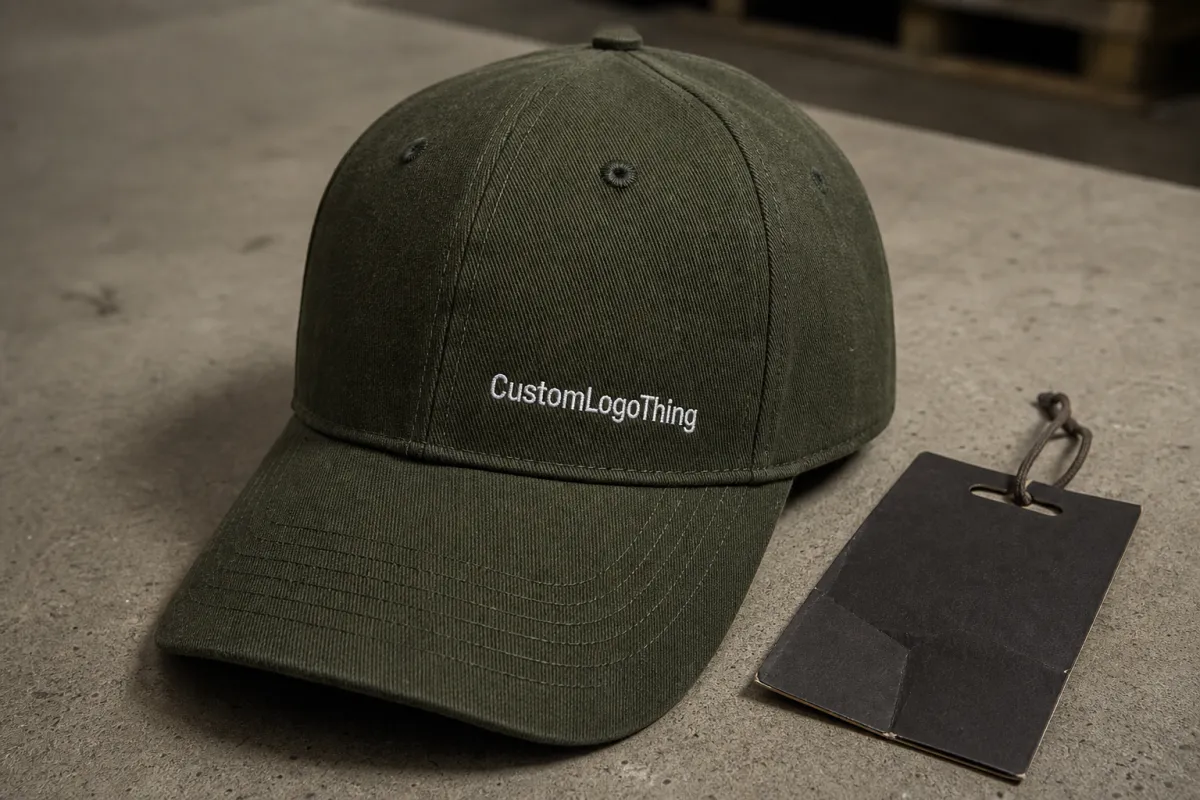
A cap program behaves more like a packaging project than a simple apparel order. The consumer is not only reading the logo. They are scanning the hangtag, checking the finish, and judging whether the brim holds its curve or the front panel collapses after a few wears. That is why a strong launch starts with the retail story first and the decoration method second.
Think about the same cap hanging on a peg hook, stacked in a display, and packed inside an ecommerce mailer. The decision changes in each setting. On shelf, the hangtag and label quality matter. In a folded stack, crown consistency and color matching matter. In a mailer, the front panels need to survive shipping without crushing, and the bill edge should not scuff. Small details become visible fast.
The programs that move cleanly usually make the basic calls early: target channel, target retail price, target hand feel, and how much branding the cap really needs. There is a clear difference between a cap built for a chain store and one built for a boutique drop. One can tolerate a heavier front panel and bolder embroidery. The other may need a softer crown, a toned-down logo, and a more refined label set.
That is also why packaging should not be treated as an afterthought. If the cap needs a size sticker, polybag, barcode, or display carton, those items belong in the quote and sample review from the start. The cap, the label, and the outer pack are part of the same sale.
Cap Styles, Fabrics, and Decoration Methods That Hold Up
The best cap style is the one that fits the channel and the customer, not the one that looks busiest in a render. For bulk retail, the most common builds are structured 6-panel caps, unstructured 5-panel or 6-panel caps, snapbacks, strapbacks, and mesh-back trucker styles. A structured front holds embroidery better and creates a cleaner retail silhouette. An unstructured crown feels softer and more casual, which is often right for lifestyle programs or seasonal drops.
Fabric choice changes both appearance and wear. Cotton twill gives a familiar hand feel and accepts embroidery cleanly. Polyester resists fade and keeps shape well in activewear or team programs. Washed cotton softens the look and can help the cap feel broken-in from day one. Mesh-back caps reduce heat buildup and work well for outdoor or utility-driven programs. Cotton-poly blends often sit in the middle, with decent structure and easier color consistency across repeat runs.
The decoration method should match the logo and the fabric. Flat embroidery is the workhorse option for clean text and smaller marks. Raised embroidery adds depth to bold logos, but it needs enough front structure to stay readable. Woven patches handle detail better than thick stitching, and rubber patches can suit sporty or tech-influenced branding. Printed labels and seam labels are useful when the front face should stay quiet but the inside still needs brand identity.
Packaging carries the rest of the story. A retail-ready cap often ships with a swing tag, polybag, size sticker, barcode label, and sometimes an inner woven label or taped seam branding. If carton marks are inconsistent, the retailer pays for the confusion later. That is why cap specification and product packaging should be built as one workflow. If you also need cartons, inserts, or mailers, Custom Packaging Products can keep the look consistent across the full program.
| Option | Typical MOQ | Typical Unit Cost | Best Use | Notes |
|---|---|---|---|---|
| Stock 6-panel cap with flat embroidery | 100-300 pcs | $3.20-$5.80 | Simple retail launches | Fastest path when color and fit are standard |
| Structured cap with woven patch and label pack | 300-500 pcs | $4.10-$7.20 | Private label programs with stronger branding | Works well for repeatable shelf presentation |
| Washed cotton or mesh-back cap with multi-location branding | 500+ pcs | $5.50-$9.00 | Premium retail or promotional programs | More setup, more finishing, more moving parts |
Fit, Construction Specs, and Quality Checks Buyers Should Lock In
The spec sheet is where a program gets protected or slowly diluted. Before production starts, lock in panel count, crown height, brim curve, closure type, stitch density, sweatband material, eyelet placement, and logo dimensions. A small change in crown depth can make the same cap feel tighter or taller, which is why reorder consistency matters more than first-run novelty.
Buyers sometimes assume that one approved sample guarantees repeatability forever. That is not safe. If the bill curve shifts by a few millimeters or the sweatband fabric changes, the cap can wear differently even if the outside still looks close. For retail, close is not enough. The second run should feel like the first one, carton after carton.
A clean approval process protects both the brand and the margin. Artwork should be documented with measurements, not only screenshots. Front logo placement, side mark placement, and inner label location should all be tied to clear dimensions from seam lines, panel centers, or crown edges. That makes it much easier to repeat the run without guesswork.
Before releasing a custom Private Label Caps bulk order to production, these checkpoints should be closed:
- Pre-production sample approval: confirm shape, hand feel, and branding placement in the same sample.
- Color review: match against a Pantone reference or approved swatch when consistency matters.
- Stitch inspection: verify density, thread tension, and clean trim on logo edges.
- Packaging verification: check hang tags, polybags, barcode labels, and carton marks before packing starts.
- Final carton count: confirm case pack quantity so retail receiving does not get delayed.
For shipments that need stronger transit control, ask how cartons are tested. Packaging teams often reference ISTA distribution methods or basic corrugated strength checks, and that matters if caps are moving through several handling points before they reach store shelves. If the program uses paperboard inserts or hang tags, FSC-certified stock is a practical way to tighten the sustainability story; the standards resource at FSC is a useful reference.
There are also a few quality issues that show up only after a few wears or a rough shipment. Embroidery that looks fine at a distance can pucker when stitched too tightly on lightweight fabric. A soft front panel can lose shape if the fuse is too light. Cheap polybags sometimes cloud or wrinkle before the carton leaves the warehouse. None of these defects are dramatic alone, but together they make a private label program feel less controlled.
Custom Private Label Caps Bulk Order Pricing and MOQ
Pricing is usually driven by six things: base cap style, fabric choice, decoration method, number of logo locations, label and packaging additions, and freight destination. A simple stock cap with one logo location is a different order from a retail program with woven labels, swing tags, size stickers, and custom packing instructions. The first quote can look attractive until the add-ons are counted.
MOQ changes with customization level. Stock shapes with basic embroidery can start lower because the factory is working from existing patterns and familiar trims. Once you ask for special labels, unique fabrics, custom inner taping, or several colorways, the minimum often rises because setup time has to be spread across more units. That is normal, and it is better to know it early than to find out after the proof is approved.
Unit cost usually drops as quantity rises, but not in a perfectly straight line. Digitizing, print screens, patch setup, and packaging prep are fixed costs that get absorbed better at higher volume. A 250-piece run may have a noticeably higher per-unit cost than a 1,000-piece run even if the cap itself looks similar. Ask for tiered pricing before you commit to the final break.
For a custom Private Label Caps bulk order, this quote checklist keeps suppliers aligned:
- Exact quantity by color and style
- Cap construction details and fabric choice
- Artwork files and decoration locations
- Label text, barcode needs, and hangtag copy
- Packaging instructions, including polybag or carton requirements
- Ship-to address, destination country, and delivery method
If the buyer already knows the target retail price, share it. A supplier can usually steer the fabric and trim package toward a realistic landed cost once the margin target is clear. That is especially useful in private label work, where the cap has to fit the shelf price as well as the brand story. If the retail target is too aggressive, the spec needs to adjust before sampling starts, not after.
Production Steps, Timeline, and Lead Time Expectations
A smooth run follows a predictable path: inquiry, spec review, artwork check, mockup or sample approval, material prep, decoration, assembly, final inspection, packing, and dispatch. The mistake many first-time buyers make is assuming the clock starts with the first email. In reality, lead time usually starts after the details are approved, because that is when the factory can release the order to the floor with confidence.
For simpler stock-cap orders, the schedule often lands around 12-18 business days after approval, depending on quantity and season. A more customized program with special labels, multiple branding locations, or several colorways can move into the 20-30 business day range before freight. Shipping sits on top of that. Domestic transit may take a few days, while ocean freight can stretch the timeline much further.
Most delays are preventable. Missing logo files, late label approvals, color changes after proofing, and packaging revisions after production starts are the usual culprits. If the cap is tied to a launch date or retail set date, those small delays become expensive quickly. The best suppliers ask for the full spec packet early and do not let the order drift into production without clear signoff.
Transit-sensitive programs also need a packaging check that respects how the goods will actually move. If caps are packed with inserts or shipped in display cartons, the carton has to protect the shape as much as the outer graphics. The ISTA resource library is a practical place to understand how carton integrity and handling expectations are usually approached. That is not overkill when the product has to arrive clean enough for shelf placement.
A custom Private Label Caps bulk order moves faster when the supplier is not forced to guess. Clear measurements, approved artwork, and locked packaging details reduce the number of handoffs between sampling, production, and packing. That saves time, and it protects the finish.
One more timing issue deserves attention: seasonal congestion. Cap programs tied to spring launches, holiday inventory, or trade-show deadlines can run into longer queues for embroidery, printing, and packing. A quote that looks attractive in a quiet month may stretch when the production floor is stacked with similar orders. Buyers who plan a buffer usually avoid the worst surprises.
What to Confirm Before You Place the Reorder and Move to Production
Before you issue the order, put the full spec packet in one place. The strongest version includes final quantity by color, approved logo artwork, label text, packaging instructions, destination address, and any carton-marking requirements. If the program also needs branded inserts or retail carton support, include that now rather than after the sample is approved.
The supplier you want is not simply the one with the lowest opening price. You want the one that reduces surprises. Repeatability and proof accuracy protect margin on future reorders, and that is where better factories quietly earn the business. A cheap quote that cannot hold color or label placement across runs usually costs more in the long run.
Compare suppliers on practical details: sample quality, response time, packaging consistency, carton labeling, and whether they can hold the same spec across repeat production. If the answer changes every time you ask about the same measurement, that is a warning sign. A retail buyer needs a partner who treats a reorder like a controlled build, not a fresh experiment.
There is also value in aligning the cap order with the label plan. Custom Labels & Tags can keep the inside story consistent, while Wholesale Programs can help when you are managing related styles across multiple channels. That is where packaging becomes easier to control and much easier to repeat.
When the style is locked, the branding locations are approved, and the packaging instructions are clear, the production path gets simpler. The order can be priced against the right spec, sampled with fewer corrections, and released with fewer delays. The quiet advantage is repeatability: a cap program that can be reordered without re-learning the whole setup is far more valuable than one that only looks good in the first run.
FAQ
How many units are typical for a custom private label caps bulk order?
MOQ depends on the cap style and decoration method. Stock shapes usually allow lower starting quantities than fully custom builds, while multiple colors or several logo placements tend to raise the minimum because setup gets spread across more variables. Ask for tiered pricing so you can compare smaller and larger breaks before committing to the final run.
What information do you need for a private label cap bulk quote?
Send the cap style, quantity, target colors, logo file, branding locations, and any packaging requirements. Include the destination zip code or country, since freight and delivery method can change the landed cost. If you already know the target retail price, share it so the supplier can suggest materials that fit the margin.
Which decoration method works best for bulk private label caps?
Embroidery is the most common choice for depth and durability on structured caps. Patches work well for detailed logos or vintage looks, while printed labels suit flat graphics and lighter branding. Match the method to the cap fabric and the logo detail, not just to the lowest setup cost.
Can I mix colors or styles in one private label cap order?
Yes, many programs allow mix-and-match colorways or related styles, but the MOQ may apply to each version. Keeping the same decoration method and label setup across styles helps preserve pricing and speed. Too many variations can complicate packing, proofing, and carton tracking, so keep the mix controlled.
How long does production usually take after approval?
Lead time starts after artwork and sample approval, not when the first quote is requested. Simple stock-cap orders often move faster than fully custom programs that need new labels or special trims. Seasonality, shipping method, and late proof changes can extend the schedule, so lock details early.

