Custom QR Code Labels for Clothing: Buyer's Guide
Custom QR Code Labels solve a plain but useful problem in apparel. A hangtag can be removed, packaging can be thrown away, and inserts get separated from the garment almost immediately. The QR label remains as a small, scannable bridge to care instructions, registration pages, product authentication, reorder links, or style-specific content. That sounds simple. It is not. The code itself may be perfect on screen and still fail once it is printed on woven tape, satin, polyester, vinyl, or pressure-sensitive stock that has to survive folding, abrasion, moisture, heat, and handling by people who are not trying to be careful.
Buyers should think about the code and the label as one system. The code carries the data, but the label controls whether the data survives contact with the real world. If the substrate stretches, the contrast softens, or the code sits too close to a seam, scan performance drops fast. The best result is not a square that looks clever in a mockup. It is a label that stays readable long enough to support packaging, product registration, loyalty signups, or anti-counterfeit verification without cluttering the garment or the broader package design.
A QR code is only useful if the label carrying it survives folding, rubbing, shipping, unpacking, and repeated handling by people who are not trying to be careful with it.
What custom qr code labels actually do on clothing
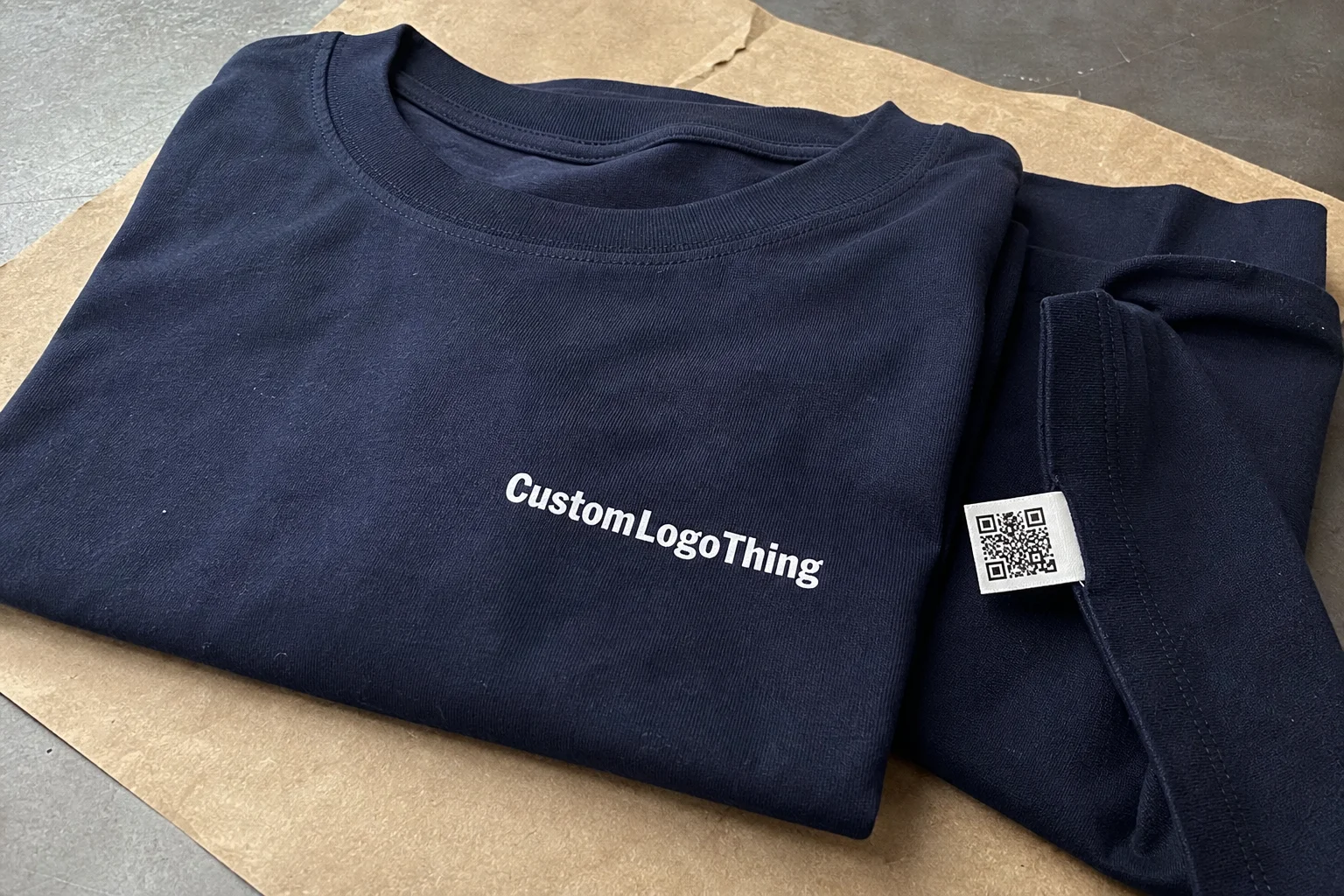
On clothing, QR labels appear in a few forms. Some are sewn into seams as woven or printed fabric labels. Others are satin or polyester care labels printed with thermal transfer, flexographic, or digital methods. For short-term use, brands also place pressure-sensitive QR labels on polybags, tissue, inserts, or outer cartons, especially when the code only needs to guide a buyer to a landing page, size chart, warranty form, or registration page.
The use case drives the material. A label inside a knit tee that gets washed every week needs a different construction from a code on a retail insert that leaves the package before the garment does. That distinction matters because custom qr code labels are often sold as if the code itself is the product. In practice, the substrate, adhesive, finish, and application method do the real work. If the face stock stretches, inks bleed, or the adhesive fails, the code becomes a dead square.
Most apparel brands use these labels for six reasons: care instructions, digital manuals, product registration, loyalty signups, style or color verification, inventory tracking, and authenticity checks. The code can support higher-value goods as well, where the buyer scans to confirm origin or check that a style has not been copied. From a packaging design point of view, the appeal is straightforward. One small mark can connect the garment to a larger customer journey without adding visual clutter.
Material choice matters here. Woven labels create a premium feel, but dense codes and fine text are harder to hold cleanly on textured yarns. Polyester and satin usually print sharper. Vinyl and pressure-sensitive stock are better for packaging inserts, polybags, and cartons than for something that will rub against skin or go through repeated laundering. If the brand also uses custom printed boxes or custom packaging products, the QR strategy should stay consistent across the entire kit so the customer sees one clear path instead of three different destinations.
For brands building a wider system, it helps to think in layers: garment label, outer retail packaging, and digital landing page. Each layer should reinforce the same message. That is where Custom Labels & Tags fit into package branding rather than acting as a separate procurement line item.
How the print and scan process works
The workflow is more methodical than many buyers expect. It starts with the destination URL or asset the code should point to, then moves into QR generation, proofing, test scans, production, and final application. A supplier should not just render the code and hope for the best. They should validate that the encoded content resolves correctly, that the QR version is not overly dense, and that the final artwork leaves enough quiet zone around the mark for a camera to pick it up quickly. The standard quiet zone is four modules on each side, and shrinking it is one of the fastest ways to create scan problems.
Resolution matters, but it is not the only factor. A code can be technically high resolution and still scan poorly if the contrast is weak or the modules are too small for the chosen process. Dark ink on a light field remains the safest option. Metallic inks, busy backgrounds, and soft gradients may look attractive, but they can reduce reliability. On textured fabric, the margin for error is even smaller because the weave itself adds visual noise.
Print method shapes the result. Flexographic printing is strong for longer runs and consistent repeat work. Digital printing handles shorter runs and variable data more efficiently. Thermal transfer is common for care labels and serialized tracking labels because it gives clean edges on compatible films and ribbons. Screen printing can produce bold marks, but it is not usually the first choice for very small QR modules unless the artwork is simple and the substrate is stable. If the code needs to change by garment, batch, region, or language, variable data printing should be part of the plan from the start.
Coating and finish can help or hurt. A gloss surface may improve ink hold on some films, but it can also create glare under store lighting and make phone cameras work harder. A matte topcoat or varnish often scans better, especially on retail packaging labels and inserts. On apparel labels, the right choice depends on the textile, the washing cycle, and whether the label sits inside the garment or on the outside of the package. For distribution testing, it is worth looking at guidance from ISTA test methods, since many packaging failures show up during handling long before they show up in a lab scan.
One practical detail buyers often miss: the smallest printable code is not the best code. A slightly larger code with better spacing usually outperforms a tight, data-heavy version. That matters when the label has to fit on a narrow seam or a small brand tag. If the destination can be simplified, the label should do less work.
Key factors that affect durability, scan rate, and appearance
Durability starts with use case. A washable garment label has to hold up against detergent, heat, steam, and repeated flexing. A packaging insert or polybag label may never see a wash cycle, but it still has to resist scuffs, static, and moisture during fulfillment. That is why custom qr code Labels for Clothing cannot be judged only by how they look at press check. They have to be tested in the environment where they will actually live.
Abrasion is a major problem. So is heat. Labels near an ironed hem, a steam press, or a dryer cycle can distort just enough to make a previously clean code unreliable. UV exposure can fade inks on some substrates, especially if the garment hangs in retail lighting or warehouse windows for long periods. If long-term readability matters, ask for material and ink combinations that have been validated with rub testing, wash testing, and the stress conditions the item will actually see.
Size and placement deserve as much attention as material. A QR code that is too small, wrapped around a curve, or placed too close to stitching can become unpredictable. A seam can interrupt the quiet zone. A fold can hide a corner. A hem can bend the code into a shape the camera cannot resolve. In apparel, a flat and stable area is worth more than a flashy layout. That is one reason buyers often place the code on a care label panel, a hangtag insert, or a flat pressure-sensitive label on packaging instead of forcing it into a decorative garment mark.
Design discipline helps scan performance. Leave blank space around the code. Keep the background simple. Use strong contrast. Avoid logos, graphics, or decorative frames that crowd the scan area. If the label also needs fiber content, care symbols, size information, or compliance text, the layout should give the QR code its own room. A cramped label can look efficient in a mockup and still perform badly on the production floor.
For brands balancing compliance and presentation, there is a practical middle ground. Use the QR code for digital depth, then keep the printed label clean enough that the garment still feels premium. That approach works well across retail packaging, package branding, and Custom Packaging Products because the code supports the experience instead of fighting it.
Material choice can be simplified with a buyer-focused view:
| Label type | Best for | Typical strengths | Typical price range |
|---|---|---|---|
| Woven fabric | Premium sewn-in garment labels | Soft feel, strong brand presentation, long life | $0.08-$0.22 per label at mid to higher volumes |
| Printed satin or polyester | Care labels and in-garment QR codes | Sharp print, flexible, good wash performance | $0.05-$0.18 per label |
| Pressure-sensitive film | Polybags, inserts, cartons, retail packaging | Fast application, clean scan quality, easy serialization | $0.04-$0.15 per label |
| Vinyl or synthetic stock | Short-term handling or special finishes | Durable face stock, good moisture resistance | $0.06-$0.20 per label |
The numbers above move with quantity, size, finishing, and artwork complexity, but they give a realistic starting point. If a quote sits far below that range, ask what was removed to get there. Usually, it is durability, finishing, or quality control.
Custom qr code labels: process and timeline from proof to production
A clean order starts with clean input. Before asking for samples, prepare the destination URL, the expected code behavior, the label size, the garment type, the quantity, and the wash or wear requirements. If the code needs to route differently by size or region, say that early. If the label needs to match a specific piece of packaging design or branded packaging, provide the artwork files and the exact placement dimensions.
A supplier should review the file before production and run a test scan on the code itself, not just the artwork mockup. They should also confirm the quiet zone, the minimum module size, and whether the selected substrate can hold the detail. That prepress step is where many problems get caught. If the code is too dense for the intended print size, the supplier should say so before the run begins.
Typical timing depends on whether the job is static or variable. For a straightforward static run, a buyer might see a proof within 1 to 3 business days and production in roughly 7 to 12 business days after approval. If the job includes serialized codes, special lamination, custom die-cutting, or multiple label constructions, 12 to 15 business days from proof approval is more realistic. Shipping time adds its own layer, especially if the labels are tied to a launch date for retail packaging or a coordinated apparel drop.
The part buyers often underestimate is sampling. A proof on paper is not the same as a sample on the final material. A good supplier should test the code on the real label stock, then scan it with common phones in normal lighting. If the label will go on a garment, it should also be checked on an actual fabric surface because cloth movement and curvature can change the reading angle. That extra check saves rework later, which is usually more expensive than the sample itself.
From a process standpoint, the order usually moves in this sequence:
- File review and code validation
- Material selection and size confirmation
- Print proof and scan test
- Buyer approval
- Production run
- Finishing, slitting, die-cutting, or folding
- Final inspection and shipment
That is the rhythm worth expecting. If a vendor skips the scan test or refuses to explain the production method, that is a signal to slow down.
Cost, pricing, and MOQ considerations for apparel labels
Price is shaped by a handful of variables: material, print method, color count, label size, finishing, quantity, and whether every code is the same or individually serialized. The biggest cost jump usually happens when a small order asks for a custom die shape, specialty adhesive, or multiple production steps. For low volumes, setup can matter more than raw material. For larger volumes, unit cost drops sharply once the press and finishing work are spread across more pieces.
MOQ is not just a supplier rule. It is often a practical cutoff for efficient production. If you are launching a new style or testing a limited run, a lower minimum may make sense even if the unit price is higher. If the label will stay in market for months, a larger run usually makes more sense because it lowers the per-piece cost and reduces the risk of reordering a slightly different version later. Buyers comparing custom qr code labels should look at total cost of ownership, not just the sticker price.
Here is the part many quotes leave out: art prep, variable data setup, proofing, freight, and replacement units for failed scans. Those may be minor on a large order and significant on a small one. Ask whether the quote includes prepress checking, one proof round, and a scan sample. If not, add those numbers before comparing suppliers. A cheap label that fails in the field can cost more in returns, rework, and lost confidence than a better-built option would have cost up front.
For apparel brands managing product packaging and retail packaging together, the label budget should sit alongside the rest of the system. A QR mark that supports reorder flow, care information, and registration may reduce customer service work later, which is a real cost offset even if it is harder to see on the PO. That is why buyers should compare not just unit price, but also the risk of unreadable labels and the labor involved in correcting them.
In practical terms, a small static run on a simple polyester label might land in the lower cost bands, while serialized, laminated, or highly durable labels will sit higher. That spread is normal. What matters is matching the build to the use case instead of buying the cheapest version and hoping the garment behaves gently.
Common mistakes that make QR labels fail on garments
The failures are usually basic, which is why they are so frustrating. Low contrast is one. Another is packing too much data into the code, which creates tiny modules that a phone camera struggles to read. Small print size is risky too, especially on fabric. If the artwork is decorative, the code can end up more like a pattern element than a functional scan target.
Production mistakes are just as common. An ink that looks strong on paper may soften on a synthetic substrate. A finish that seems attractive in a proof may introduce glare. A label that has not been tested on the actual garment can behave differently once the cloth folds, stretches, or sits against the body. Good suppliers treat the final application as the real test, not the mockup.
Operational mistakes can be even more expensive. A dead URL turns a working scan into a bad experience. Temporary landing pages create the same problem if the campaign outlives the page. Smart buyers plan for redirects so the code can keep working after the first promotion ends. If a code is going onto a product line with long shelf life, the destination needs to be maintained with the same discipline as the SKU itself.
There are also packaging-specific issues. A pressure-sensitive label stuck to a curved polybag can lift at the edges if the adhesive is not right. A glossy overlaminate can cause bright reflection under retail lights. A label applied too close to a fold line can crease after packing. These are the kinds of details that separate clean execution from expensive rework.
The easiest way to avoid the worst errors is simple: test the code on actual phones, in bright light and low light, after handling the label, and on the real garment or package surface. Do not rely on a single scan in ideal conditions. If it has to work in the real world, the real world needs to be part of the approval step.
Expert tips for better scan performance and cleaner branding
Keep the code visually quiet. Let the surrounding label graphics carry the personality, and let the QR area stay functional. That approach gives you a cleaner result than trying to make the code itself do design work. In apparel, restraint usually looks better anyway.
Use a short, stable URL or a well-managed redirect structure. If marketing wants to change the landing page later, the printed code should not need to be rerun unless the destination structure truly changes. That matters most for seasonless styles, evergreen care pages, and repeat-order programs. It is one of those practical details that makes custom qr code labels more useful over time.
Test at the smallest intended size, not the easiest one. If the code scans at the minimum approved size on the final material, you have a usable production standard. If it only scans when enlarged, the artwork still needs work. The same rule applies to finish: test matte, gloss, or soft-touch exactly as it will ship. Labels on clothing and labels on packaging do not behave identically, so each application should earn its own approval.
Choose sewn-in labels when the code needs to stay with the garment for the life of the product. Choose peel-and-stick labels when the code belongs to the package, insert, or short-term retail flow. That decision sounds obvious, but it is easy to blur the two during procurement. A good buyer keeps the function clear from the start.
Finally, build a versioning system. If styles, sizes, or batches are encoded differently, keep the naming clean so operations, retail teams, and customer service can identify the product fast. That is especially useful when the same code family supports inventory tracking, reorder flow, and customer education. Good package branding is not just decorative. It helps the team run the line better too.
Next steps: how to spec and order the right label
The decision path is straightforward once the use case is clear. Start with the garment or packaging role, define the QR destination, choose the label material, confirm the size, and set the quantity. Then decide whether the code needs to survive washing, shipping, or only the point of sale. That sequence keeps the order grounded in function instead of guesswork.
Ask for a sample or proof that matches the final finish and placement as closely as possible. A paper proof is useful, but a production-like sample is better. If the label will live on a garment, test it on the actual fabric. If it will sit on a polybag or carton, scan it in the same lighting the customer or warehouse team will see. A real test removes a lot of uncertainty.
A simple spec sheet helps the whole project move faster. Include artwork files, code destination, expected wash durability, application method, target order volume, and any packaging design requirements tied to the rest of the order. If the labels must coordinate with custom printed boxes or another branded packaging component, say that upfront so the supplier can keep the visual system consistent.
If you want the safest path, ask for one final scan check before approving the full run. That last scan on the actual surface catches more problems than a long email thread ever will. It also gives you a clean benchmark for future orders, which is valuable when styles repeat or expand.
The best custom qr code labels balance scan reliability, durability, and clean branding so the label works in the real world, not just in a design file. If you keep the material, print method, placement, and destination aligned, the code becomes a useful part of the garment and the wider product packaging system instead of a fragile add-on.
How long do custom qr code labels last on clothing?
Lifespan depends on the label material, print method, and how often the garment is washed, dried, or rubbed during use. Woven and high-durability printed labels generally hold up longer than low-cost paper or short-run adhesive options. Testing on the actual garment and finish is the best way to confirm whether the code stays readable over time.
What size should custom qr code labels be for apparel?
The right size depends on the amount of data, print quality, and how close the code will be scanned from. Larger codes are easier to scan, especially on textured fabric or curved surfaces like seams and hems. A supplier should test the code at the smallest intended size before production.
Can custom qr code labels be used on both clothing and packaging?
Yes, but the material choice may differ because clothing labels must handle wear and washing, while packaging labels may only need short-term adhesion. The same QR destination can be used across garment labels, hangtags, inserts, and outer packaging for consistent customer journeys. Each application should be tested separately because scan conditions and surface behavior are not the same.
What affects the price of custom qr code labels the most?
The biggest pricing factors are quantity, material, print process, label size, finishing, and whether each code is the same or unique. Setup and proofing can have a larger impact on small orders, while larger runs usually reduce unit cost. More durable materials and specialty finishes generally cost more, but they can reduce replacement and failure risk.
How do I make sure a QR code scans reliably after printing?
Use strong contrast, enough white space around the code, and a simple design that does not crowd the scan area. Test the final artwork on the actual label material and on the finished garment or package surface. Check scans with multiple phones, in different lighting conditions, before approving the full production run.