Buyer Fit Snapshot
| Best fit | Custom Recyclable Shoe Boxes projects where brand print, material claims, artwork control, MOQ, and repeat-order consistency need to be specified before quoting. |
|---|---|
| Quote inputs | Share finished size, material target, print colors, finish, packing count, annual reorder estimate, ship-to region, and any compliance wording. |
| Proofing check | Approve dieline scale, logo placement, barcode or warning zones, color tolerance, closure strength, and carton packing before bulk production. |
| Main risk | Vague material claims, crowded artwork, missing packing details, or unclear freight terms can make a low unit price expensive after revisions. |
Fast answer: Custom Recyclable Shoe Boxes: Materials, Costs, Steps should be specified like a repeatable production item. The safest quote records material, print method, finish, artwork proof, packing count, and reorder notes in one written spec.
Production checks before approval
Compare the actual filled-product size with the drawing, then confirm tolerance on folds, seals, hang holes, label areas, and retail display edges. Reserve space for logos, QR codes, warning copy, and material claims before decorative graphics fill the panel.
Quote comparison points
Review material grade, print process, finish, sampling route, tooling charges, carton quantity, and freight assumptions side by side. A quote is only useful when the supplier can repeat the same color, closure quality, and packing count on the next order.
Custom Recyclable Shoe Boxes: Materials, Costs, Steps is not marketing fluff. It is the packaging problem sitting behind a lot of footwear launches: how do you make a box that looks sharp, protects the shoes, and still belongs in the paper recycling stream without turning into a material salad? A glossy laminated carton can look expensive for about five minutes. Then it becomes trash with better lighting. A well-built recyclable box does the opposite. That is why custom recyclable shoe boxes matter. The real challenge is not finding a box that can be recycled in theory. The challenge is making custom recyclable shoe boxes that survive handling, support the brand, and do not burn money for no reason.
Most buyers start with the artwork and ignore the structure. That is backwards. A footwear box gets stacked in a warehouse, tossed into cartons, opened by a retailer or fulfillment team, then handled by a customer who has zero patience for crushed corners or a lid that pops off like it gave up. Good custom recyclable shoe boxes handle all of that without loading up mixed materials that make recycling harder. If you are packaging sneakers, dress shoes, kids' shoes, or performance footwear, the box is not decoration. It is the first physical proof that the brand knows what it is doing.
Custom Recyclable Shoe Boxes: What They Are and Why They Matter
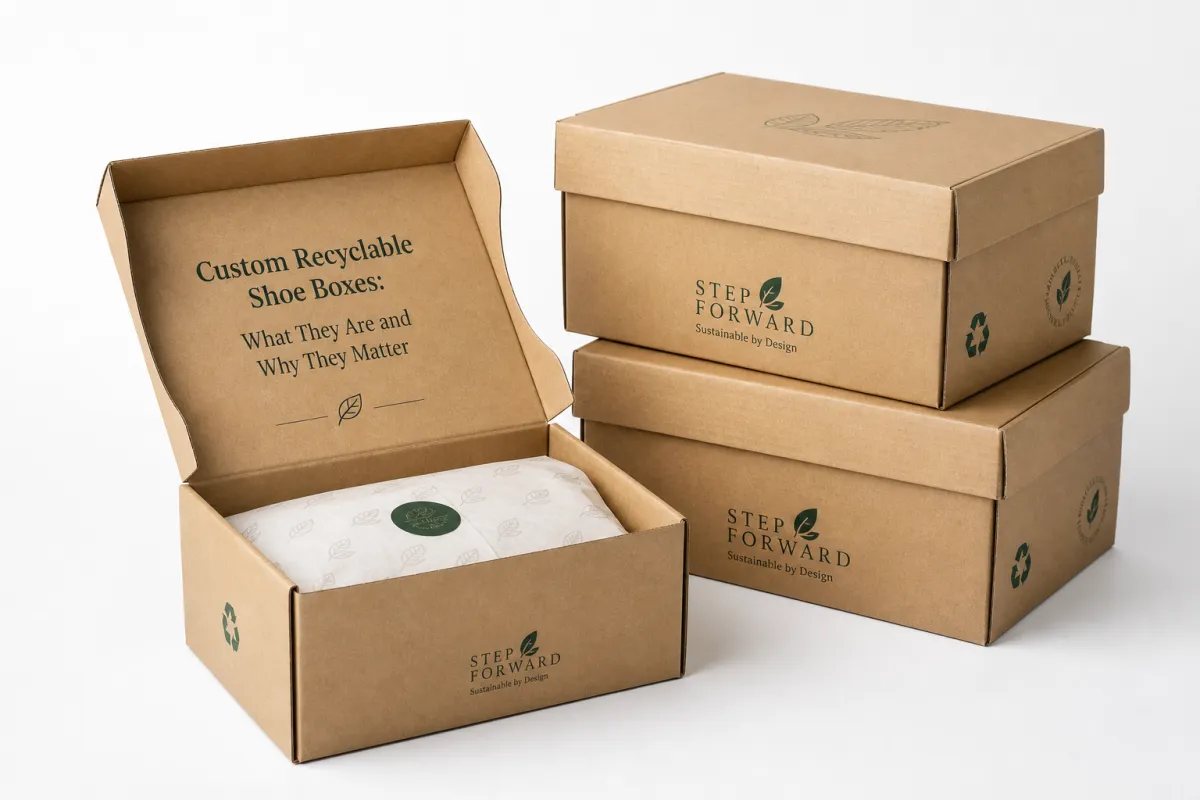
custom recyclable shoe boxes are fiber-based shoe cartons designed for standard paper recycling streams, assuming the local program accepts them and the box is not packed with plastic, foil, magnets, or other mixed components. In plain language, that usually means paperboard, kraft board, or corrugated stock, printed with recycling-friendly inks and finished with as little non-fiber material as possible. Nothing flashy. Just sensible product packaging that does its job without drama.
Why do footwear brands care? Because the box is not just a shipper. It shapes the product experience, carries the sustainability claim, and tells part of the brand story before the customer even puts the shoes on. custom recyclable shoe boxes can support a premium look without pretending to be eco-friendly theater. They also give the brand a cleaner answer when buyers ask what happens to the box after delivery. That question comes up a lot more than people admit, especially with younger shoppers and retail partners who actually pay attention to packaging.
There is a practical side too. Shoe packaging moves in high volume. A brand might ship thousands of units a month, and even a small change in board thickness, print coverage, or carton style can affect freight cost, damage rates, and storage space. custom recyclable shoe boxes are useful because they let you tune the structure to the product. Lightweight canvas sneakers do not need the same build as heavy leather boots. A kids' shoe line does not need the same insert strategy as a premium running shoe launch. That sounds obvious, yet plenty of orders still start with one box size and force the shoes to fit the box instead of the other way around.
For a packaging buyer, the real value is control. custom recyclable shoe boxes let you choose the footprint, lid style, print layout, internal support, and fiber content so the box performs like a tool instead of a decoration. You also get a cleaner claim when the materials are chosen carefully. FSC-certified board, water-based inks, and an aqueous coating are not magic words, but they are common, credible choices for brands that want packaging to feel responsible without sounding fake. If you want to talk sustainability, the structure has to back it up. Otherwise the box is just green cosplay.
One more thing. Recyclability is not the same thing as recycled content. A box can be recyclable and still be made from virgin fiber. It can also contain recycled fiber and still fail in real-world recycling if the coating, adhesive, or add-on component causes trouble. That is why custom recyclable shoe boxes should be designed as a system, not as a print job with a lid attached. Materials, glue, print, and end-of-life all need to work together.
How Custom Recyclable Shoe Boxes Are Made
The manufacturing process for custom recyclable shoe boxes starts with the board choice. For folding-style shoe cartons, common options include 300gsm to 450gsm paperboard for lighter footwear and heavier chipboard or corrugated E-flute for products that need extra crush resistance. The right stock depends on weight, shipping distance, and whether the box is mainly for retail presentation or for direct-to-consumer transport. There is no prize for picking the heaviest board on the list. Overbuilding just makes the box more expensive and harder to fold cleanly.
Material selection
Most custom recyclable shoe boxes use one of three core material families: paperboard, kraft board, or corrugated board. Paperboard works well when shelf appearance matters and the box needs crisp print reproduction. Kraft board gives a more natural look, often with a stronger perception of sustainability because the fiber color reads as plain and honest. Corrugated stock is the workhorse when the box has to handle shipping abuse, though it can add bulk unless the design is tuned carefully. A lot depends on the distribution channel. A brand selling through retail stores can usually use a lighter carton than a brand shipping direct to consumers in outer mailers.
Material thickness should match shoe weight. Lightweight lifestyle sneakers can work in 350gsm board, especially if the carton is stored and shipped in secondary cases. Heavier boots usually need thicker board or a corrugated setup with a better compression rating. If the box is too soft, the corners crush, the lid bows, and the stacked look falls apart. If it is too rigid, you pay for material that gives you little extra value. The sweet spot for custom recyclable shoe boxes is usually the lightest structure that still passes handling and transit requirements.
Printing and finishing
Printing is where many brands spend money in the wrong place. Full-coverage dark inks, heavy floods, and high-gloss laminated finishes can complicate recycling or at least muddy the message. Water-based inks, soy-based inks, and low-migration printing systems are common choices for custom recyclable shoe boxes. They deliver strong color without pushing the box into a mixed-material category. An aqueous coating can add rub resistance and a light sheen while staying closer to recyclable paper packaging than plastic film lamination. That matters if the box spends time in transit, because scuffing makes a brand-new carton look tired fast.
Foil stamping, soft-touch film, spot UV, and magnetic closures create a more luxurious feel, but they also pull the box away from simple recyclability. Sometimes that tradeoff makes sense. Sometimes it is just expensive perfume on cardboard. If the packaging has to support premium retail positioning, a limited amount of special finishing can work. If the main goal is genuinely recyclable packaging, keep the finish stack restrained. custom recyclable shoe boxes usually look best when the visual system comes from smart artwork, good typography, and controlled color use instead of a pile of decorative extras.
Structural engineering
Structure is where the box earns its keep. Tuck-top cartons, lift-off lids, drawer-style cartons, and one-piece foldable boxes all do different jobs. A standard shoe box often uses a lid-and-base format because it stores efficiently and opens easily. A mailer-style recyclable box can be a better fit for e-commerce because it resists transit damage and reduces the need for an outer shipper. For custom recyclable shoe boxes, the structure should be chosen based on how the product is sold, not on what a supplier already has sitting around.
Small details matter here. Ventilation holes can help with odor and moisture management in athletic shoes. Finger cutouts can improve opening. Internal tabs can hold the shoes in place without plastic inserts. Some brands add a paper wrap or tissue sheet to create a more polished unboxing moment without hurting recyclability. None of that needs to be fancy. It needs to be deliberate. Good custom recyclable shoe boxes are boring in the best way: they open properly, hold their shape, and do not surprise anyone for the wrong reasons.
Adhesives deserve attention too. Paper-based glues are usually fine, but the wrong adhesive can interfere with repulping or create weak seams. Ask for adhesive specifications if the box is supposed to support a recycling claim. The same goes for inserts. Paperboard inserts are better than plastic trays if the goal is cleaner recyclability. A lot of brands think the box alone matters. It does not. The whole pack needs to behave like a fiber system.
At this stage, the best custom recyclable shoe boxes are the ones that balance four things at once: structure, print quality, shipping strength, and end-of-life simplicity. Miss one, and you will feel it somewhere else. Usually in damage rates or reorders.
Key Factors That Shape Performance and Shelf Appeal
custom recyclable shoe boxes have to do two jobs at once: protect the product and sell the product. That tension is why packaging decisions get messy. If the box is too plain, it feels cheap. If it is too dressed up, it starts looking wasteful or hard to recycle. The good ones sit in the middle, where the design feels intentional and the structure is strong enough to survive real use.
Protection and compression strength
Protection starts with the board grade, but it does not end there. The box should handle stacking pressure, corner drops, and repeated handling without losing shape. For custom recyclable shoe boxes, compression strength matters more than people expect because shoe cartons are often stacked in distribution centers and retail back rooms. A box that looks fine on a sample table can fail once it sits under weight. Ask for edge crush test data or equivalent performance guidance if the packaging will spend time in transit. If the supplier can quote basis weight but not performance, that is not a good sign.
For direct-to-consumer shipments, think beyond the box itself. If the shoes will travel inside an outer mailer or shipper, the inner carton can be lighter. If the shoe box is the shipping container, the structure needs to be stronger and the closure has to be more secure. custom recyclable shoe boxes that ship directly should be tested under real conditions, not just admired on a render. Compression, drop, and vibration are boring until the first customer opens a crushed box.
Visual identity and retail impact
The shelf is not kind. A shoe box competes against dozens of other cartons, and buyers often decide in seconds whether the packaging feels worth picking up. That is why the design language matters. Use contrast that reads clearly from a distance, but keep the artwork disciplined. Good typography, one or two primary colors, and a strong logo lockup usually do more than overcomplicated graphics. custom recyclable shoe boxes do not need to shout to look premium. They need to look coherent.
Consistency is a hidden advantage. If your line includes multiple sizes or styles, the packaging system should make those variations feel related. That can happen through a shared grid, a common color band, or a simple label system. The goal is not to make every box identical. The goal is to make the range feel like a family. In practice, that helps retail teams, warehouse workers, and customers identify the product faster. It also cuts down on printing chaos because you are not rebuilding the box for every SKU. Good custom recyclable shoe boxes should scale across a line without creating a pile of one-off dielines.
Sustainability credibility
This is where a lot of brands get sloppy. If you want to make a sustainability claim, the materials and the messaging need to match. Use FSC or PEFC-certified board when possible. Choose water-based or soy-based inks. Avoid plastic lamination if the main promise is recyclability. Keep the artwork honest. If the box is recyclable only in certain programs, say that carefully. Recyclability depends on local infrastructure, and pretending otherwise makes the brand look careless.
custom recyclable shoe boxes can support a stronger sustainability message when the entire design is built around fiber recovery. That includes the box, the insert, the label, and even the tape or sticker choices if the box doubles as a mailer. It also helps to keep claims simple. "Made with recyclable paper-based materials" is cleaner than cramming five eco buzzwords onto one side panel. Customers are not fooled by packaging that sounds green but still includes a plastic window and a thick film layer. They know the costume when they see it.
Another practical point: print coverage affects both recyclability and appearance. Heavy ink usage can make a carton look rich, but too much coverage can erase the natural fiber look that many buyers now associate with responsible packaging. A restrained print system often makes custom recyclable shoe boxes feel more credible. Less clutter. Better read. Fewer excuses.
Custom Recyclable Shoe Boxes: Cost and Pricing Breakdown
Price depends on more variables than most buyers want to hear about, which is annoying but true. custom recyclable shoe boxes can land anywhere from roughly $0.20 to $1.50 per unit, depending on size, material, print, quantity, and finishing. That range is wide because shoe boxes are not one product. A plain kraft folding carton at volume is a different animal from a rigid premium presentation box with multi-color print and custom inserts.
For a basic recyclable shoe box order around 3,000 to 5,000 units, a simple folding carton with one- or two-color print might sit around $0.22 to $0.45 per unit. Add heavier board, more colors, or a better coating, and you can move into the $0.40 to $0.80 range fast. If the design includes specialty inserts, custom die-cuts, or larger mailer-style construction, costs climb further. custom recyclable shoe boxes are economical when the design is simple and the run size is decent. They get expensive when every part is treated like a branding trophy.
Tooling is another cost bucket. Dieline setup, die cutting, and plating can add a one-time charge, often anywhere from $150 to $800 depending on complexity and supplier setup. If there are multiple sizes, that tooling can multiply. The smart move is to standardize dimensions wherever possible. A unified box family reduces setup cost and simplifies replenishment. Brands That Sell several shoe types often save more over a year by using a shared size matrix than by chasing a different package for every model. That is one of those practical decisions that does not photograph well but pays the bills.
Printing method also affects price. Offset printing is common for higher-quality graphic reproduction and can be cost-effective at larger volumes. Digital printing can make sense for short runs, sampling, or frequent design changes, though unit cost is usually higher. custom recyclable shoe boxes with simple artwork and larger quantities are usually best priced with conventional print methods. If your design changes every season and the run is small, digital may save you from sitting on obsolete inventory. There is no universal winner. The right answer depends on how often the style changes and how much stock you can carry.
Freight deserves its own line item because box size affects shipping more than people realize. Flat-packed cartons ship efficiently, but oversized boards or rigid constructions take more space and raise inbound cost. That matters on big orders. A few extra millimeters in the dieline may not seem like much on-screen, but multiplied across pallets it changes cube utilization. custom recyclable shoe boxes should be sized as efficiently as possible while still leaving enough clearance for the shoes, tissue, inserts, and any protective wrap.
Sampling costs are modest, but they are not zero. Expect sample rounds, color proofs, and occasional structural revisions. A good supplier will push for sample approval before full production. That extra step saves expensive errors later. For brands buying custom recyclable shoe boxes, the cheapest quote is rarely the best one. The better question is: what is included, what can change, and how many surprises show up after the order is placed?
If you want a rough rule of thumb, think in layers: materials set the floor, printing defines the middle, finishing adds the premium, and logistics decide whether the quote still makes sense. That is the real budget picture for custom recyclable shoe boxes. Clean materials and modest finishes are usually the best value. Fancy is fine. Wasteful is not.
Step-by-Step Process and Timeline
Most buyers want a timing answer right away. Fair enough. For custom recyclable shoe boxes, a typical project often takes 12 to 20 business days after final artwork and proof approval, assuming the design is straightforward and the supplier has capacity. More complex jobs, custom inserts, or specialty print effects can stretch that to three to five weeks. The fastest way to blow a schedule is to treat packaging like an afterthought and send half-finished artwork.
Step 1: Define the box brief
Start with the shoe dimensions, the sales channel, the quantity, and the target look. Is this for retail shelves, e-commerce, or both? Will the box travel alone or inside an outer mailer? Does the brand need a luxury feel, a natural kraft look, or something minimal and technical? These answers determine what kind of custom recyclable shoe boxes you actually need. If you skip the brief, the supplier will make assumptions. Assumptions are where budget goes to die.
Gather the practical details too. Measure the longest shoe, the height including any stuffing, and the weight of the pair with inserts. If the line includes multiple sizes, build a dimension chart so the boxes do not end up too tall or too loose. A sloppy fit looks amateur and wastes material. Proper sizing is one of the easiest ways to improve custom recyclable shoe boxes without increasing decoration spend.
Step 2: Choose materials and structure
Decide whether the box should be folding carton, lid-and-base, corrugated, or mailer-style. Then choose stock and thickness. If sustainability is a priority, ask for FSC-certified board and recyclable finishes. If shipping durability matters most, request compression guidance and transit testing references such as ISTA procedures. For many custom recyclable shoe boxes, the winning formula is plain board, smart structure, and minimal finish. That combination often beats a heavily decorated box that looks strong on paper but falls apart in actual use.
Once the structure is set, review dielines carefully. Check panel sizes, glue flaps, closing tabs, and artwork bleed. A shoe box is not a poster that happens to fold. It is a functional object. If the structure is wrong, the print will not rescue it. This is also where insert design should be finalized. Paperboard inserts are often enough to keep shoes centered and prevent scuffing, which is another reason custom recyclable shoe boxes are so flexible when planned correctly.
Step 3: Approve artwork and proofs
Artwork approval is where many projects stall because nobody wants to own the details. Confirm color values, logo placement, regulatory copy, and recycling language. Ask for physical proofs if color accuracy matters. Screen mockups are not enough when the box is part of the brand experience. A gray that looks elegant online can print muddy on uncoated stock. custom recyclable shoe boxes often look best when the artwork is adjusted to suit the board, not forced to match a brand guide built for digital screens.
Pay close attention to barcode placement, size labeling, and any retailer-required information. Footwear packaging often carries sizing codes, material notes, and SKU identification. Leave room for those details without cluttering the design. Clean information hierarchy makes the box easier to use in warehouse and store environments. That is the kind of thing buyers appreciate even if they never say it out loud.
Step 4: Production and finishing
Once approved, the box moves into printing, cutting, scoring, gluing, and packing. During production, a supplier should check registration, color consistency, fold quality, and glue integrity. For custom recyclable shoe boxes, the glue lines and corners matter just as much as the print. A pretty carton that splits on the first fold is a waste of board and time. Ask for in-line or batch QC photos if the order is large or if you are working with a new vendor.
If the order includes testing, this is the stage where sample units should be pushed through compression or drop evaluation. Small improvements here save bigger problems later. A slightly stronger crease, a better tuck depth, or a tighter insert can make the difference between a neat delivery and a return pile. These details are exactly why custom recyclable shoe boxes need a production-minded approach, not just a design-minded one.
Step 5: Delivery and storage
Flat-packed cartons should be packed and labeled so the receiving team can identify size, style, and quantity quickly. Store the boxes in a dry area away from humidity, which can weaken board and affect fit. If the order is large, define how the cartons will be palletized and whether mixed SKUs can share pallets. Good pallet discipline reduces damage and confusion. It also makes replenishment simpler. In practice, custom recyclable shoe boxes work best when the back-end handling is as organized as the artwork.
Common Mistakes to Avoid With Recyclable Shoe Boxes
Most problems with custom recyclable shoe boxes are not mysterious. They come from skipping the boring parts. That is usually where the money gets burned. A nice-looking sample does not guarantee a good production run, and a sustainability claim does not mean the carton will behave well in use.
One common mistake is choosing a material that is too thin. A light carton can save pennies on paper but create crushed corners, weak stack performance, and damaged presentation. Another mistake is over-specifying premium finishes. Foil, film lamination, and soft-touch coatings may look polished, but they can make the box harder to recycle and more expensive than the product deserves. If your brand story depends on recyclability, do not sabotage it with decorative layers that add little value. The better path for custom recyclable shoe boxes is to let texture, proportion, and color do more of the work.
Another issue is ignoring the inside of the box. Many brands obsess over the lid graphic and forget the inside print, insert shape, and shoe retention. Then the shoes rattle around, scuff, or shift during transport. Small internal features prevent that. A simple kraft insert or paper cradle often does the job cleanly. Done well, custom recyclable shoe boxes feel more refined because the product arrives organized rather than loose and noisy.
Misjudging the size is also common. Too much empty space makes the box bulky and wasteful. Too little space makes assembly frustrating and increases the risk of product deformation. Size charts should be based on actual shoe samples, not catalog guesses. And if there are multiple size runs, do not assume one carton will work across all of them. That shortcut creates a lot of annoying repacking. custom recyclable shoe boxes should fit the product with just enough clearance for practical packing, not a heroic amount of optimism.
There is also the packaging claim problem. If the box is "recyclable" but the insert is plastic, the tape is excessive, and the finish is a film laminate, the claim starts to sound thin. Better to be specific and accurate than broad and vague. If the box is recyclable paperboard with an aqueous coating and paper insert, say that. If it depends on local recycling acceptance, say that too. Honest language builds trust. Sloppy language does not. That rule applies to custom recyclable shoe boxes just as much as it does to the shoes inside.
Finally, many teams rush the proof stage. Color shifts, misaligned folds, barcode errors, and copy mistakes are all preventable. Once a full production run is moving, correction gets expensive fast. Review every panel, not just the front. A well-managed proof process is not glamorous, but it protects margin. With custom recyclable shoe boxes, proofing is not admin work. It is risk control.
Expert Tips and Next Steps for Your Next Order
If the goal is to make custom recyclable shoe boxes that feel premium without wasting money, start with standardization. Build one or two carton families that cover most sizes, then tune the artwork by style or collection. That reduces dieline chaos and keeps production cleaner. Brands that rebuild the box for every SKU tend to spend more and get less than they expect. Packaging should support the line, not multiply the workload.
Next, simplify the finish stack. Let the board itself do some of the visual work. Kraft stock, controlled print coverage, and a good structure can look sharp without extra surface treatment. If you need a more elevated look, choose one upgrade and make it count. Maybe that is a deep spot color. Maybe it is a soft matte aqueous coating. Maybe it is a better unboxing insert. The point is to focus the budget. custom recyclable shoe boxes usually work best when one thing gets upgraded instead of everything getting a little worse.
Ask for performance data, not just pictures. Compression guidance, ECT or BCT references, and transit test results matter when the box will move through warehouses or e-commerce channels. If your supply chain is rough, insist on sample validation before full production. A supplier who can explain board choices and test logic is usually more useful than one who only talks about "premium feel." With custom recyclable shoe boxes, physical performance is the part that protects profit.
Think about the unpacking sequence too. The customer should be able to open the box without tearing it apart, and the contents should feel orderly when removed. Tissue paper, a paper insert, and a clean closing tab can make a simple box feel composed. That experience does not need plastic tricks. It needs intention. Good custom recyclable shoe boxes create a clear moment when the customer opens the lid and sees a product that feels cared for.
Finally, build the sustainability story around facts. Use certified board where possible. Avoid overstating recyclability. Keep non-fiber elements to a minimum. If the box is meant to be recycled with paper packaging, design it to behave like paper packaging. That sounds obvious because it is. Plenty of brands still hide behind vague language and hope nobody notices the laminated surface or plastic insert. People notice. The better route is calmer and more credible. custom recyclable shoe boxes do not need to pretend. They just need to be well made.
Before placing an order, check these five points: shoe dimensions, board type, print finish, insert style, and expected shipping path. If those are defined, the rest becomes manageable. If they are not, the project will drift. Packaging projects that drift always cost more than they should. custom recyclable shoe boxes work best when the decision set is narrow and practical.
Comparison table for custom recyclable shoe boxes
| Option | Best use case | Confirm before ordering | Buyer risk |
|---|---|---|---|
| Paper-based packaging | Retail, gifting, cosmetics, ecommerce, and lightweight products | Board grade, coating, print method, sample approval, and carton packing | Weak structure or finish mismatch can damage the unboxing experience |
| Flexible bags or mailers | Apparel, accessories, subscription boxes, and high-volume shipping | Film thickness, seal strength, logo position, barcode area, and MOQ | Low-grade film can tear, wrinkle, or make the brand look cheap |
| Custom inserts and labels | Brand storytelling, SKU control, retail display, and repeat-purchase prompts | Die line, adhesive, color proof, copy approval, and packing sequence | Small errors multiply quickly across thousands of units |
Decision checklist before ordering
- Measure the real product and confirm how it will be packed, displayed, stored, and shipped.
- Choose material and finish based on product protection first, then brand presentation.
- Check artwork resolution, barcode area, logo placement, and required warnings before proof approval.
- Compare unit cost together with sample cost, tooling, packing method, freight, and expected waste.
- Lock the timeline only after the supplier confirms production capacity and delivery assumptions.
FAQ
Are custom recyclable shoe boxes really recyclable everywhere?
Not always. Recyclability depends on local curbside programs and the materials used in the box. Fiber-based custom recyclable shoe boxes with simple inks and minimal coatings are usually the safest choice, but local acceptance still matters.
What material is best for custom recyclable shoe boxes?
For retail presentation, paperboard is often the first choice. For more demanding shipping, corrugated or heavier board may be better. The best material for custom recyclable shoe boxes depends on weight, handling, and whether the box ships alone or inside an outer mailer.
Can I still make the box look premium without plastic lamination?
Yes. Strong typography, good proportion, controlled color, and a matte aqueous coating can go a long way. Plenty of premium-looking custom recyclable shoe boxes use restrained design instead of plastic film.
How much should I budget for custom recyclable shoe boxes?
For moderate volumes, a simple recyclable shoe carton can often fall around $0.22 to $0.45 per unit, while more complex versions can reach $0.80 or higher. Quantity, print complexity, and structure change the number fast. custom recyclable shoe boxes are usually most economical when they are standardized and printed with restraint.
How long does production usually take?
A straightforward order often takes 12 to 20 business days after final proof approval. Larger or more complex custom recyclable shoe boxes can take longer, especially if sampling or structural revisions are needed.
Do I need testing before production?
If the box will ship through a rough supply chain, yes. Ask for compression and transit guidance, especially if the shoes are heavy or the carton replaces an outer shipper. Testing protects both the product and the brand. For custom recyclable shoe boxes, skipping validation is a tidy way to pay twice.
Done well, custom recyclable shoe boxes are not a compromise. They are a cleaner packaging choice that can protect the shoes, support the brand, and keep the materials simpler for the customer and the recycler. If the box is sized correctly, printed intelligently, and built from the right board, it does the job without drama. That is usually the best packaging outcome anyway. The takeaway is simple: define the shoe dimensions, choose the lightest board that still passes handling tests, keep finishes fiber-friendly, and verify the box before you run full production. custom recyclable shoe boxes should earn their place by performing, not by making noise. When you Choose the Right structure, the right finish, and the right production spec, custom recyclable shoe boxes become one of the quiet advantages in a footwear launch.

