Buyer Fit Snapshot
| Best fit | Custom Recycled Cardboard Boxes Supplier projects where brand print, material claims, artwork control, MOQ, and repeat-order consistency need to be specified before quoting. |
|---|---|
| Quote inputs | Share finished size, material target, print colors, finish, packing count, annual reorder estimate, ship-to region, and any compliance wording. |
| Proofing check | Approve dieline scale, logo placement, barcode or warning zones, color tolerance, closure strength, and carton packing before bulk production. |
| Main risk | Vague material claims, crowded artwork, missing packing details, or unclear freight terms can make a low unit price expensive after revisions. |
Fast answer: Custom Recycled Cardboard Boxes Supplier: Board, Finish, Dieline, and Unit Cost should be specified like a repeatable production item. The safest quote records material, print method, finish, artwork proof, packing count, and reorder notes in one written spec.
Production checks before approval
Compare the actual filled-product size with the drawing, then confirm tolerance on folds, seals, hang holes, label areas, and retail display edges. Reserve space for logos, QR codes, warning copy, and material claims before decorative graphics fill the panel.
Quote comparison points
Review material grade, print process, finish, sampling route, tooling charges, carton quantity, and freight assumptions side by side. A quote is only useful when the supplier can repeat the same color, closure quality, and packing count on the next order.
Custom Recycled Cardboard Boxes Supplier: What to Know
If you are shopping for a Custom Recycled Cardboard boxes supplier, start here: recycled board is not a downgrade by default. Good fiber, the right flute, and a box spec built around the product can protect just as well as virgin stock in plenty of real-world situations. You also get a cleaner sustainability story and less material waste. A good custom recycled cardboard boxes supplier does more than sell corrugated sheets. They balance strength, print quality, Fit, and Cost so the package actually works in a warehouse, on a truck, and on a shelf.
That balance matters more than people usually admit out loud. A recycled-content box can still stack neatly, print sharply, and ship safely if the spec is right. A bad spec does the opposite. It crushes early, scuffs in storage, or costs more because somebody guessed instead of measuring. The sections below explain how a custom recycled cardboard boxes supplier operates, how pricing gets built, and how to compare suppliers without getting lost in packaging jargon.
What a Custom Recycled Cardboard Boxes Supplier Actually Does
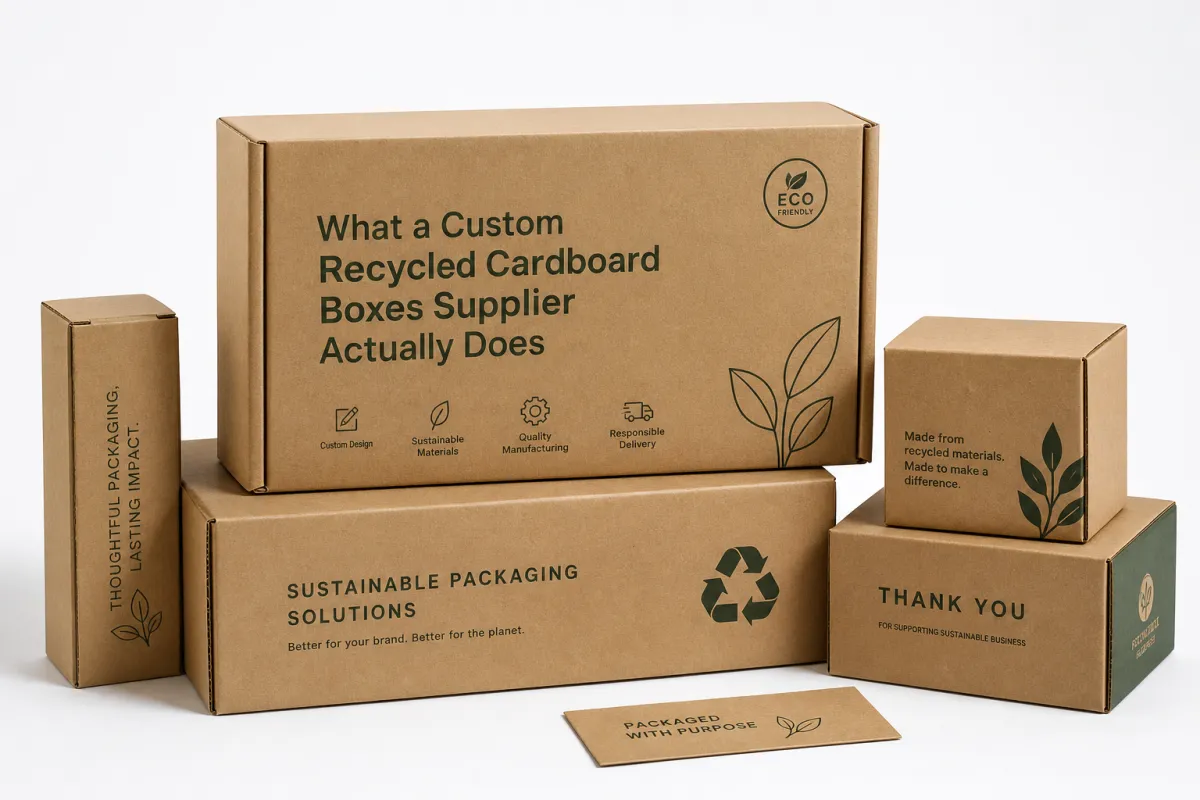
A custom recycled cardboard boxes supplier takes product requirements and turns them into a packaging structure that can survive actual handling. That sounds basic until you look at how many decisions sit underneath it. The supplier may source recycled-content linerboard and medium, choose a flute profile, size the carton to the product, then tune print and finishing so the box still feels like part of the brand instead of a plain shipping cube. The role blends materials sourcing, packaging design, and production management.
There is a real difference between recycled content, recyclable, and post-consumer fiber. Recycled content means part of the board came from recovered fiber. Recyclable means the material can usually be recycled again if local systems accept it and the package is not buried under coatings or mixed materials. Post-consumer fiber is recovered material that has already been used by consumers or businesses before being collected and repulped. Those terms are related, but they are not synonyms. A good custom recycled cardboard boxes supplier should explain the difference without turning it into a legal maze.
The custom part matters most where buyers tend to gloss over the details. The box has to fit the product and the channel. A retail carton may need cleaner print registration, tighter folds, and a better shelf face than a plain shipper. A shipping carton may need stronger corners, better compression resistance, and less ink coverage so the board keeps its structural performance. Inserts, dividers, and closure style all change behavior. A tuck-top mailer, a roll-end front lock box, and a regular slotted carton can all use recycled board, but they behave very differently once the packing line starts moving.
From a buyer’s view, the real value of a custom recycled cardboard boxes supplier is translation. They take product needs and turn them into a board spec that actually works. That includes dimensions, stacking strength, print coverage, moisture exposure, handling method, and whether the box is part of branded packaging or just a protective outer shipper. Done well, that work supports protection and package branding without turning the carton into an overbuilt expense.
For buyers who want sourcing claims that hold up, organizations such as the EPA recycling guidance and the FSC program are useful references. A careful supplier will not hide behind vague buzzwords. They will tell you what the board is, what it is not, and what paperwork they can provide.
Bottom line: a strong custom recycled cardboard boxes supplier is part materials expert, part converter, and part advisor. The best ones save money by preventing over-specification just as often as they save money through board selection.
How Recycled Cardboard Box Manufacturing Works
Manufacturing usually starts with recovered fiber being repulped and turned back into paperboard. That board becomes the liner and medium in corrugated constructions, or it may be converted into folding carton stock if the package is more retail-facing. A custom recycled cardboard boxes supplier may work directly with mills, convert board in-house, or manage outside plants for part of the process while handling artwork and quality control themselves.
Understanding board structure helps. Corrugated board usually has two flat liners with a fluted medium in between. The liner gives the surface for print and abrasion resistance. The medium creates the arch structure that provides crush resistance. Flute profile changes performance: E flute is thinner and prints well, B flute offers a solid balance of stacking strength and surface quality, C flute is common for general shipping performance, and double-wall builds like BC or EB can handle heavier loads or longer storage periods. A custom recycled cardboard boxes supplier should match that structure to the job instead of using one default board for everything.
The converting steps matter just as much. Depending on the package, the supplier may slit, score, die-cut, fold, glue, or window the carton. They may add a water-based coating, a matte varnish, or a simple print pass. Some suppliers do all of that in one facility. Others coordinate between a board plant, a printing partner, and a finishing line. That is not a problem by itself. It just means the buyer should know who owns each step and who signs off on the final sample.
Quality checks should happen throughout the process, not only at the end. Board caliper can be checked to confirm thickness. Edge crush testing, usually shortened to ECT, helps estimate stacking strength. Box compression can be measured with methods aligned to standards like ASTM D642, especially when the package will be palletized or stored in a warehouse. Print registration should be checked so logos and copy do not drift off panel. Fit testing with the actual product is the simplest and most revealing check of all. A drawing can look perfect and still leave too much movement or too little clearance.
Here is the practical version: a custom recycled cardboard boxes supplier that understands manufacturing will ask about product weight, shipping method, and storage environment before they start talking about ink colors. That sequence matters. A nice-looking box that folds weak in a humid back room is not a smart package. It is just an expensive problem.
The cheapest board is rarely the cheapest box once damage, returns, and rework are counted.
If your program needs retail presentation as well as shipping performance, ask the custom recycled cardboard boxes supplier how they handle custom printed boxes that need cleaner edges, better fold memory, or stronger ink holdout. Small details such as crease depth and glue placement can change how the finished carton feels in the hand.
What Drives Cost and Pricing for Custom Recycled Boxes
Pricing surprises a lot of buyers because a custom recycled cardboard boxes supplier is not pricing a single box. They are pricing a system. Board grade, box size, printing method, finishing, quantity, setup, and freight all shape the final number. If you are comparing quotes, make sure the structure, recycled-content target, print coverage, and shipping terms are the same. Otherwise, the lowest number on the page may not be the lowest landed cost. It may just be the number with the least context attached.
Size is one of the biggest cost drivers. Larger cartons use more board, though they can sometimes be more efficient if they are built around a standard die line and load neatly on pallets. Smaller cartons can become expensive when they need custom tooling or tighter graphics alignment. Board grade matters too. A lightweight mailer made with E flute recycled corrugate prices differently from a heavy double-wall shipping box designed for stacked storage. Add inserts, tear strips, tabs, or specialty coatings, and the cost moves again.
Setup costs hit smaller runs the hardest. Printing plates, die lines, tooling, and proofing all require work before the first sellable box exists. A custom recycled cardboard boxes supplier may spread those costs across a larger quantity, which is why per-unit pricing usually improves as volume rises. On a modest custom run, setup can add several cents or even more than a dollar per unit depending on complexity. On a larger run, the setup charge can fade into the background of the unit price.
To make comparison easier, here is a simple view of how different options often behave:
| Option | Typical Use | Approximate Unit Price Range | Strength / Brand Fit | Watch-Outs |
|---|---|---|---|---|
| Stock recycled corrugated box | Basic shipping, fast replenishment | $0.20-$0.60 | Good protection, limited branding | May not fit product well |
| Simple custom recycled mailer | Light e-commerce and retail packaging | $0.45-$1.20 | Better package branding and fit | Higher setup cost on smaller runs |
| Full-print custom shipping box | Branded packaging for shipping and unboxing | $0.70-$1.80 | Strong visual impact and tailored structure | Ink coverage and finishing can raise cost |
| Heavy-duty recycled carton with inserts | Fragile or stacked product packaging | $1.10-$2.50+ | High protection, better load control | More material, more assembly, more freight weight |
These ranges are only directional, because a custom recycled cardboard boxes supplier prices against the actual spec, not a generic category. Still, they help when you are judging whether a quote is in the right neighborhood. A simple one-color box with standard dimensions should not price like a high-coverage retail carton with custom inserts and a specialty finish. Packaging math should stay annoying, but not mysterious.
Hidden costs matter too. Freight can change landed price quickly, especially for bulky cartons that take up truck space. Storage charges may apply if you are not receiving boxes right away. Rush production can add fees, and extra sampling rounds can burn time and budget. A sensible custom recycled cardboard boxes supplier should separate piece price from freight, tooling, and one-time setup charges so you can see the whole picture.
If you want to reduce cost without weakening the pack, start with the easy wins: reduce ink coverage, standardize sizes, choose a simpler fold, and question whether you truly need a premium finish on every panel. A cleaner one- or two-color design often does more for a brand than a box coated in ink from edge to edge.
For broader package planning, compare the box program against other formats in the supplier’s catalog. If your needs span shipper, display, and retail formats, review Custom Packaging Products alongside Custom Shipping Boxes so you can see where the cost and performance differences actually sit.
Process and Timeline: From Quote to Delivery
Most projects follow a pretty predictable path, though the pace depends on how prepared the buyer is and how complex the structure gets. A custom recycled cardboard boxes supplier usually starts with discovery: product dimensions, product weight, shipping environment, branding goals, and any sustainability targets. From there, the supplier prepares a quote, suggests a structure, and, if needed, creates a dieline or rough sample for review. Once artwork is approved, the production sample or pre-production proof gets checked. After that, the order moves into manufacturing and shipping.
If you want the process to move faster, give the supplier useful inputs early. The big ones are straightforward: length, width, height, product weight, whether the box is for retail or shipping, whether the product is fragile, how many boxes you need, and whether the print file is final or still changing. It also helps to say whether you care most about the lowest possible unit cost, the strongest board, or the best-looking branded packaging. A custom recycled cardboard boxes supplier can optimize for only one or two priorities at a time before something else gives way.
Lead times vary, but a realistic planning range often looks like this:
- Discovery and quote: 1-3 business days when product information is complete.
- Structural review and sample prep: 3-10 business days depending on complexity.
- Artwork proofing and revisions: 2-7 business days, sometimes longer if branding is still changing.
- Production: often 10-20 business days for standard custom orders, longer for high-volume or specialty finishes.
- Shipping: depends on distance, freight method, and pallet count.
Those numbers can stretch. New tooling, very custom die cuts, specialty coatings, or tight print registration all add time. Seasonal demand and freight scheduling do too. A custom recycled cardboard boxes supplier that gives you an honest timeline is more useful than one that promises speed nobody can maintain. I will take “12 to 15 business days after proof approval” over “very fast” every time, because one is a schedule and the other is a shrug.
Sampling deserves more respect than it gets. A flat digital mockup will not show whether the closure tab feels awkward, whether the flaps spring open, or whether the inserts slow packing speed. The sample stage is where you confirm fit and handling. If your warehouse team, fulfillment center, or retail staff has to pack hundreds or thousands of units, the difference between a box that folds naturally and one that fights the operator can affect labor cost every day.
Plan inventory buffers with the same discipline you use for the product itself. If boxes arrive late, production stops. If they arrive too early and the storage space is damp or crowded, the board can pick up moisture and lose performance. A careful custom recycled cardboard boxes supplier should help you match order timing to receiving and assembly capacity instead of treating boxes like a side quest.
How to Choose a Custom Recycled Cardboard Boxes Supplier
Choosing the Right custom recycled cardboard boxes supplier is less about the cheapest quote and more about the best fit for your product and workflow. Start with the use case. Is the box mainly for shipping, retail display, subscription unboxing, or warehouse stacking? The answer changes the board grade, print approach, and closure style. A box for direct-to-consumer delivery may need stronger corners and cleaner branding than a plain master carton. A retail carton may need a smoother print surface, even if it does not travel very far.
Next, look at transparency. A good supplier should explain recycled content, board type, flute profile, and any coatings or finishes without hiding behind fuzzy claims. Ask for spec sheets. Ask for printed samples. Ask what compression performance they expect and whether they can point to testing methods such as ISTA procedures for transit simulation or compression checks aligned to ASTM methods. For shipping-heavy programs, the testing conversation usually matters more than the artwork conversation. If the box fails in transit, the logo on the outside will not save the customer experience.
One practical way to judge a supplier is to watch how they answer questions. Do they ask about product fragility, humidity, pallet height, and warehouse handling, or do they jump straight to color counts? Do they suggest a structure that matches the product, or do they try to force the product into one box style they already prefer? The best custom recycled cardboard boxes supplier understands that packaging design is driven by both brand and mechanics.
Use a simple comparison framework when you review options:
- Confirm protection needs first, then think about appearance.
- Ask for a sample built to the real dimensions, not a guessed size.
- Review board grade, recycled content, and flute profile on the same sheet.
- Check how the supplier handles revisions and reorders.
- Compare landed cost, not only unit price.
That last point gets missed constantly. A lower quote may hide higher freight, extra tooling, or a larger minimum order quantity. A stronger custom recycled cardboard boxes supplier will help you see the full packaging cost clearly, including whether a slightly better board grade reduces damage enough to pay for itself.
When a program needs broader packaging support, I like to review the supplier’s full catalog. Sometimes a project starts as a shipping box and ends up needing custom inserts, protective wraps, or a retail-ready outer. In those cases, looking at Custom Packaging Products alongside the specific carton style helps you make decisions that support both operations and branding. If the box is going to be the main customer-facing package, make sure the supplier can talk about custom printed boxes with the same confidence they use on the structural side.
For buyers who care about sustainability claims, ask for documentation before you write anything into product copy. A solid custom recycled cardboard boxes supplier should explain what is recyclable, what recycled content means, and whether any chain-of-custody certification applies. That kind of clarity protects your marketing team and your legal team at the same time. Which, frankly, is a nice change.
Common Mistakes When Buying Recycled Cardboard Boxes
One of the most common mistakes is assuming all recycled board behaves the same. It does not. Fiber quality, moisture response, flute structure, liner weight, and manufacturing consistency can vary enough to change performance in real shipping conditions. A custom recycled cardboard boxes supplier should explain the expected behavior of the board, especially if the boxes will sit in a warehouse, ride on a truck for several days, or move through temperature swings.
Another mistake is oversizing the box. Extra space feels harmless until the effects show up: more filler material, more movement in transit, more scuffing, and sometimes a stronger board spec than the product needs. I have seen buyers pay for bigger cartons when a tighter structure would have protected the product better. The right custom recycled cardboard boxes supplier will push back if the size is inflating cost or reducing pack efficiency.
Artwork approval causes trouble too. If the structure is not locked first, print margins can end up too close to the cut line, panel wraps can miss the closure area, and logos can land where folds break the image. That hurts especially with retail packaging and branded packaging, where the customer sees every edge. Approving art before structure is fixed can turn a clean concept into a production headache.
People also underestimate time. A quote can look easy on paper, then the real variables show up and the timeline stretches. New dies, new artwork, specialty coatings, and re-sampling all add days. Freight can add more. A custom recycled cardboard boxes supplier that tells you the truth about timing is doing you a favor, even if the answer is less convenient than you hoped.
Do not ignore order volume and freight. A great unit price can become expensive if you have to order more than you can store, or if the boxes ship from far away on an inefficient route. Landed cost matters. Warehouse space matters. Labor needed to assemble the box matters. A recycled box that saves a bit of board weight but takes twice as long to pack is not saving money. It is just wearing a green label while your team pays for the difference.
Here is a simple checklist worth using before you approve the order:
- Does the box fit the product with enough clearance for packing but not enough to allow movement?
- Is the board grade matched to the shipping or display channel?
- Has the supplier provided a real sample, not only a rendering?
- Are setup, freight, and storage costs visible in the quote?
- Have you tested the package with the actual product under realistic handling?
A custom recycled cardboard boxes supplier who helps you answer those questions is usually worth more than a cheaper quote from someone who only sells price. Good product packaging is as much about avoiding mistakes as it is about making a good first impression.
Expert Tips and Next Steps with a Custom Recycled Cardboard Boxes Supplier
If you want the cleanest path forward, start with a short package brief. Keep it practical: product dimensions, product weight, shipping channel, branding goals, target quantity, and any sustainability requirements such as recycled content expectations or FSC documentation. A concise brief helps a custom recycled cardboard boxes supplier quote more accurately and cuts down the back-and-forth that slows projects down. It also gives you a better shot at comparing quotes on equal terms.
When possible, ask for two versions of the quote. One should be the best-value structural option, and the other should be the higher-performance option. That side-by-side view often shows whether your box is being overbuilt, or whether a slightly stronger board actually earns its place. I like this approach because it keeps the discussion grounded in tradeoffs instead of assumptions. A custom recycled cardboard boxes supplier can usually show where a change in flute, board weight, or print coverage shifts the final price.
Testing should happen under real conditions, not only on a bench. Stack the boxes. Move them in a cart. Leave them in a warm or cool space if that reflects your warehouse conditions. If the package will ship through parcel, ask about transit testing concepts used by groups such as the ISTA community, because shipping stress is rarely just one kind of stress. Compression, vibration, impact, and handling inconsistency usually show up together.
For some buyers, the right move is not only about the box itself but about the broader packaging system. A carton may need inserts, a mailer may need a tear strip, or a retail box may need secondary protection in shipment. A supplier with a wider packaging range can help you think beyond one format. If your program is growing, keeping Custom Packaging Products in view alongside Custom Shipping Boxes can make future expansion easier.
From an operations standpoint, the best projects are the ones where the supplier and buyer agree on the metrics that matter: damage rate, fit, print quality, pack speed, freight cost, and reorder consistency. A custom recycled cardboard boxes supplier should not make those metrics feel complicated. They should reduce uncertainty, not add to it.
Practical next steps: gather your dimensions, request samples, compare at least three suppliers on the same criteria, and review the quote against total landed cost rather than unit price alone. Do that, and you usually end up with a better structure, fewer surprises, and a box that earns its place in the line.
FAQs
What should I ask a custom recycled cardboard boxes supplier before ordering?
Ask about recycled content level, board grade, flute profile, print options, lead time, and whether they can provide structural samples before production. Also request clarity on setup fees, freight, minimum order quantity, and what happens if your final dimensions change after quoting. A good custom recycled cardboard boxes supplier should answer those points directly.
How do I know if recycled cardboard boxes will be strong enough for my product?
Match the board style and flute profile to the product weight, shipping method, and stacking height, then test the box with the real item. Look for compression, fit, and edge-crush guidance from the supplier instead of relying only on recycled-content claims. A capable custom recycled cardboard boxes supplier will talk about performance first and sustainability language second.
Why do custom recycled cardboard boxes cost more than stock boxes?
Custom boxes include design work, cutting tools, setup, and often more exact material selection, while stock boxes are made in standard sizes. Per-unit cost usually drops as quantity rises, but smaller runs often carry more setup cost per box. That is normal, and a custom recycled cardboard boxes supplier should be able to show you where the money goes.
How long does it take to get custom recycled cardboard boxes made?
The timeline depends on artwork approval, sampling, tooling, production capacity, and shipping method, so simple orders move faster than highly custom ones. Build in time for sample review and corrections, because that step often prevents expensive rework later. A thoughtful custom recycled cardboard boxes supplier will give you a schedule that includes those review points.
Can a custom recycled cardboard boxes supplier help with sustainability claims?
Yes, a good supplier can explain recycled content, recyclability, and material sourcing so your claims stay accurate and supportable. Ask for documentation or spec details before using any environmental statement in marketing or on-pack copy. The right custom recycled cardboard boxes supplier makes those claims easier to trust and easier to defend.
If you are comparing suppliers right now, keep the focus on fit, board performance, transparency, and landed cost. That mix usually tells you more than a glossy sample ever will, and it is the best way to judge whether a custom recycled cardboard boxes supplier is actually aligned with your product, your brand, and your operation. The safest move is simple: choose the box spec that protects the product first, then trim the extras until the package still does its job without burning money.

