Buyer Fit Snapshot
| Best fit | Custom Recycled Hang Tags with Logo for Sustainable Brands projects where brand print, material claims, artwork control, MOQ, and repeat-order consistency need to be specified before quoting. |
|---|---|
| Quote inputs | Share finished size, material target, print colors, finish, packing count, annual reorder estimate, ship-to region, and any compliance wording. |
| Proofing check | Approve dieline scale, logo placement, barcode or warning zones, color tolerance, closure strength, and carton packing before bulk production. |
| Main risk | Vague material claims, crowded artwork, missing packing details, or unclear freight terms can make a low unit price expensive after revisions. |
Fast answer: Custom Recycled Hang Tags with Logo for Sustainable Brands should be specified like a repeatable production item. The safest quote records material, print method, finish, artwork proof, packing count, and reorder notes in one written spec.
Production checks before approval
Compare the actual filled-product size with the drawing, then confirm tolerance on folds, seals, hang holes, label areas, and retail display edges. Reserve space for logos, QR codes, warning copy, and material claims before decorative graphics fill the panel.
Quote comparison points
Review material grade, print process, finish, sampling route, tooling charges, carton quantity, and freight assumptions side by side. A quote is only useful when the supplier can repeat the same color, closure quality, and packing count on the next order.
Custom Recycled Hang Tags with Logo for Sustainable Brands
Custom recycled hang tags with logo do more than label a product. The right stock, print method, and pricing setup can make the whole order smarter, cleaner, and easier to live with.
A candle can sit on the same shelf as six others and still lose the sale because the tag looks cheap. Brutal, but true. That is why custom recycled hang tags with logo often punch above their weight. They are one of the cheapest places to make a product feel more considered without ripping up the whole packaging system.
From a packaging buyer’s angle, the tag is tiny. The impact is not. It sets the tone, carries the price point, and supports branded packaging without demanding a full redesign of the box, label, or insert. Get the tag right and the product feels intentional. Get it wrong and people notice in about half a second. The shelf does not care about your internal approval process.
Recycled content matters more now because shoppers actually look at it. Some care about the claim. Some care about whether the claim sounds real. Either way, a recycled tag is no longer a cute side note. It is part of the proof. That is why custom recycled hang tags with logo keep showing up in stronger packaging design systems. They are visible, practical, and easy to align with a sustainability story that does not feel fake.
For brands building a fuller packaging system, these tags usually sit next to other pieces like Custom Labels & Tags or a broader mix of Custom Packaging Products. That matters because a tag never really lives alone. It has to match the tone of the box, the insert, and the rest of the product packaging, especially when the product ships in custom printed boxes or retail mailers.
“If the hang tag feels generic, the whole product feels generic. Customers will not say it out loud. They just buy like it is true.”
What Are Custom Recycled Hang Tags with Logo?
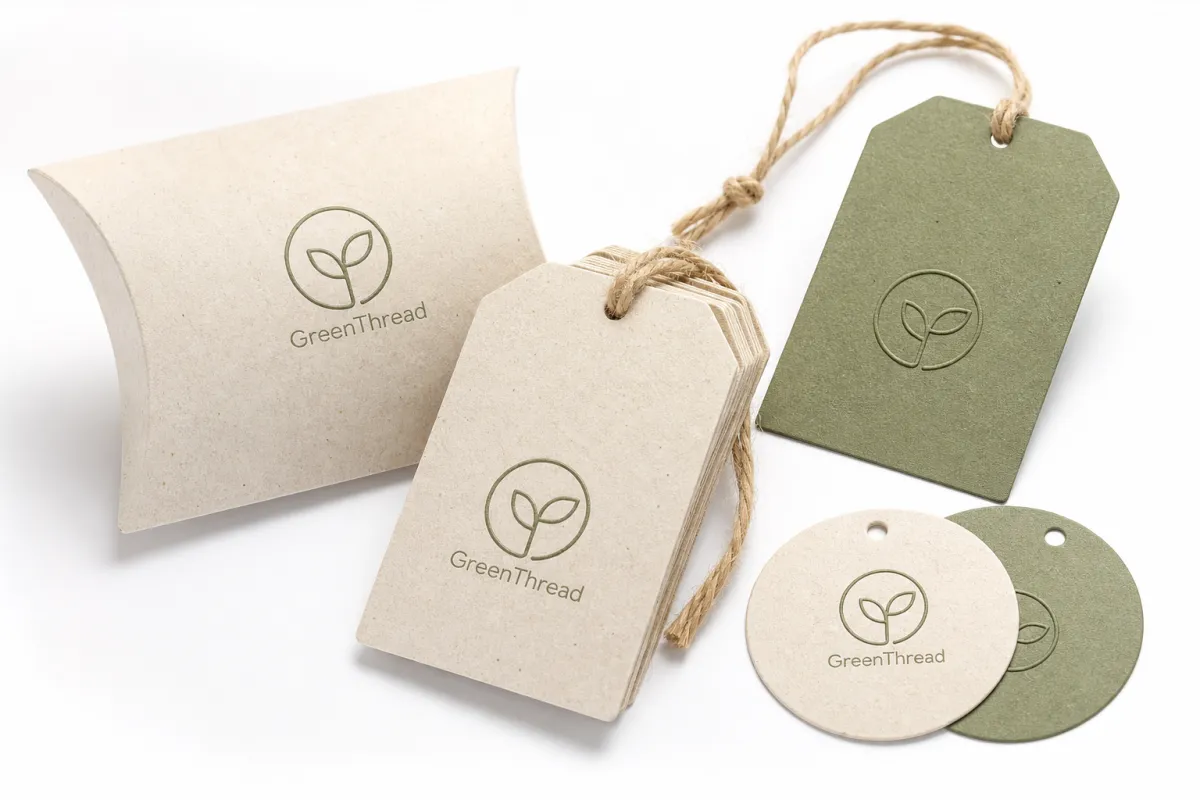
At the simplest level, custom recycled hang tags with logo are paper tags made from recycled fiber and printed with your branding, product details, and any useful copy you want to fit. The stock may contain post-consumer fiber, pre-consumer fiber, or a blend. Plain English version: the paper has already lived a life before this one. That lowers demand for virgin fiber and gives the tag a more honest material story.
The format is familiar. Square. Rectangle. Rounded corner. Folded. Die-cut. No mystery there. The tag can carry a logo, size information, care instructions, a QR code, a sustainability note, or a short line of brand voice. For retail, e-commerce, and gifting, the tag usually does three jobs at once: identification, pricing, and presentation. That is a lot for a small piece of paper, which is exactly why custom recycled hang tags with logo matter more than they look like they should.
Some people hear “recycled” and immediately picture dull, rough, or flimsy. That is lazy thinking. Recycled papers vary a lot. Some feel soft and fibrous. Some feel clean and stiff. Some have a natural surface that still prints well and reads as premium. The real job is Choosing the Right balance of texture, thickness, opacity, and print behavior. A 14 pt recycled uncoated tag can work perfectly for a beauty accessory or apparel line. A thicker 18 pt or 24 pt stock makes more sense for premium retail packaging or products that get handled constantly.
Why does the keyword matter in sustainable packaging? Because material claims only hold up if the whole system makes sense. A recycled tag attached to a plastic fastener and tucked into a PVC pouch looks odd. A recycled tag paired with paper-based packaging, restrained print coverage, and a clear design language looks believable. That is the difference between sustainability as decoration and sustainability as an actual brand decision.
There is also the compliance side. If you plan to mention FSC sourcing, recycled content, or any sustainability language, the paper spec has to support it. The tag should match what you can prove. For a solid reference on responsible forestry and certification language, the FSC site is a good place to check the basics before anything goes into packaging copy.
Recycled does not mean weak. It does mean the design needs a little more respect. Brightness, ink absorption, and finish matter. On one stock, a deep black logo looks crisp. On another, the same logo can soften if the sheet is too porous or the type is too small. That is not failure. That is the paper behaving like paper. I have seen gorgeous logos turn muddy just because someone chose a stock by photo instead of sample.
If you are ordering custom recycled hang tags with logo for the first time, ask for samples before you approve the full run. A PDF tells you almost nothing about feel. A physical sample tells you whether the stock is too soft, too warm, too bright, or too slippery for the job. That one step saves a lot of dumb arguments later.
How Custom Recycled Hang Tags with Logo Are Made
The production path is simple enough once you strip away the sales pitch. Stock selection comes first. Then artwork setup. Then proofing. Then printing, die cutting, finishing, and packing. Each step affects the next one, which is why rushed tag orders get expensive in small annoying ways. A bad file becomes a delayed proof. A delayed proof pushes finishing. A finishing delay can wreck a launch date. Packaging work has a lovely way of punishing sloppy planning.
Recycled paper behaves differently on press than coated stock. It usually absorbs ink more aggressively, which can soften fine details and dull color if the design gets too delicate. A bold logo with enough stroke weight usually holds better than a thin script. Dark text on a light background is safer than pale text on a textured sheet. For custom recycled hang tags with logo, contrast matters more than decoration.
Digital printing works well for short runs and fast approvals. It is usually the better choice if you need a small quantity, a bunch of SKU variations, or a test batch for a new product line. Offset printing makes more sense for larger quantities, tighter color control, and lower unit cost once setup gets spread across enough pieces. Specialty processes like foil, embossing, or spot UV can work, but only when the budget and the brand story actually justify them. Otherwise you are paying for features that fight the recycled message instead of supporting it.
Finishing choices are where brands tend to get dramatic for no reason. An uncoated matte recycled stock gives a natural look and is easy to write on if your team needs batch codes or store notes. Soft-touch lamination feels premium, but it may clash with a strict eco story unless the rest of the package also points in that direction. Spot UV can highlight a logo nicely, but too much of it on a recycled tag creates a weird mixed signal. String choices matter too. Cotton string, paper string, and recycled fiber ties fit the story better than plastic fasteners pretending to be invisible.
Proofing should never be treated like a checkbox. A digital proof catches layout errors. A physical proof catches the things that actually matter in print: color, texture, hole placement, and the real size of the tag in hand. If your logo includes a tiny tagline, check whether it survives the stock. If the hole sits near the edge, make sure it is not too fragile. If the design depends on a pale tint, ask for a sample because recycled paper can shift the tone in a way that looks subtle on screen and obvious on paper. That is normal.
For brands that want a real-world view of print and recycling behavior, the EPA recycling guidance is worth a quick look. It will not lay out your artwork for you, but it does explain why material choices matter after the product leaves your hands.
Here is the sequence I would use for custom recycled hang tags with logo: approve the stock first, then confirm the size, then finalize the print method, then lock the finishing details. Do it in reverse and the budget usually gets fatter for all the wrong reasons. Cosmetic add-ons are easy to approve and annoying to remove later. That is not an accident.
Key Factors That Affect Quality and Sustainability
Not all recycled paper is equal. Buyers still treat it like it is, then wonder why one stock feels better than another. The useful variables are recycled fiber content, thickness, surface texture, brightness, and certification. A sheet with 30% recycled content will not behave the same as one made with 100% post-consumer fiber. A rougher sheet prints differently than a smoother one. A bright white recycled paper makes color pop. A natural tone gives you a warmer, more grounded look.
For custom recycled hang tags with logo, logo readability is not just a design question. It is a waste question. If the logo is too small, too light, or too close to the paper color, the tag may need a reprint or a heavier ink setup to stay readable. That burns time and material. A cleaner mark with enough contrast usually performs better and feels more intentional anyway. Fancy does not automatically mean effective.
Durability matters too. Hang tags get handled by warehouse teams, retail staff, and customers. They get stacked, pinned, tied, shipped, and tossed into bags. If the tag curls, tears around the hole, or smudges while it is still in the pack, the whole impression falls apart. This is where stock weight earns its keep. A 14 pt paper can work for lightweight products, but a 16 pt or 18 pt recycled stock usually holds up better for apparel, candles, and gift items. You do not need overbuilt board. You do need a tag that survives normal handling without looking tired.
Ink and finish tradeoffs deserve a blunt conversation. Heavy coverage can make a recycled tag feel richer, but it can also make the material look less honest if the brand is trying to keep the presentation light and low-impact. Foil can elevate the mark, yet it complicates recycling and can feel out of place on a modest brand voice. Lamination protects, but it also strips away some of the tactile charm that makes recycled paper appealing in the first place. None of these choices are banned. They just need a reason.
For sourcing claims, FSC certification and recycled paper documentation are the pieces that matter. If you are making a claim, make sure the paperwork supports it. Chain-of-custody language is not glamorous, but it keeps brand teams out of trouble later. If you are building a broader sustainability program, the tag should match the rest of the package instead of fighting it. That means matching paper choices, keeping waste low, and making sure the design is efficient enough that the product does not need a second round of revisions. Waste is not only landfill waste. It is also wasted time.
Premium and eco-friendly are not opposites. That myth refuses to die. A well-chosen recycled stock with confident typography, enough white space, and a sensible finish plan can look more expensive than a shiny tag loaded with effects. In branded packaging, restraint usually ages better than decoration.
Think of custom recycled hang tags with logo as part of the same visual system as your retail packaging and shipping materials. If the tag feels elegant but the box is noisy, the package feels split in two. If the tag, box, label, and insert all share the same tone, the whole product feels more deliberate. That matters more than most teams want to admit.
Custom Recycled Hang Tags with Logo: Cost and Pricing Factors
Pricing is rarely mysterious once you break it apart. The main cost drivers are quantity, paper grade, size, print sides, number of colors, die-cut complexity, and finishing. If you want the short version, here it is: small runs cost more per tag because setup is spread across fewer pieces. Larger quantities reduce the unit cost faster. That is normal print math, not a vendor trick.
For custom recycled hang tags with logo, stock choice is usually the first budget fork. Basic recycled uncoated papers tend to be the most affordable. Textured or extra-thick recycled sheets cost more. Specialty fibers, custom tints, and unusual sizes push the price up again. A standard rectangular tag with one or two ink colors on a simple recycled sheet is the easiest spec to control. A die-cut shape, double-sided print, rounded corners, and a specialty finish all add labor and raise the chance of waste.
| Option | Typical Stock | Best Use | Rough Unit Price Range |
|---|---|---|---|
| Basic recycled tag | 14 pt uncoated recycled paper | Simple apparel, inserts, everyday product packaging | $0.08-$0.18 at 5,000 units |
| Premium recycled tag | 16 pt to 18 pt textured recycled stock | Gift items, candles, boutique retail packaging | $0.14-$0.30 at 5,000 units |
| Custom shape tag | Thicker recycled sheet with die-cut shape | Strong package branding, seasonal launches | $0.22-$0.45 at 5,000 units |
| Short-run test order | Digital printed recycled stock | Small launches, sample kits, SKU testing | $0.25-$0.65 at 500 units |
Those numbers are not a promise. They are a buying signal. Artwork complexity, vendor location, shipping method, and current paper availability will move the final quote up or down. The pattern stays the same, though. A clean, simple spec saves money. A complicated spec spends it.
Need a rule that actually helps? Spend first on legibility, stock quality, and the parts of the tag customers touch. Add embellishment only when it has a real brand benefit. If the product is a minimalist apparel line, a natural recycled tag with strong typography may be enough. If it is a premium candle or gift item, a heavier recycled stock and a controlled finish can help the tag earn its keep.
Custom shapes are nice. They are not free magic. They require die-cutting, which adds tooling or setup. They also increase the chance of waste if the shape is too intricate for the stock thickness. The same is true for special finishes. Spot UV can look sharp on custom recycled hang tags with logo, but it should support the design, not carry the brand message on its back like a tired intern.
For brands comparing tag cost against the rest of the system, it helps to think of the tag as a small piece of a larger package branding budget. A few cents per tag may matter less than a redesign that causes missed deadlines or unusable artwork. That is why the cleanest orders are often not the cheapest-looking ones; they are the ones that avoid expensive surprises.
If you are planning a full launch and need tags to coordinate with custom printed boxes or inserts, lock the tag spec before the rest of the package goes to press. Aligning the whole system once is cheaper than correcting one piece after another. The project feels calmer too, which is underrated and rare.
Custom Recycled Hang Tags with Logo Ordering and Production Timeline
A clean ordering process saves more money than people think. Start with the use case. Is the tag for apparel, candles, food gifts, or general retail? Is it meant to carry a size, a price, or a story? Is it going inside a box or hanging in open display? Once the job is clear, size and stock choices get much easier. That is one reason custom recycled hang tags with logo run smoothly when the brief is tight.
- Define the tag’s job and the product category.
- Choose the size, stock, and quantity range.
- Send a vector logo file and any copy.
- Review the proof for layout, color, and hole placement.
- Approve the final spec and lock the production schedule.
Typical production timelines depend on the print method and the finish. Small digital orders can often move in about 5 to 8 business days after proof approval. Offset runs usually take about 10 to 15 business days. Specialty shapes, foil, or extra finishing can stretch that to 15 to 20 business days, especially if the paper has to be sourced or the die has to be made. Shipping time sits on top of that. If the launch date matters, do not wait until the week before. That is how teams end up paying for panic.
The slow points are predictable. Artwork revisions drag. Color approvals drag. Custom Die Cuts drag. A recycled paper that goes out of stock can drag the whole job. One decision-maker helps. So does one finalized logo file and one approved text version. Nothing burns schedule faster than five people “just checking one thing” after the proof has already gone out.
custom recycled hang tags with logo also need to coordinate with the rest of the package. If you are already buying custom printed boxes, tissue paper, or inserts, lock the color palette and tone together. The tag should not look borrowed from a different product line. That kind of mismatch is subtle, but buyers feel it. A package that shares the same material logic and visual rhythm looks more expensive, even if the parts are modest on their own.
For teams launching a new item, I like a one-page spec sheet. Keep it simple: final size, stock, print colors, logo placement, hole position, string or fastener type, quantity, target ship date, and approved file version. Put that in one place and reorders stop becoming detective work. That matters a lot for seasonal lines or retail packaging that refreshes every few months.
If your product has handling or transit concerns, think about performance as well as appearance. Hang tags usually do not need heavy transport testing, but the way they are packed with goods can still matter. For higher-volume distribution, some teams reference general shipping and handling practices from groups like ISTA, even if they are not running a formal test program. It is not about being obsessive. It is about avoiding crushed corners and bent stacks because someone packed tags like they were mailing postcards during a storm.
For brands that build custom recycled hang tags with logo into a repeat order, consistency is the real win. Save the exact spec. Save the file. Save the approved proof. That one habit makes the next reorder faster, cheaper, and less annoying. It also helps if you later add matching packaging design elements or a new SKU family that needs the same visual language.
Common Mistakes to Avoid with Recycled Logo Hang Tags
The first mistake is the lazy one: claiming recycled values without checking the paper source. Buyers notice vague sustainability language. Retailers do too. If the stock is recycled, say what is known and what is documented. If you want FSC-backed sourcing language, make sure the certificate trail is real. If the claim cannot be supported, drop it. Clean honesty beats slippery copy every time.
The second mistake is design-related. Logos that are too small, too thin, or too low-contrast often disappear on uncoated recycled paper. That is extra painful on custom recycled hang tags with logo because the whole point is recognition. A tag should not make the brand harder to see. If your logo depends on delicate hairlines, test a bolder version for the tag. Packaging is not the place to prove you can print microscopic details nobody asked for.
The third mistake is overfinishing. Shiny add-ons are tempting. I get it. But too much gloss, foil, or lamination can weaken the material story and make the tag feel disconnected from the sustainability message. A little sheen can help. Too much starts to look like the brand wanted eco credibility and luxury theater in the same breath. That rarely ages well.
File prep is another common mess. Low-resolution art, missing bleed, and the wrong color mode slow everything down. If the logo is supplied as a blurry PNG and the designer asks why it looks soft, the answer is already in the file name. Use vector art when possible. Include bleed. Add final dimensions. Send the copy in a clean format. Those are boring instructions, which is probably why people ignore them until the proof comes back wrong.
Quantity mistakes are expensive in a more obvious way. Order too many and you tie up cash in inventory that may sit through a season change. Order too few and you rush a reprint with no room to compare options. For custom recycled hang tags with logo, the sweet spot is usually enough quantity to cover a realistic sell-through window plus a small buffer for spoilage or store-level replacement. Guessing is not a strategy.
Finally, do not disconnect the tag from the rest of the retail packaging. If the box is sleek and black but the tag is natural kraft with no tonal bridge, the system can feel split. That is not always wrong, but it should be deliberate. The tag, box, label, and insert should speak the same visual language, or at least neighboring dialects.
Expert Tips and Next Steps for Better Orders
The best pro move is simple: order samples before you commit. Recycled papers vary more than most buyers expect. One stock may feel soft and rustic. Another may look smoother and a bit brighter. A third may print a darker black than you wanted. Those differences are not defects. They are exactly why sample packs exist.
Here is the order of decisions I recommend for custom recycled hang tags with logo: choose the stock first, then the shape, then the print method, then the finishing. Most people do the opposite and start with a shiny idea. That usually leads to budget friction. If you start with the material, the rest of the plan gets easier because the material tells you what the design should be doing. Kind of annoying, but very useful.
Build a one-page spec sheet for every SKU family. Include size, quantity, ink colors, logo placement, hole position, fastener choice, and target delivery date. If you are using the tag across multiple products, note whether each item needs a separate price or barcode area. That kind of detail sounds dull until someone has to fix a launch in a hurry. Then it becomes very interesting.
For new product lines, I also like one test run before the larger batch. It is a modest expense, and it catches a lot of avoidable problems. Does the recycled stock read too warm? Is the logo too small? Does the tag hang straight? Did the punch hole land where the string will not fight it? These sound like tiny things, but tiny things usually decide whether a package feels polished or merely assembled.
One more practical tip: coordinate the tag with the rest of the branded packaging system early. If the tag is going to live beside custom printed boxes, labels, tissue, or inserts, make sure the visual tone is locked before anything enters production. That keeps the final presentation from feeling stitched together after the fact.
If you are comparing suppliers, ask three blunt questions. What recycled stock options are actually available? What is the real timeline after proof approval? What finishing choices add cost without improving the brand story? Those questions cut through a lot of fluff. And yes, there is fluff. Plenty of it.
For a clean next step, compare two recycled stock options, request a proof, confirm the production window, and document the exact order spec. That is the most practical path for custom recycled hang tags with logo. It gives you a repeatable system, not just one decent order that nobody can reproduce later.
If you are building a broader package line, keep the tags aligned with the rest of your product packaging and your long-term reorder plan. That is how custom recycled hang tags with logo stay useful after the first launch instead of becoming one more seasonal detail people forget about.
What recycled paper works best for custom recycled hang tags with logo?
Choose a recycled uncoated stock if you want a clean eco look and a write-on surface that behaves well in retail. Use a thicker sheet if the tag needs a more premium feel or has to survive heavier handling. Ask for samples, because recycled papers can differ a lot in brightness, texture, and how they absorb ink.
How much do custom recycled hang tags with logo usually cost?
Pricing usually depends on quantity, size, paper thickness, print colors, and finishing choices. Short runs cost more per tag because setup gets spread across fewer pieces. Special shapes, foil, or laminated finishes raise the unit price quickly, so keep embellishment tied to a real brand need.
Can custom recycled hang tags with logo still look premium?
Yes. Strong typography, enough white space, and a recycled stock with a good surface can look very polished. Premium does not require glossy effects. Texture and a confident layout usually do more work than a pile of finishes. A clean logo placement can make the tag feel more expensive than a cluttered coated one.
How long does production take for recycled logo hang tags?
Simple digital orders can move quickly, while larger offset or specialty orders need more setup and finishing time. Proof approval, artwork changes, and Custom Die Cuts are the usual schedule bottlenecks. If you need a firm launch date, lock the spec early and avoid changing the artwork after proofing.
What file format should I send for custom recycled hang tags with logo?
Vector files like AI, EPS, or PDF usually give the cleanest logo edges and easiest scaling. Raster files should be high resolution if that is all you have, but they are not the first choice. Include bleed, final dimensions, and any front or back copy so prepress does not have to guess.
Custom recycled hang tags with logo are not just a sustainability checkbox. They are a visible, low-cost place to improve package branding, support honest material claims, and make a product feel finished instead of assembled. If the stock is right, the artwork is clean, and the production plan is disciplined, custom recycled hang tags with logo can carry a surprising amount of brand value without inflating the rest of the package. The practical move is to sample the stock, lock the spec, and keep the next reorder saved before the first run even ships.

