Buyer Fit Snapshot
| Best fit | Custom Resealable Pouches with Logo projects where brand print, material claims, artwork control, MOQ, and repeat-order consistency need to be specified before quoting. |
|---|---|
| Quote inputs | Share finished size, material target, print colors, finish, packing count, annual reorder estimate, ship-to region, and any compliance wording. |
| Proofing check | Approve dieline scale, logo placement, barcode or warning zones, color tolerance, closure strength, and carton packing before bulk production. |
| Main risk | Vague material claims, crowded artwork, missing packing details, or unclear freight terms can make a low unit price expensive after revisions. |
Fast answer: Custom Resealable Pouches with Logo: Film, Print, MOQ, and Carton Packing should be specified like a repeatable production item. The safest quote records material, print method, finish, artwork proof, packing count, and reorder notes in one written spec.
Production checks before approval
Compare the actual filled-product size with the drawing, then confirm tolerance on folds, seals, hang holes, label areas, and retail display edges. Reserve space for logos, QR codes, warning copy, and material claims before decorative graphics fill the panel.
Quote comparison points
Review material grade, print process, finish, sampling route, tooling charges, carton quantity, and freight assumptions side by side. A quote is only useful when the supplier can repeat the same color, closure quality, and packing count on the next order.
Custom Resealable Pouches with logo can look simple from a distance, which is exactly why people underestimate them. A good pouch has to protect the product, stay easy to open and close, hold up through shipping and storage, and still carry the brand with enough clarity that it feels intentional after the tenth time someone picks it up. That is the real test. The mockup sells the idea, sure, but the pouch itself has to earn trust in a pantry, a gym bag, a retail display, or a drawer full of half-used products.
For packaging teams, custom resealable pouches with logo solve several problems at once. They present a product cleanly, help preserve freshness, and make the package easier for customers to use after opening. That combination matters for coffee, protein powder, pet treats, trail mix, tea, supplements, bath salts, dry snacks, and small-format beauty products. If the zipper feels solid and the film feels dependable, people remember that. If the seal misbehaves or the pouch feels flimsy, they remember that too. Packaging leaves a fast impression and a surprisingly long one.
Brands building retail packaging or expanding a product line often find custom resealable pouches with logo more practical than moving everything into rigid tubs or using Custom Packaging Products such as custom printed boxes for every SKU. Flexible packaging generally ships lighter, takes up less space, and adapts more easily to awkward fills. The real work is Choosing the Right structure, print method, and finish so the pouch looks branded without sacrificing barrier performance or everyday usability. That part is kind of the whole job.
Custom resealable pouches with logo: What they are and why they work
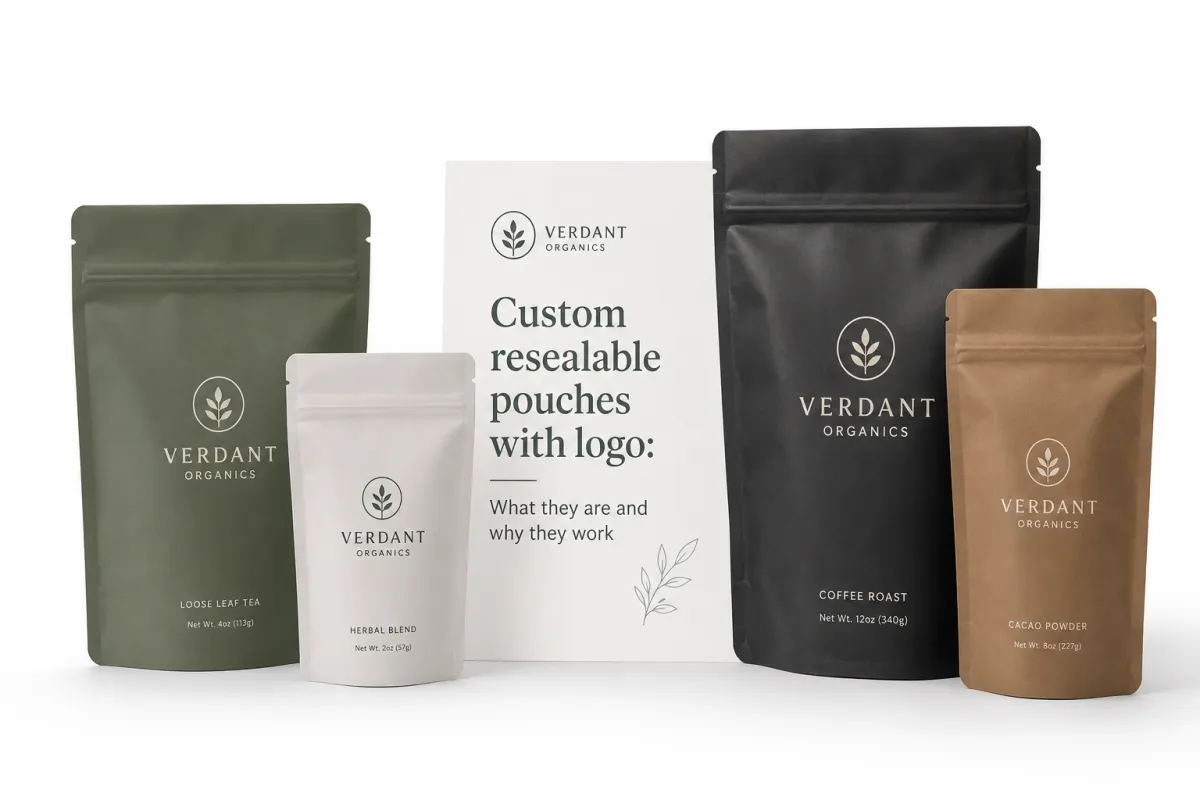
Think of custom resealable pouches with logo as flexible packaging designed to look good on a shelf and still behave well after opening. Most versions use a zipper or press-to-close seal, a tear notch for the first opening, and a stand-up base or bottom gusset so the pouch can sit upright. Some add a hang hole for peg displays. Others use a clear window so shoppers can see the product before they buy it. The format is practical first, then visual, and that order matters more than a lot of teams realize.
The logo carries more weight than many buyers expect. Branding matters, of course, but the logo also helps shoppers find the right item quickly in a crowded retail setting. A clean mark on custom resealable pouches with logo gives a product line a sense of continuity, which can make a newer brand feel established without pretending it is bigger than it really is. I have seen that consistency do a lot of quiet work. It does not scream for attention; it simply keeps the line from looking scattered.
These pouches work especially well for products that need freshness and portability in the same package. Snacks stay crisp longer. Coffee holds aroma better. Pet treats are easier to store without spills. Supplements travel neatly. Beauty and wellness samples feel more polished because the pouch opens with less fuss and closes again with a satisfying snap. That is why the format shows up so often in package branding strategies where the package has to sell part of the story before anyone reads the spec sheet.
- Snacks and dry foods: granola, jerky, candy, nuts, dried fruit, tea.
- Supplements: capsules, powders, gummy vitamins, protein blends.
- Beverage ingredients: coffee, loose-leaf tea, drink mixes.
- Pet products: treats, chews, training bites.
- Beauty and wellness: bath salts, masks, travel kits, sample packs.
The use cases keep expanding because custom resealable pouches with logo handle a stubborn packaging problem very well: people want something that survives opening, closing, shipping, and shelf display without needing a rigid box for every item. Once a product is used over time, the pouch has to support the customer after the sale, not just before it. That shift sounds small. It is not.
How custom resealable pouches with logo work
The structure behind custom resealable pouches with logo is more layered than it looks at first glance. The outer film carries the print and gives the pouch its surface appearance. Beneath that sits a barrier layer that helps resist oxygen, moisture, aroma loss, and light. The seal area keeps the package closed after filling. The zipper or press-to-close closure gives the customer a way to reopen it. Every layer needs a clear job, and none of them should be included just because they sound useful in a quote sheet.
Many buyers begin with artwork, then work backward into structure. That usually creates avoidable problems. The closure style affects everyday use more than the color palette does. A standard press-to-close zipper works well for many food and supplement products. Child-resistant zippers may be a better fit for regulated products or items that should not be easy for a toddler to open. Tear-open top seals create a secure first opening, but the tear line has to be placed carefully so it does not interfere with the zipper area. With custom resealable pouches with logo, convenience and protection need to work together rather than compete for space.
Print method changes the final result too. Digital printing is often chosen for shorter runs and quick artwork changes. Flexographic printing is common for larger runs where color consistency matters across a high volume. Gravure can make sense when the order is large enough to absorb the setup cost. Artwork placement also affects readability, especially near seams, zippers, and windows. A logo that falls across a fold or gets lost in a side seal can make an otherwise good pouch feel careless. Customers notice that immediately, even when they cannot explain why.
The protective value of custom resealable pouches with logo depends on the barrier spec, not the marketing language. Products sensitive to moisture need a water vapor transmission rate that matches the contents. Aroma-sensitive goods need solid oxygen barrier performance. Fragile or abrasive products call for stronger puncture resistance. A supplier worth working with should explain those details in plain language. If the answer stays vague, that is a signal worth paying attention to.
"Ask for the structure spec, not just the stock description. Two pouches that look nearly identical on screen can behave very differently once they are filled, sealed, and stacked in real conditions."
Brands comparing flexible packaging with custom printed boxes often find the pouch wins on shipping efficiency and storage space. Boxes still serve a purpose in premium kits and display-heavy launches, but custom resealable pouches with logo are often the more practical choice when freshness, light weight, and easy handling sit at the top of the list.
Materials, finishes, and print choices that change performance
Material selection changes almost everything about custom resealable pouches with logo. PET is commonly used for stiffness, clarity, and strong print performance. PE adds flexibility and reliable sealing. Metallized structures improve barrier protection and help shield light-sensitive contents. Matte laminates soften the visual effect and hide scuffs more easily. Each choice nudges the pouch toward a different balance of cost, appearance, and protection. There is no single perfect film, only a decision that fits the product and the reality of how it will be used.
Finish matters more than many procurement conversations give it credit for. A matte finish can make custom resealable pouches with logo feel more refined and keep fingerprints from standing out. Gloss gives color more punch and can make bold artwork feel livelier. Soft-touch coatings add a velvety feel that often reads as premium, although they usually cost more and can show wear sooner in rough handling. If the pouch will pass through distribution centers, sit on a retail shelf, and get handled in a home kitchen or work bag, durability deserves as much attention as style. Pretty is fine. Useful is better.
Print choices affect both visual impact and spend. Full-color artwork allows photography, gradients, and more detailed branding. White ink on clear film works well when the design includes a window or transparent panel, though it adds complexity. Spot color systems can be efficient for simple graphics, yet they limit subtle shading and layered detail. Custom resealable pouches with logo usually look stronger when the artwork is built around the film and the closure, not forced onto the pouch like a label after the fact.
Windows can be useful or distracting. They help when the product itself is attractive and consistent, such as coffee beans, dried fruit, or bath salts. They work less well when the contents are dusty, irregular, or visually flat once exposed. A window also reduces the available space for branding, so the logo and front-panel hierarchy need to do more of the work. A window should earn its place by improving trust or product clarity. If it does not, leaving it out is often the cleaner choice.
Compliance and product fit deserve a careful conversation before approving a structure for custom resealable pouches with logo. For food products, ask whether the materials are suitable for food contact. For scented products, ask about odor control so the pouch does not pick up warehouse smells. For oily or greasy products, check grease resistance and seal integrity. For long-distance shipping, ask how the structure handles vibration and crush. Packaging.org has helpful industry context on packaging categories and standards at Packaging.org, and ISTA publishes widely used transport testing methods at ISTA.
| Option | Typical look | Typical cost impact | Best for |
|---|---|---|---|
| Matte PET/PE pouch | Clean, modern, soft sheen | Moderate | Premium snacks, supplements, wellness products |
| Gloss laminated pouch | Bright, high color pop | Lower to moderate | Retail displays, bold branding, high-contrast artwork |
| Metallized barrier pouch | Reflective, protective, high shelf impact | Moderate to higher | Coffee, aroma-sensitive goods, light-sensitive contents |
| Clear window pouch | Product visibility with brand graphics | Moderate | Visually appealing products, trust-building retail packaging |
| Soft-touch finish | Velvety feel, premium touch | Higher | Luxury launches, gift-ready product packaging |
If your brand also uses custom printed boxes for secondary packaging, keep the visual system aligned. The pouch does not need to duplicate the box exactly, but the logo, color palette, and typography should clearly belong to the same family. That kind of package branding gives the line a finished, intentional feel rather than a collection of unrelated packaging choices.
Custom resealable pouches with logo pricing: what drives cost
Pricing for custom resealable pouches with logo usually comes down to five things: size, material structure, print complexity, zipper type, and finish. Larger pouches use more film. Thicker barrier structures cost more. Full-color graphics cost more than simple one- or two-color art. A child-resistant zipper or specialty closure adds another layer of expense. Matte, gloss, and soft-touch finishes all move the final number in different directions. None of those changes is mysterious; they just stack up faster than most first-time buyers expect.
Small runs cost more per unit for a simple reason: setup work has to be spread across fewer bags. That remains true whether the supplier is using digital printing, flexographic plates, or gravure cylinders. With custom resealable pouches with logo, the setup burden also shows up in proofs, color matching, dieline preparation, and production coordination. A 1,000-unit order may have a much higher unit cost than a 10,000-unit order. That does not make the smaller order a mistake. It just means you are paying for flexibility and lower commitment.
Stock pouches with labels can look cheaper at first, especially for a launch that still needs proof in the market. The quoted unit price does not always tell the full story, though. Labels add labor. Holding multiple pouch styles takes space. The finished package can feel less integrated, which matters in retail packaging. Fully printed custom resealable pouches with logo usually look more polished and scale better once the line settles into a repeat order pattern. The better route depends on cash flow, volume, and how much shelf presence the product needs right now.
Here is a practical comparison for planning.
| Packaging option | Typical unit range | Typical lead time | What you give up | What you gain |
|---|---|---|---|---|
| Stock pouch + label | $0.10-$0.30 | Fastest | Less integrated branding, limited barrier customization | Lower setup cost, easier for small tests |
| Digital custom pouch | $0.18-$0.45 | Moderate | Higher unit price than high-volume print | Shorter runs, flexible artwork, strong shelf appeal |
| Flexo custom pouch | $0.08-$0.25 at scale | Moderate to longer | Plate cost, less friendly for tiny orders | Better economics for larger runs |
| Custom resealable pouches with logo plus premium finish | $0.22-$0.60 | Moderate to longer | Higher price per unit | More premium feel, stronger shelf impact |
Those figures only help if they reflect the full landed cost. Ask whether the quote includes setup, plates, proofing, freight, and color matching support. A low quote that grows hidden fees later is not low at all; it is just delayed accounting. If you are comparing custom resealable pouches with logo across several vendors, request the same quantity tiers from each one so the break points are easier to compare.
One more practical point: custom resealable pouches with logo can reduce storage and shipping costs compared with rigid formats, but only when the size is right. Over-sized pouches waste film and freight space. Under-sized pouches create filling headaches. Either way, the usable cost per pack climbs. A good pouch fits the product instead of fighting it.
From artwork to delivery: the process and timeline
The process for custom resealable pouches with logo is usually manageable, though every step can slow down if the details are assumed instead of confirmed. It starts with a quote request. After that comes the dieline, which is the flat template showing exact print areas, seam zones, zipper placement, and safe margins. Artwork setup follows, then proofing, revisions, approval, production, quality checks, and shipping. Straightforward on paper, less tidy in motion.
Missing dieline information is one of the most common delays. Artwork built at the wrong resolution causes another. If the text sits too close to seams or the zipper, production may need another round of corrections. Late color changes can stretch the proof cycle as well. If the pouch needs regulatory copy or ingredient panels, that review adds time too. Clean files and a fast approval loop save far more time than most teams expect when ordering custom resealable pouches with logo. It is not glamorous work, but it keeps the job from dragging.
Timelines vary by print method and structure. A stock-based custom pouch project can sometimes move in roughly 10 to 15 business days after proof approval if the artwork is ready and the base material is available. Fully custom printed pouches often need 15 to 25 business days or more, especially when plates, specialty finishes, or more complex structures are involved. Freight adds another variable. Air shipping is faster and more expensive. Ocean freight is slower and easier on the budget. The launch date will not wait for indecision.
A supplier checklist helps keep the process grounded. Ask who signs off on the final proof. Ask when production starts, not only when the quote was sent. Ask whether a last-minute correction is allowed after proof approval, because many factories will not make one. Ask for a sample or mockup if the pouch needs to fit existing filling equipment. If the answers feel vague, expect the timeline to be vague as well. The same discipline applies when custom resealable pouches with logo need to coordinate with labels, cartons, or inserts as part of a broader packaging rollout.
Transport testing becomes worthwhile when the order is large or the product is fragile. ISTA testing protocols can reveal crush and vibration issues before volume production begins. That kind of check matters more than a polished mockup on a desk. Packaging that fails in transit is simply a more expensive problem with better graphics.
Common mistakes when ordering custom resealable pouches with logo
The first mistake is choosing the wrong barrier level. A pouch that works for dry snacks may not protect aroma-sensitive coffee or oily products well enough. If the material does not match the product, the consequences show up in stale inventory, leaks, or crushed contents. That is a protection issue, not a design preference. Custom resealable pouches with logo should be selected by product behavior first and artwork second.
The second mistake is crowding the front panel with too much text. Small logos, low contrast, and dense copy make the design harder to read from retail distance. Seams and zippers also consume usable space. If the logo sits too low or too close to a fold, the pouch starts working against itself. Strong packaging gives the eye one clear path. Weak packaging tries to say too much and ends up saying very little.
The third mistake is choosing only by unit price. A low-cost pouch that is hard to fill, hard to seal, or hard to stack can create hidden labor costs that do not show up in the first quote. If the pouch arrives scuffed or looks thin on shelf, it can damage conversion, especially in Premium Product Packaging where the package carries part of the value. Custom resealable pouches with logo should support sales and operations, not create more work for both.
The fourth mistake is ordering the wrong quantity or skipping samples. Plenty of brands estimate fill weight from a spreadsheet and never test the real product. Then the finished pouch turns out too tall, too short, too narrow, or awkward to reseal. A physical sample tells you things a spec sheet cannot, including how the zipper feels, how the pouch stands, and whether the artwork reads well in hand. Irregular or bulky products deserve two size tests instead of one guess. That extra step saves a lot of hassle later.
- Wrong barrier: product loses freshness, aroma, or texture.
- Poor artwork placement: logo gets cut by seams or zipper lines.
- Overcrowded design: weak shelf readability and lower retail impact.
- No physical testing: size, seal, and fill problems show up too late.
Brands that already use custom printed boxes sometimes expect the same rules to carry over directly. They do not. Boxes and pouches behave differently in production, shipping, and display, even when the package branding needs to feel consistent. The structure has to fit the product, and that distinction prevents waste, delays, and regret. Regret is an expensive finishing option, honestly.
Expert tips for better custom resealable pouches with logo
Start with the product, not the graphics. If the contents are oily, moist, aromatic, brittle, or sensitive to light, that behavior should drive the structure for custom resealable pouches with logo. A beautiful pouch that cannot protect the product is still a failure, even if it photographs well. The best designs begin with shelf life, handling, and storage conditions. The logo comes after the package can actually do its job.
Design for quick scanning. A shopper should understand the product in a glance. Put the logo where it can be seen at normal shelf distance. Use one clear selling point near the top, such as flavor, benefit, size, or key ingredient. Do not bury the product name under decoration. With custom resealable pouches with logo, hierarchy matters more than ornament. A clean front panel usually sells better than a crowded one, whether the item lives in retail packaging, sample packs, or premium trial sizes.
Ask for at least one physical sample or prototype before committing to a full run, especially when the SKU is new. This is a good place to spend a little in order to avoid spending a lot later. Check the zipper. Check the seal. Check how the pouch stands on a shelf. Check how the surface behaves after a fingerprint or two, because real use rarely looks like showroom use. If the project also includes cartons or labels, place them next to the pouch before final approval so the whole system can be reviewed together.
Keep the procurement process tight by working from two or three structure options instead of a long list. Too many choices slow decisions and rarely improve the result. One standard barrier structure, one premium option, and one lower-cost backup is enough for most launches. Ask for pricing by quantity tier so the point where unit cost drops is visible. Then compare that against the value of better print quality or a better zipper. Custom resealable pouches with logo often justify the higher upfront spend when they improve sales velocity or reduce spoilage.
If you want a smoother rollout, review the dieline with your designer before final artwork is locked in. That sounds basic because it is basic, yet it is also where many avoidable errors start. Make sure safe zones are respected, the barcode has breathing room, and the closure area does not swallow important text. Then run a fill test before the full order. One afternoon of testing reveals more than a week of email threads.
For buyers comparing pouches with other Custom Packaging Products, the better question is not which package looks nicest. It is which package supports the product, the margin, and the customer experience at the same time. Custom resealable pouches with logo often win when freshness, portability, and shelf appeal all matter together. They are not right for every category, though for many product lines they are the sensible choice.
Bottom line: the strongest custom resealable pouches with logo are built around the contents, the channel, and the actual customer experience, not only the artwork file. Once the structure, finish, and proofing process are handled properly, the pouch does more than carry a product. It supports brand trust, repeat purchase, and a cleaner path from shelf to home and back to shelf again. If you are planning an order, start by confirming the product's barrier needs, then test the pouch size in hand before locking the artwork. That one move prevents a lot of expensive surprises.
How do I choose the right size for custom resealable pouches with logo?
Start with the product's fill weight and physical dimensions, then leave room for the zipper, seal area, and headspace. Ask for a size chart or physical mockup before approving artwork. If the product is irregular or bulky, test two sizes instead of guessing. That extra step can save you from ordering custom resealable pouches with logo that look fine on paper and fail at the fill line. A pouch that is five millimeters off in the wrong place can become a daily annoyance.
Are custom resealable pouches with logo better than labels on stock bags?
Usually yes, if shelf appeal and brand consistency matter. Custom pouches give you a more integrated look, stronger package branding, and more control over barrier performance. Labels on stock bags can work for small runs or fast launches, but they usually look less cohesive. If you need a safer first step, stock plus label is workable. If the product needs to stand out in retail packaging, custom resealable pouches with logo usually make more sense. The difference is not subtle once the product hits a shelf.
What is the minimum order for custom resealable pouches with logo?
There is no single minimum because the answer depends on print method, material structure, and supplier setup. Digital printing often supports lower quantities, while flexographic and gravure runs usually make more sense at higher volumes. Ask for tiered quotes so you can see the point where unit cost drops. That gives you a clearer view of how custom resealable pouches with logo fit your budget and launch plan. It also helps you avoid paying premium pricing longer than necessary.
How long does it take to produce custom resealable pouches with logo?
The timeline depends on proofing speed, print method, and whether the pouch is stock-based or fully custom. Simple projects can move in roughly 10 to 15 business days after proof approval if the artwork is ready. More complex runs often need 15 to 25 business days or longer. Build in time for revisions, testing, and freight if the launch date matters. The fastest orders are usually the ones where the artwork for custom resealable pouches with logo is already clean and approved. A rushed file almost always creates a slower project.
What should I ask a supplier before ordering custom resealable pouches with logo?
Ask about barrier performance, zipper type, lead time, proofing process, and total landed cost. Request sample images or physical samples so you can check feel, closure quality, and print clarity. Confirm whether the quote includes plates, setup, shipping, and color matching support. If the supplier cannot answer clearly, that is a useful warning sign. Good custom resealable pouches with logo come from clear specs, not hopeful guessing. If they cannot explain the structure in plain language, keep looking.

