Buyer Fit Snapshot
| Best fit | Custom Retail Bags with Logo projects where brand print, material claims, artwork control, MOQ, and repeat-order consistency need to be specified before quoting. |
|---|---|
| Quote inputs | Share finished size, material target, print colors, finish, packing count, annual reorder estimate, ship-to region, and any compliance wording. |
| Proofing check | Approve dieline scale, logo placement, barcode or warning zones, color tolerance, closure strength, and carton packing before bulk production. |
| Main risk | Vague material claims, crowded artwork, missing packing details, or unclear freight terms can make a low unit price expensive after revisions. |
Fast answer: Custom Retail Bags with Logo: Design, Cost, and Process should be specified like a repeatable production item. The safest quote records material, print method, finish, artwork proof, packing count, and reorder notes in one written spec.
Production checks before approval
Compare the actual filled-product size with the drawing, then confirm tolerance on folds, seals, hang holes, label areas, and retail display edges. Reserve space for logos, QR codes, warning copy, and material claims before decorative graphics fill the panel.
Quote comparison points
Review material grade, print process, finish, sampling route, tooling charges, carton quantity, and freight assumptions side by side. A quote is only useful when the supplier can repeat the same color, closure quality, and packing count on the next order.
Custom Retail Bags with Logo: Design, Cost, and Process
Custom retail Bags with Logo pull more weight than most people give them credit for. They move from the counter to the street, into cars, onto office desks, and sometimes into the customer’s closet for reuse months later. That is a lot of exposure for a piece of packaging most teams treat like a boring supply order. Done well, custom retail bags with logo do more than carry a purchase. They make the handoff feel intentional and keep the brand visible after the sale is over. If you need matching branded packaging or coordinated insert materials, our Custom Packaging Products page is a useful place to compare formats.
I have watched buyers spend hours arguing over a logo size of 4.5 inches versus 5 inches, then approve a bag that is the wrong shape for the product. That kind of mismatch is common. The real value of custom retail bags with logo is not decoration for decoration’s sake. It is presentation that supports the product and the price point. A clean edge, handles that do not feel flimsy, and a size that fits the contents without looking stuffed can make the entire shopping experience feel more considered. No drama. Just better retail.
There is also a practical side people miss. A branded bag can become a small walking billboard, sure, but it can also shape how customers judge the store itself. If the bag feels cheap, the brand feels cheap. If it feels sturdy and looks like it was made on purpose, the store reads as more organized. That does not mean every bag needs foil stamping and ribbon handles. It means the bag should match the job it needs to do.
What Custom Retail Bags with Logo Really Do for a Brand
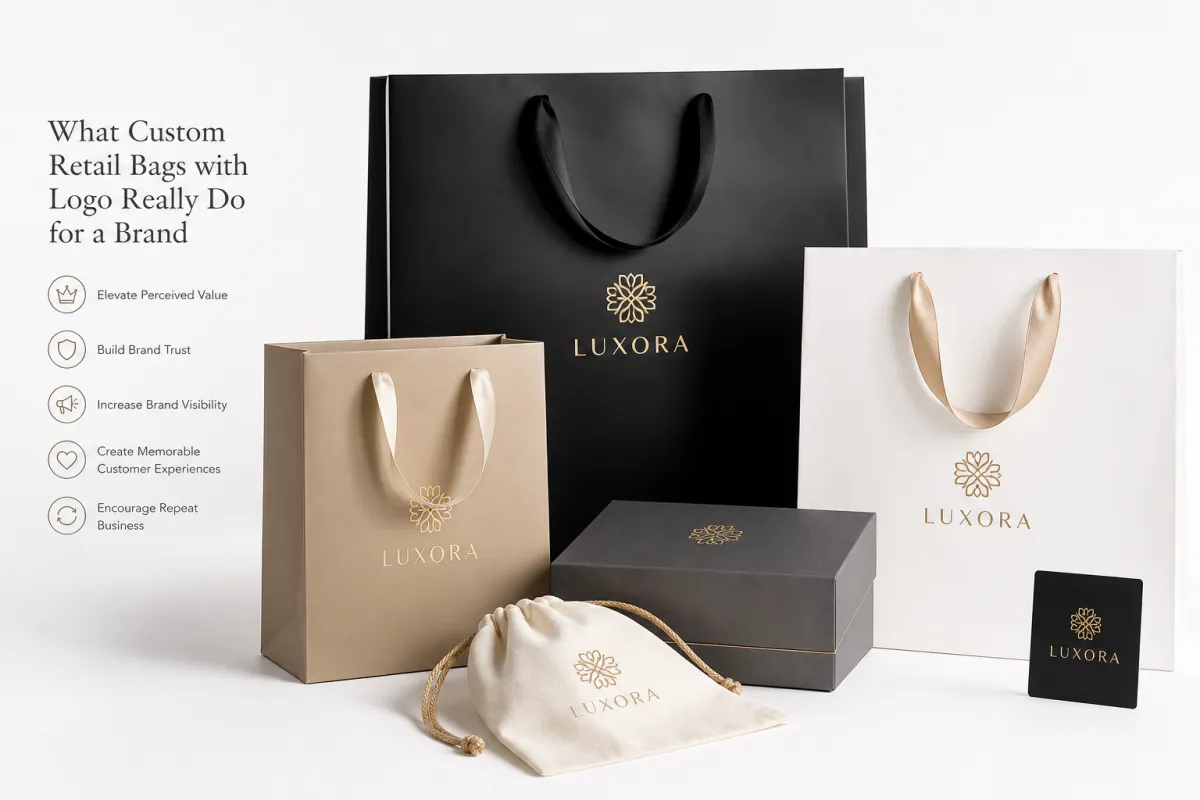
Custom retail bags with logo are not just containers. They are part of the retail packaging system, and they speak before anyone says a word at the counter. A plain bag moves product from point A to point B. A branded bag adds intent. It tells the customer the store pays attention to presentation, and that matters whether the business sells luxury goods or everyday basics. From a packaging buyer’s point of view, that extra layer often affects perceived value more than the spreadsheet suggests.
I see stores underestimate the bag all the time. They treat it like a line item and not a branding surface. That is a miss. Custom retail bags with logo shape the last physical moment of the transaction, and that moment is one of the few times a customer actually holds the brand in their hand. If the bag feels thin, looks off-size, or clashes with the rest of the package branding, the whole presentation drops a notch. If it feels sturdy and looks deliberate, people notice. Maybe not consciously. Still counts.
Reuse is the part people forget. Customers stash custom retail bags with logo in cars, reuse them for returns, or hand them along with gifts. That gives the bag a second and third life outside the store. A bold logo, good contrast, and a build that survives more than one outing can put your brand in front of more eyes than a lot of paid media ever will. Not magic. Just normal human behavior.
The best bag is the one people are not embarrassed to carry twice.
There is also a real gap between generic shopping bags and custom-Printed Retail Bags. Generic bags solve the transport problem. Custom retail bags with logo are built as part of the packaging system. That means the bag can be specified by size, stock, handle type, coating, print method, and finish. Each choice changes the final look and feel. When those choices fit the product, the bag stops acting like an afterthought and starts acting like part of the merchandise.
For retailers that use boxes, tissue, sleeves, or inserts, custom retail bags with logo help tie the whole system together. The shopper sees the same visual language from shelf to checkout to exit. That consistency matters whether the store sells fragrance, folded apparel, or small giftable items. In a crowded market, consistency reads as organized. Organized reads as trustworthy. And yes, customers absolutely notice when the bag feels disconnected from the rest of the purchase.
How Custom Retail Bags with Logo Are Made
The production path for custom retail bags with logo usually starts with a practical set of decisions: bag style, dimensions, material, handle type, print method, and finish. That order matters because one change can force three other changes. A thick coated stock may support a premium look, but it can also call for a different handle attachment or fold pattern. A basic kraft bag may print cleanly with one or two colors, while a laminated bag can need a different press setup. Good packaging planning starts with the product, not with the artwork.
Most paper-based custom retail bags with logo go through bag converting. Sheets or rolls are printed, cut, folded, glued, and finished into the final carrier shape. Flexographic printing works well for simple repeats and larger runs. Offset printing is often chosen for sharper detail and tighter color control on smoother paper stocks. Screen printing can work on certain reusable materials. Specialty finishes like foil stamping or embossing can be added after the main print run when the design needs texture or shine. There is no universal winner. The right method depends on quantity, budget, and the result you want in hand.
Artwork prep and file setup
Artwork prep is where a lot of custom retail bags with logo projects either stay on track or turn into a headache. The logo should usually be supplied as vector art because vectors scale cleanly and hold edges better than low-resolution raster files. Printers also need bleed, safe area, and exact placement, especially near folds and gussets. Put the logo too close to a seam and the finished bag may crop it in a way that looked fine on screen but feels off in real life. Color matters too. Pantone references, coated versus uncoated paper behavior, and the effect of laminates all change what the customer sees.
That is why proofing is not a box to tick and forget. It is the checkpoint that keeps custom retail bags with logo aligned with the actual product. A good proof should show the front, back, gussets if printed, handle placement, and any special notes about finish or varnish. If there is text, a barcode, a care note, or a legal mark, it deserves the same care as the logo. Tiny mistakes get expensive fast when they are repeated across thousands of bags.
One thing I always push buyers to ask is whether the proof is a flat mockup or a production-style layout. Those are not the same thing. A flat visual can look gorgeous and still hide a problem near a fold line. A production layout may look a little less polished, but it shows how the bag will actually be built. That distinction saves grief later.
Structure and finishing
Structural features do quiet work, but they matter. Reinforced tops help the bag keep its shape under load. Gussets create room for folded apparel or boxed goods. Rope handles feel different from twisted paper handles, and that difference changes how the customer reads the bag. Die-cut handles are common for lighter bags or retail sleeves. Laminated finishes add moisture resistance and a smoother surface, while matte coatings give the bag a softer visual tone. Custom retail bags with logo built for repeat use often need stronger construction than bags meant for a single quick carry.
Typical timing depends on the format, but many orders move through proof approval, setup, print, conversion, finishing, packing, and shipping in that order. Straightforward custom retail bags with logo can sometimes ship in about 10 to 15 business days after approval, while specialty finishes, imported materials, or large runs can stretch the timeline. The delay is usually not the print itself. It is missing artwork, late approvals, or changes to the structure after quoting. That is where schedules fall apart. I have seen a “simple bag order” get delayed two weeks because someone decided the handle color should match a new campaign theme. Cute idea. Bad timing.
For heavier retail applications, some buyers also reference testing standards such as ISTA when they want confidence that the bag or its packed contents can handle transit and repeated handling. That does not mean every shopping bag needs lab testing. It does mean there is a real difference between “looks fine” and “holds up in use.”
Materials, Sizes, and Finish Choices That Change the Result
The material choice can make custom retail bags with logo feel budget-friendly, premium, eco-conscious, or highly durable. Kraft paper remains one of the most common options because it is sturdy, affordable, and easy to brand with one- or two-color graphics. Coated paper gives a smoother surface and better image sharpness, which works well for cosmetics, boutiques, and gift packaging. Recycled paper can be a smart middle ground for brands that want a lower-impact story without giving up structure. For reusable needs, polypropylene or cotton can make sense, especially if the bag is expected to stay in circulation for a long time.
There is no universal best material for custom retail bags with logo. A jewelry shop may want a small, refined bag with a narrow gusset and a premium paper stock. A clothing store might need a wider bag with a stronger base and handles that do not strain under folded garments. A gift shop could benefit from a medium-size laminated bag that resists scuffs and keeps the print bright. The right material is the one that matches how the product actually moves through the store and out into the customer’s day.
Size is another place where buyers sometimes guess instead of measuring. That usually backfires. A bag that is too small can crush a product or force awkward packing, while one that is too large can look wasteful and cheapen the presentation. For custom retail bags with logo, size should connect to the actual item dimensions plus room for tissue, inserts, or a box if needed. Think width, gusset, and height together rather than height alone. The bag should feel balanced in the hand and proportionate to the purchase.
Handle choice changes both feel and performance. Twisted paper handles are common and cost-effective. Rope handles create a more polished, giftable appearance and usually support a stronger tactile impression. Ribbon handles can signal boutique or premium positioning. Die-cut handles are simple and clean for lighter loads. Reinforced handles are a smart choice for heavier merchandise or bags intended for reuse. Custom retail bags with logo can look far more expensive, or far more modest, depending on the handle spec alone.
Finish options matter just as much. Matte lamination softens the visual tone, gloss makes colors pop, and soft-touch coatings create a velvety feel that customers often associate with higher-end packaging. Embossing and debossing add depth without relying on full-color print, while foil stamping can bring metallic contrast to a logo or border. Spot UV can highlight a logo or pattern without covering the entire surface. Each finish changes how light moves across the bag, and that changes how people read the brand.
For sustainability, buyers should look at the full picture instead of one claim. Recycled content, FSC-style sourcing expectations, reusability, and print coverage all matter. The FSC system is a useful reference point for responsibly sourced paper products, especially when a brand wants its claims to hold up. In practice, the better eco-friendly choice is often the one that balances source material, useful life, and actual performance. A bag that tears right away is not sustainable just because it started with recycled stock.
Packaging buyers also think about how custom retail bags with logo fit alongside Custom Packaging Products such as tissue, inserts, and outer boxes. When those pieces share a common color palette or finish, the shopper experiences a coordinated system instead of a pile of unrelated items. That kind of alignment is one of the quiet strengths of strong retail packaging.
Custom Retail Bags with Logo: Cost and Pricing Factors
Pricing for custom retail bags with logo usually comes down to a few variables: size, material, print colors, number of decorated sides, handle type, finish complexity, and quantity. The more steps the bag takes in production, the more the cost climbs. Small runs are usually expensive per unit because setup costs are spread over fewer pieces, while larger quantities bring the unit price down. That is why a buyer ordering 500 bags may see a very different number than a buyer ordering 5,000 bags, even when the design looks similar.
In real terms, a simple kraft paper bag with one-color print might land around $0.18 to $0.35 per unit at higher quantities, depending on size and construction. A laminated bag with rope handles, fuller coverage, or specialty finishes can move into the $0.60 to $1.50 range or higher. Those are not universal numbers, but they are useful planning ranges. If a quote comes in far outside that zone, the reason is usually one of three things: the material is more premium, the decoration is more complex, or the volume is too low to absorb setup costs efficiently. Custom retail bags with logo should be priced against performance, not decoration alone.
| Bag Type | Typical Use | Common Features | Indicative Unit Range |
|---|---|---|---|
| Kraft paper bag | Boutiques, bookstores, gift shops | Twisted handles, one- or two-color print | $0.18-$0.35 |
| Coated paper bag | Cosmetics, apparel, premium retail | Smoother print surface, matte or gloss finish | $0.35-$0.80 |
| Laminated premium bag | Luxury retail, gifting, launches | Rope handles, foil, embossing, soft-touch | $0.60-$1.50+ |
| Reusable nonwoven or fabric bag | Events, loyalty programs, repeat carry | Stitched handles, screen print, high reuse | $0.75-$2.50+ |
Artwork complexity also matters more than many people expect. A single solid logo is easier than a multicolor illustration with fine registration, and metallic inks, foil accents, or special coatings add their own labor and tooling. When a printer has to manage multiple spot colors or a tight graphic pattern across a large surface, production risk goes up. That does not make custom retail bags with logo impossible or impractical. It just means the quote reflects more than paper and ink.
One useful budgeting approach is to set a target bag cost before the design gets locked. Decide what the bag needs to do, what the margin can support, and how visible the brand should be in the customer’s hand. Then work backward. A premium product can justify a more substantial bag, while a lower-margin item may call for a simpler format with clean branding and minimal finishing. That keeps the packaging decision tied to business reality instead of wishful thinking.
Sometimes a higher unit price still makes sense. If the customer is buying a high-margin item, receiving a gift, or shopping in a store where presentation drives repeat visits, custom retail bags with logo can pay for themselves through perceived value and reuse. A bag that lasts longer and looks better often does more brand work than a cheaper one that gets tossed immediately. From a retail packaging standpoint, cost should be judged against the number of impressions the bag creates, not just the invoice total.
There is one trap worth calling out. Cheap bags can become expensive if they fail in use. A torn handle, a crushed corner, or print that rubs off means replacements, complaints, and a bad look at the counter. That is why experienced buyers do not compare price alone. They compare cost per useful impression. Not a glamorous metric, but it gets closer to the truth.
Step-by-Step Timeline for Ordering Custom Retail Bags with Logo
Ordering custom retail bags with logo goes a lot smoother when the planning happens before the quote request. Start by defining what the bag will carry, how often it will be used, and whether it needs to support apparel, cosmetics, boxed goods, or heavier merchandise. A bag for folded shirts has different requirements than a bag for glass bottles or gift sets. If the product weight or shape changes, the bag spec should change too. Clear input now saves revision cycles later.
Build the specification first
Once the use case is clear, lock in the basic spec: width, gusset, height, material, handle type, print locations, and any special finish. This is the point where custom retail bags with logo stop being an idea and become a production item. If sustainability matters, note recycled content, source requirements, or any supplier certification expectations. If the retailer wants the bag to match existing product packaging, include swatches or prior packaging references so the printer can compare tone, texture, and contrast.
Then request quotes using the same information from every supplier. That sounds obvious, and yet it is where a lot of buying teams lose the thread. One quote may include one-sided print, another may include both sides, and a third may assume a different stock thickness altogether. Without a clean spec sheet, custom retail bags with logo become hard to compare. Apples to apples is the only comparison that helps.
Review proofs with a production eye
When proofs arrive, slow down and inspect them as if the bags were already on the counter. Check logo placement, line thickness, handle spacing, copy accuracy, and any legal or barcode text. If the design wraps around corners, make sure the visual break is acceptable. Small marks that seem harmless on screen can vanish in the fold or get lost against a gusset seam. Proof review is also the time to confirm color expectations, especially if the brand depends on a specific tone or contrast ratio.
A simple way to protect the order is to build a checklist before approval:
- Confirm final dimensions and gusset depth.
- Verify artwork file type, color mode, and resolution.
- Check logo centering and margin spacing.
- Review handle style and reinforcement details.
- Approve finish notes, coating, or lamination.
That checklist looks basic because it is basic. It also prevents expensive corrections. Custom retail bags with logo are often ordered in volume, and once production starts, every small mistake repeats across the run.
Understand the timing stages
Most projects move through four broad stages: proof approval, setup or tooling, production, and shipping. Simple custom retail bags with logo can move quickly if the stock is available and the artwork is ready. Specialty work takes longer because foil dies, custom handles, imported paper, or extra finishing steps add coordination time. Peak retail seasons also affect lead times because converters and printers get busy fast. If the bags are needed for a product launch or store opening, build in buffer time instead of betting on the fastest estimate.
From a quality standpoint, ask how the supplier handles in-line inspection and final packing. Bags may be counted, banded, boxed, or palletized depending on the order size. If shipping damage is a concern, ask for the outer-carton spec too. The bag itself can be perfect and still arrive scuffed if the outer packaging is weak. That is another reason custom retail bags with logo should be planned as part of the wider retail packaging flow, not as a disconnected purchase.
For retailers who also need boxes, sleeves, or mailers, a coordinated approach through Custom Packaging Products can reduce visual drift across the shelf and checkout. That consistency matters. A shopper usually notices when the bag feels like part of the brand family, even if they never put it into words.
Common Mistakes When Designing Custom Retail Bags with Logo
The most common mistake is choosing a bag because it looks good in a mockup and never checking how it behaves in a real hand. Custom retail bags with logo need more than visual appeal. They need load strength, print durability, and a shape that stays presentable once it is filled. A bag that buckles, wrinkles badly, or tears at the handle does the opposite of what branded packaging is supposed to do.
Logo placement causes trouble too. A mark that sits too low can disappear when the bag is filled. A mark that is too small can lose impact from a few feet away. A mark that sits too close to a fold may get distorted by production tolerances. That is why custom retail bags with logo should be designed with the physical bag layout in mind, not only the flat artwork file. The best proofs show how the logo reads in use, not just how it sits on a digital rectangle.
Color inconsistency can chip away at the brand feel. If the bag, tissue, label, and box all use slightly different versions of the same color family, the result can look less polished than expected. That problem shows up often in retail packaging because different substrates behave differently. Paper, board, and film all reflect color in their own way. A brand does not need perfect identity matching in every case, but it should avoid obvious drift. Custom retail bags with logo are often the first item customers see, so they should stay close to the rest of the system.
Another misstep is overcomplication. A design with too many colors, too much small text, or excessive surface coverage may look impressive on a screen but feel busy on a store bag. On a smaller size, complex art can crowd the logo and weaken recognition. Simpler graphics usually age better because they stay legible across print methods and bag sizes. That is especially true for custom retail bags with logo that need to be reordered over time. Less fuss. More staying power.
Finally, do not ignore the handoff moment. The bag is often the last physical touchpoint in the sale, and if it feels like an afterthought, the whole experience loses some polish. Good custom retail bags with logo do not just hold the purchase. They reinforce the product, the store, and the price point in one clean move.
Expert Tips for Better Custom Retail Bags with Logo
The best custom retail bags with logo are designed for how people actually behave, not how a spec sheet wishes they behaved. That means the bag should still look decent when it is half full, stacked under a counter, carried in the rain, or photographed for social media. Real-world use exposes weak choices fast. If the bag only looks good when empty and flat, it is not finished. It is a render with handles.
One of the smartest things a buyer can do is test a sample configuration before committing to a full run. Even one or two mockups can reveal a lot about print contrast, handle comfort, and how the bag sits when loaded. That matters especially when trying a new finish like soft-touch lamination, foil, or embossing. Custom retail bags with logo usually cost more than plain stock bags, so sample testing is cheap insurance against an expensive mistake.
Another practical tip is to keep the logo bold enough to be recognized quickly. Retail bags get seen fast and often from a distance. Thin lines, low-contrast type, and crowded layouts can disappear in normal use. Strong package branding is usually simple enough to remember and clean enough to reproduce consistently. If the bag is part of a luxury presentation, the logo can be subtle, but it still needs to be readable and balanced with the overall design.
Finish selection should match the brand position, not just the budget. A matte, textured bag can feel quiet and refined, which works well for boutique labels or natural products. A higher-shine bag with metallic accents can suit gift retail or premium launches where visual drama helps. Heavy products need stronger construction first, then decoration second. That order matters. Custom retail bags with logo should never look elegant on the outside and fail under real weight.
If the bag is part of the product story, it deserves the same discipline as the product itself.
It also helps to treat the bag as one piece of a larger packaging system. Tissue, inserts, labels, cartons, and shelves should all pull in the same direction. When the retail packaging feels coordinated, the brand reads as more deliberate and more trustworthy. That is not fluff; it is what happens when visual cues repeat cleanly across touchpoints. Custom retail bags with logo are strongest when they support that repeatable language instead of standing alone.
For many brands, custom retail bags with logo are also a good moment to review the rest of the line. If the boxes, sleeves, and mailers do not match, the customer notices the gap. A quick look at Custom Packaging Products can help identify where the family of branded packaging needs tightening before the next order is placed.
One last practical note: keep a sample on file. Not a photo. A physical bag. Paper, coating, and handle feel are hard to judge from a screen, and the next reorder will go better if someone can compare the old bag to the new proof. That sounds small, but it saves a lot of “why does this feel different?” conversations later.
Next Steps for Ordering Custom Retail Bags with Logo
If you are ready to order custom retail bags with logo, gather the basics first. You will move faster and get cleaner quotes if you already know the target bag size, approximate product weight, quantity range, artwork file format, finish preference, and delivery deadline. Those details give a supplier enough information to quote accurately instead of guessing. They also help avoid the common trap of comparing prices that are not built on the same spec.
A simple decision matrix can make the process easier. Rank your priorities in order: cost, sustainability, premium appearance, durability, turnaround, or reuse. Not every project needs all six at the same time. A launch event may value presentation and speed. A permanent retail line may care more about cost stability and repeatability. Custom retail bags with logo should support the business goal first and the aesthetic second, not the other way around.
Once the priorities are clear, send the same spec sheet to the supplier or suppliers you want to compare. Ask for a quote, a proof, and any notes about material availability or finish constraints. If the bag needs to coordinate with boxes or inserts, say so up front. It is much easier to adjust artwork before approval than to patch the rest of the system later. That is especially true for custom retail bags with logo that sit at the center of a wider brand presentation.
Prepare the artwork in a production-friendly format, ideally vector, and confirm color expectations early. If the brand uses a specific shade, provide references rather than a casual description. The more precise the input, the less room there is for avoidable revision. In practice, the smoothest custom retail bags with logo projects are the ones where the buyer, designer, and supplier all agree on the real purpose of the bag before the first proof is sent.
The practical takeaway is pretty simple: choose the bag around the product, not around a pretty mockup. Pick the size, material, handle, and finish that fit the load and the brand story, then proof the layout like it is going into production tomorrow. That is how custom retail bags with logo stop being filler and start doing real work for the business.
Common Questions About Custom Retail Bags with Logo
What is the best material for custom retail bags with logo?
Kraft paper works well for many retail uses because it is sturdy, cost-effective, and easy to brand with simple graphics. Heavier coated paper or laminated stock fits premium shopping experiences where appearance matters as much as durability. Reusable materials such as polypropylene or cotton make sense when the bag is meant to be kept and carried often. The best choice depends on product weight, brand position, and whether sustainability or presentation matters more. For many stores, custom retail bags with logo start with kraft, then move up the material ladder only if the product and customer experience justify it.
How long do custom retail bags with logo usually take to produce?
Typical timing depends on proof approval, material availability, printing method, and finishing complexity. Simple orders can move faster, while specialty finishes, custom handles, or large-volume runs add time. A realistic plan should include time for artwork review, sample or proof approval, production, and shipping. Always confirm the lead time before finalizing a launch date or store opening. If the bags are important to the launch, build in a cushion so custom retail bags with logo arrive with room to spare instead of landing on the edge of the event.
Are custom retail bags with logo expensive for small orders?
Small orders usually cost more per bag because setup, tooling, and printing preparation are spread across fewer units. The price gap often narrows as order size increases, which is why volume planning matters. Simpler materials, fewer colors, and standard sizes can help keep smaller runs more affordable. If the bags are tied to a high-margin product, a slightly higher unit cost may still make business sense. In other words, custom retail bags with logo can be affordable in business terms even when the unit price looks high on paper.
What file format should I use for the logo artwork?
Vector artwork is usually best because it scales cleanly and prints more reliably than low-resolution images. Common production-friendly formats include AI, EPS, and sometimes PDF with outlined fonts. If only a raster file exists, it should be high resolution and checked carefully for print quality. Good artwork prep reduces revision time and helps the final bag match the intended brand look. When custom retail bags with logo are being printed across thousands of units, file quality is not a small detail; it is part of the manufacturing input.
How do I choose the right size for custom retail bags with logo?
Start with the actual product dimensions and include enough room for tissue, inserts, or folding if needed. Check the bag’s width, gusset, and handle strength, not just the height. A bag that is too large can feel wasteful, while one that is too small can damage products or look awkward. Sizing should support both function and presentation so the customer can carry the purchase comfortably. The best custom retail bags with logo are sized for the item, the brand moment, and the way the customer will actually use the bag after the sale.

