Buyer Fit Snapshot
| Best fit | Printed Retail Bags with Logo projects where brand print, material claims, artwork control, MOQ, and repeat-order consistency need to be specified before quoting. |
|---|---|
| Quote inputs | Share finished size, material target, print colors, finish, packing count, annual reorder estimate, ship-to region, and any compliance wording. |
| Proofing check | Approve dieline scale, logo placement, barcode or warning zones, color tolerance, closure strength, and carton packing before bulk production. |
| Main risk | Vague material claims, crowded artwork, missing packing details, or unclear freight terms can make a low unit price expensive after revisions. |
Fast answer: Printed Retail Bags with Logo: Film, Print, MOQ, and Carton Packing should be specified like a repeatable production item. The safest quote records material, print method, finish, artwork proof, packing count, and reorder notes in one written spec.
Production checks before approval
Compare the actual filled-product size with the drawing, then confirm tolerance on folds, seals, hang holes, label areas, and retail display edges. Reserve space for logos, QR codes, warning copy, and material claims before decorative graphics fill the panel.
Quote comparison points
Review material grade, print process, finish, sampling route, tooling charges, carton quantity, and freight assumptions side by side. A quote is only useful when the supplier can repeat the same color, closure quality, and packing count on the next order.
Printed Retail Bags With Logo: Sustainable Buying Guide
Printed Retail Bags with logo do a lot of work for something most people barely think about. They carry the purchase, carry the brand, and keep talking long after the customer has left the store. That is why printed retail bags with logo deserve more attention than they usually get. A good bag can move through a shopping center, into a car, onto a desk, and sometimes into another person's hands before it is done. A weak one tears, creases, and makes the whole brand look rushed. There is no mystery there.
What follows is a practical buying guide for printed retail Bags with Logo: materials, print methods, pricing, timelines, sustainability tradeoffs, and the mistakes that cost real money. No filler. Just the parts that matter when you want a bag that looks right, holds up, and does not turn into a storage headache in the back room.
Printed Retail Bags with Logo: Why They Punch Above Their Weight
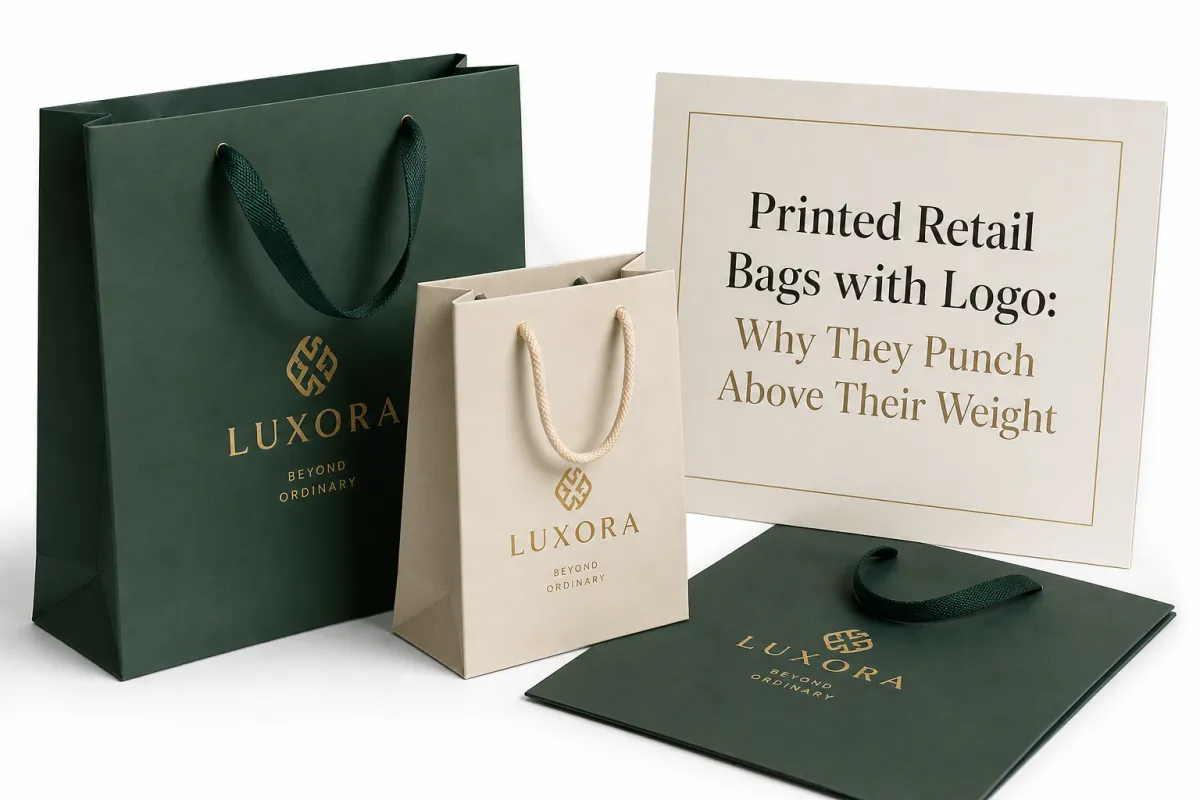
Retail packaging gets judged in seconds and remembered for days. Printed retail bags with logo are one of the few packaging items that stay visible after the sale is over. They get carried in public, photographed, reused, and sometimes kept around longer than the product itself. That is a lot of brand exposure for a piece of paper or fabric that may cost less than lunch.
At the basic level, printed retail bags with logo are shopping bags customized with a brand mark, product message, or visual pattern. The category includes Kraft Paper Bags, coated paper bags, recycled paper bags, FSC-certified paper options, and reusable formats such as nonwoven polypropylene or cotton-style totes. Not every bag belongs in the same bucket. A boutique apparel store, a jewelry counter, and a home goods retailer all need different things, even if the goal is the same: a bag that does not embarrass the brand.
The reason printed retail bags with logo matter in sustainable retail is not just the material. The whole experience matters. The bag influences perceived quality, waste volume, customer convenience, and how often the logo gets seen outside the store. A plain bag can do the job. A well-chosen branded bag can do the job and keep working after that. That is the difference between packaging as a cost and packaging as a working brand asset.
In practice, the goal is not to buy the fanciest bag possible. It is to buy the right bag. Sometimes that means a simple kraft bag with one-color printing and a recycled content claim that can actually be supported. Sometimes it means a heavier reusable bag because the customer carries larger items and needs something sturdier than a single-use paper bag. Printed retail bags with logo should fit the product, the channel, and the way customers actually leave the store, not the way the mockup looked on a screen.
My rule of thumb: if the bag cannot survive a sidewalk, a car ride, and one more item stuffed inside, the branding is not the problem. The spec is.
That is also why printed retail bags with logo need a practical buying lens. You want print clarity, enough strength for the load, a clean end-of-life story, and a price that still leaves room for the rest of the packaging budget. A bag does not need gold foil to do its job. It does need to hold together, print sharply, and make sense for the business.
If you want to compare environmental claims properly, start with material guidance rather than marketing adjectives. The FSC certification system is useful for sourcing forest-based materials responsibly, and the EPA recycling guidance is a better reality check than a vague "eco-friendly" label on a spec sheet. Printed retail bags with logo are only sustainable if the material, coating, ink, and local disposal path all line up.
How Printed Retail Bags with Logo Are Made and Printed
The production flow for printed retail bags with logo is clear on paper and a little annoying in real life, which is exactly why the details matter. It usually starts with material selection, then moves into sheet cutting or roll preparation, printing, die-cutting or bag-forming, handle attachment, gluing, quality checks, and packing. The more custom the bag, the more each step can influence both cost and appearance.
Material comes first. Kraft paper is common because it is strong, familiar, and relatively affordable. Recycled paper can work very well, but it may show more fiber variation and a slightly rougher surface. That is not a defect; it is a visual trait. For printed retail bags with logo, that trait can be useful or distracting depending on the artwork. Heavy coatings create a smoother print surface and a more polished look, but they can complicate recycling. That tradeoff is not abstract. It affects how the bag performs on press and what happens after the customer is finished with it.
Print method matters just as much. Flexographic printing is efficient for larger runs and simple artwork, especially one- or two-color logos. Offset printing gives tight image quality and is often preferred for sharper graphics, full-color art, or premium presentation. Digital printing is useful for shorter runs, frequent artwork changes, or launches where speed matters more than the lowest possible unit price. Screen printing still has a place for bold marks on reusable bags, especially when the design is simple and the surface can handle it. Printed retail bags with logo are not one-size-fits-all, and the press choice can change the final cost by a meaningful amount.
Handle style changes the feel too. Twisted paper handles are budget-friendly and familiar. Flat paper handles can be cheaper in some formats. Rope or cord handles feel more premium and usually push the unit price up. Die-cut handles create a cleaner look but reduce grab-and-go strength unless the bag is built carefully. For printed retail bags with logo, the handle often gets ignored during design approval and then becomes the thing customers notice first because they have to hold it.
Ink and finishing are the last major decisions. Water-based inks are often the better sustainability choice for paper bags because they reduce solvent concerns and can work well for basic graphics. Heavy lamination, spot UV, metallic foil, and soft-touch coatings can create a strong shelf impression, but they also add cost, complexity, and sometimes disposal headaches. The sharpest-looking printed retail bags with logo are not always the best buying decision. The best-looking one on a shelf and the best-performing one in a store do not always wear the same jacket.
Registration and contrast are where a lot of bags quietly fail. A logo that looks clean on a white proof can look muddy on brown kraft if the line weight is too thin or the contrast is weak. Textured substrates can make small type soften at the edges. If the artwork depends on tiny details, printed retail bags with logo need a substrate and print process that can support those details. Otherwise, the bag ends up looking cheaper than the brand intended.
I have seen a few cartons come off press where the color looked perfect in the proof room but shifted once the ink hit a rougher recycled stock. That kind of thing is not rare. Paper, coating, humidity, and ink density all play a part, and if a supplier tells you it will "probably be fine," that is the moment to ask for a physical sample.
Key Factors That Affect Performance, Sustainability, and Shelf Appeal
Printed retail bags with logo sit at the meeting point of strength, appearance, and disposal. If one of those three is off, the bag stops pulling its weight. Buyers often focus on the front-of-house look and miss load capacity, storage footprint, and what the bag does once someone actually uses it. That is usually where trouble starts.
Material durability versus environmental goals is the first balancing act. Recycled kraft is often a strong default because it gives a good mix of cost, printability, and sustainability credibility. FSC-certified paper helps when you want a cleaner sourcing story and documentation from the forest source. Virgin kraft may be stronger and more consistent, but it is not always the best answer if sustainability is the priority. Laminated or heavily coated bags can create a premium appearance, but they may weaken recyclability and add layers that complicate end-of-life handling. Printed retail bags with logo should reflect the real priority, not just the word "eco" on a sample sheet.
Size and load capacity matter just as much. A bag that is too small bows at the gusset and crushes the product. A bag that is too shallow makes the top protrude awkwardly. A bag that is too weak tears at the handle punch or bottom fold. Practical buyers usually ask for a bag sized to the product plus a little breathing room, not a bag sized to whatever looked neat in the spec catalog. For apparel, a common paper bag might work at around 8 x 4 x 10 inches for small items or 16 x 6 x 12 inches for larger orders, while heavier boxed products may need wider gussets and reinforced bottoms. Printed retail bags with logo should be matched to the actual fill weight, not guessed from a mockup.
Branding choices matter more than people expect. One-sided printing is cheaper and often enough for simple retail use. Full-wrap printing creates more visual impact but raises cost and increases the chance of registration issues. A single bold logo in the right spot often looks better than cramming the bag with too much graphic noise. White space is not wasted space. It can make printed retail bags with logo feel more premium because the logo has room to breathe.
Sustainability claims need a careful hand. Recyclability depends on local rules, not just on the fact that the bag is paper-based. Water-resistant coatings, plastic windows, metalized finishes, and mixed-material handles can complicate recycling streams. Some bags are technically recyclable in one region and ignored in another. That is why a supplier's "eco" language should never replace a real material breakdown. Printed retail bags with logo should come with a clear note on paper weight, coating type, ink type, and whether the structure is compatible with curbside recycling where the bag will be used.
Operational details round out the picture. Bags take storage space, and storage is not free. A flat-packed carton may save freight and backroom space compared with a pre-shaped reusable bag. Carton counts, pallet patterns, and shipping weight all affect the total footprint and the total cost. If the bag saves a little on unit price but doubles your warehouse hassle, you have not really saved anything. Printed retail bags with logo should make the store easier to run, not just nicer to photograph.
One more practical note: if the bag needs to survive heavier transit abuse, ask whether the structure has been tested against a recognized shipping standard. For retail bags that are packed, shipped, or reused across multiple legs, references such as ISTA testing guidance can help frame the conversation. Not every store needs that level of rigor, but the principle is useful: test the bag against the path it will actually travel.
Printed Retail Bags with Logo: Step-by-Step Process and Timeline
The cleanest orders for printed retail bags with logo begin with a tight brief. The clearer the brief, the fewer unnecessary revisions later. A useful brief should include product type, bag size target, approximate load weight, artwork colors, finish preferences, budget, and sustainability goals. If the bag has to fit a folded garment box or a rigid gift set, say so up front. If the customer experience depends on a premium unboxing feel, that needs to be stated clearly too.
After the brief comes artwork and dieline review. This is where the printer checks logo placement, bleed, safe zones, gusset placement, handle clearance, and any fold lines that might cut through a design element. Small mistakes here can turn into expensive reprints. Printed retail bags with logo are especially sensitive to this step because the artwork is often simple enough that people assume it is easy. It is not. Simple artwork leaves less room for error because every misalignment is visible.
Proofing should happen in two layers. Digital proofs are useful for layout, color intent, and copy checks. Physical samples are better for judging structure, hand feel, thickness, print absorption, and overall presentation. If the bag will carry a heavier product or has a special finish, a sample is not optional. It is the cheapest way to discover whether the design actually works. Skipping sample approval is how people end up paying twice for printed retail bags with logo.
Here is a practical production sequence:
- Confirm bag size, material, and print method.
- Approve the dieline and artwork placement.
- Review digital proof and request corrections.
- Request a physical sample if the structure, handle, or finish is custom.
- Approve final proof and lock the quantity.
- Move into production, drying or curing, packing, and freight.
Timelines vary by method and complexity, but a realistic range helps prevent launch panic. Simple printed retail bags with logo in standard sizes can sometimes move in about 10 to 14 business days after final proof approval. Custom sizes, multiple print colors, premium coatings, or special handles can push that to 15 to 25 business days. Add shipping time on top of that, especially if the bags are traveling by freight instead of parcel. International transit can extend the lead time further. That is not a manufacturing problem; it is just physics plus logistics.
There is also a drying or curing stage to think about. Some inks and finishes need time to set properly before packing. If a supplier promises a rushed turnaround on a more complex bag, ask how they are handling curing, inspection, and carton packing. Printed retail bags with logo that arrive with scuffed print or tacky surfaces were rushed somewhere along the line. Usually more than one place.
For launch dates, my advice is plain but useful: build in slack. Give the supplier enough time to fix one proof cycle, enough time for one sample round, and enough time for freight to slip by a few days if needed. Printed retail bags with logo are not usually the thing that should be running your deadline. They are too visible to gamble on.
Printed Retail Bags with Logo Cost and Pricing Breakdown
Pricing for printed retail bags with logo depends on a handful of variables that show up in nearly every quote: material, size, print colors, handle style, finish, quantity, and tooling. Custom size and custom construction usually cost more because they require setup work. More colors mean more print complexity. Premium finishes increase labor and material cost. None of that is mysterious, but it still surprises buyers who only look at the final unit number.
The easiest way to think about pricing is to separate the bag into base structure and decoration. A simple kraft paper bag with one-color printing at larger volumes might land in the lower cost band. A heavier bag with multiple colors, reinforced handles, and a specialty finish will cost more, sometimes a lot more. Printed retail bags with logo can vary widely, so the quote only makes sense if you know what is inside it.
| Bag Type | Typical Use | Approx. Unit Price at 5,000 Pieces | Common Add-Ons | Notes |
|---|---|---|---|---|
| Basic kraft paper bag, one-color logo | Apparel, gift, lightweight retail | $0.18-$0.35 | Twisted handles, bottom reinforcement | Usually the best value for high-volume printed retail bags with logo |
| Recycled or FSC-certified paper bag, two-color print | Boutique retail, specialty goods | $0.24-$0.48 | Heavier stock, matte finish, custom sizing | Strong balance of cost and sustainability messaging |
| Premium paper bag with coating or foil detail | Luxury, cosmetics, premium gifting | $0.55-$1.20 | Soft-touch lamination, rope handles, foil | Higher shelf appeal, but recycling gets more complicated |
| Reusable nonwoven or fabric-style bag | Frequent reuse, heavier carry loads | $0.45-$1.10 | Screen print, stitched handles, gusseted shape | Better cost per use if the bag stays in circulation |
The table is a starting point, not a promise. Small orders often cost more per unit because setup charges are spread across fewer pieces. With printed retail bags with logo, a run of 500 bags can be much more expensive per piece than 5,000 or 10,000. That is normal. The setup does not care whether you ordered 500 or 5,000.
Hidden costs deserve their own line item. Setup fees can run roughly $50-$300 depending on complexity. Plates or screens may add $80-$250 per color, especially on traditional press work. Freight can materially change the landed cost, particularly for bulky bags with low unit price but high carton volume. Rush charges are common when the timeline gets compressed, and proof revisions can add time even when they do not add direct cost. Printed retail bags with logo look cheap until the bill includes everything around the bag, not just the bag itself.
Volume discounts are real, but over-ordering is not a trophy. If the design may change in six months, locking cash into a huge stock run is a bad habit. I have seen buyers celebrate a lower unit cost while quietly creating a storage problem and a markdown problem. That is not savings. That is inventory with a smile on it. Printed retail bags with logo should be ordered in a quantity that matches sales velocity, artwork stability, and storage space.
The other pricing mistake is comparing quotes that are not actually the same. One supplier may quote a bag with heavier paper, another may quote lighter stock. One may include freight, another may not. One may include a sample, another may charge extra. Ask for the same details every time: material weight, print method, finish, handle type, setup fees, freight, and whether revisions are included. Only then can printed retail bags with logo be compared fairly.
Think in total cost per use, not sticker price. A reusable bag that costs more upfront may be cheaper over time if it is used a dozen times. A paper bag that costs less upfront may be better if the customer is unlikely to reuse it and the brand prioritizes recyclability over longevity. There is no magic answer. There is only a better fit for the use case. That is how printed retail bags with logo should be evaluated.
Common Mistakes When Ordering Printed Retail Bags with Logo
The most common mistake is simple: approving a mockup before checking how the bag behaves in the real world. A design can look sharp on a screen and still fail once a product is placed inside. Handles pull at the wrong angle. Gussets do not expand enough. A boxy product sits too low. Suddenly the bag that looked polished in a mockup looks awkward in hand. Printed retail bags with logo need to be judged in context, not in isolation.
Another easy mistake is bad contrast. Tiny logos, thin fonts, low-contrast gray-on-brown artwork, and overly intricate graphics are the usual suspects. Textured kraft paper is not forgiving. Recycled fibers are not forgiving either. If the artwork depends on hairline rules or delicate gradients, the print method must be selected with care. Printed retail bags with logo should be readable from a normal carrying distance, not just from six inches away under office lighting.
Handle strength gets ignored more often than it should. That is odd, because the handle is the part the customer abuses first. If the bag will hold a boxed item, a bottle, or multiple purchases, the handle attachment point and bottom fold need real attention. A weak handle makes the bag feel cheap even if the logo looks nice. Printed retail bags with logo are only as good as the weakest construction detail.
Sustainability claims can also go sideways. A bag with mixed materials, plastic lamination, foil, or complex coatings may be labeled "eco" in the sales deck and still create disposal headaches. Some buyers assume paper automatically means recyclable everywhere. It does not. Recycling depends on the local system and the specific build of the bag. If the material mix is messy, the claim gets shaky fast. That is why printed retail bags with logo need clear documentation, not just pretty language.
There is also the over-ordering problem. Teams often buy enough printed retail bags with logo to cover best-case sales, then discover the campaign changed, the logo updated, or the store format shifted. Now the bags sit in storage while the brand burns cash. A smaller test run is usually smarter, especially if the bag is tied to a new product line or a store refresh. Fifty to one hundred units in a pilot location can reveal issues that a sales forecast will never catch.
One bad bag can cost more than a slightly pricier good one. Returns are expensive. Reprints are worse. Reputation is the real bill.
There is a better way to think about printed retail bags with logo. Test the bag with actual staff, actual products, and a small batch before scaling. Ask the person packing the bag whether it feels too thin. Ask the person carrying it whether the handle digs in. Ask the customer-facing team whether the logo reads cleanly from a few steps away. You will learn more in one week of real use than in three rounds of static approval emails.
Expert Tips and Next Steps for Smarter Ordering
Start with one decision: what matters most for this order? Lower cost, stronger durability, more premium presentation, or better sustainability credentials. Printed retail bags with logo get messy when teams try to optimize every variable at once. They usually end up paying more and liking the result less. Pick the main goal first, then let the rest of the spec support it.
Ask for two samples if the order is large enough to justify it. One sample should sit close to your target budget. The other should push quality a bit further. Comparing the two side by side makes the tradeoffs obvious. Printed retail bags with logo are much easier to approve when you can physically feel the difference between a thinner stock and a heavier one, or between a simple handle and a more premium attachment.
Get supplier specs in writing. Not verbally. Not "roughly." In writing. Ask for paper weight, print method, coating or finish, load limit guidance, handle type, carton quantity, and recycling notes. Vague answers are how budget problems start. Printed retail bags with logo are a packaging purchase, not a guessing game. If a supplier cannot describe the build clearly, that is a warning sign.
It also helps to compare two realistic paths:
- Path 1: a cost-first paper bag with one-color print, recycled or kraft stock, and a simple handle.
- Path 2: a more premium bag with stronger paper, better finish, and higher visual impact.
Neither path is automatically better. The right one depends on how the bag is used. A fast-moving apparel store may prefer the first path because unit cost and speed matter most. A boutique gifting counter may choose the second path because presentation drives repeat business. Printed retail bags with logo should match the selling environment, not some imaginary ideal version of it.
One practical rollout plan works better than complicated theory: finalize the format, approve artwork, confirm timeline, place a small test order, review performance in store, then scale. That order matters. Printed retail bags with logo are visible enough that a rushed rollout can hurt the brand, but simple enough that a disciplined test can save a lot of money. If the bag performs well, expand the order. If it does not, fix the spec before you burn through a larger run.
From a buying perspective, the best printed retail bags with logo are the ones that survive daily use, support the brand visually, and do not create avoidable waste. That sounds basic because it is basic. Packaging is supposed to work. The clever part is choosing a bag that works hard without getting in the way. Print clarity, load strength, and end-of-life practicality are the three levers that matter most. Get those right, and printed retail bags with logo stop being a line item and start doing real brand work.
How much do printed retail bags with logo usually cost?
Price depends on bag size, material, print colors, quantity, and finish. Simple kraft bags in larger volumes are usually the lowest-cost option, while custom sizes, premium paper, and multi-color printing increase setup and unit cost. Ask for quotes that separate setup fees, freight, and rush charges so you can compare apples to apples. For many buyers, printed retail bags with logo land somewhere from the low cents to a little over a dollar per piece, depending on the build.
What material is best for printed retail bags with logo if sustainability matters?
Recycled kraft or FSC-certified paper is a strong default for most retail uses. Choose the lightest material that still handles the product weight safely. Avoid mixed-material constructions unless reuse is the real priority and recycling is not the main goal. Check local recycling rules before claiming the bag is recyclable. Printed retail bags with logo should have a clear material story, not just a nice-sounding one.
How long does it take to produce printed retail bags with logo?
Simple orders can move quickly if artwork is ready and the bag size is standard. Custom sizes, special finishes, and proof revisions add time. Build in time for sampling, approval, production, drying or curing, and shipping. If the order is tied to a launch date, place it early and keep one backup option. For many standard runs, printed retail bags with logo often need roughly 10 to 25 business days after approval, depending on complexity.
What print method works best for printed retail bags with logo?
Digital printing works well for short runs and fast changes. Flexographic or offset printing is often better for larger quantities and tighter unit costs. Screen printing can be useful for bold, simple designs on reusable bags. The best choice depends on run size, artwork complexity, and the bag surface. Printed retail bags with logo are not a one-method category, which is exactly why the print process should be chosen after the brief, not before it.
What mistakes should I avoid with printed retail bags with logo?
Do not approve artwork before checking size, contrast, and bleed on the real dieline. Do not under-spec the bag for the product weight. Do not assume an eco claim means the bag is actually recyclable everywhere. Do not skip samples if the bag matters to the customer experience. The fastest way to waste money on printed retail bags with logo is to treat them like a generic accessory instead of a working part of the sale.
Printed retail bags with logo are one of those purchases that looks simple until you have to make the decisions. Then every detail matters: the paper weight, the handle, the print method, the finish, the freight, the storage space, and the customer who is going to carry it out the door. Get those details right, and printed retail bags with logo can improve brand recall, reduce waste, and hold up in daily use. If you are placing an order, lock the size, material, print method, and load target first, approve a physical sample before mass production, and test one fully packed bag in real hands before you sign off. That is the clearest way to avoid surprises and end up with a bag that actually earns its keep.


