Buyer Fit Snapshot
| Best fit | Custom Retail Boxes MOQ projects where brand print, material claims, artwork control, MOQ, and repeat-order consistency need to be specified before quoting. |
|---|---|
| Quote inputs | Share finished size, material target, print colors, finish, packing count, annual reorder estimate, ship-to region, and any compliance wording. |
| Proofing check | Approve dieline scale, logo placement, barcode or warning zones, color tolerance, closure strength, and carton packing before bulk production. |
| Main risk | Vague material claims, crowded artwork, missing packing details, or unclear freight terms can make a low unit price expensive after revisions. |
Fast answer: Custom Retail Boxes MOQ: Pricing, Specs, and Timeline should be specified like a repeatable production item. The safest quote records material, print method, finish, artwork proof, packing count, and reorder notes in one written spec.
Production checks before approval
Compare the actual filled-product size with the drawing, then confirm tolerance on folds, seals, hang holes, label areas, and retail display edges. Reserve space for logos, QR codes, warning copy, and material claims before decorative graphics fill the panel.
Quote comparison points
Review material grade, print process, finish, sampling route, tooling charges, carton quantity, and freight assumptions side by side. A quote is only useful when the supplier can repeat the same color, closure quality, and packing count on the next order.
Custom Retail Boxes MOQ: Pricing, Specs, and Timeline
Custom Retail Boxes MOQ can decide whether a launch protects cash flow or ties up money in inventory. I have seen brands save a little on the unit price and then lose it back in storage, reprints, or slow sell-through. A 250-unit run and a 1,000-unit run can use the same artwork and shelf plan, yet the financial outcome can be wildly different once the boxes start moving through the real world. That is why smart buyers treat Custom Retail Boxes MOQ as a planning variable, not a bragging right.
Cheap on paper is not the same thing as cheap in practice. A slightly higher per-box price at a lower MOQ can save money if it keeps you from over-ordering packaging that sits in a warehouse collecting dust. The real question is not "what is the smallest number?" It is "what quantity matches the sales pace, shelf space, and launch risk?"
From a packaging buyer's point of view, custom retail boxes MOQ is where production reality meets merchandising reality. You are paying for more than boxes. Setup, board procurement, die cutting, finishing, and the discipline to avoid dead stock all sit inside that number. That is the lens to use before you compare quotes for custom printed boxes, retail packaging, or broader product packaging programs. If the quote looks too clean, it is probably hiding something.
Why custom retail boxes MOQ changes your margin math
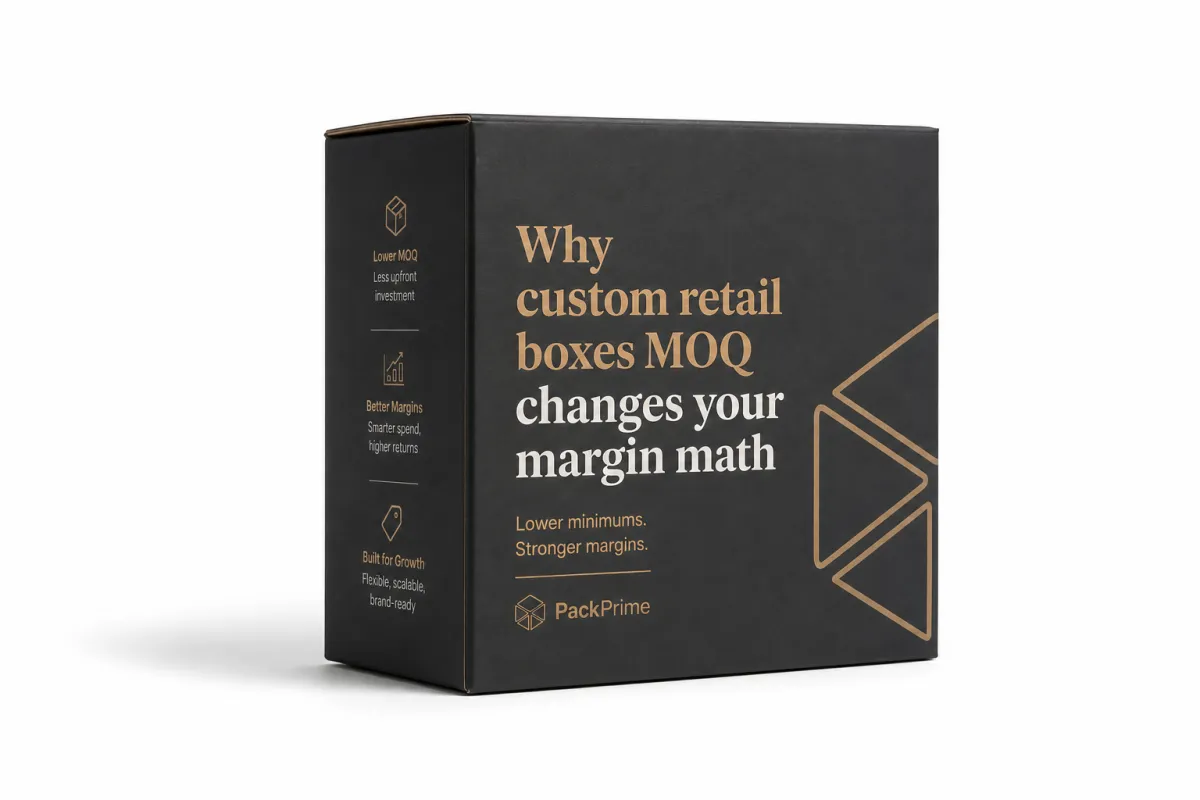
Custom retail boxes MOQ matters because packaging has fixed costs that do not shrink just because the run is smaller. A press still needs setup time. A die still needs to be made or mounted. Board still has to be ordered in a usable sheet size. Finishing steps like lamination, spot UV, foiling, or window patching still add labor and waste allowance. Those costs show up whether you order 250 units or 5,000 units, which is why a low MOQ often carries a higher unit cost even when the order feels smaller.
That does not make the lower MOQ wrong. It depends on turn rate. If a product sells out in six weeks, a bigger order can make sense because inventory moves before storage and obsolescence start eating the margin. If the product is seasonal, experimental, or tied to a limited retail test, custom retail boxes MOQ should stay conservative so you are not paying for packaging that outlives the campaign. The right buying decision matches volume to velocity.
Here is the part people like to miss: a lower unit price is not always a lower total cost. A buyer may save eight cents per box by moving from 500 units to 2,000 units, but if 1,200 of those boxes sit unused for nine months, the savings evaporate fast. Add warehousing, handling, spoilage from a revision, and capital locked in inventory, and the "cheaper" bulk buy turns into the expensive one. That is the hidden math behind custom retail boxes MOQ.
MOQ means minimum order quantity, but in packaging it is really shorthand for production efficiency. The supplier is spreading fixed setup costs across enough units to make the run viable. Buyers should think the same way. If the product has fast sell-through, a larger MOQ can lower the unit cost. If the product is unproven, a smaller MOQ reduces risk. Both are rational. The right answer changes with the channel, category, and forecast.
A lower MOQ is not "better" by default. It is better only when the risk of over-ordering is higher than the savings from scale.
Retail buyers feel three variables immediately. First, how fast does the product turn? Second, how much shelf space does it occupy? Third, how painful is the mistake if the quantity guess is wrong? If any of those answers is fuzzy, custom retail boxes MOQ should be tested in smaller steps instead of treated like a one-shot commitment. That matters even more for new package branding programs, where the box is part of the offer, not just a shell around it.
Custom retail boxes MOQ should be discussed alongside the sales plan, not after it. A box that must support a luxury shelf display, a club-store pallet, or a boutique checkout moment is part of the product economics. A few cents saved on print is meaningless if the box looks flimsy, stacks badly, or fails to protect the item during retail handling.
One more practical point: a higher MOQ often buys pricing room, but it also raises the cost of change. If the barcode moves, the legal copy changes, or the artwork needs a correction, the larger run makes the mistake more expensive. The smartest custom retail boxes MOQ decision balances price, revision risk, and inventory exposure. That is the margin math most people skip.
Product details: which retail box format fits the job
Pick the structure before asking for a quote. That sounds basic, yet plenty of buyers start with quantity and only later discover the format is wrong for the product. Custom retail boxes MOQ is easier to judge once the structure is clear, because box style drives board grade, finishing steps, assembly time, and whether inserts are needed. In practice, structure usually matters more to the economics than artwork does.
| Box format | Best use | Typical board / structure | MOQ impact |
|---|---|---|---|
| Tuck end carton | Lightweight cosmetics, supplements, small consumer goods | 14pt-18pt SBS or C1S | Usually the easiest to run at a lower custom retail boxes MOQ |
| Sleeve | Simple branding, wraparound presentation, secondary packaging | Paperboard sleeve with open tray or inner pack | Moderate, because die cutting is simple but fit has to be accurate |
| Display box | Counter displays, small accessories, retail-facing merchandising | Folding carton, microflute, or reinforced board | Higher, because structural consistency matters on shelf |
| Mailer-style retail box | Hybrid e-commerce and retail shipping programs | E-flute or B-flute corrugated | Moderate to high, depending on print coverage and inserts |
| Rigid presentation packaging | Premium sets, gift programs, electronics accessories, high-touch retail | Rigid chipboard with wrapped paper | Usually higher, because hand assembly and materials raise setup cost |
Tuck end cartons are efficient because production teams know them well and they assemble fast. They work for products that are light, stable, and not likely to crush under normal handling. Sleeves fit well when the inner item already has protection and the retailer wants a stronger visual brand layer. Display boxes earn their keep when the product needs to face shoppers immediately instead of hiding inside a shipping carton. Mailer-style retail boxes make sense when shipping and shelf presentation have to live in the same structure. Rigid packaging sits at the premium end, but it often pushes custom retail boxes MOQ upward because wrapping, lining, and hand assembly take time.
Structure matters more than decoration for products that are heavy, fragile, or top-loaded. A small electronics accessory can survive in a standard carton, but a jar, bottle, or glass component may need a stronger board caliper, internal support, or a lock-bottom design. If the box has a window cutout, tolerances get tighter. If it has to stack on a retail shelf, the edges need to stay square. If it is part of branded packaging that has to signal quality fast, the unboxing path matters as much as the print.
Inserts, partitions, and inner supports change both protection and custom retail boxes MOQ. A foam insert, paperboard divider, or molded cradle can increase tooling burden and add manual assembly. That is not a reason to avoid them. It is a reason to decide early. A box that looks simple from the outside can turn expensive if the inside needs a precise fit. The buyer who asks about inner supports before requesting a quote usually gets a more accurate custom retail boxes MOQ answer.
Merchandising goals belong in the format decision. If the box needs anti-tamper security, a tear strip or seal area may help. If the product must be scanned fast, the barcode has to live on a flat, readable panel. If the retailer wants the front panel to sell the product without an associate hovering nearby, the graphics and structure need to work together. That is why custom printed boxes are not just design assets; they are selling tools.
Rule of thumb: if the box must survive shipping, sit on a shelf, and sell the product, choose the structure first and the quantity second. That sequence keeps custom retail boxes MOQ aligned with the actual packaging job instead of with a guess.
Specifications that affect fit, print, and protection
Specification mistakes are expensive because they ripple through the whole run. Custom retail boxes MOQ looks fine on a quote sheet until the dimensions are off by a few millimeters and the product fits loosely, rubs at the corners, or needs a redesign. The best brief is not the prettiest one; it is the one that gives the manufacturer exact internal dimensions, board type, finish, and assembly needs in plain language.
- Internal dimensions: length, width, and height measured around the product, not guessed from the outer shape.
- Board caliper: 14pt, 18pt, 24pt, or corrugated construction depending on weight and retail handling.
- Print sides: one side, two sides, or full wrap, with clear notes on where barcodes and legal copy belong.
- Finish: matte, gloss, soft-touch, spot UV, foil, or no coating at all.
- Special features: windows, inserts, partitions, seals, hang tabs, or tear strips.
Dimensions deserve extra attention because they affect everything from fit to freight. A carton that is even slightly oversized can look cheap on shelf, while a carton that is too tight can crush the product or distort the graphics. In custom retail boxes MOQ work, a bad dimension can force a second dieline, a new sample, and a longer approval cycle. That means the packaging mistake is not just material waste. It is time waste, and time is usually the scarcer resource.
Print choices also shape the effective MOQ. CMYK is the most flexible route for full-color graphics, but spot colors are useful when a brand needs exact consistency across product packaging lines. Full-bleed coverage can increase ink usage and make press control more demanding. Reverse printing on clear windows or inside flaps can add a premium feel, but it also changes the production path. The more special effects you pile in, the more important it becomes to confirm the right custom retail boxes MOQ before art gets locked.
Finish selection is not just about looks. Matte usually hides scuffs better on shelf, while gloss can deliver brighter color impact under store lighting. Soft-touch feels premium, but it is not always the best choice for products that will be stacked, handled, or exposed to abrasion. Packaging design should be judged against the selling environment, not just a render on a screen. A beautiful prototype that fails under retail handling is a problem, not a win.
Durability is measurable, which is nice because guessing is overrated. A box that has to survive warehouse stacking should tolerate pressure at the corners. A box used in humid climates may need a coating that resists warping. A box moving through both distribution and retail touchpoints may need a structure that handles repeated handling without opening early. If you expect shelf life of several months, say so in the brief. It affects custom retail boxes MOQ because durability choices change board cost and finishing choices.
Packaging teams often look to standards and testing resources rather than winging it. The Packaging and Processing Association is a useful starting point for packaging guidance, and ISTA provides transit-testing resources that help frame shipping performance. Those references do not replace a production quote, but they make the spec sheet sharper. If sustainability matters, FSC-certified paperboard can also enter the conversation, especially for branded packaging programs with retailer scorecards.
Specifications are not paperwork. They are the bridge between product packaging intent and the actual production run. The cleaner the spec sheet, the easier it is to compare custom retail boxes MOQ options without finding surprise corrections later.
Custom retail boxes MOQ: pricing, volume breaks, and hidden costs
Unit price usually falls as quantity rises. That part is predictable. What is less obvious is that total spend rises too, which means the best custom retail boxes MOQ is not the cheapest per-box line on the quote. It is the quantity that matches turnover without creating unused inventory. The buyer who sees that distinction makes better decisions across launch, replenishment, and seasonal planning.
Pricing is easier to read when you split it into visible and hidden layers. The visible layers are obvious: box price, setup fee, finishing fee, and freight. The hidden layers are where mistakes get expensive: extra proofs, retooling, insert assembly, warehousing, and the cost of reordering after a sellout. Custom retail boxes MOQ is the lever that changes how those costs spread across the run.
| Run size | Typical unit price | Common setup cost | Risk profile | Best fit |
|---|---|---|---|---|
| 250 units | $1.10-$1.85 | $180-$450 | Low inventory risk, higher unit cost | Pilots, limited editions, test launches |
| 500 units | $0.72-$1.20 | $180-$450 | Balanced for many small launches | Early-stage retail programs |
| 1,000 units | $0.42-$0.88 | $180-$450 | Better scale, moderate inventory exposure | Proven SKUs with steady turn |
| 5,000 units | $0.18-$0.36 | $180-$450 | Lowest unit cost, highest capital tie-up | Stable, repeatable retail demand |
Those numbers are illustrative, not universal. A simple folding carton with a single-color print may land near the low end of the range, while a carton with foil, spot UV, and an insert can move up quickly. Still, the pattern holds: custom retail boxes MOQ gets cheaper by unit as quantity rises, but the buyer has to ask whether the savings stay real after storage, shipping, and markdown risk.
Compare two common scenarios. A brand orders 500 boxes at a slightly higher unit price and sells through in ten weeks. Packaging cost stays manageable, and the retailer gets a fresh, consistent presentation. Another brand orders 2,000 boxes to chase a lower unit price, but the product sells slowly and 1,100 boxes are still sitting six months later. Even if the per-box cost is lower, the total cash tied up is much higher. That is the hidden penalty custom retail boxes MOQ can create when quantity is chosen by headline pricing alone.
There is also a markdown effect. If a package has to change for a new promotion, a different claim, or a revised barcode, old inventory often loses value right away. The larger the run, the worse that write-down can be. Buyers who think in terms of package branding and lifecycle cost catch this faster than buyers who only compare one quote to another. They ask how long the design stays valid, not just how low the first price is.
A line-item quote is the best comparison tool because it separates the pieces that matter. Ask for the board grade, the print method, the finishing details, the insert cost if any, and the freight assumption. Then compare custom retail boxes MOQ options on the same basis. A quote that hides setup or assembly costs can make the cheapest option look attractive when it is not.
Do not compare only the lowest MOQ and the highest MOQ. Compare at least three points. A 250-unit run may be ideal for a test, 500 may be the break-even point for a small retail rollout, and 1,000 may be the sweet spot for a fast-moving product. The best custom retail boxes MOQ is often the middle number, not the smallest or the biggest.
Process and timeline: from quote to delivery
The production path is straightforward only when the brief is complete. A solid custom retail boxes MOQ order starts with a request for quote, moves to dieline approval, then artwork review, then sample approval if needed, and finally into full production. If any step is rushed or incomplete, the schedule stretches. The package may still get made, but timing becomes less predictable and the cost of corrections climbs.
For a standard folding carton, a typical timeline after proof approval might be 12-15 business days, depending on capacity and finishing. Rigid packaging or jobs with inserts, windows, or specialty coatings can move closer to 18-25 business days. Shipping time is separate. That matters because many buyers confuse factory turnaround with delivery date, and they are not the same thing. Custom retail boxes MOQ planning only works when the receiving date is realistic.
The slow points are usually the same. Missing dimensions. Unclear copy. Artwork not built on the dieline. Late color corrections. A barcode that changes after proofing. Scope changes after the quote is already approved. Every one of those delays can push a schedule by days or weeks. The simplest way to keep the order on track is to reduce changes after proofing. Fewer changes mean fewer surprises, and fewer surprises make custom retail boxes MOQ more efficient.
Here is the sequence that tends to work best:
- Confirm the product dimensions and weight.
- Choose the box structure based on retail use.
- Decide on board grade, finish, and any inserts.
- Request pricing for at least two custom retail boxes MOQ tiers.
- Approve the dieline and artwork only after fit is confirmed.
- Plan shipping, receiving, and shelf placement before production finishes.
That order matters because it keeps the quote honest. If you choose quantity before structure, the estimate may be useless. If you approve art before fit is settled, rework becomes more likely. If you ignore receiving logistics, the boxes may arrive before your team has the space or labor to unload them. Packaging delays often happen outside the factory. Smart custom retail boxes MOQ planning accounts for the whole chain.
Another detail that gets overlooked is sample strategy. A physical sample can save far more money than it costs if the product is sensitive to fit, opening behavior, or shelf appearance. For products with tight tolerances, a sample is not optional. It is insurance. The same applies to retail packaging that has to support a premium shelf presence or a specific package branding standard across multiple SKUs. I have watched one missed millimeter turn into a second sample, a delayed launch, and an annoyed sales team. Nobody wants that kind of week.
At Custom Logo Things, the cleanest projects start with complete specs and a realistic launch window. That is true for a single SKU and even more true for a multi-product rollout. If you want a deeper menu of packaging options, review our Custom Packaging Products page, then use our FAQ for common production questions before you submit a quote request. The more complete the brief, the more useful the custom retail boxes MOQ estimate will be.
Why choose us for custom retail boxes MOQ orders
Buyers usually do not need more hype. They need fewer surprises. That is the real reason to work with a packaging partner that takes custom retail boxes MOQ seriously. The value is not in promising the impossible. It is in giving accurate specs, transparent pricing, and practical recommendations that fit the product instead of forcing a generic structure into the wrong job.
Reliability starts with measurement. If the fit is wrong, everything else gets harder. If the print file is not ready, proof cycles drag. If the finishing choice is mismatched to the retail environment, the box may look great in a photo and disappoint on shelf. A good supplier helps prevent those mistakes before production starts, which is where the real savings live. That is especially true for custom printed boxes that need to support a brand launch with no room for waste.
There is also a plain business case for clear communication. Buyers who know what is included in the quote can compare options with confidence. They know whether the price includes inserts, whether freight is part of the estimate, whether an alternate board changes the MOQ, and whether a special finish affects timeline. That clarity cuts back-and-forth and keeps the project moving. It is one reason custom retail boxes MOQ decisions are easier when the supplier acts like a packaging consultant instead of a price-only vendor.
Custom Logo Things is set up to support that process with flexible quantity options, standard and custom structures, and the kind of production discipline that matters on retail deadlines. For a buyer, that means the box is treated as a sales tool, not a commodity. Good retail packaging protects the product, supports shelf conversion, and reinforces branded packaging without making the run harder than it needs to be. That balance is hard to get right if the MOQ conversation starts too late.
What should you expect from a strong quote conversation?
- A clear explanation of board, finish, and structure choices.
- A breakdown of what changes the unit cost and why.
- Two or more quantity tiers so custom retail boxes MOQ can be compared properly.
- Advice on whether inserts, windows, or special coatings are worth the extra spend.
- Realistic timelines tied to artwork status and production capacity.
That approach is not flashy, but it works. In a category where product packaging can affect sell-through, returns, and perceived quality, consistency matters more than drama. Buyers who want dependable custom retail boxes MOQ outcomes usually value the same things: accurate specifications, predictable turnaround, and a final pack that looks like it belongs on the shelf.
Next steps: build a quote-ready packaging brief
The fastest way to cut waste is to make the brief better before asking for pricing. Gather the product dimensions, target quantity, box style, print coverage, finish preference, and shipping method. If possible, add product weight, retail channel, and whether inserts are needed. Those details make a custom retail boxes MOQ quote much more accurate and reduce the chance of rework.
Compare at least two quantity scenarios. Three is better. A 250-unit test can protect a launch. A 500-unit run may be the most practical middle ground. A 1,000-unit run can lower unit cost if the product sells at a steady pace. That comparison is the difference between a guess and a decision. The numbers should show where the break-even point sits between lower unit cost and lower inventory risk.
Artwork status should be shared early. A final print-ready file, a rough concept, and a full redesign are not the same thing, and they do not produce the same pricing or schedule. If the artwork is ready, custom retail boxes MOQ planning moves faster. If the art still needs development, timeline and cost should be adjusted accordingly. Buyers who say that upfront usually get cleaner quotes and fewer delays.
A simple decision order works best:
- Confirm fit and function.
- Lock the structure.
- Choose finish and print coverage.
- Set the custom retail boxes MOQ after the packaging build is clear.
That sequence keeps the quote aligned with the real job. It also helps the packaging decision support sales instead of slowing them down. The box should not become a storage burden or a revision headache. It should fit the product, fit the channel, and fit the sales plan. That is what custom retail boxes MOQ is supposed to do.
If you want packaging that works as hard as the product inside it, start with the brief, not the guess. That is the most practical way to make custom retail boxes MOQ pay off instead of creating waste. Start there, compare three volume breaks, and do not let the first quote trick you into ordering more than the launch can absorb.
What is a typical custom retail boxes MOQ for first-time orders?
It often starts at a few hundred units, but the exact number depends on the box style, print method, and finishing complexity. Simple folding cartons usually allow a lower custom retail boxes MOQ than rigid presentation boxes or display packaging. The best move is to ask for several quantity tiers so you can compare pricing and risk before you commit.
Can I lower my custom retail boxes MOQ without changing the box design?
Sometimes, but the fastest savings usually come from simplifying print, finish, or structural features rather than only reducing quantity. A cleaner design with fewer special effects is easier to produce in smaller runs. If the MOQ is fixed, ask whether a standard structure or a different board grade can reduce setup complexity.
How does artwork affect custom retail boxes MOQ pricing?
Ready-to-print artwork shortens approval time and reduces back-and-forth that can delay production. Multiple spot colors, full-coverage graphics, and specialty finishes can increase setup requirements and raise the effective custom retail boxes MOQ cost. Supplying accurate dieline-based artwork helps avoid rework and extra proof cycles.
How long does production usually take after I approve the quote?
Production time depends on structure, print complexity, and whether samples are needed before the full run. Straightforward orders can move in about 12-15 business days after proof approval, while more complex jobs may take longer. Shipping time should always be added separately so the delivery date reflects reality, not just factory turnaround.
What should I send when asking for a custom retail boxes MOQ quote?
Send product dimensions, target quantity, box style, print coverage, finish preference, and whether inserts are needed. Include your timeline and shipping destination so the quote reflects both production and freight needs. If possible, attach artwork or a reference box so the manufacturer can quote more accurately and keep the custom retail boxes MOQ discussion grounded in facts.
Custom retail boxes MOQ is not a paperwork line item. It is the point where pricing, inventory, and shelf strategy meet. Get the quantity wrong and the box becomes expensive before it ever reaches the shelf. Get the specs right, compare a few volume breaks, and the packaging starts doing its job as a sales asset. That is why the best custom retail boxes MOQ choice is the one that supports sell-through, protects margin, and keeps the product moving.

