Buyer Fit Snapshot
| Best fit | Custom Retail Cartons with Embossing projects where brand print, material claims, artwork control, MOQ, and repeat-order consistency need to be specified before quoting. |
|---|---|
| Quote inputs | Share finished size, material target, print colors, finish, packing count, annual reorder estimate, ship-to region, and any compliance wording. |
| Proofing check | Approve dieline scale, logo placement, barcode or warning zones, color tolerance, closure strength, and carton packing before bulk production. |
| Main risk | Vague material claims, crowded artwork, missing packing details, or unclear freight terms can make a low unit price expensive after revisions. |
Fast answer: Custom Retail Cartons with Embossing: Design, Cost & Impact should be specified like a repeatable production item. The safest quote records material, print method, finish, artwork proof, packing count, and reorder notes in one written spec.
Production checks before approval
Compare the actual filled-product size with the drawing, then confirm tolerance on folds, seals, hang holes, label areas, and retail display edges. Reserve space for logos, QR codes, warning copy, and material claims before decorative graphics fill the panel.
Quote comparison points
Review material grade, print process, finish, sampling route, tooling charges, carton quantity, and freight assumptions side by side. A quote is only useful when the supplier can repeat the same color, closure quality, and packing count on the next order.
Custom Retail Cartons with embossing change the first three seconds of a product encounter. A shopper lifts the box, feels the raised logo under a thumb, and the packaging starts communicating before the product is even visible. That tactile moment matters because retail decisions are fast; many shoppers make a shelf judgment in just a few seconds, and texture often tips the scale when color and typography are already doing similar work. That is the quiet strength of custom retail cartons with embossing: they add physical presence to a brand message that would otherwise stay flat.
At Custom Logo Things, the conversation usually starts with a practical question: what should the carton say before anyone opens it? If the answer is quality, care, and distinction, custom retail cartons with embossing are often the right fit, provided the artwork, board, die cutting plan, and finishing choices all point in the same direction. The best cartons do not announce themselves with noise. They feel deliberate the moment they are touched.
I have seen simple embossed cartons outperform louder packaging simply because they felt more certain in the hand. Not flashy. Not overworked. Just confident. That is not magic; it is good packaging discipline, and it usually shows up in the details most people never think about until the sample is sitting on the desk.
What Custom Retail Cartons with Embossing Actually Do
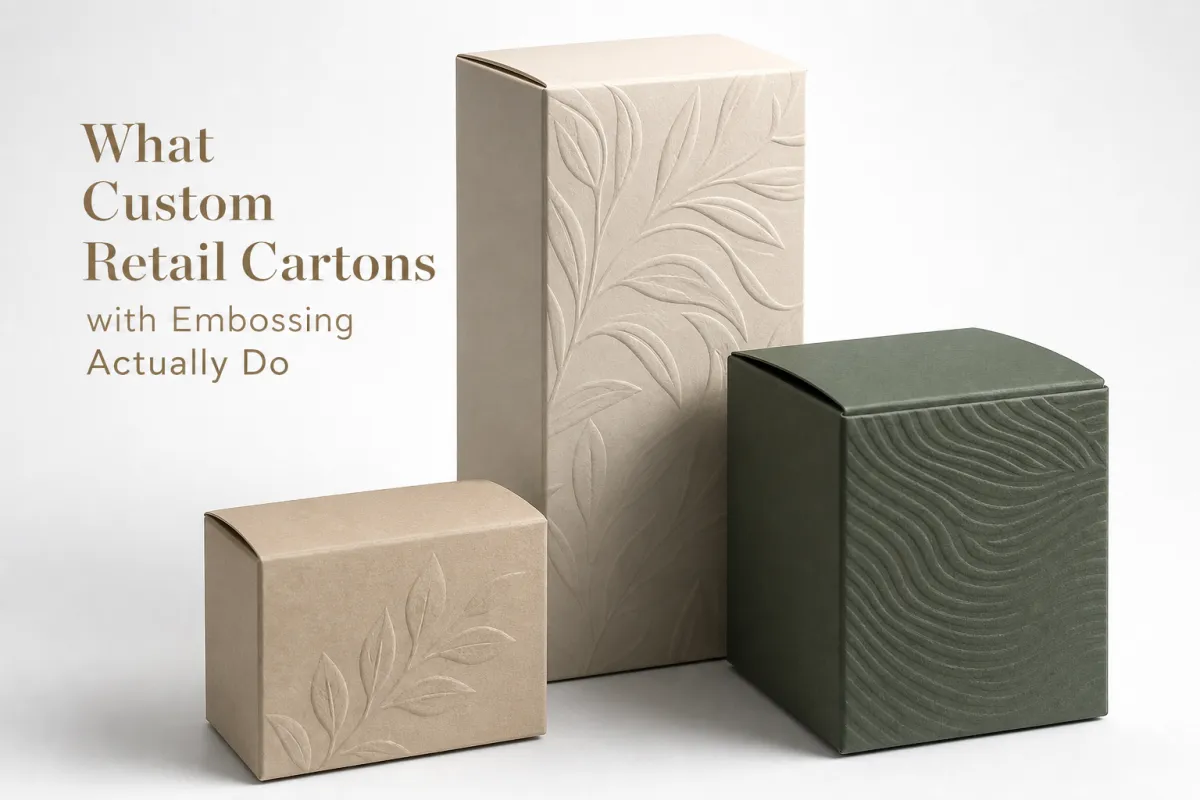
On a shelf, a carton gets one brief chance to explain why it deserves attention. Color speaks first. Shape follows. Texture comes next, usually only after the hand reaches out. Custom retail cartons with embossing help at that exact handoff point. Raised detail catches light differently, but the real advantage sits in the fingertips. A blind impression, a lifted logo, or a textured pattern can create a premium signal that printed ink alone cannot reproduce.
Embossing is simple in concept and exacting in execution. A matched pair of dies presses the board into relief. The selected area rises above the surface, creating height without needing extra ink. That is why embossing is usually treated as a pressure-based finishing method rather than a printed effect. On custom retail cartons with embossing, the finish is physical before it is visual. It changes how the package behaves in the hand, not just how it looks in a mockup.
Brands use embossing for a few grounded reasons. It separates a carton from competitors that rely on flat printing alone. It gives logos, seals, or product names more authority. It can also make Custom Printed Boxes feel less disposable, which matters when the carton is part of the product experience rather than a temporary shell. Buyers notice that difference faster than brands sometimes expect. A raised mark suggests effort, and effort tends to read as value.
The process does have limits. Embossing is not a decorative afterthought. It performs best when the board, layout, and artwork are built to support it from the beginning. Tiny type, crowded edges, and folds placed too close to the raised area can flatten the effect or distort the panel. Good custom retail cartons with embossing feel restrained and certain. They do not chase attention with clutter.
A raised logo only feels premium when the rest of the carton gives it room. Crowded layouts strip away the quiet confidence that embossing depends on.
That is why packaging design deserves more attention than it usually gets. A carton with embossing is not a plain box that happens to have one special finish added late in the game. It is a coordinated piece of retail packaging where the tactile effect, structural format, and printed artwork have to support each other. When they do, the result feels more expensive than the sum of its parts.
There is also an honesty test built into embossing. If the stock is flimsy or the layout is trying too hard, the finish can feel fake, almost like costume jewelry. That is a bit blunt, sure, but it is true. The cartons that work best are the ones that look like they were designed for the finish from day one, not rescued by it.
How the Embossing Process Works on Cartons
Most people picture embossing as a decorative stamp. Production is more mechanical than that. A male die and a female die are made to match. The board passes between them under pressure, and the chosen shape is lifted into relief. The pressure, board thickness, and die depth all need to be aligned carefully, because custom retail cartons with embossing depend on how the paperboard responds when it is forced into a new form.
In a typical workflow, embossing happens after printing and before final finishing or carton conversion, though the exact order can change with the plant and the complexity of the job. If foil stamping is involved, the sequence may shift to protect registration and reduce cracking. If the carton is die cut and folded after finishing, alignment becomes even more important, because the raised area has to land exactly where the art planned it. Small misses are easy to see once the carton is in hand.
Three embossing styles come up often:
- Blind embossing uses no added foil or ink in the raised area, so the shape itself carries the design.
- Registered embossing aligns the raised detail with printed artwork, which gives logos and names a tighter relationship to the rest of the panel.
- Combined embossing pairs the raised effect with foil, coating, or spot varnish for more visual depth.
Each choice changes both the look and the budget. Blind embossing is usually quieter and more controlled. Registered embossing can feel sharper, but it demands tighter proofing and more exact setup. Combined effects can look dramatic, yet they add registration risk, especially on custom retail cartons with embossing that use narrow borders, small marks, or layered graphics.
Depth and detail are where projects succeed or go sideways. Fine lines, tiny serif type, and sharp internal corners do not always survive cleanly on every board grade. A more open fiber structure can soften the edges. A very deep emboss can crush the surrounding area or warp the carton panel. The smartest art direction often trims the design down until the tactile detail reads clearly after production instead of only looking good on screen.
There is a practical reason experienced packagers insist on test pulls. Paperboard has memory, but not unlimited memory. Push too far and the panel starts to look tired; keep the relief within the material's comfort zone and the effect feels crisp. That difference can be the line between premium and merely expensive.
If you want to see how structure and finish influence one another, it helps to compare broader Custom Packaging Products and watch how different carton styles handle pressure. Folding cartons, Rigid Setup Boxes, and sleeve cartons all behave differently once the dies hit the board, which means embossing has to be planned around the material rather than added as a decorative extra.
Design, Material, and Cost Factors for Custom Retail Cartons with Embossing
Price is usually the first question, and it should be. Custom retail cartons with embossing can range widely depending on tooling, board choice, carton size, and how much of the design is actually raised. A simple blind emboss on a compact carton may stay relatively accessible. A deep, registered, multi-level emboss with foil moves into a much higher setup bracket because each layer adds work and risk.
The main pricing drivers usually include these:
- Die tooling: matched dies are custom made, and the upfront cost is real.
- Board type: smoother, more premium paperboard usually holds detail more cleanly.
- Carton size: larger cartons can require bigger dies and more press time.
- Emboss depth: deeper relief often needs stronger boards and tighter setup.
- Run length: short runs usually carry a higher per-unit cost than longer production runs.
- Registration complexity: when embossing must align with print or foil, setup becomes more exacting.
A realistic example helps. Short runs of custom retail cartons with embossing usually cost more per unit because tooling and press setup are spread across fewer cartons. A longer run can improve efficiency substantially, especially when the carton format stays fixed and the artwork stays focused. Buyers often see noticeable price movement once quantities move from a few thousand units into a larger production order.
Material choice matters as much as the die. Smooth, sturdy boards usually hold fine detail better. Premium paperboard with a tight surface and consistent caliper tends to give the cleanest result for logos and delicate patterns. Rougher stock can still work, but the raised image may read softer. That is not always a weakness. For some product packaging, a slightly muted tactile effect feels more natural, more handmade, and less clinical.
Heavier or more fibrous materials can soften the edge of the relief. If the goal is a crisp corporate mark or a clean cosmetic panel, a board that presses sharply is usually better than one with heavy texture. This kind of detail is easy to miss in a spec sheet and easy to notice once the sample arrives on a desk.
There is a second cost layer that rarely gets discussed early enough: revision time. If the emboss area needs to move after art approval, the schedule may absorb new plates, new dies, or new proofs. That kind of change sounds small on a call and turns expensive in production. A good spec avoids that trap by deciding the tactile hierarchy before print files are final.
| Embossing Option | Typical Use | Relative Setup Complexity | Cost Impact |
|---|---|---|---|
| Blind emboss | Clean logos, seals, simple patterns | Moderate | Usually the most economical premium finish |
| Registered emboss | Raised detail aligned to print | Higher | Higher setup and proofing cost |
| Emboss with foil | Luxury retail, gift, cosmetic, or prestige goods | High | More tooling, more registration risk, higher unit price |
| Multi-level emboss | Detailed crest, emblem, or layered mark | Very high | Most expensive, often used sparingly |
Design also shapes budget in less obvious ways. A large embossed field asks for more press attention than a compact logo panel. Close registration with foil or ink adds setup time because the artwork has to land in exactly the right spot. Multi-level relief looks striking, but it usually takes more testing and can force artwork revisions. In other words, custom retail cartons with embossing become costly less from the emboss itself and more from design choices that ask too much of the process.
From a buyer's point of view, restraint often gives the best return. A focused embossed brand mark on a well-built carton can feel more premium than a crowded front panel loaded with effects. That matters in retail packaging, where the box has to do its job quickly on shelf and still hold up through handling, shipping, and stocking. A cleaner spec usually ages better than a flashy one.
If sustainability sits anywhere in the brief, ask what board is being used and whether the carton can support FSC-certified materials. Chain-of-custody and fiber sourcing standards are outlined by the Forest Stewardship Council. For brands trying to reduce unnecessary material use, one strong finish on a well-constructed carton can be a better choice than layering on several heavy coatings.
That said, sustainability claims should be handled carefully. A carton is only as responsible as the actual material sourcing and production setup behind it. Pretty language on a sell sheet does not make a package sustainable. Documentation does.
Step-by-Step: From Dieline to Approved Sample
The cleanest projects usually begin with the dieline. Before anyone polishes artwork or chooses texture, the team needs to confirm carton size, fold style, product weight, and the exact spot where the embossed area can live without conflict. With custom retail cartons with embossing, the raised area should stay away from seams, flaps, and score lines. Those structural zones can fight the relief during folding and assembly.
Once the structure is locked, artwork planning starts. This is the point where some projects sharpen and others get crowded. Fine detail should be simplified. The focal point should sit where the eye naturally lands. The embossing should reinforce the brand story, not compete with it. A logo crest, seal, product name, or symbol can work beautifully if the rest of the front panel stays controlled.
For many projects, the sample is the real decision point. Screens hide a lot. A physical prototype shows how deep the emboss is, whether the board crushes, how the carton folds, and how the raised detail behaves next to print or foil. That matters because custom retail cartons with embossing often feel very different in the hand than they do on a monitor. A screen can suggest luxury. A sample can prove it.
Once the sample is approved, the production file should be locked. At that stage, the board spec, die details, ink references, coating notes, and tolerances should all be documented. If the production team has to guess what the client intended, the risk of drift rises quickly. Clear approval paperwork reduces the odds of softer relief, shifted alignment, or a finish that feels heavier than expected.
A practical sequence many packaging teams follow looks like this:
- Confirm the dieline and carton construction.
- Choose the board grade and finish combination.
- Place the embossing zone with enough clearance from folds.
- Review artwork for line weight, spacing, and readability.
- Produce a sample or prototype.
- Test the sample by folding, handling, and viewing under store-like lighting.
- Approve the final spec before the run begins.
That sequence matters even more when packaging design has to answer to commercial reality. If the embossed area is part of a logo lockup, the team should test whether it still reads from a few feet away. If the emboss sits over a soft-touch coating, the tactile contrast may feel excellent, but it still needs to survive transit and shelf handling. Those are the questions that separate polished product packaging from packaging that only behaves well in mockups.
For general carton structure and print planning, many buyers compare options within broader Custom Packaging Products ranges before finalizing the embossing spec. That comparison can help determine whether the job suits a folding carton, a heavier presentation box, or a sleeve-and-tray style format better.
Process and Timeline: What Happens From Order to Delivery
From order to delivery, custom retail cartons with embossing follow a more deliberate path than a plain printed carton. Quoting and structural review come first. Then the die is created, samples are prepared, approvals are gathered, and the print run begins. After that, embossing is applied, cartons are converted, and inspection happens before shipment. Each stage can introduce its own timing pressure, so the calendar depends on planning rather than speed.
Delays usually come from a few familiar places. Late artwork changes are one. Unclear board selection is another. If the team keeps revising the carton structure after the emboss is already engineered, the schedule can slip quickly. Multiple sample rounds also add time, especially if the client is still deciding between a smaller logo emboss and a larger decorative field.
A useful timing framework goes like this: tooling and sample approval add lead time up front, while production time depends on run size, finishing steps, and factory workload. A straightforward project can move steadily once approval is given, but the buyer should still expect several working steps before cartons are ready for shipment. For custom retail cartons with embossing, most of the calendar lives in the planning phase.
Communication matters more than many teams admit. A reliable supplier should confirm approval checkpoints, share sample milestones, and flag issues before the job reaches full production. If the board grade changes, if the relief is too shallow, or if the die needs adjustment, the customer should hear that early. That kind of transparency saves time and protects retail packaging quality.
Industry standards can also shape expectations. For transport and performance concerns, many brands look to testing protocols discussed by the International Safe Transit Association, especially when the carton will move through distribution before it reaches the shelf. If the package is part of a larger shipping and retail program, that testing can be worth the effort.
Not every embossed carton needs the same level of testing. A light luxury sleeve sold in a boutique has different demands than a heavier carton moving through national retail. Still, it helps to ask how the carton will be stacked, handled, and displayed. That conversation decides whether the embossing should be deep and dramatic or modest and controlled.
One more practical reality: a carton can pass a desk review and still fail in a warehouse. Forklift vibration, carton stacking, and repeated handling can soften the look of a finish much faster than a consumer might expect. It is boring to talk about, but it saves money.
For businesses that want a broader view of sourcing and fulfillment, packaging organizations such as the Institute of Packaging Professionals offer useful context on materials, process knowledge, and packaging practice. Even when a buyer never reads the standards line by line, the discipline behind them shows up in better carton specs and fewer surprises during production.
Common Mistakes That Weaken Embossed Retail Packaging
The biggest mistake is asking embossing to carry too much detail. A raised design can be elegant, but once tiny lettering, tight borders, and ornamental flourishes crowd the same space, clarity drops fast. The carton stops feeling premium and starts feeling busy. With custom retail cartons with embossing, restraint usually reads as confidence rather than lack of effort.
Poor material pairing causes problems too. If the board is too thin, too soft, or too rough, the image may flatten or look uneven. Pressure can crush the sheet where the relief is strongest, which weakens the presentation and can make the carton look tired before it even reaches a shelf. Board selection is not just a procurement call. It is part of the design itself.
Ignoring fold lines is a quieter but expensive error. Embossing too close to a score, flap, or glue area can distort the carton during assembly. Once the box is folded and packed, the raised detail may not sit the same way it did on the flat sample. At volume, that inconsistency becomes visible quickly. In retail packaging, visible inconsistency tends to erode trust faster than most brand teams expect.
Skipping physical samples is another common misstep. A polished PDF is not a substitute for real board, real pressure, and real finishing behavior. Screen proofs hide grain direction, surface response, and how the raised area feels under the fingers. If you are ordering custom retail cartons with embossing, a physical sample is the safest way to avoid a surprise that shows up too late to fix cheaply.
Another trap appears when too many finishes fight for the same panel. Embossing, foil, soft-touch coating, heavy color, spot varnish, and complex die cutting can work together if the art direction is disciplined. Handled loosely, they compete for attention and weaken the overall effect. One clear idea usually beats four competing ones.
There is also a subtle mistake that shows up in brand reviews: the team falls in love with the effect before confirming the retail context. A carton that looks dramatic in a presentation room may read as too dark, too shiny, or too subtle under real store lighting. That is why shelf testing matters. The box has to survive reality, not just a slide deck.
If the carton needs a long explanation, the design has probably done too much. The strongest embossed packages communicate fast, then reward a closer look.
Good retailers know product packaging has to work at distance and at touch. If the embossed feature cannot be seen from across the aisle, it should still feel meaningful in the hand. That balance matters more than any single effect. When the finish supports the structure, the structure supports the brand, and the brand supports the product, the carton feels right without trying too hard.
Expert Tips for Custom Retail Cartons with Embossing
Place the emboss where the hand naturally lands. That might be the logo panel, a seal, a crest, or the product name block. If the shopper has to hunt for the effect, some of its force disappears. Custom retail cartons with embossing work best when the tactile moment feels expected the second the package is lifted.
Keep the layout restrained. Clean typography, generous whitespace, and a limited palette usually let the raised detail do more work. On many projects, the strongest package branding comes from a calm front face and one well-chosen tactile feature. The carton does not need to shout. It needs to feel considered, almost inevitable.
Compare embossing with other finishes before committing. Sometimes a smaller embossed logo with a foil accent creates more shelf impact than a large relief field. Sometimes soft-touch coating adds enough hand feel that the emboss can stay modest. Sometimes a spot varnish gives just enough contrast without pushing the budget too far. For custom retail cartons with embossing, the strongest spec is usually the one that balances appearance, touch, and cost instead of chasing every possible effect.
Think about the retail environment too. Bright store lighting can flatten subtle relief if the emboss is too shallow. Darker shelves may need stronger contrast. If the carton sits inside a tray or is viewed at an angle, the emboss should still read from the side. Those small realities matter because retail packaging is judged in motion, under imperfect light, and often next to louder competitors.
One more practical step helps: test the carton in hand before release. Hold it, stack it, fold it, and compare it with competing packs. A design that looks fine on a monitor can feel fragile once die cutting, board thickness, and emboss depth are all interacting. The physical sample is where the real answer shows up.
Here is a simple decision filter I use when reviewing custom retail cartons with embossing:
- Does the raised area support the brand story?
- Is the board sturdy enough to hold the detail?
- Will the emboss survive folding and shipping?
- Is the cost in line with the item's retail price point?
- Would a smaller effect deliver the same shelf impact more efficiently?
If the answer to those questions is yes, the spec is usually close. If the answer keeps drifting toward maybe, the design probably needs another pass. That is normal. Good packaging design often gets better once the first idea is trimmed down.
Brands planning a broader packaging refresh should also review how the carton fits into the rest of the product packaging system, from master shipper to shelf display. A premium carton can carry the brand well, but only if the rest of the chain respects the same material and finishing logic. The box cannot do all the work while the surrounding system ignores it.
For buyers who need a practical next step, the cleanest path is to gather the dieline, identify the one brand element that should feel elevated, request a sample, compare pricing by run length, and review the carton in hand before approving production. That keeps custom retail cartons with embossing grounded in actual manufacturing conditions instead of guesswork.
When the spec is right, custom retail cartons with embossing can do a lot of quiet work: stronger shelf appeal, better hand feel, clearer brand identity, and a more polished customer impression. That is the real value. Not just a raised logo, but a carton that makes the product feel deliberate from the moment someone picks it up. If you are deciding where to start, begin with the dieline and the one detail that deserves to be touched first. Everything else should support that choice.
FAQ
How much do custom retail cartons with embossing usually cost?
Cost depends on tooling, carton size, board choice, and how much of the design is embossed. Short runs usually cost more per unit because setup and die charges are spread across fewer cartons. Pricing becomes more efficient when the run is larger and the emboss area is kept focused.
What materials work best for custom retail cartons with embossing?
Smoother, sturdier boards generally hold raised detail better than thin or overly textured stock. Premium paperboard often gives the cleanest result for fine logos, borders, and small type. The best choice depends on carton size, product weight, and whether the emboss needs deep definition.
Does embossing add a lot of time to the production timeline?
Yes, embossing usually adds lead time because tooling and sample approval come before full production. The exact delay depends on whether a new die is needed and how quickly samples are approved. Planning the structure and artwork early helps prevent timeline slippage later.
Can custom retail cartons with embossing include foil or other finishes?
Yes, embossing is often paired with foil stamping, coatings, or other premium finishes. Combining effects can create a stronger shelf presence, but it also increases setup complexity. The artwork should be designed so the effects support each other instead of competing visually.
What is the biggest mistake brands make with embossed cartons?
The most common mistake is asking for too much detail in too small an area. Another frequent issue is choosing a board that cannot hold the raised image cleanly. A physical sample is the safest way to confirm the look before committing to production.

