Buyer Fit Snapshot
| Best fit | Custom Seal Stickers for Boxes projects where brand print, material claims, artwork control, MOQ, and repeat-order consistency need to be specified before quoting. |
|---|---|
| Quote inputs | Share finished size, material target, print colors, finish, packing count, annual reorder estimate, ship-to region, and any compliance wording. |
| Proofing check | Approve dieline scale, logo placement, barcode or warning zones, color tolerance, closure strength, and carton packing before bulk production. |
| Main risk | Vague material claims, crowded artwork, missing packing details, or unclear freight terms can make a low unit price expensive after revisions. |
Fast answer: Custom Seal Stickers for Boxes: Material, Adhesive, Artwork, and MOQ should be specified like a repeatable production item. The safest quote records material, print method, finish, artwork proof, packing count, and reorder notes in one written spec.
Production checks before approval
Compare the actual filled-product size with the drawing, then confirm tolerance on folds, seals, hang holes, label areas, and retail display edges. Reserve space for logos, QR codes, warning copy, and material claims before decorative graphics fill the panel.
Quote comparison points
Review material grade, print process, finish, sampling route, tooling charges, carton quantity, and freight assumptions side by side. A quote is only useful when the supplier can repeat the same color, closure quality, and packing count on the next order.
Custom seal Stickers for Boxes do more work than most teams expect. A plain corrugated carton can protect a product just fine, but the package still feels a little unfinished until the closure is marked, branded, and easy to spot on a packing bench, a warehouse shelf, or a front porch.
That small sticker can act like a handshake. It may carry a logo, hold the flaps together, show a message like "packed with care," or simply add a clean point of contact that makes a shipment look intentional. For brands building branded packaging, keeping package branding consistent, or tightening the fulfillment process, that tiny detail often changes the whole read of the box.
The practical side matters too. The right seal can help with handling, make a customer notice tampering faster, and keep a packing line moving at a steady pace. The wrong one peels, curls, lifts in cold weather, or disappears into brown kraft board, which means the budget savings were never real savings. Custom seal stickers for boxes work best when they are chosen as part of the whole packaging system, not treated like a last-minute add-on.
A seal sticker should still look deliberate after the carton has been stacked, shifted, and handled by people who never saw the original packing bench.
If you think of custom seal stickers for boxes as a small version of product packaging discipline, the choices start to make sense. Size, adhesive, facestock, color contrast, and finish all affect how the seal behaves on a real box, not just on a mockup. I have seen plenty of clean proofs fall apart once they met recycled board and a cold shipping dock, so the real carton always gets the final say.
Why Custom Seal Stickers for Boxes Stand Out
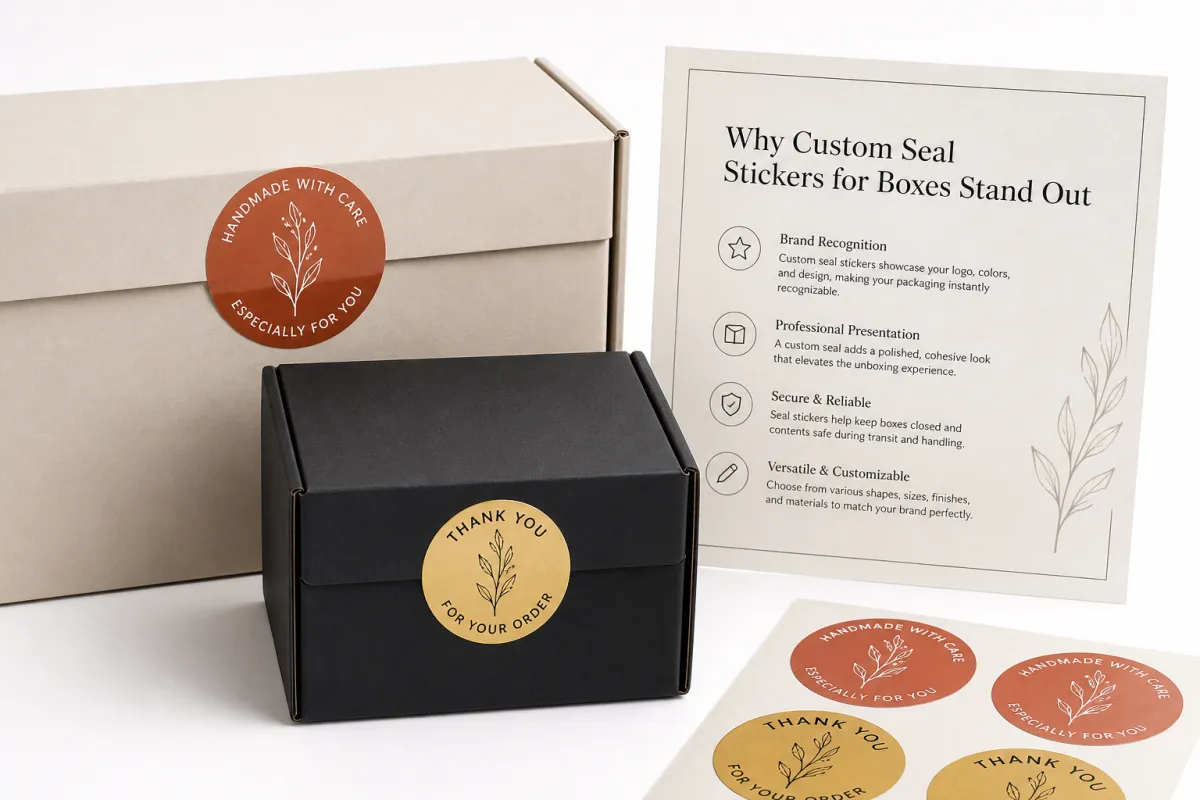
A plain corrugated box says "shipment." A well-placed seal says "this order was prepared on purpose." That difference matters because the customer's first physical touchpoint usually happens before the product is even visible, and custom seal stickers for boxes are one of the fastest ways to improve that moment without replacing the whole carton program.
Seal stickers sit in the space between tape and a full label system. They can be decorative, functional, or both. Some businesses use custom seal stickers for boxes as branded closures that hold flaps together and reinforce the logo. Others use them as tamper-evident accents across the opening seam. Many choose them simply because the box looks cleaner and more finished with a branded closure than it does with plain clear tape running across the top.
The small format matters. People notice the first thing they touch. They notice contrast too. A bright seal on kraft board can turn a basic carton into packaging that feels coordinated, while a muddy print on a textured recycled box can make the whole shipment look rushed. That is why custom seal stickers for boxes are so useful in packaging design: they take up very little space, but they change the perceived quality of the whole package.
Another reason they stand out is orientation. A sticker at the closure tells the eye where the box opens and where it was last closed. That makes the package easier to inspect, easier to store, and often easier to present at retail. For businesses that ship direct-to-consumer, wholesale samples, subscription kits, or retail packaging, that small cue can make the box feel more intentional than a generic carton ever will.
Many buyers underestimate how much a seal contributes to the final read of the package. Custom seal stickers for boxes are not just decoration. They can support presentation, basic security signaling, and packing-line consistency when the same seal size is used across different carton sizes.
Used well, they also support custom printed boxes and other branded components without forcing every shipper to print a fully custom carton for every order. That matters when volume varies, artwork changes often, or the business wants to keep some flexibility in its product packaging program.
How Custom Seal Stickers for Boxes Work
To understand custom seal stickers for boxes, it helps to break them down the way a production team would. Every seal has four main pieces: the facestock, the adhesive, the liner, and the printed layer. Each one affects how the sticker handles during application and how long it stays where it should.
Facestock, Adhesive, Liner, and Print
The facestock is the visible material. It might be paper, BOPP, polypropylene film, or another face material chosen for a specific look or level of durability. The adhesive does the holding, but not every adhesive behaves the same way. A hot warehouse, a cold delivery truck, or a dusty folding line can all change how custom seal stickers for boxes perform once they leave the press.
The liner is the carrier sheet or roll backing, and it matters more than people think because it affects application speed and consistency. A seal that releases cleanly from the liner helps the operator keep a steady pace. A poorly cut liner can slow a line down, especially when the team is applying seals by hand on hundreds or thousands of cartons.
The print layer is what carries the logo, message, or graphic. With custom seal stickers for boxes, color contrast is often more important than decoration. A crisp one-color print on kraft can outwork a complicated full-bleed design if the seal has to be read at a glance during packing and delivery.
Where the Seal Sits on the Box
Most seals go across the top flap closure, where they can hold the box shut and create a clear visual line across the opening. Some are placed on side panels or bundles when the goal is more about branding than closure. In retail packaging, a seal might be positioned so the logo faces forward when the carton sits on a shelf. In fulfillment, the same seal might be centered on the seam so it is obvious when the box has been opened.
That placement choice changes the user experience. A seal across the center seam is easier to inspect, while a seal on the corner may be faster to apply during a busy packout. Custom seal stickers for boxes should match the way the carton is handled, not just how it appears in a proof.
Decorative Versus Functional
Decorative seals emphasize the look of the package. Functional seals are meant to help indicate opening or disturbance. The two can overlap, but they are not identical. A decorative seal may use a smooth film with strong visual impact. A functional seal often uses paper or a material that shows disruption more clearly if someone tries to remove it.
That distinction matters for buyers comparing custom seal stickers for boxes as a styling tool versus a packaging control point. For a light retail shipment, a branded closure might be enough. For a higher-value order, it may be smarter to treat the seal as a visual indicator rather than a security device on its own. That is the honest version, even if it is not the flashiest answer.
Different Carton Surfaces
Surface type changes everything. Kraft board has a different feel from coated cardboard, and recycled board often has more tooth and fiber variation than a smoother premium carton. Lightly textured surfaces can be friendly to some adhesives and unforgiving to others. If the box stock is glossy or coated, the seal may need a stronger adhesive or a material that keeps edge hold without curling.
That is why test panels matter. A file proof cannot tell you how custom seal stickers for boxes will behave on actual stock. The carton texture, board caliper, coating, and even the dust level in storage can affect the final result.
For teams comparing materials and handling methods, ISTA publishes widely used shipment test methods that help buyers think beyond the label itself and focus on how the entire packaged unit travels through vibration, compression, and temperature swings.
Key Factors That Shape Custom Seal Stickers for Boxes
Good custom seal stickers for boxes start with a simple question: what job does the seal need to do first? If the answer is presentation, the design can be lighter and more expressive. If the answer is closure support, the adhesive and size deserve more attention. If the answer is tamper visibility, the material choice matters more than the art alone.
Size and Shape
Round, square, oval, and custom die-cut shapes all have a place. Round seals tend to apply quickly and look tidy on smaller cartons. Squares and rectangles can carry more information, which is useful when a logo needs breathing room. Ovals give a softer visual read, and die-cuts can match a brand mark closely if the artwork is simple enough to reproduce cleanly.
Size should match the flap area. A sticker that is too small can disappear into the box, while one that is too large may buckle at the fold or slow down application. For many custom seal stickers for boxes, a 1.5-inch to 3-inch footprint is common, but the real answer depends on the box face, the artwork, and whether the seal is mostly decorative or partly functional.
Material Choices
Paper remains a strong choice for many buyers because it prints well, takes ink cleanly, and can show tearing when removed. BOPP and similar films often offer better moisture resistance and a cleaner surface for bright color or high-gloss presentation. Other film options can help when the shipping environment is damp, cold, or subject to scuffing.
Here is the tradeoff in plain language: paper usually feels more natural and often fits kraft-based product packaging beautifully, while film usually holds up better in rougher transit. For custom seal stickers for boxes, the right answer depends on whether the package needs a soft paper look or a tougher surface that resists moisture and abrasion.
If sustainability claims matter, paper facestocks can be specified with certified sourcing. For paper-based custom seal stickers for boxes, FSC certification is one route buyers often review when they want chain-of-custody support for broader packaging programs.
Adhesive Strength and Environment
Adhesive strength is not just "strong" or "weak." It has to work in the right temperature band, on the right surface, with the right pressure. A carton stored in a warm warehouse overnight can behave differently from one sealed in a cooler packout room. Cold chain shipping adds another layer of difficulty because some adhesives need time and pressure to wet out properly.
For custom seal stickers for boxes, that means one adhesive may be perfect for local delivery and disappointing for long-haul fulfillment. A buyer who ships 200 boxes a week in a stable environment may need a very different spec from a company shipping seasonal product across multiple zones. That difference is easy to miss until the first batch starts lifting on a Monday morning.
Finish, Contrast, and Readability
Matte, gloss, soft-touch, and uncoated finishes each create a different impression. Gloss can look bright and polished, but it can also reflect light in a way that makes small text harder to read. Matte often feels calmer and prints beautifully on kraft-toned brands. Soft-touch adds a premium feel, though it usually raises cost and should be used where the tactile effect really matters.
Contrast is the part many teams get wrong. Dark text on medium kraft can vanish. Tiny reverse type can fill in. A simple logo with enough negative space often performs better than an elaborate badge with five lines of copy. With custom seal stickers for boxes, readability at arm's length usually beats complexity.
| Option | Typical Price Direction | Durability | Best Use |
|---|---|---|---|
| Paper seal | Often the lowest cost; roughly $0.04-$0.12 per unit at higher volumes, depending on size and print coverage | Good for dry cartons and lighter handling | Retail packaging, kraft boxes, presentation-focused shipping |
| BOPP or film seal | Usually moderate; roughly $0.06-$0.18 per unit at higher volumes | Better moisture and scuff resistance | Warehouse shipping, humid environments, higher handling risk |
| Specialty finish seal | Higher; often $0.10-$0.28 per unit or more, depending on finish and setup | Varies by material and coating | Premium launches, gift packaging, branded packaging programs |
Those numbers are not fixed quotes, and they can move with quantity, artwork complexity, and the converter's equipment, but they do give buyers a realistic starting point. For custom seal stickers for boxes, the cheapest material is not always the cheapest decision if it causes rework, waste, or a poor customer impression.
Custom Seal Stickers for Boxes Pricing and Cost Factors
Pricing for custom seal stickers for boxes is shaped by a few core variables: quantity, size, shape, material, finish, color count, and whether the job requires a custom die or special print setup. Once you understand those pieces, the quote stops looking mysterious.
The fastest way to think about cost is this: more setup usually means more upfront spend, while more volume usually lowers the unit price. A 1,000-piece run may look expensive on a per-unit basis, but a 10,000-piece run could reduce the price per seal dramatically even while the overall invoice grows. That pattern is common across custom seal stickers for boxes, custom printed boxes, and other branded packaging items.
Where the Money Goes
Setup costs often include prepress review, proofing, and die creation for custom shapes. If the seal is a simple circle or square, those charges can stay modest. Once the job moves into a custom contour, the die becomes a real line item. Special finishes such as foil, raised varnish, or soft-touch coatings can add more cost because they introduce extra production steps and tighter inspection.
For many buyers, that extra cost is justified when the seal will be used on every carton for months. A seal that strengthens the opening point and supports the brand can pay for itself over a long run of custom seal stickers for boxes. If the seal will only be used for a limited campaign, a simpler spec may be the better move. I would rather tell a team that plainly than dress it up.
Volume Breaks and Inventory Planning
Volume breaks usually reward larger orders. That does not mean you should overbuy. It means you should estimate realistic usage, add a small safety margin, and compare the savings from a larger run against storage space and artwork stability. A seal that sits in inventory for a year may not be a bargain if the design changes before the stock is used.
For businesses with steady fulfillment, I usually suggest thinking in monthly usage blocks. If a brand uses 8,000 custom seal stickers for boxes a month, it may make sense to order a little above that level rather than tiny rush orders that interrupt the packing line. The sweet spot is often where the unit cost is acceptable and the reorder cycle is predictable. Nobody wants to be stuck taping boxes shut because a seal reorder was delayed by one week.
Budgeting by Use Case
It helps to separate presentation-driven seals from operational seals. A premium launch seal may deserve a special finish because the package is part of the marketing story. A warehouse seal may just need reliable adhesion, decent print clarity, and a clean application path. Those are different jobs, and they should not share the same cost target by default.
For larger packaging programs, it also helps to think of seals as part of a system. If you already buy cartons, inserts, or other branded components, coordinating the seal with the rest of the line can reduce surprises. That is where a broader look at Custom Packaging Products and supporting items such as Custom Labels & Tags can keep the entire package consistent rather than pieced together from unrelated materials.
Here is the budgeting rule I use most often: if a slightly better material prevents even a small amount of rework, returns, or damaged presentation, the upgrade often pays for itself. That is especially true for custom seal stickers for boxes used at scale.
Step-by-Step Process and Timeline
Most custom seal stickers for boxes projects move faster when the team knows the sequence before the quote is even approved. The cleaner the artwork and the clearer the application goal, the fewer surprises later.
1. Define the Use Case
Start with the box itself. Measure the flap area, note the box board type, and decide whether the seal is meant to hold, decorate, or signal opening. A seal on a lightweight mailer has different needs from one used on a heavy corrugated shipping carton. If the seal must survive rough handling, that should be specified early.
2. Choose Size, Material, and Finish
Once the use case is clear, narrow the material options. Paper may be enough for presentation work. Film may be the better answer for moisture or abrasion. Gloss, matte, or soft-touch should be chosen based on the visual goal and the way the box will be seen in natural light, warehouse light, or retail fixtures. Many custom seal stickers for boxes look great in proofs and lose impact when the finish does not suit the stock, so this step deserves real attention.
3. Prepare Artwork
Vector files are the safest route because they scale cleanly and keep type sharp at small sizes. Simple artwork also helps if the seal is tiny. If the design has a slogan, keep it short. The best performing custom seal stickers for boxes usually lean on a logo, brand name, or short message rather than a long sentence that becomes unreadable after application.
Artwork that is already sized to the intended closure point also speeds things up. If the file matches the box dimensions from the start, there is less back-and-forth on proof corrections and fewer chances for the final seal to feel crowded or too small.
4. Review the Proof and Sample
Proofing is where many delays start, but it is also where many mistakes are prevented. Check the color contrast, the die line, the crop, and the placement. If possible, ask for a sample run or a production-like proof and test it on the actual carton. That simple step can reveal issues with adhesive grab, edge lift, or visual scale that are hard to predict on screen.
For custom seal stickers for boxes, I recommend testing on the same stock the pack line will use, not a substitute. Kraft, coated, and recycled boards can each behave differently, and a proof on the wrong surface can create false confidence.
5. Production and Shipping
Once approved, a straightforward order with final artwork and stock availability can often move through production in roughly 5-10 business days, while more complex runs with custom dies or specialty finishes may need 10-15 business days or longer. Shipping adds its own time, so a buyer planning a launch should build in a buffer rather than betting on the fastest possible window.
That timeline is why custom seal stickers for boxes should be ordered before inventory gets tight. If the seal supports a seasonal campaign, a holiday box program, or a retail launch, I would rather see the order placed early with a little room to adjust than rushed at the end.
When a team is evaluating package movement and shipment durability, it helps to keep the broader test picture in view. The seal is one piece; the carton, closure, and transit path are the rest. That is exactly why shipping methods and corrugated performance standards matter alongside the artwork itself.
Simple Pre-Approval Checklist
- Box size and flap width confirmed
- Seal placement marked on the carton
- Material chosen for the shipping environment
- Finish selected for the desired visual effect
- Quantity matched to the reorder window
- Delivery date checked against launch or replenishment timing
With that checklist, custom seal stickers for boxes become a controlled part of the packaging workflow instead of a last-minute add-on.
Common Mistakes to Avoid With Custom Seal Stickers for Boxes
Most problems with custom seal stickers for boxes do not come from the printing press. They come from mismatched expectations. The team wanted a seal that looked great on a design board, but the carton had different needs in the warehouse or during transit.
- Choosing the wrong adhesive: A seal that works on a clean, dry sample may fail on a dusty carton, a cold shipment, or a box stored in a warm stack for several days.
- Making the design too busy: Tiny text, thin strokes, and low-contrast details can disappear on textured board. Clear branding usually performs better than overdesigned art.
- Skipping surface tests: Kraft, coated, and recycled board all behave differently. Testing on the actual carton stock is the only reliable way to judge adhesion and readability.
- Ignoring lead times: Custom dies, proof rounds, and special finishes can stretch schedules. A launch tied to custom seal stickers for boxes should not start with a rush order.
- Buying for looks only: A seal that is hard to peel, hard to place, or hard to inventory can slow down the packing team even if it photographs well.
One issue I see often is underestimating the box surface. A glossy carton can reject one adhesive and welcome another. A recycled board with more fiber texture can give you a beautiful paper look but demand careful pressure during application. That is why the best custom seal stickers for boxes are chosen with the whole packaging environment in mind.
It also helps to connect the seal to the rest of the packout plan. If the carton will be stacked, shipped, and opened by customers who may not have a knife handy, the seal should still make sense after rough handling. A package can be branded beautifully and still fail operationally if the seal design was too delicate for the job.
For teams shipping under stricter parcel conditions, it is worth checking test methods and handling recommendations through sources such as ISTA rather than assuming a neat mockup tells the full story. The same goes for paper sourcing claims: if a sustainability story matters, the stock spec should support it all the way back through the supply chain.
Expert Tips and Next Steps for Custom Seal Stickers for Boxes
The best custom seal stickers for boxes are rarely the fanciest ones. They are the ones that fit the box, survive the environment, and keep the packing team moving without extra thought. That is the standard to aim for.
Test a Small Run First
If the seal is new, order a small sample run before committing to volume. That gives the team a chance to test adhesion, placement, color accuracy, and how the sticker behaves after the box is folded, stacked, and carried. A small test often catches the problems that a PDF proof cannot show.
When a business uses custom seal stickers for boxes for both presentation and shipping protection, testing becomes even more valuable because the seal has two jobs instead of one. A sample run helps separate "looks good" from "works on the floor."
Use Two Specs if the Business Needs Two Jobs
Some brands benefit from a lighter presentation seal for retail packaging and a tougher seal for fulfillment. That is not wasted complexity if the two channels have different demands. A glossy, polished seal can be perfect for a gift box, while a more durable version may suit the shipping carton that spends time in a warehouse or parcel network.
That split can also help control cost. Instead of forcing one expensive spec to do everything, the brand can Choose the Right version for each use. For many teams, that is a smarter way to manage custom seal stickers for boxes over time.
Keep a Reorder File Ready
Save the final art, size, material, quantity, proof notes, and intended placement in one place. That way, the next order does not start from scratch. A clean reorder file reduces mistakes and makes it easier to respond when stock drops faster than expected.
Good packaging teams treat seals like any other recurring component. The file should be ready before the last roll or sheet runs out. That is especially true if the seal is part of a coordinated line with custom printed boxes, inserts, or other branded packaging components.
Photograph the Test Box in Real Light
Take photos in natural light, warehouse light, and, if relevant, retail display light. A seal that looks sharp in one setting can fade in another. This is a simple step, but it gives buyers a much better read on how the package will feel in the real world. For custom seal stickers for boxes, contrast and finish often show their true behavior only when light hits the carton from different angles.
That kind of review is worth the time because packaging decisions are rarely judged on paper alone. They are judged when the carton moves through the packing bench, the parcel carrier, and the customer's hands. If the seal still looks intentional in all three places, you chose well.
So the next steps are straightforward: measure the box, mark the sealing point, request a proof, and test the first sample on the actual carton stock before you lock the order. If that sample survives stacking, handling, and a real warehouse shift, you are on the right track with custom seal stickers for boxes.
What size are custom seal stickers for boxes usually best for?
A common starting point is a size that spans the flap or closure area without overpowering the front of the carton. Smaller boxes usually need compact seals so the closure looks neat, while larger cartons can handle wider designs with more branding space. The safest move is to test the size on the actual box before ordering volume, because custom seal stickers for boxes need to fit the seam and still read clearly after application.
Do custom seal stickers for boxes provide tamper evidence?
They can, but only if the adhesive and material are chosen for that purpose and the sticker is placed across the opening seam. Paper-based seals often show visible disruption when removed, while film-based options may resist tearing differently. For higher-security shipments, treat custom seal stickers for boxes as a visual indicator rather than assuming they replace a dedicated security system.
How much do custom seal stickers for boxes cost?
Pricing usually depends on quantity, size, shape, material, finish, and whether the design needs a custom die or special print setup. Larger orders often reduce the per-sticker price, while specialty materials and complex shapes increase the total cost. The best way to budget is to estimate monthly usage and compare a smaller frequent reorder against a larger bulk run of custom seal stickers for boxes.
How long does it take to produce custom seal stickers for boxes?
Timing depends on proof approval, artwork readiness, material choice, and whether the job requires a new die or specialty finish. Simple orders with final artwork usually move faster than custom shapes or heavily proofed projects. Build in extra time if the seals are tied to a product launch, seasonal campaign, or retail shipment deadline, because custom seal stickers for boxes should arrive before the packing schedule gets tight.
What artwork works best for custom seal stickers for boxes?
Vector artwork is usually the safest choice because it stays crisp at small sizes and supports clean color separation. High-contrast designs tend to print and read better on kraft or recycled boxes, especially when the seal is small. Keep essential text minimal so the logo, brand name, or seal message stays legible after application, and the finished custom seal stickers for boxes look intentional rather than crowded.
Used with care, custom seal stickers for boxes can tighten presentation, improve the packout experience, and help a box feel finished the moment it leaves the bench. Measure the carton, Choose the Right stock, test one sample on the actual box surface, and only then lock the reorder so the seal keeps doing its job long after the first shipment goes out.

