Buyer Fit Snapshot
| Best fit | Custom Set Up Boxes Manufacturer projects where brand print, material claims, artwork control, MOQ, and repeat-order consistency need to be specified before quoting. |
|---|---|
| Quote inputs | Share finished size, material target, print colors, finish, packing count, annual reorder estimate, ship-to region, and any compliance wording. |
| Proofing check | Approve dieline scale, logo placement, barcode or warning zones, color tolerance, closure strength, and carton packing before bulk production. |
| Main risk | Vague material claims, crowded artwork, missing packing details, or unclear freight terms can make a low unit price expensive after revisions. |
Fast answer: Custom Set Up Boxes Manufacturer: Board, Finish, Dieline, and Unit Cost should be specified like a repeatable production item. The safest quote records material, print method, finish, artwork proof, packing count, and reorder notes in one written spec.
Production checks before approval
Compare the actual filled-product size with the drawing, then confirm tolerance on folds, seals, hang holes, label areas, and retail display edges. Reserve space for logos, QR codes, warning copy, and material claims before decorative graphics fill the panel.
Quote comparison points
Review material grade, print process, finish, sampling route, tooling charges, carton quantity, and freight assumptions side by side. A quote is only useful when the supplier can repeat the same color, closure quality, and packing count on the next order.
If you are comparing packaging partners, a Custom Set Up Boxes manufacturer can change how a product feels before anyone even touches the item inside. That is not marketing fluff. It is the result of structure, finish, and fit doing real work. A rigid box that opens cleanly, holds its shape, and matches the brand story does more than a lot of expensive noise ever will.
From a packaging buyer's point of view, the real question is not whether rigid boxes look good. It is whether the custom set up boxes manufacturer you choose can balance brand impact, protection, lead time, and unit cost without turning the project into a mess later. That tradeoff gets sharp in beauty, apparel, gifts, electronics, and luxury retail, where retail packaging is part of the sale, not a side note. Buyers comparing broader formats should also look at Custom Packaging Products alongside rigid box options so the structure fits the product and the channel.
There is a simple reason setup boxes matter: they create a physical cue for quality. Folding cartons can be efficient, and mailers can be useful for shipping, but a rigid setup box communicates stability the second it is lifted. In package branding, that matters because people read weight, texture, and opening sequence as value signals. A strong custom set up boxes manufacturer designs around that reality instead of treating the box like a generic container with a logo slapped on it.
Why a custom set up boxes manufacturer matters
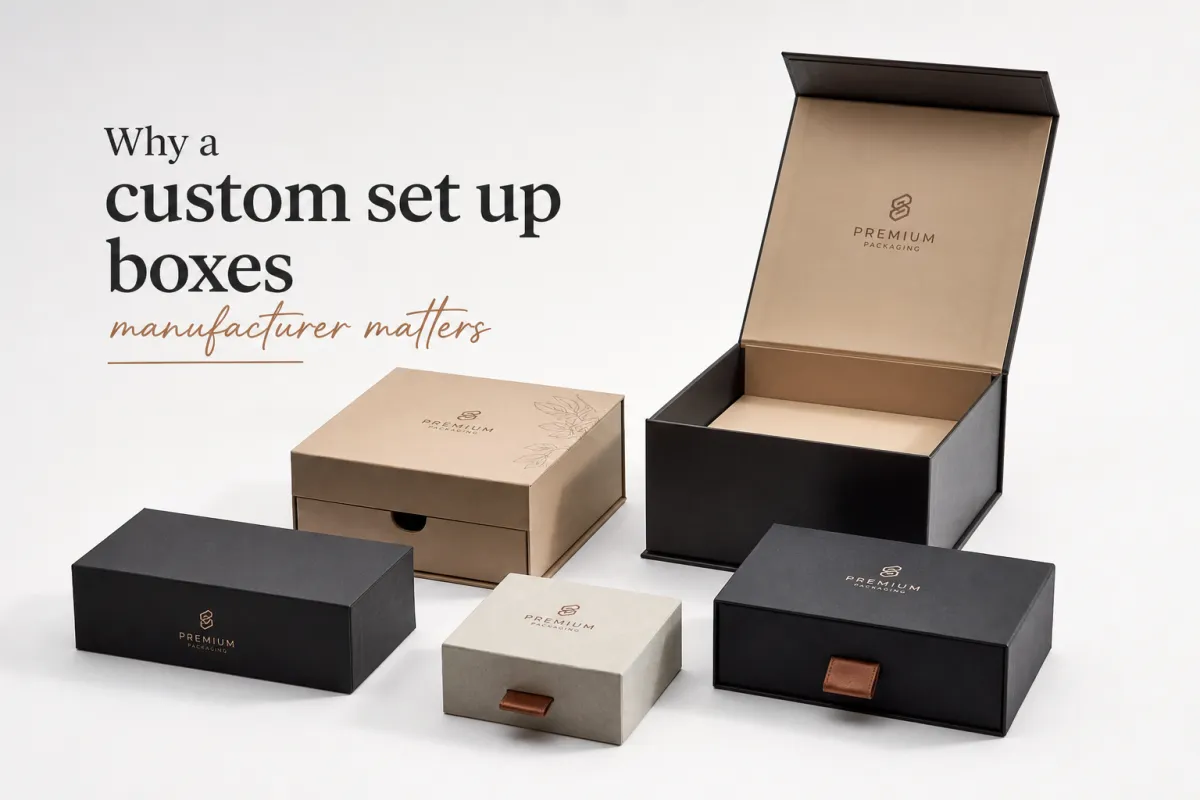
A custom set up boxes manufacturer does more than make a box with a logo on it. The right partner builds rigid, pre-assembled packaging that keeps its shape, supports the product, and signals premium positioning before the product is even visible. That sounds small until you put the boxes side by side on a shelf. A rigid box sits with authority. A folding carton flexes. A mailer protects the shipment, but it rarely gives the same sensory cue.
That is why a custom set up boxes manufacturer matters most where perception drives purchase behavior. Beauty buyers want a clean reveal. Apparel brands want unboxing to feel like part of the gift. Electronics makers need structure and insert control. Gift brands want the packaging itself to feel worth keeping. In those categories, branded packaging is not decoration. It is part of the product story and part of the price.
I have sat through enough packaging reviews to know that buyers often underestimate what the box does on the shelf. In practice, a rigid setup box can beat a louder design in a weaker structure because the physical form carries trust. Nobody says, “This is a well-constructed box.” They just feel it. A custom set up boxes manufacturer helps create that response by controlling board grade, wrap paper, and closure style instead of relying on print alone.
There is also the practical side. A good custom set up boxes manufacturer can reduce damage risk for premium items that would otherwise need heavy secondary packaging. That matters when product packaging has to survive retail handling, stockroom stacking, or e-commerce transit. The economics are not always obvious from the first quote, but fewer damaged units and fewer returns can make up for the higher unit price of rigid construction.
Here is the basic contrast buyers should keep in mind: folding cartons are built from paperboard and ship flat; setup boxes are rigid and assembled before they reach the packer. That makes setup boxes more expensive to produce and ship, but they often deliver a more premium experience. A custom set up boxes manufacturer is the right fit when presentation carries real weight. If the box is part of the offer, not just the outer shell, rigid construction earns its place.
Packaging buyer reality check: the cheapest box is not always the least expensive choice. If the wrong structure slows packing, damages inserts, or weakens retail presentation, the final cost is higher than the quote suggests. A custom set up boxes manufacturer should be judged on the full outcome, not on one line item and a hopeful mood.
How a custom set up boxes manufacturer works
The process usually starts with a brief. A custom set up boxes manufacturer needs product dimensions, weight, opening preference, target market, and finish expectations before any useful quote can happen. If the item is fragile, the manufacturer also needs to know how it will travel, whether it sits in retail displays, and whether the customer opens it as a gift or as a purchase. Those details shape the box from the inside out.
Next comes the dieline or structural drawing. This is the point where the custom set up boxes manufacturer turns an idea into actual measurements: lid depth, base height, wall thickness, insert clearance, and closure fit. Buyers sometimes treat this step like paperwork. It is really the blueprint. A box that looks elegant in a rendering can become annoying fast if the product rattles, the lid is too tight, or the insert steals too much room.
Then come samples. A reliable custom set up boxes manufacturer should be willing to produce a prototype or preproduction sample so the buyer can test fit, finish, and color. This is where real handling matters. Does the magnetic closure pull shut with a crisp feel? Does the drawer slide too loosely? Does the lift-off lid bind after the wrap is applied? Those are the questions that save a launch from embarrassment later.
Production itself is a chain of steps. Rigid board is cut, wrapped, printed, laminated, finished, assembled, checked, and packed for shipment. A custom set up boxes manufacturer may also coordinate specialty work such as foil stamping, embossing, debossing, soft-touch lamination, spot UV, or specialty paper application. Each finish changes the look and sometimes the handling behavior, so ask whether the decoration helps the box or just adds cost.
In-house, domestic, and overseas models all shift the balance differently. An in-house or domestic custom set up boxes manufacturer usually offers faster communication and easier revisions, while overseas production can lower unit cost at scale but may add freight time and longer sample cycles. Neither model is automatically better. The right choice depends on volume, launch timing, tolerance for revisions, and how tightly the packaging must align with the rest of the supply chain.
One more detail matters here: a good manufacturer does not just cut and glue. It coordinates prepress, finishing approvals, inspection, and carton packing so the final product arrives ready for use. When that process is handled well, the buyer sees fewer surprises and less back-and-forth. When it is handled poorly, the project turns into a stack of tiny delays that quietly eat the launch calendar.
Custom set up boxes manufacturer pricing and cost drivers
Pricing from a custom set up boxes manufacturer depends on more variables than most first-time buyers expect. Size is only one of them. Board thickness, paper wrap, print coverage, insert design, manual assembly, and finish complexity all affect the final number. A compact rigid box may be simple to build, but once you add a magnet closure, foil stamping, and a form-fitted insert, the cost curve moves quickly.
Rigid boxes usually cost more than folding cartons, and that makes sense. A custom set up boxes manufacturer is building a structure that uses more material, more labor, and more handling. But the premium is not wasted if the box helps position the product in a higher price tier or reduces transit damage. In packaging design, cost should be measured against commercial function, not just material volume.
For smaller runs, setup charges matter a lot. A custom set up boxes manufacturer may need to recover sample development, tooling, prepress, and assembly preparation across fewer units. That is why low-volume orders often have a much higher unit price than larger runs. Once volume rises, the labor and setup are spread over more boxes, and the economics improve. Buyers who know their demand forecast can often save money just by ordering more strategically.
There is also a cost gap between plain construction and decorative construction. A custom set up boxes manufacturer may quote one price for a basic rigid box with printed wrap and another for a presentation box with multiple inserts and specialty finishing. The second box is not just prettier. It is more complex to produce, and the production risk is higher because every extra feature adds another point where tolerance, alignment, or registration can drift.
Here is a simple cost framework that helps buyers budget with fewer surprises:
- Prototype cost for sample development and structure checks.
- Per-unit cost based on size, board grade, wrap paper, and print coverage.
- Freight for samples, inbound cartons, or finished goods delivery.
- Storage if boxes ship flat or if finished goods need warehouse space.
- Contingency for one revision cycle or a finish adjustment.
That is why a custom set up boxes manufacturer should always be compared on total landed cost, not just the quoted unit price. A low quote can hide expensive sample revisions, higher freight, or a poor fit that leads to wastage. A higher quote can be the better deal if it includes tighter tolerances, clearer communication, and fewer downstream headaches.
| Box Type | Typical Use | Relative Cost | Lead-Time Pressure | Best Fit |
|---|---|---|---|---|
| Folding carton | Lightweight retail goods | Lowest | Lowest | High-volume, cost-sensitive product packaging |
| Standard rigid setup box | Beauty, gifts, apparel, accessories | Mid to high | Moderate | Premium retail packaging with strong shelf presence |
| Drawer or magnetic presentation box | Luxury, electronics, curated gift sets | High | Higher | Brand storytelling and repeat-use packaging |
| Rigid box with custom insert system | Fragile or multi-piece products | Highest | Highest | Protection, precise fit, and premium unboxing |
That table is not a fixed rulebook, because every custom set up boxes manufacturer prices based on its own labor model and sourcing base. Still, the pattern holds: complexity, not just size, Drives the Quote. If you are collecting estimates, ask for line-item pricing so you can see whether the cost increase comes from material, printing, assembly, or freight assumptions.
For Brands That Sell into premium retail, the more useful question may be this: what does the box help me earn? If a better box supports a higher margin, stronger product packaging, or lower damage rates, then the right custom set up boxes manufacturer can pay back far more than the packaging line item suggests.
Key factors to evaluate before you order
The first thing to evaluate is the material stack. A custom set up boxes manufacturer should be able to explain the rigid board grade, the wrap stock, the print surface, and the insert material in plain language. If the product is heavy, brittle, or oddly shaped, those choices matter a lot. A thin board may look fine in a mockup and still fail in daily handling. The right stack supports both the product and the brand position.
Structure matters just as much. A custom set up boxes manufacturer may suggest a lift-off lid, shoulder box, drawer box, or magnetic closure depending on the desired opening sequence. A shoulder box adds reveal drama. A drawer box creates a slower, more deliberate experience. A magnetic flap can feel polished, but it also introduces another component that must be aligned. Each format creates a different emotional rhythm for the customer.
Brand fit is the next filter. Color accuracy, texture, finish level, and reveal sequence should match the product story. If the brand is clean and clinical, a heavily textured wrap may feel off. If the brand sells indulgence or luxury, a basic uncoated stock can feel too plain. A strong custom set up boxes manufacturer should translate the brand into packaging design instead of forcing the design to fit a stock structure.
Then there is the question of function. Will the box sit on a shelf or move through e-commerce transit? Does it need to fit inside master cartons with minimal wasted space? Will the consumer keep the box after opening it? A thoughtful custom set up boxes manufacturer will ask these questions because the answer affects everything from the lid tolerance to the insert depth. The smartest boxes usually feel premium because they are engineered, not because they are over-decorated.
"The best rigid box is not the one with the most decoration. It is the one that fits the product, survives the journey, and still feels special when it is opened."
Before you place an order, ask a few blunt questions. What tolerance range is acceptable for the lid fit? How does the custom set up boxes manufacturer handle color matching if the first sample is slightly off? What happens if the insert needs to shift by a few millimeters? Does the supplier offer a documented quality control check? These questions sound technical, but they save money and embarrassment later.
If sustainability matters, ask for materials and certifications upfront. A custom set up boxes manufacturer may be able to source FSC-certified paper, recycled board content, or lower-impact finishes, depending on the structure. You can review FSC standards at fsc.org. For transit performance, the packaging should also be considered against real shipment conditions, not just a desk test. That is where standards and practical use should meet.
Step-by-step process and timeline
A clean project usually follows a predictable sequence, and a dependable custom set up boxes manufacturer should be able to show it clearly. The first stage is the brief. The second is the quote. The third is the dieline or structure draft. Then comes the sample, the revision cycle, approval, production, inspection, and delivery. Simple jobs move through the chain faster. Complex jobs linger at whichever stage has the most uncertainty.
From a planning perspective, the biggest delays usually come from artwork changes, structural revisions, and finish approvals. A custom set up boxes manufacturer may be ready to produce, but the clock stops if the brand keeps changing dimensions or if the print file is not finalized. In practice, buyers speed up launches by locking dimensions early and reviewing samples with the product team, not just the marketing team.
For a straightforward rigid box, a realistic timeline often falls in the range of 12 to 18 business days after proof approval, though that depends on complexity, volume, and the supplier's current queue. A custom set up boxes manufacturer handling a more complex presentation box with inserts, foil stamping, or specialty paper can need longer, especially if sample revisions are required. Freight time adds its own layer, which is why launch plans should not treat production and delivery as the same step.
It helps to think of the schedule in milestones rather than one single deadline. A custom set up boxes manufacturer should give you a point at which the dieline is locked, a point at which the sample is approved, and a point at which production begins. Once those are visible, the buyer can coordinate packaging with inventory, photography, retailer onboarding, and product packaging approvals much more confidently.
There is also a practical difference between a first launch and a repeat order. The first order often takes longer because the structure is being proven. The second run is usually smoother because the custom set up boxes manufacturer already has the specifications, artwork, and approval history. If the brand expects seasonal changes, it is smart to archive the approved files and maintain a clear version record so the next run does not start from scratch.
For brands that need outside transit testing or stronger validation, standards from organizations like ISTA can help frame how the packaging should perform in shipping conditions. That does not mean every box needs formal certification. It does mean the package should be judged against realistic handling. A strong custom set up boxes manufacturer should welcome that conversation instead of treating shipping stress as an afterthought.
Good planning is mostly about timing the work that depends on decisions. Confirm the dimensions early. Approve the print file fast. Review physical samples with enough time to make a correction. Those small disciplines keep the project moving. A custom set up boxes manufacturer can only work as quickly as the information it receives, and launch calendars punish vague instructions more than they punish honest budgets.
Common mistakes when choosing a custom set up boxes manufacturer
The biggest mistake is choosing only on price. A low quote from a custom set up boxes manufacturer can look appealing until you notice the weaker board, looser tolerances, or hidden charges for sampling and revisions. In packaging procurement, the first number is rarely the full number. Buyers who focus only on unit price often pay for the missing quality later through returns, rework, or a weaker retail presentation.
Another common error is underspecifying the product. A custom set up boxes manufacturer cannot make a solid recommendation if the brief only says “premium box” without dimensions, product weight, transit conditions, and desired insert behavior. Vague information leads to vague quotes. Vague quotes lead to mismatched expectations. That is how projects drift into redesigns that could have been avoided with a better brief.
Skipping the sample is risky, especially when color matching and fit matter. A custom set up boxes manufacturer may show a beautiful rendering, but a rendering cannot tell you whether the lid tension feels right or whether the insert holds the product centered. One physical sample can reveal what a dozen emails will not. For premium branded packaging, that test is worth the time.
The final mistake is assuming that a box which looks premium on screen will behave the same way in the hand. Structure changes the experience. Board thickness changes the feel. Closure style changes the opening rhythm. A custom set up boxes manufacturer should be evaluated on physical performance, not digital promise. If the box is meant to support package branding, the buyer needs to know how it opens, stacks, ships, and survives handling.
Quick checklist of avoidable errors:
- Relying on a quote without line-item detail.
- Submitting incomplete dimensions or no product weight.
- Approving artwork before confirming structure.
- Ignoring freight and storage when comparing suppliers.
- Skipping sample review because the launch is tight.
A careful custom set up boxes manufacturer search usually avoids all five. That is not because the process is magical. It is because packaging gets easier when the buyer treats it like a production system instead of a decorative purchase.
Expert tips and next steps for a custom set up boxes manufacturer search
If you are collecting quotes, ask every custom set up boxes manufacturer for the same comparison set: board specification, wrap stock, finishing options, MOQ, sample lead time, and freight assumptions. Without that discipline, one supplier may look cheaper simply because it omitted a cost another supplier included. Comparable inputs make comparable quotes. Anything less is noise.
I recommend shortlisting three suppliers and comparing them on four axes: material quality, communication speed, sampling clarity, and total landed cost. A custom set up boxes manufacturer that answers questions clearly during the quoting phase usually handles production more predictably later. A supplier that takes three days to answer a simple spec question may not be the partner you want when a launch deadline tightens.
For new SKUs or seasonal programs, a pilot run or preproduction sample is usually the safest move. A custom set up boxes manufacturer can often flag practical issues before they turn into a full production headache. That may be a weak magnet, an insert that shifts, or a paper wrap that shows scuffing more easily than expected. Catching those issues early protects both margin and reputation.
Before the first call, gather the facts that matter: product dimensions, weight, brand assets, target budget, order quantity, launch date, and transit expectations. A custom set up boxes manufacturer works faster when the brief is specific. If the design team and operations team are both involved, even better. That keeps the box aligned with the brand story and the fulfillment reality at the same time.
For readers who want to understand the company behind the packaging work, the About Custom Logo Things page is a useful place to start. If you are comparing structures, finishes, or broader custom printed boxes options, the broader product range can show where rigid setup packaging fits inside the full packaging mix. That context matters because not every product needs the same box, even when every product needs strong presentation.
Honestly, the best choice is usually the supplier that balances quality, timing, and scale instead of trying to win on one number alone. A custom set up boxes manufacturer should help you move from concept to production with fewer questions, not more. If the partner can explain the structure, quote the job clearly, and produce a sample that matches the brief, you are probably close to the right answer.
As a final filter, ask yourself one simple question: does this custom set up boxes manufacturer make the product feel more valuable, easier to ship, and more consistent to buy again? If the answer is yes, the packaging is doing real work. If the answer is only “it looks nice,” keep looking.
That is the practical lens I would use for any custom set up boxes manufacturer search. The strongest partner is the one that gives you premium presentation without adding avoidable friction, and that is exactly where smart custom set up boxes manufacturer selection earns its keep.
Frequently Asked Questions
What does a custom set up boxes manufacturer do that a carton supplier does not?
A custom set up boxes manufacturer produces rigid, pre-assembled boxes that hold their shape and feel more premium than folding cartons. They usually manage board wrapping, decorative finishes, inserts, and hand assembly as part of the workflow. That makes them a better fit for premium retail, gifting, and presentation-focused packaging.
How long does a custom set up boxes manufacturer usually need from sample to delivery?
Simple projects can move quickly, but multiple revisions or specialty finishes extend the schedule fast. A custom set up boxes manufacturer should break the work into separate stages for sampling, approval, production, and freight so you can see where delays are most likely. Ask for a milestone-based schedule rather than a single promised date.
What is the typical minimum order quantity for custom set up boxes?
MOQ varies by size, structure, print method, and finishing complexity. A custom set up boxes manufacturer usually spreads setup and labor across fewer units on small runs, which raises the per-unit cost. If you need a smaller quantity, ask whether the supplier offers prototype, pilot, or short-run options.
How can I reduce pricing with a custom set up boxes manufacturer without hurting quality?
Simplify the structure before you cut materials, print passes, or decorative finishes. A custom set up boxes manufacturer can often lower cost by using standard dimensions, reducing insert complexity, or trimming specialty effects that do not add much value. Compare total landed cost, not just unit price, so freight and revisions do not erase the savings.
What should I prepare before contacting a custom set up boxes manufacturer?
Have product dimensions, weight, packaging goals, and branding assets ready before requesting quotes. A custom set up boxes manufacturer can recommend better options when you also share finish preferences, insert needs, transit requirements, target budget, and launch timeline. The more specific the brief, the more accurate the quote and sample can be.

