Buyer Fit Snapshot
| Best fit | Custom Tissue Paper Bulk projects where brand print, material claims, artwork control, MOQ, and repeat-order consistency need to be specified before quoting. |
|---|---|
| Quote inputs | Share finished size, material target, print colors, finish, packing count, annual reorder estimate, ship-to region, and any compliance wording. |
| Proofing check | Approve dieline scale, logo placement, barcode or warning zones, color tolerance, closure strength, and carton packing before bulk production. |
| Main risk | Vague material claims, crowded artwork, missing packing details, or unclear freight terms can make a low unit price expensive after revisions. |
Fast answer: Custom Tissue Paper Bulk: Material, Print, Proofing, and Reorder Risk should be specified like a repeatable production item. The safest quote records material, print method, finish, artwork proof, packing count, and reorder notes in one written spec.
Production checks before approval
Compare the actual filled-product size with the drawing, then confirm tolerance on folds, seals, hang holes, label areas, and retail display edges. Reserve space for logos, QR codes, warning copy, and material claims before decorative graphics fill the panel.
Quote comparison points
Review material grade, print process, finish, sampling route, tooling charges, carton quantity, and freight assumptions side by side. A quote is only useful when the supplier can repeat the same color, closure quality, and packing count on the next order.
Custom Tissue Paper Bulk: Pricing, Specs, and MOQ Tips
The first layer a customer touches can shape perceived quality before the product is even visible. That is the whole point of Custom Tissue Paper bulk. It changes the unboxing feel, steadies the unit economics, and keeps branded packaging consistent from one shipment to the next. For apparel, gifts, beauty, and premium accessories, tissue is usually the quietest part of the package and somehow one of the most memorable.
From a packaging buyer's point of view, the real advantage is control. Custom Tissue Paper bulk reduces last-minute reordering, keeps color and print coverage aligned across launches, and avoids the awkward mismatch that shows up when one store buys a tiny run and another store buys a different tiny run. The customer does not care that the change was understandable. They just see a package that feels a little off. That is what stings.
There is a waste angle too, and it is not decorative. Fewer shipments, fewer emergency freight charges, and fewer leftover scraps can lower packaging waste in practical terms. If your goal is better package branding without filling the back room with random overages, Custom Tissue Paper bulk is one of the cleaner decisions you can make.
"The cheapest sheet is not always the cheapest program. The better metric is total cost after setup, freight, and the cost of reordering because the first run was too small."
Why custom tissue paper bulk beats piecemeal orders
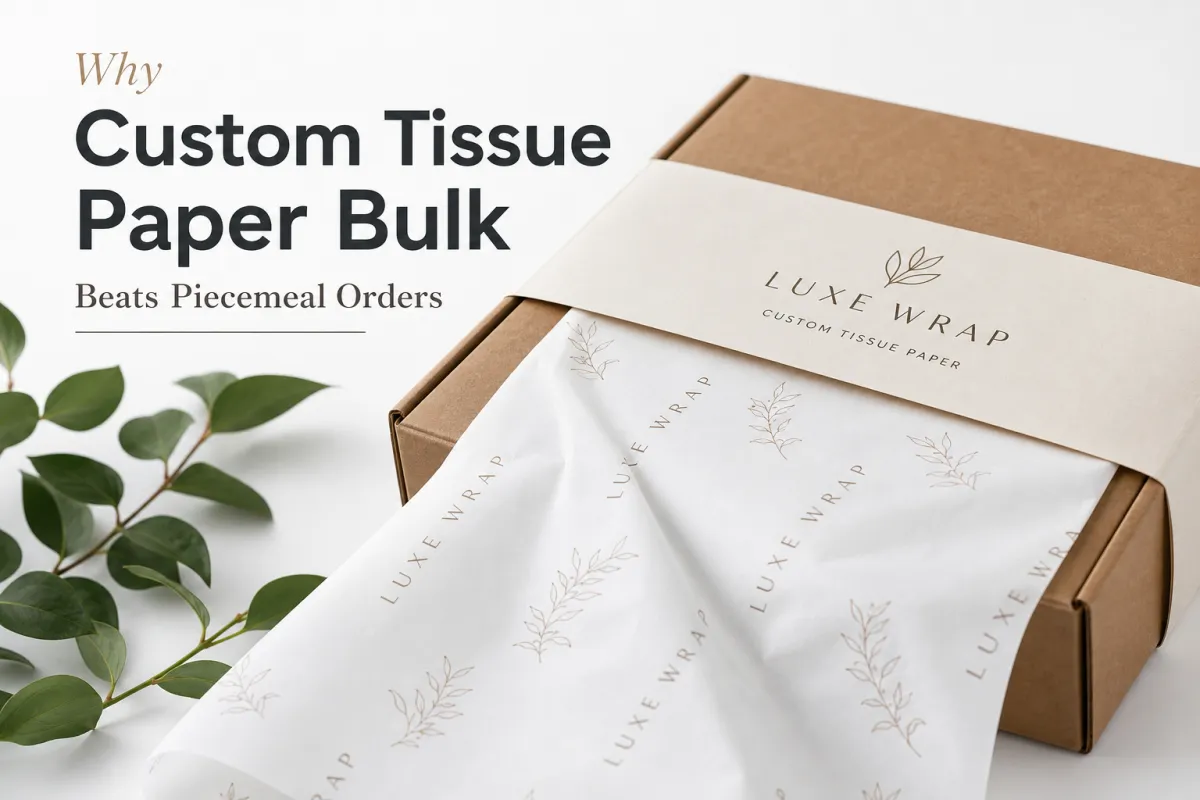
Custom tissue paper bulk solves the mess that small orders create: inconsistency. Piecemeal buys invite drift. One shipment uses a slightly different white. Another comes back with a different repeat. A rushed reorder changes print density because somebody needed the sheets yesterday. The package still works. It just looks a little off, and customers notice that faster than brands like to admit.
Bulk ordering also changes the math. Setup fees, proofing work, and freight all hit harder on tiny orders. A brand that buys custom tissue paper bulk can spread those fixed costs over more sheets, which usually lowers the effective cost per unit. In plain English, a 5,000-sheet run often makes more sense than five separate 1,000-sheet buys, even before you count the time spent chasing each reorder.
Planning gets easier too. If your line launches in waves, bulk tissue keeps color and artwork aligned across spring releases, holiday restocks, and retailer replenishment. That matters for package branding because a repeat customer notices when the tissue inside a box matches the box itself. It also matters if you are coordinating with Custom Packaging Products such as rigid boxes, mailers, and inserts, since the printed paper should feel like part of the same system, not a random afterthought somebody grabbed in a panic.
Sustainability gains are real here. Custom tissue paper bulk can reduce the number of inbound shipments, which lowers transport emissions and warehouse handling. It also gives buyers more control over paper sourcing, so the tissue can be specified with recycled content, FSC options, or lower-ink layouts instead of whatever stock happens to be sitting around this week. For brands trying to make packaging design look thoughtful without inflating material use, that matters.
I have sat through enough packaging reviews to know the same pattern shows up over and over: teams spend weeks polishing the box and then treat tissue like filler. That is backwards. Tissue is often the first branded surface the customer touches, so it deserves the same discipline as the outer carton. Otherwise the whole reveal feels kinda half-finished.
- Lower unit cost: more sheets per run means setup, proof, and freight are absorbed more efficiently.
- Better consistency: one approved color and one print spec are easier to maintain than multiple small orders.
- Cleaner inventory: bulk tissue is easier to forecast around launches, restocks, and retail resets.
- Less waste: fewer rush orders and fewer duplicate deliveries usually mean fewer boxes, labels, and pallets.
Honestly, the biggest mistake is treating tissue like a disposable line item. Custom tissue paper bulk affects the whole presentation stack, and it does so at a lower cost than many other branded packaging elements. That is why so many teams start with tissue before moving on to more expensive upgrades like custom printed boxes or specialty mailers.
Custom tissue paper bulk product options and uses
There is no single version of custom tissue paper bulk. Buyers usually choose from a set of practical variables: sheet size, sheet count per pack, printed or unprinted tissue, one-color or multi-color branding, and whether the sheet will act as a wrap, a liner, or filler. Those choices shape how the tissue looks in the box, how it folds around the product, and how much the program costs to keep in stock.
For e-commerce unboxing, the tissue often serves as the first visual layer under the top flap. In boutique apparel, it is more likely to be wrapped around garments, jewelry, or accessories to add friction and a sense of care. For gift wrapping and premium retail packaging, custom tissue paper bulk can do double duty: it protects the product and carries the logo or pattern that reinforces the brand. Subscription boxes use it differently again; in that setting, tissue helps control the reveal sequence so the customer opens the package in stages instead of tearing into everything at once like they are late for something.
The print decision changes the feel of the sheet. Full flood coverage makes the brand louder, but it also adds ink load, which can slightly change softness, drying time, and cost. A repeat logo pattern printed on a white or natural tissue usually keeps the sheet lighter in hand and easier to fold. If the brand is still refining its visual identity, a single-color repeat is often the safer entry point for custom tissue paper bulk because it balances visibility and budget.
There is a middle path too. Some brands start with a one-color repeat in custom tissue paper bulk, then move to a more detailed pattern once they know the reorder rhythm. That approach is common in retail packaging because it avoids locking in an expensive design before the team has real sell-through data.
Common use cases
Here is how custom tissue paper bulk usually maps to use case:
- Apparel brands: wrap shirts, scarves, and accessories so the product arrives neat and photo-ready.
- Cosmetics and skincare: cushion secondary cartons and add a clean branded reveal.
- Gift programs: support seasonal packaging without needing a completely new box structure.
- Wholesale and retail restocks: keep shelf-facing presentation consistent across multiple store locations.
Sustainability-friendly choices
Responsible sourcing matters here because tissue is visually simple but operationally sensitive. A buyer can request recycled content, FSC-certified paper, and water-based or soy-based inks without changing the overall presentation of custom tissue paper bulk in any dramatic way. That combination is usually enough for brands that want stronger sustainability signals without jumping to a much more expensive substrate.
Keep the ink coverage in proportion to the need. Lower-ink layouts usually cost less, dry faster, and reduce the chance of rub-off on delicate fabrics or coatings. The greenest option is not the loudest graphic. It is the one that fits the use case with the least unnecessary material. Simple idea. Hard to mess up, though plenty of brands still do.
If your tissue has to work alongside Wholesale Programs, the smarter move is to align the print spec with the broader packaging calendar. That way, custom tissue paper bulk is ordered on the same planning cycle as the cartons, mailers, and inserts, which keeps the whole packaging system from drifting in three different directions.
Specs that matter: paper, ink, sheets, and finish
Most problems with custom tissue paper bulk start long before production. They start with missing spec details. Buyers should confirm paper weight, opacity, dimensions, trim tolerance, number of print sides, and whether the artwork is centered or repeated. Leave those out and two quotes that look similar can produce very different outcomes. Fun surprise. Not the good kind.
Paper weight and opacity
Tissue paper is usually specified in lightweight ranges, often around 17 to 28 gsm depending on the application. A lighter sheet feels airy and folds easily, while a heavier sheet tends to resist tearing and gives a more premium hand. Opacity matters too. If the logo needs to show clearly without the sheet turning dense and stiff, the printer may recommend a stock that balances cover and softness. In custom tissue paper bulk, that balance affects both presentation and performance.
For fragile products, tear resistance and foldability are not abstract specs. They decide whether the sheet wraps cleanly around corners or splits at the fold line. A smooth-feeling sheet is nice. A sheet that rips at the first crease is useless. Brands shipping glassware, ceramic accessories, or cosmetics should ask for a sample fold test before approving a production run of custom tissue paper bulk.
Ink, coverage, and layout
Print standards are the second big lever. PMS color matching is usually the safest route if brand color has to stay stable across packaging design assets. Some artwork works best as a repeat pattern that runs edge-to-edge. Other pieces look better centered with a wide clear border. Full flood coverage can look striking, but it may increase ink cost and change the hand of the sheet. For many programs, custom tissue paper bulk works best with a restrained repeat that keeps the paper usable as both wrap and filler.
If the design uses more than one color, ask whether the quote is based on one pass, two passes, or a more complex setup. That detail matters because multi-color branding can increase setup work and extend proofing time. The same thing applies to artwork that runs close to the edge of the sheet, since trim control becomes more important when the print sits tight to the cut.
Performance and compliance
Buyers ask about rub-off risk for a reason. Some papers look fine in a stack but mark easily when pressed against coated packaging or satin fabrics. A production-grade custom tissue paper bulk order should be reviewed for dry-down, migration, and color transfer before final approval. If the tissue is part of a ship-ready program, broader distribution testing can be informed by standards from the ISTA testing community, especially when the whole package has to survive transit without scuffing or compression issues.
For sustainability claims, request FSC options or recycled-content documentation and confirm the ink system. Water-based and soy-based inks are common requests, and they can fit well with lower-waste production planning. Public guidance from the FSC and the EPA can help teams document the claims they make about paper sourcing and recycling. That is not just compliance theater. It protects brand credibility.
One more detail gets overlooked: trim tolerance. If the tissue has to fit neatly into a box, the cut size should be tight enough to prevent bunching but not so tight that the sheet is hard to fold. Ask for a clear tolerance range before you approve custom tissue paper bulk. A little precision saves a lot of fulfillment trouble later.
Custom tissue paper bulk pricing, MOQ, and savings
Pricing for custom tissue paper bulk is driven by a short list of variables, and most of them are measurable: sheet size, paper stock, print colors, coverage, quantity tier, and freight distance. Once those are known, a supplier can usually quote with far less guesswork. If a quote arrives without those inputs, the price may look attractive now and drift later once the details are clarified.
MOQ, or minimum order quantity, is tied to the setup method and the print complexity. Simple one-color repeat programs often carry a lower barrier than full-coverage or multi-color jobs. That said, the break point is not universal. A larger sheet size, tighter color control, or special paper stock can push the MOQ higher. The smart move is to ask for tiered pricing on custom tissue paper bulk so you can see the actual jump between a pilot run and a production run.
| Order tier | Typical use | Approx. unit price range | What usually improves |
|---|---|---|---|
| 1,000-2,500 sheets | Pilot launch, sample program, small seasonal test | $0.16-$0.30 per sheet | Proofing flexibility, lower upfront commitment |
| 5,000-10,000 sheets | Steady e-commerce or boutique retail replenishment | $0.09-$0.18 per sheet | Better setup absorption, lower reorder pressure |
| 25,000+ sheets | Multi-location retail, wholesale, recurring seasonal demand | $0.05-$0.12 per sheet | Lowest effective cost, strongest inventory efficiency |
Those figures are directional, not absolute, because custom tissue paper bulk can swing based on paper grade, print coverage, and freight. A 20 x 30 inch full-coverage sheet is not going to price the same way as a smaller one-color repeat. That is exactly why buyers should ask for landed cost, not just unit price. Landed cost includes the sheet, the print setup, packing materials, and shipping together.
The landed-cost view shows where savings actually happen. In many programs, the biggest savings come from fewer reprints, fewer rush fees, and more stable inventory planning. A brand that orders too little often pays twice: once for the small run and again for the emergency restock. Custom tissue paper bulk cuts that cycle down by making the original order large enough to last through a full sales period.
There is a hidden labor cost too. Every reorder takes internal time: artwork check, quote review, approval, receiving, and inventory allocation. For a busy packaging team, that labor can exceed the difference between two price tiers. When the program is structured well, custom tissue paper bulk reduces decision fatigue and keeps the team focused on higher-value packaging design work.
If you want a useful rule of thumb, compare at least two volume tiers and one alternate print spec. For example, compare a single-color repeat against a two-color version and compare 5,000 sheets against 10,000 sheets. The result usually shows where the pricing curve bends. That bend is often the sweet spot for custom tissue paper bulk.
How the custom tissue paper bulk process and timeline work
The process for custom tissue paper bulk is straightforward on paper, but the details matter. It usually begins with a quote request, moves into artwork review, then proof approval, production, quality check, and delivery. Each step has a narrow set of choices, and the schedule only stays healthy when those choices are made quickly and clearly.
- Quote request: share sheet size, quantity, print count, color references, and target ship date.
- Artwork review: confirm logo files, repeat pattern, clear space, and any positioning rules.
- Proof approval: review the digital proof or mockup against the exact sheet dimensions.
- Production: print, dry, cut, and package the run according to the approved spec.
- Quality check: inspect color consistency, trim accuracy, and any rub-off concerns.
- Delivery: ship the order and check cartons against the receiving plan.
What slows things down? Missing dielines, vague repeat instructions, and late color changes. Those are the usual suspects. If the artwork file is not set up correctly, a supplier may need to redraw the layout before the proof can be approved. If the brand color is still under discussion, the project can lose several business days before production even starts. With custom tissue paper bulk, the cleanest jobs are the ones where design, purchasing, and fulfillment are all using the same version of the spec.
What speeds things up? Final artwork, clear PMS references, and a single decision-maker. A buyer who knows the sheet size and quantity upfront is much easier to serve than a team still arguing over three trim options. If you are coordinating tissue with Custom Packaging Products, keeping the tissue approval tied to the box or mailer approval can save time across the entire packaging program.
Timeline planning should always separate production from freight. A typical custom tissue paper bulk run may need about 12-15 business days after proof approval, though larger or more complex jobs can take longer. Freight time sits on top of that and depends on destination, carrier, and shipping method. If the tissue is needed for a product launch, the shipping date should be treated as a separate milestone, not a casual guess.
The best internal habit is to set three dates at the start: proof approval, production complete, and in-hand receipt. Once those dates are locked, the rest of the project becomes far easier to manage. That discipline is especially useful for brands running multiple packaging items at once, because it keeps custom tissue paper bulk from becoming the bottleneck in a larger branded packaging rollout.
One practical note: ask for a sample or digital proof on the exact tissue size before the run begins. A logo can look fine on screen and drift when repeated across a large sheet. A proof that matches the final dimensions is far more useful than a generic artwork preview. With custom tissue paper bulk, precision at the proof stage prevents expensive revisions later.
Why choose us for sustainable custom tissue paper bulk
Custom Logo Things is built for buyers who want the packaging answer to be practical, not flashy. For custom tissue paper bulk, that means clear quoting, plain-language specs, and print guidance that helps avoid expensive revisions. The value is not just in printing a logo. It is in helping the order land correctly the first time, with the right paper, the right color, and the right carton count.
Specialists tend to outperform general printers on tissue because tissue has its own handling rules. It folds differently from card stock. It reacts differently to heavy ink. It is more sensitive to rub-off and cut accuracy. A specialist understands those tradeoffs and can steer buyers away from overbuilt artwork or under-specified paper. That is one reason custom tissue paper bulk often performs better when it is sourced from a team that handles branded packaging every day rather than a shop that treats tissue as a side job.
Sustainability is part of the value equation too. Buyers increasingly want paper choices that support responsible sourcing, low-waste production planning, and efficient shipping. Custom tissue paper bulk can support those goals without making the package feel cheap. Recycled-content tissue, FSC options, and lower-ink layouts can sit comfortably inside a premium retail presentation if the design is disciplined.
The other advantage is clarity. Good suppliers answer the questions that matter before the order is placed: What is the MOQ? How many colors are included? Is the quote based on sheet count or packed reams? What is the expected proof cycle? That kind of transparency saves time for purchasing teams, and it is especially useful for brands that are comparing tissue against custom printed boxes or other packaging design upgrades.
For buyers who need broader packaging support, it can help to align tissue with Wholesale Programs so that replenishment, forecasting, and shipping all follow the same commercial logic. That makes custom tissue paper bulk easier to manage over time, especially when the brand has multiple SKUs or seasonal collections.
Support matters too. A responsive quote review, a clean proof process, and direct communication on revisions can be the difference between a smooth purchase and a month of avoidable back-and-forth. In packaging, that kind of reliability is not a luxury. It is part of the product.
If you are building a broader sustainability story, pair tissue decisions with public standards and source documentation. The point is not to decorate the spec sheet with jargon. The point is to make sure the claims are grounded in materials, not marketing fluff. That is where custom tissue paper bulk can quietly do a lot of work for the brand.
What to do next before you order custom tissue paper bulk
Before you request a quote for custom tissue paper bulk, gather the basics: sheet size, quantity, number of ink colors, target ship date, and any brand color standards. If you already know the fold method or the carton size it needs to fit, add that too. A tighter brief usually produces a better first proof and a faster approval cycle.
Next, organize the artwork files. Vector logo art, PMS references, and clear repeat instructions are the minimum. If the design is supposed to sit centered on the sheet, say so. If it should tile edge-to-edge, say that instead. The more specific the input, the less time the supplier spends guessing how custom tissue paper bulk is supposed to look in real use.
Then compare two quantity tiers. A smaller order may look safer, but the larger tier often reveals a better cost structure and a smoother production plan. That does not mean everyone should buy the maximum volume. It means the buyer should see where the pricing curve improves and where inventory risk begins. For many brands, that comparison is the difference between an expensive trial and a profitable repeat program.
Finally, ask for the proof on the exact tissue size before the run is released. That one step prevents a surprising number of problems, from logo placement drift to border issues and trim mismatch. A clean proof is the fastest way to get from packaging design to production without wasting time. If your team wants a packaging partner that understands the economics as well as the presentation, custom tissue paper bulk is a smart place to start.
Request the quote, review the proof, and lock the production schedule while the details are still fresh. For brands that care about control, consistency, and presentation, custom tissue paper bulk is one of the most efficient upgrades in the entire packaging stack.
The practical takeaway is simple: define the sheet, the print, and the quantity before you shop price. If those three pieces are clear, custom tissue paper bulk becomes easy to compare, easier to approve, and much less likely to turn into a messy reorder six weeks later.
FAQ
What is the minimum order for custom tissue paper bulk?
MOQ usually depends on sheet size, print coverage, and color count, so ask for tiered quotes instead of assuming one universal minimum. For custom tissue paper bulk, the best break point often appears once setup costs are spread across a larger run, which is why comparing two or three quantities is more useful than asking for a single number.
How much does custom tissue paper bulk cost per sheet?
Price is driven by stock weight, print method, number of colors, sheet size, and freight. Ask for landed cost per 1,000 sheets so you can compare suppliers on the same basis. In many cases, custom tissue paper bulk becomes materially cheaper at the middle and upper tiers because the fixed setup cost stops dominating the quote.
Is custom tissue paper bulk recyclable?
Uncoated tissue with low-ink coverage is often easier to recycle than laminated or heavily decorated alternatives, but local rules still apply. If sustainability matters, request recycled content and water-based or soy-based inks. Those choices help keep custom tissue paper bulk aligned with cleaner sourcing goals without changing the overall presentation.
How long does custom tissue paper bulk take to produce?
Timeline includes proof approval, production, and shipping, so the fastest jobs are usually the ones with final artwork ready on day one. Rush orders may be possible, but they usually cost more and leave less room for revisions. For custom tissue paper bulk, the safest plan is to treat freight as a separate step and confirm milestone dates before the job starts.
What artwork do you need for custom tissue paper bulk?
Provide vector logo files, PMS color references, sheet dimensions, and any repeat pattern instructions. Ask for a proof on the exact tissue size before production starts so print placement is confirmed. That keeps custom tissue paper bulk from turning into a guess-and-check exercise, and it usually leads to a cleaner final result.

