Buyer Fit Snapshot
| Best fit | Custom Tissue Paper Cost projects where brand print, material claims, artwork control, MOQ, and repeat-order consistency need to be specified before quoting. |
|---|---|
| Quote inputs | Share finished size, material target, print colors, finish, packing count, annual reorder estimate, ship-to region, and any compliance wording. |
| Proofing check | Approve dieline scale, logo placement, barcode or warning zones, color tolerance, closure strength, and carton packing before bulk production. |
| Main risk | Vague material claims, crowded artwork, missing packing details, or unclear freight terms can make a low unit price expensive after revisions. |
Fast answer: Custom Tissue Paper Cost: Material, Print, Proofing, and Reorder Risk should be specified like a repeatable production item. The safest quote records material, print method, finish, artwork proof, packing count, and reorder notes in one written spec.
Production checks before approval
Compare the actual filled-product size with the drawing, then confirm tolerance on folds, seals, hang holes, label areas, and retail display edges. Reserve space for logos, QR codes, warning copy, and material claims before decorative graphics fill the panel.
Quote comparison points
Review material grade, print process, finish, sampling route, tooling charges, carton quantity, and freight assumptions side by side. A quote is only useful when the supplier can repeat the same color, closure quality, and packing count on the next order.
Custom tissue paper cost: what buyers usually overlook
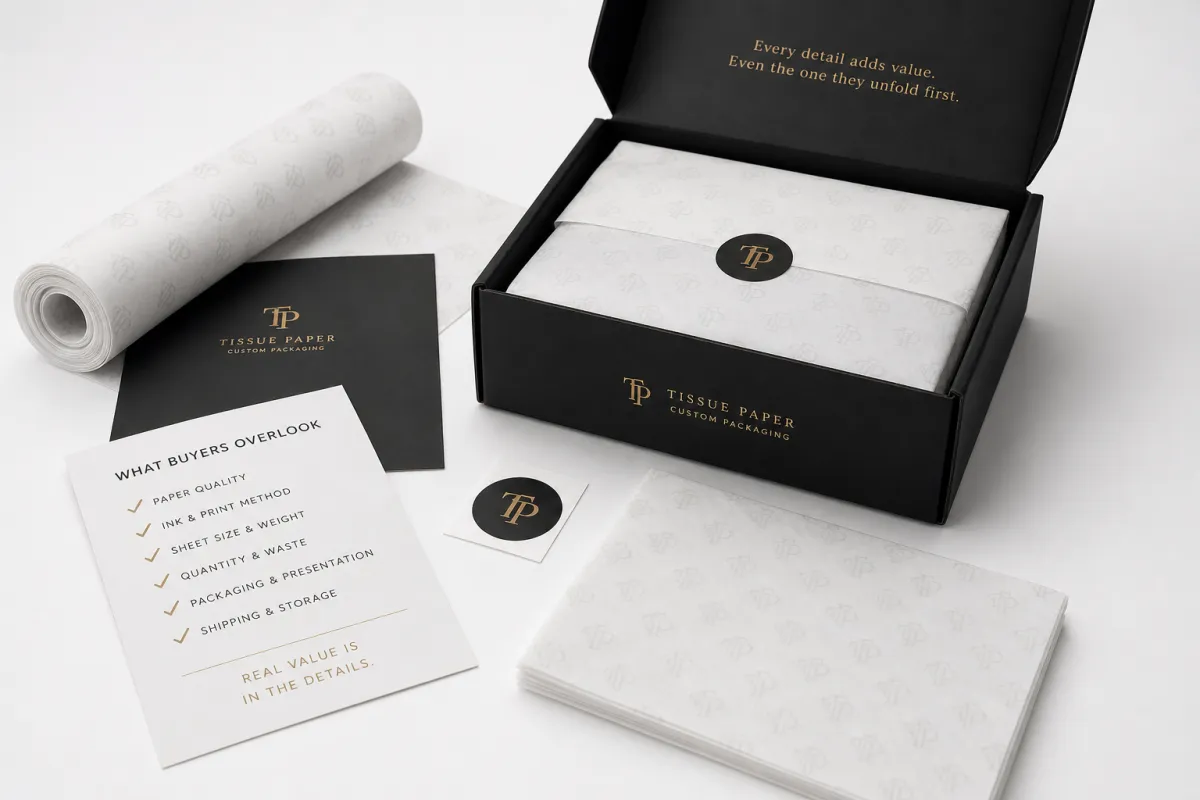
A package can look polished from the outside and still feel cheap the second someone opens it. That is usually the moment Custom Tissue Paper cost gets misunderstood. Buyers focus on the box, the mailer, the ribbon, the tape. Then they choose tissue that is too thin, too see-through, or printed so heavily that it fights the product inside. The whole presentation drops a level, and the brand loses credibility with it.
I have seen this happen in brand reviews more times than I can count. Someone saves a few cents on tissue, then wonders why the unboxing feels flat. The paper is tiny. The problem is not. It sits right at the reveal, which is where customers make snap judgments.
The practical truth is simple: Custom Tissue Paper cost is not just a print number. It comes from paper weight, sheet size, ink coverage, color count, setup time, packaging format, and freight. A quote that looks cheap on the page can turn expensive once MOQ, rush shipping, or extra press work enters the picture. I always tell buyers to look at the landed number, not the factory sticker. The sticker is rarely the real story.
Good tissue does more than sit there and look pretty. It protects apparel, cosmetics, candles, and gift items from scuffing while they move through transit. That makes it part of the packaging system, not a decoration stapled on at the end. In practice, a modest upgrade in tissue stock often costs less than fixing a weak unboxing experience later. Crisp tissue, clean print, correct sizing. That combination does real work.
That is the decision buyers are actually making. You are not paying for paper alone. You are paying for appearance, consistency, and the feeling a customer gets when the package opens with intention instead of luck. In retail packaging, that tiny layer can do more for perceived value than people expect. Honestly, that is why Custom Tissue Paper cost should be measured against the value it creates, not just the cheapest line item in your inbox.
The smart way to think about it is basic:
- Low unit cost only matters if the sheet size and print finish still fit the brand.
- MOQ can move the unit price faster than most buyers expect.
- Ink coverage affects press time, approval time, and waste.
- Shipping can make a bargain quote look ridiculous once cartons hit the dock.
For packaging buyers comparing Custom Packaging Products, tissue is still one of the lower-cost ways to make the whole setup feel intentional. That is the upside. The catch is obvious: choose the wrong spec and the savings disappear while the tissue still looks generic. So the real job is not to chase the cheapest run. It is to understand what drives custom tissue paper cost, where the hidden fees hide, and which choices actually protect margin.
“A tissue sheet is not a place to guess. The design either supports the brand or quietly drags it down.”
For buyers comparing Custom Packaging Products, the right tissue spec can be the difference between a package that feels thought through and one that feels assembled from leftovers. That sounds harsh because it is. Customers notice details fast.
Product details that change custom tissue paper cost
The biggest driver of custom tissue paper cost is still the spec sheet. Paper weight, dimensions, print method, and finish all push the price in different directions. A lightweight tissue might work for soft goods or insert wrapping, but once you want better opacity, better fold memory, or a smoother print surface, the cost moves. That is normal. Materials do not care what the budget memo says.
Paper weight is one of the first things I check. Common tissue stocks sit in a lighter range that folds easily and ships cheaply. Heavier tissue feels more premium and hides product color better, but it also uses more material and can raise the quote. If you are wrapping apparel or cosmetics, the difference between a thin sheet and a more substantial one can be obvious in hand. That is not a style preference. It is a real part of custom tissue paper cost.
Sheet size matters just as much. Larger sheets consume more paper, reduce the number of sheets per master sheet during production, and add bulk to the cartons. A 20 x 30 inch sheet is not priced the same way as a 15 x 20 inch sheet, even if the artwork is identical. Small dimension changes can move cost more than buyers expect because they affect yield and finishing efficiency. Boring math. It always shows up in the quote.
Print coverage is another big lever. A simple repeating logo in one color usually costs less than a full-bleed pattern with heavy ink coverage. Edge-to-edge designs need tighter registration, and multi-color artwork adds setup and proofing time. White ink on colored tissue can also raise the price because it often needs a more controlled run. If you want a clean branded look without blowing up custom tissue paper cost, a restrained repeat pattern with limited color count is usually the sweet spot.
One-side versus two-side printing changes the bill too. One-side printing is common because it keeps ink usage and production complexity under control. Two-side printing can look richer, but it adds handling steps and cost. Whether it is worth it depends on how the tissue is folded, how transparent the stock is, and whether the customer ever sees the reverse side. In plenty of runs, paying for both sides is unnecessary. That is the kind of decision that protects custom tissue paper cost without making the package look cheap.
Artwork complexity is easy to underestimate. Tiny type, fine lines, gradients, and artwork that needs tight color matching can slow proofing and raise reject risk. A good printer can still run it, but the job gets more technical. That usually shows up as setup charges or a slightly higher unit price. Simpler graphics cost less because they are faster to approve, easier to print, and less likely to fail inspection.
Finish and handling matter too. Some buyers want flat tissue for fast packing. Others want folded sheets packed into retail-ready bundles or boxed sets. Every extra handling step adds labor. Tissue that is wrapped, banded, or packed for shelf display is not priced like loose bulk tissue in cartons. If your team is shipping into a warehouse or kitting line, bulk format may be the right move. If the tissue goes straight onto a shelf, presentation packaging may justify the added cost.
There is also a difference between standard grade, acid-free tissue, and specialty recycled or premium tissue. Acid-free is often preferred for apparel, archival, and gift applications where staining or yellowing would be a problem. Recycled content can support brand claims and sustainability positioning, but the actual price depends on local supply and certification needs. For brands that care about sourcing, FSC-certified paper can support procurement requirements; the relevant standard is explained by the Forest Stewardship Council. Not every project needs certification, but it belongs in the discussion when the program needs to look responsible, not just branded.
One more thing: print method affects custom tissue paper cost even when the design looks simple. Some projects suit large-volume repeat printing, while smaller runs may need more manual setup. The buyer sees a logo. The production team sees ink density, registration tolerance, and drying behavior. Those are not the same problem.
Specifications to lock in before you request pricing
If you want a clean quote for custom tissue paper cost, do not send a vague email that says, “Need pricing for tissue.” That is how buyers get useless ranges. The printer needs actual specs. Sheet size, paper weight, print colors, artwork type, quantity, and destination all shape the number. Better inputs. Better pricing. There is no mystery there.
Start with sheet dimensions. Decide whether you need a standard size or a custom cut. Standard sizes usually move faster and cost less because production waste is easier to manage. Custom sizes can be perfect for specific boxes or folded apparel programs, but the extra cutting and yield math can push custom tissue paper cost upward. Measure the product, the internal box space, and the wrapping style before you quote anything.
Next, lock in the paper gsm or basis weight. Not every vendor describes tissue the same way, so be clear about the feel you want. Thin sheets are cheaper and lighter. Thicker sheets feel better in hand and resist tearing, but they use more material. For gift packaging, apparel, and some retail packaging applications, the right middle ground usually matters more than chasing the heaviest stock. Over-spec the tissue and you are spending money where the customer barely notices.
Color count comes next. One-color logos are the easiest way to keep custom tissue paper cost down. Two-color artwork is still manageable. Full CMYK or heavy flood coverage adds complexity and can require tighter quality control. If your brand already has a strong printed box or a branded label, the tissue does not need to do everything. A restrained repeat pattern often looks cleaner anyway. That is not a compromise. That is good packaging design.
Pantone matching deserves attention. If brand colors matter, give the vendor the exact reference. Guessing by eye wastes time and can create reprints. White ink on dark tissue can also be tricky depending on the stock and press setup. Some printers handle it well; others charge extra or suggest a different approach. That is why precise spec calls keep custom tissue paper cost predictable.
Packaging format should be decided before you ask for a quote. Do you want flat sheets in cartons, folded tissue in packs, or retail-ready bundled sets? Flat sheets are usually the most efficient. Folded or bagged tissue adds labor and often changes carton counts. If your operation packs by hand, flat may be enough. If the tissue is going into stores, a more polished format may make sense. Either way, the format Changes the Quote.
Compliance and use case also matter. Tissue for apparel and gifts is usually straightforward. Tissue used near food-adjacent items or in regulated environments may need extra care around materials, inks, and handling. Buyers should ask the supplier what standards apply to their market. For packaging damage prevention and transit testing, industry references like ISTA help frame expectations for shipping performance, even if tissue itself is not the main test subject. That kind of thinking saves people from assuming every printed layer behaves the same under pressure.
Before you send a request, I would make sure these five items are clear:
- Sheet size in inches or millimeters.
- Paper weight or the feel target you want.
- Print colors and whether Pantone matching matters.
- Quantity and target MOQ.
- Packaging style such as flat, folded, wrapped, or boxed.
If you bring those details to the table, the answer you get on custom tissue paper cost will be useful instead of decorative. That saves time on both sides.
Custom tissue paper cost: pricing, MOQ, and volume breaks
The pricing structure for custom tissue paper cost usually has three parts: setup, unit production, and freight. Setup covers the work needed to prepare the print run. Unit production covers the actual sheets. Freight covers getting the cartons to your warehouse, 3PL, or store network. A quote that hides any of those pieces is not a quote. It is a trap with better formatting.
Setup fees matter most on small orders. If a printer has to prepare plates, screens, color adjustments, or sampling, those costs get spread across fewer sheets. That is why low-volume runs can feel expensive on a per-sheet basis. On bigger orders, the setup cost gets diluted and the unit price becomes far more attractive. That is where MOQ starts to matter in a very real way.
MOQ, or minimum order quantity, is not random. It exists because printing tissue in small lots creates more machine changes, more labor, and more waste per finished sheet. If you are only ordering a test run, expect the custom tissue paper cost per unit to be higher. If you can consolidate orders, standardize the size, or use the same art across multiple product lines, you usually get a better number. That is one of the few reliable ways to lower unit cost without cheapening the brand.
Here is the pattern I see most often: the first meaningful price drop happens once the print setup is spread over enough sheets to stop hurting the math. After that, the price can flatten out for a while, then drop again at a higher volume tier. The exact break points depend on the printer, the stock, and the artwork. Still, the logic stays the same. More sheets usually mean lower custom tissue paper cost per sheet.
| Order Type | Typical MOQ | Typical Unit Cost Trend | Best For |
|---|---|---|---|
| Short run, simple one-color repeat | 500-1,000 sheets | Highest unit cost, setup spread thin | Testing artwork, small launches |
| Mid-volume branded tissue | 3,000-5,000 sheets | Better balance of setup and production | Most growing brands |
| High-volume repeat program | 10,000+ sheets | Lowest unit cost, freight becomes more important | Established retail packaging programs |
Those ranges are not magic numbers. They are a realistic way to think about custom tissue paper cost across common order sizes. A simple design with standard size sheets will usually land better than a complex print on custom dimensions, even at the same MOQ. That is why buyers should compare like with like. A low unit price on a different spec is not the same thing as a better deal.
Shipping is the quiet budget killer. Tissue is light, but it is bulky. That means carton volume can matter more than weight. A quote that looks strong at the factory can lose its edge once you add ocean freight, domestic trucking, duties, or expedited air service. This is the part most people skip when they brag about sourcing savings. Then the invoice arrives.
There are also a few hidden cost traps that inflate custom tissue paper cost fast:
- Rush production that interrupts the standard print schedule.
- Multiple artwork versions for different SKUs or regions.
- Custom folding that adds labor and packing time.
- Special inks or heavy flood coverage.
- Split shipments that multiply freight charges.
On the buying side, the smartest move is to compare landed cost, not factory cost. Landed cost includes product, packaging, freight, and any duties or receiving fees you know about. A cheap quote that arrives late or costs too much to move is not cheap. It is just underreported.
For brands that also buy custom printed boxes or other branded packaging items, there is a real benefit to consolidating the strategy. A coordinated packaging design can reduce the temptation to overspend on every single component. Put the visual weight where it matters. Keep the rest efficient. That is how good programs protect margin without looking bare.
Process and timeline: how custom tissue paper orders move
A clean order process keeps custom tissue paper cost under control because fewer mistakes get baked into the run. The usual flow is straightforward: request a quote, confirm specs, review artwork, approve a proof, produce the order, then ship it out. Simple process. Not always simple execution. Most delays happen before the press even starts.
The first delay point is usually artwork. Files sent in the wrong format, low-resolution logos, or unclear color references slow the whole job. If the printer has to redraw a logo or rebuild a repeat pattern, that is extra time. Extra time usually becomes extra cost. Clean vector files and exact color references make a visible difference in custom tissue paper cost because they reduce prepress work.
Proof approval is another place where timelines slip. Buyers sometimes ask for “one small tweak,” then another, then another. Each round pushes the schedule back. That is fine if the project is still in development. It is not fine if launch timing is already promised to a retailer. A fast approval process is one of the easiest ways to avoid a rush fee. Paying more because the email chain went nowhere for three days is not a noble business strategy.
For simple repeat jobs, production can move fairly quickly once the proof is approved. For new artwork, special paper, or difficult color matching, the timeline stretches. A practical range for many custom runs is often somewhere around 12-20 business days from approval to shipment, though complex jobs can take longer. International freight adds another layer. Air is fast and expensive. Ocean is slower and usually more sensible for larger volumes. That tradeoff changes the true custom tissue paper cost, so it should be discussed early.
Sampling deserves a real answer too. Some buyers skip samples to save time, then end up paying for a reprint because the color, opacity, or fold behavior was not what they expected. If the tissue is part of a premium retail experience, a sample or strike-off is worth the extra step. If the order is a straightforward repeat of an approved spec, you may not need it. The right move depends on risk, not habit.
During production, the most common quality checks include:
- Print alignment so the repeat stays even across the sheet.
- Color consistency from carton to carton.
- Fold quality if the order is shipped pre-folded.
- Sheet count accuracy so the cartons match the purchase order.
- Packaging integrity so the tissue arrives clean and usable.
Those checks are not glamorous, but they matter. A tissue order that arrives wrinkled, off-color, or short-counted creates more work downstream and can damage the brand moment it was supposed to support. That is why I tell buyers to choose a vendor who talks clearly about process, not just price. Clear process usually means fewer surprises in custom tissue paper cost and fewer headaches in receiving.
If your packaging program is tied to product launches, coordinate tissue with other branded packaging items early. The art direction for tissue should not be an afterthought once the boxes are already ordered. Strong packaging design works because the components speak the same language. That includes the tissue.
Why choose us when custom tissue paper cost matters
Most buyers do not need a lecture about paper. They need a straight answer on custom tissue paper cost, MOQ, and what spec actually makes sense. That is the standard I would want if I were buying. Clear pricing by spec. No mystery fees. No fake urgency. No “we’ll figure it out later” nonsense. When the quote is transparent, the buyer can make an informed decision instead of comparing guesses.
Factory-direct sourcing matters because it strips out some of the middleman markup that often hides inside branded packaging programs. It also gives better visibility into where the money goes: material, print, finishing, packing, and freight. That visibility helps buyers make smarter tradeoffs. If your budget is tight, you can decide whether to reduce print coverage, standardize the sheet size, or shift quantity to hit a better price tier. That is a real advantage in custom tissue paper cost, not a slogan.
Quality control is not optional. Good tissue should print cleanly, fold correctly, and arrive ready to use. Bad tissue wastes labor, and labor is expensive. If your team has to sort wrinkled sheets or reject cartons at receiving, the “cheap” order turns into a very average purchase. Solid print alignment, consistent ink density, and careful packing are not luxury extras. They are what make the item usable.
Good service saves money too. Quick replies keep a project moving. Strong preflight checks catch file issues before they become production issues. Honest MOQ guidance helps buyers avoid placing a run that is too small to be economical or too large for the current sales volume. That is the kind of support that protects custom tissue paper cost without pushing premium options that do not fit the use case.
There is also value in speaking plainly about tradeoffs. A buyer does not need every feature. Sometimes a standard tissue stock with a crisp one-color repeat is the smartest answer. Sometimes a premium acid-free sheet is worth the upgrade because the brand sells apparel, jewelry, or gifts that need a more polished reveal. The job is not to oversell. The job is to match the spec to the brand and the budget.
For brands using Custom Packaging Products across boxes, inserts, and tissue, consistency matters more than flashy extras. A coordinated system improves package branding and keeps the presentation from feeling random. That is especially true for retail packaging, where customers notice whether the whole structure feels intentional or pieced together.
And yes, sustainability comes into play for some buyers. Recycled content and FSC-certified materials can matter for policy, retail requirements, or brand values. The Environmental Protection Agency has useful general material-recovery context at EPA.gov, though every packaging choice still needs to be evaluated by actual material specs and logistics. Sustainability is good. Unsupported claims are not.
In short, the right supplier should help you reduce waste, keep the spec honest, and improve your final custom tissue paper cost without cutting corners that the customer will notice immediately. That is the real value.
Next steps to get an exact custom tissue paper cost
If you want a real number, send real information. That is the fastest path to an accurate custom tissue paper cost. The minimum useful quote request should include sheet size, paper type or weight, print colors, quantity, packaging style, and shipping destination. If you leave out the destination, the freight estimate is guesswork. If you leave out quantity, the MOQ discussion is pointless. Precision saves time.
Artwork should go out early, even if it is not perfect yet. A vendor can tell you whether the file is print-ready, whether the colors are likely to cost more, and whether the repeat pattern makes sense on the chosen sheet size. That review often catches the easy problems before they become expensive ones. In a lot of cases, a small layout adjustment lowers custom tissue paper cost without changing the visual identity at all.
Ask for more than one quantity tier. A useful quote usually shows what happens at the MOQ, a mid-volume order, and a larger order. That side-by-side view makes the unit cost curve obvious. If the jump from 3,000 to 5,000 sheets is small, maybe the larger run is smarter. If the freight advantage disappears at a higher volume, maybe it is not. The point is to compare actual landed cost, not chase a theoretical discount.
Request a sample or proof if the tissue has to match a retailer standard, coordinate with premium product packaging, or support a launch where the unboxing moment matters. A proof is cheap compared with a reprint. Color on tissue can look different from color on a monitor, and transparency changes how the design reads in hand. That is just how the material behaves.
Use this checklist before you ask for a quote:
- Confirm sheet dimensions and whether they are standard or custom.
- Choose paper weight or at least define the feel target.
- Set the print method, color count, and Pantone references.
- Decide on flat, folded, wrapped, or boxed packaging.
- State quantity, timeline, and delivery location.
The cleaner the brief, the better the answer. That is true for tissue, boxes, inserts, and just about every piece of branded packaging I have seen purchased well. If you want to keep custom tissue paper cost under control, specify the job before you price it. That is how smart buyers avoid guesswork and get a quote that actually holds up.
What affects custom tissue paper cost the most?
Sheet size, paper weight, print coverage, and total quantity usually have the biggest impact. Setup fees and color complexity can push the price up fast on small orders. Shipping matters too, especially if the order is bulky or needs to move quickly.
What is the minimum order for custom tissue paper?
MOQ varies by printer and print method, but smaller custom runs usually cost more per sheet. Higher quantities lower the unit cost because setup is spread across more product. If you only need a test run, ask for the smallest feasible quantity and compare landed cost.
How much does custom tissue paper cost per sheet?
There is no universal number because the price changes with size, color count, print coverage, and order volume. Simple designs in larger quantities cost far less per sheet than short runs with full coverage printing. A useful quote should break out material, print, and freight so you can see where the money goes.
Can I lower custom tissue paper cost without hurting the brand look?
Yes. Smaller print coverage, fewer colors, and standard sheet sizes can reduce cost without ruining the design. Consolidating artwork versions and avoiding rush production also saves money. The best savings usually come from choosing the right spec mix, not from cutting quality blindly.
How long does custom tissue paper production take?
Typical timing depends on proof approval, quantity, and whether the artwork needs adjustments. Simple repeat jobs move faster than new designs with custom color matching or special paper requirements. Shipping time can add several days or weeks, so always ask for the full timeline before you commit.
If you want the cleanest answer on custom tissue paper cost, send the specs first and ask for the quote second. That is how you get a number you can actually buy against, not a vague estimate that falls apart once the cartons are on the move.

