Buyer Fit Snapshot
| Best fit | custom tissue paper printed for packaging buyers comparing material specs, print proof, MOQ, unit cost, freight, and repeat-order risk where brand print, material, artwork control, and repeat-order consistency matter. |
|---|---|
| Quote inputs | Share finished size, material target, print colors, finish, packing count, annual reorder estimate, and delivery region. |
| Proofing check | Approve dieline scale, logo placement, barcode or warning zones, color tolerance, and any recyclable or compostable wording before bulk production. |
| Main risk | Vague material claims, crowded artwork, or missing packing details can create delays even when the unit price looks attractive. |
Fast answer: Custom Tissue Paper Printed: Ordering, Pricing, Quality should be specified like a repeatable production item. The safest quote includes material, print method, finish, artwork proof, carton packing, and reorder notes in one written spec.
What to confirm before approving the packaging proof
Check the product dimensions against the actual filled item, not only the sales mockup. Ask for tolerance on folds, seals, hang holes, label areas, and retail display edges. If the package carries a logo, QR code, warning copy, or legal claim, reserve that space before decorative graphics fill the panel.
How to compare quotes without losing quality
Compare board or film grade, print process, finish, sampling route, tooling charges, carton quantity, and freight assumptions side by side. A lower quote is only useful if the supplier can repeat the same color, closure quality, and packing count on the next order.
Custom Tissue Paper printed is one of those packaging choices that looks small on a spreadsheet and huge in a customer’s hands. It is cheap enough to be overlooked and visible enough to matter. That is exactly why smart brands treat it like a branding tool, not filler. A few cents per sheet can change the whole unboxing moment. If you are comparing it with custom printed boxes or inserts, tissue usually gives you the most visual lift for the least money. That is why it keeps showing up in ecommerce, gift retail, subscription kits, and seasonal drops.
If you are building a fuller packaging system, start with the pack-out before you obsess over artwork. A clean tissue wrap, the right box size, and one decent insert can make the whole presentation feel deliberate even when the rest is simple. For brands comparing presentation options, the Custom Packaging Products page is a useful place to sort out the basics before you commit to anything.
If the tissue looks off on a flat proof, it usually looks worse once someone folds it, creases it, and stuffs it around a product. That is not a clever insight. It is just packaging reality, and people still ignore it.
What custom tissue paper printed means for brands
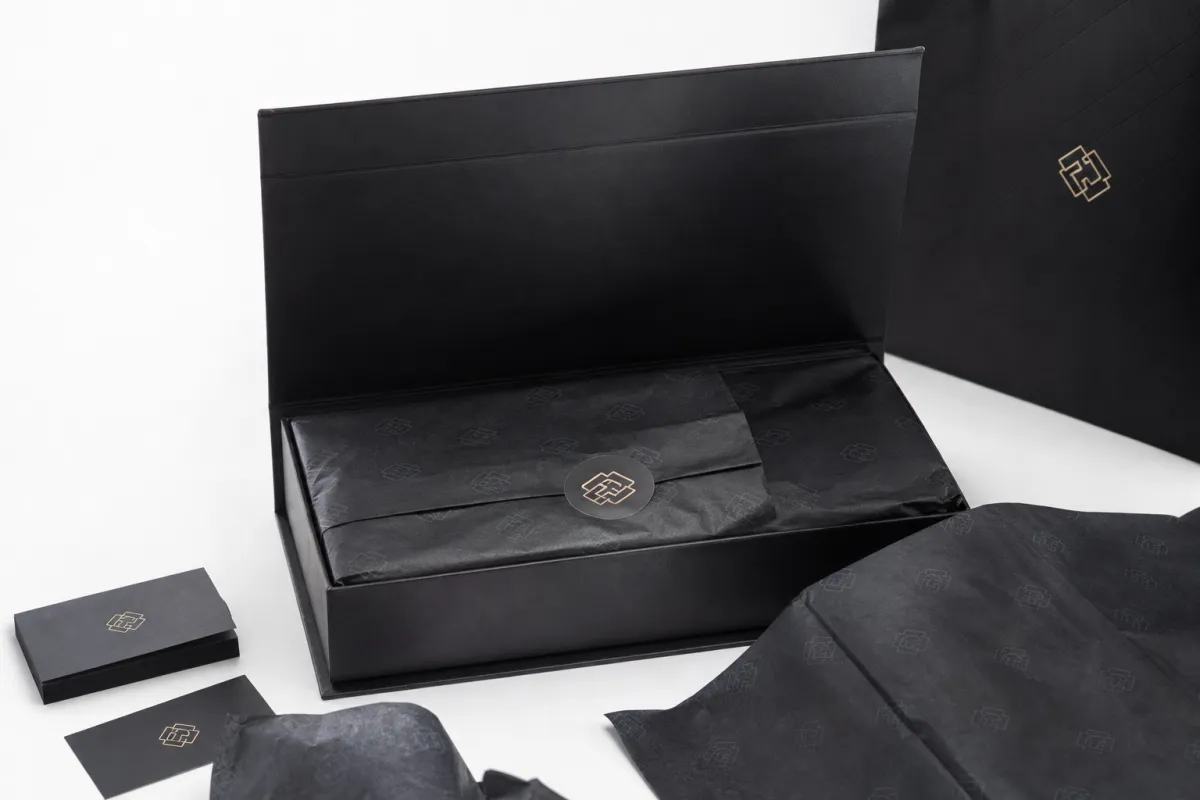
At the basic level, Custom Tissue Paper printed means branded tissue sheets printed with a logo, repeat pattern, message, or simple graphic system. The sheet still has a job to do. It needs to wrap the product, protect finishes from scuffs, and survive handling without tearing in the first ten seconds. Sounds simple. Simple is usually where brands get sloppy and end up with packaging that feels random.
The part people underestimate is that Custom Tissue Paper printed is one of the cheapest upgrades in the box, yet it often changes perceived value more than a fancy insert ever will. A clean repeat pattern around a shirt, candle, accessory, or skincare set makes the order look considered. Customers notice that right away. They may not talk about print registration or paper weight, because normal humans do not speak in packaging jargon. They do notice whether the order feels thoughtful or half-assembled.
That is why custom tissue paper printed keeps showing up in ecommerce, retail bags, gift boxes, subscription kits, and holiday packaging. The job is pretty straightforward: add a layer that looks branded, opens well, and does not destroy the margin. In the real world, it sits between presentation and protection. It is not structural like a box. It is not just decoration either.
There is a real difference between decorative tissue and functional tissue. Decorative tissue can look great in a mockup and then fall apart in production. If it shreds too easily, bleeds ink, or folds badly, it creates extra work for fulfillment and extra complaints for the customer. Functional tissue needs the right paper weight, a usable fold line, and ink that stays put. custom tissue paper printed should make the pack-out faster, not turn every order into arts and crafts.
From a buying perspective, the real question is not "Do we want tissue?" It is "What are we trying to improve?" If the answer is presentation, protection, or a stronger package branding system, then custom tissue paper printed is usually money well spent. If the tissue is only there because someone watched a nice unboxing clip and got excited, the result usually looks expensive and behaves like clutter.
For brands that want a restrained look, tissue plus a sticker, a card, or a box liner usually works better than stacking five extras on top of each other. The best product packaging programs know when to stop. Nobody gets loyalty points for stuffing a box with random extras and calling it premium.
How custom tissue paper printed is made
The production flow for custom tissue paper printed starts with usable artwork, not a vague idea and a good attitude. A supplier needs the logo, repeat pattern, sheet size, quantity, intended use, and color target before anything useful can happen. If the artwork is messy, the tissue will be messy. That is not a printer being difficult. That is how production works.
In a normal run, the brand brief becomes a layout, the layout becomes a proof, and the proof gets checked for repeat spacing, bleed, logo placement, and margin alignment. Then comes press setup, color check, cutting, packing, and shipping. custom tissue paper printed sounds simple because the final sheet looks simple. The work lives in the details nobody notices until they are wrong.
Print method matters more than many buyers expect. Some orders use a basic repeat print setup that keeps cost lower and works well for one-color logos or limited palettes. Others use methods that handle more detail, but once you ask for thin type, complex gradients, or full-coverage art, risk and price both climb. With custom tissue paper printed, simpler usually looks better anyway. Busy art on thin tissue tends to look busy in the wrong way.
Repeat size, spacing, and placement are not minor choices. They decide what the customer sees after the tissue is folded, scrunched, taped, or tucked around the product. A logo that looks perfect on a flat sheet can disappear into a fold. A pattern that is too dense can feel heavy and cluttered. A pattern that is too sparse can look like somebody forgot to finish the job. That is why custom tissue paper printed needs to be reviewed in the actual use format, not just on a screen.
Color matching is another place where expectations need a reality check. Exact Pantone matching can be possible in some cases, but tissue absorbs ink differently than coated paper or label stock. Bright shades can mute. Dark fills can look muddy. Soft neutrals can shift depending on the paper base. If you are setting up custom tissue paper printed, a good supplier will tell you the safe range instead of promising a perfect match the paper cannot hold. That honesty saves everybody a headache later.
Proofing is worth slowing down for. A clean proof catches placement problems, repeat errors, and contrast issues before you commit to the whole batch. One corrected mockup is cheap. Five thousand misprinted sheets are not. For broader packaging education, groups like packaging.org can help when you are comparing presentation materials, but the final call still comes down to your own pack-out and budget.
If your tissue sits inside a larger fulfillment system, treat it like a component, not a decoration. The same logic applies across the box, insert, and tissue in a lot of branded packaging programs. The best results happen when all three are designed together, not when they are ordered in separate meetings and everyone hopes for harmony. That is how you end up with custom tissue paper printed that matches the brand on paper but fights the box, the sticker, and the actual customer experience.
Key factors that affect quality and price
If you want to compare custom tissue paper printed options properly, start with the specs that actually move cost and quality. Paper weight, sheet size, print coverage, number of colors, paper finish, and whether the stock is acid-free all matter. A lighter tissue may cost less and fold more easily, but it can tear faster. A heavier tissue feels more premium, but it also adds bulk and can push the final package size up.
Here is the part people miss: the most expensive option is not always the best option. If the tissue is too thick, your fold becomes bulky. If it is too thin, it wrinkles badly and tears at the corners. For custom tissue paper printed, the best spec depends on the product. A jewelry box does not need the same structure as a pair of shoes or a ceramic gift item.
Print coverage has a direct effect on both price and perceived quality. A one-color repeat with a small logo is usually the cheapest branded option. Full-coverage printing with multiple colors costs more because it uses more ink, more setup time, and tighter control. If the design is highly graphic, the supplier may also need a more careful press setup to keep the sheet from looking patchy. With custom tissue paper printed, less ink often looks sharper than more ink. Weird, but true.
Minimum order quantities can be annoying, but they exist for a reason. Setup time does not shrink just because the order is small. The press still has to be ready, the design still has to be checked, and the sheets still have to be cut and packed. That is why a small run of custom tissue paper printed usually carries a higher unit cost. You are paying for setup across fewer sheets. Shocking, I know.
Supplier location matters too. Domestic production usually gives you faster turnaround and easier communication, while overseas production can lower the raw unit cost at larger volumes. Then freight and lead time show up and remind everybody that math exists. A buyer looking at custom tissue paper printed should ask about setup charges, plate costs if applicable, freight, and whether the vendor includes sampling or charges it separately.
Acid-free and archival-grade options are worth considering if the tissue goes around delicate merchandise, collectibles, or products that will sit in storage for a while. For sustainability-minded brands, FSC-certified paper can support sourcing claims when backed by documentation. The certification is not the whole story, but it is better than vague eco language that means nothing. If that matters to your line, ask for paperwork before you approve custom tissue paper printed. The source matters more than the slogan. More on certification basics is available at fsc.org.
| Option | Typical use | Rough unit cost | What you get |
|---|---|---|---|
| One-color logo repeat | Everyday ecommerce, retail bags | $0.12-$0.22 per sheet at 5,000 sheets | Lowest branded cost, clean look, easier approval |
| Two-color repeat pattern | Gift boxes, subscription kits | $0.18-$0.32 per sheet at 5,000 sheets | More visual interest, slightly higher setup and ink cost |
| Full-coverage multi-color print | Seasonal packaging, premium launches | $0.28-$0.55 per sheet at 5,000 sheets | Heavier visual impact, tighter print control needed |
| Low-volume short run | Testing, small brands, seasonal drops | $0.30-$0.75 per sheet depending on setup | Flexible quantity, highest per-sheet cost |
The pricing ranges above are indicative, not quotes. They are closer to what buyers usually see once setup, paper grade, and print complexity get factored in. A brand ordering custom tissue paper printed for 5,000 sheets can usually keep unit cost down better than a brand ordering 500 sheets. That is how fixed setup costs behave. They do not care about anyone's budget.
Do not ignore the downstream packaging design effect. If your tissue is oversized, you waste paper and slow the line. If it is undersized, packers fight the fold and use more sheets than planned. For many brands, a better fit saves more money than shaving a few cents off the unit price of custom tissue paper printed.
Custom tissue paper printed pricing and budgeting
Good budgeting starts with a realistic view of how custom tissue paper printed is actually priced. Small custom runs usually carry higher unit costs because the setup gets spread across fewer sheets. Larger quantities drive the price down once that setup gets absorbed. No trick here. If the order is tiny, setup hurts more. If the order is larger, the unit cost usually settles down.
The biggest cost drivers are boring, which is exactly why people ignore them. Number of colors, sheet size, print coverage, paper weight, quantity, and shipping distance matter far more than a polished explanation from a salesperson. If the design is one-color and the sheet size is standard, custom tissue paper printed tends to stay in a lower range. If the design is full-bleed, multi-color, and low quantity, the price moves up fast. Clean economics. Annoying, but clean.
When you budget, do not stop at the sheet price. Include artwork prep, sampling, proof revisions, freight, storage, and the cost of running out early. The real landed cost of custom tissue paper printed is the sum of all that, not the number on a quote line. I have seen brands celebrate a low unit price and then get hit with shipping and reprint fees. A bargain quote that falls apart in transit is not a bargain.
A practical buying rule is to order for 1 to 3 months of usage if the tissue goes into every pack-out. That usually gives you enough volume to keep setup costs reasonable without filling the warehouse with paper. For seasonal brands, the math changes. If usage spikes around launches or holidays, smaller runs can make more sense even if the per-sheet price is higher. With custom tissue paper printed, the right quantity depends on sell-through, not ego.
Here is a simple budget frame that works for most teams:
- Setup and proofing: plan for design time, proof rounds, and any sample fees.
- Production: the base sheet cost, which changes with quantity and print coverage.
- Freight: often overlooked, especially on heavier or larger-volume orders.
- Storage: if you are buying ahead, count the space and handling cost.
- Reorder buffer: keep enough stock to avoid paying rush pricing later.
Brands comparing custom tissue paper printed to other branded packaging components should look at total impression per dollar. One dollar spent on tissue can often do more for presentation than one dollar spent on a more complex insert. That is not because tissue is magically better. It is because customers see it immediately. It covers a large visual area, and it frames the product before the product comes out.
If you are already investing in custom printed boxes, tissue can help the inside match the outside without turning the whole order into a luxury project. A simple one-color repeat inside a good box creates a cleaner package branding system than a box with no interior treatment and a pile of random filler. In other words, custom tissue paper printed is a smart way to finish the job without adding a ridiculous amount of cost.
If you want to compare packaging formats, the better question is not which one is cheapest. It is which one supports the product, the margin, and the brand story. Sometimes tissue wins. Sometimes a card wins. Sometimes you need both. Packaging people hate vague answers, but this is one of those annoying cases where the honest answer depends on the product.
For brands that want a consistent look across boxes, tissue, and inserts, the economics usually improve once the whole system is planned together. Separate ordering tends to create mismatched visuals and awkward quantities. Coordinated ordering gives you a better shot at predictable custom tissue paper printed costs, a cleaner warehouse count, and a more professional finish.
Step-by-step timeline for custom tissue paper printed
The timeline for custom tissue paper printed usually starts with intake. The supplier needs the logo files, quantity, sheet dimensions, color targets, and the intended use. If you are wrapping apparel, the fold requirement is different than if you are lining a rigid gift box. That sounds obvious until someone sends a logo and says, "You can figure the rest out." No. That is not a plan.
Next comes the proof. A mockup shows placement, repeat spacing, and general visual balance. This is where many orders go sideways because the buyer only checks whether the logo is there. That is not enough. You need to check how the design behaves at the fold line, how much white space remains, and whether the text is still legible after the sheet gets tucked. custom tissue paper printed is judged in motion, not on a flat file.
After proof approval, the job enters production scheduling. Lead times vary by method and quantity, but a simple run may move in a few business days after approval, while larger or more complex orders can take one to several weeks. Freight adds its own clock. If the supplier is domestic, transit may be manageable. If it is overseas, build in more buffer. In practice, custom tissue paper printed is not delayed by printing alone. It is delayed by proofing, waiting, and shipping.
Things that slow the order down are usually predictable:
- Missing vector files or low-resolution artwork
- Too many revision rounds over tiny design choices
- Color changes after proof approval
- Unclear sheet size or folding direction
- Waiting until the last minute to request a sample
Once the shipment arrives, check it before you push it into full fulfillment. Count the cases. Check color consistency. Look for crushed corners, moisture damage, or packing issues. If the sheets are meant for a controlled pack-out, you do not want to find a problem after the team has already mixed the stock into daily operations. custom tissue paper printed can look perfect on paper and still arrive damaged if the freight packaging was weak.
If the tissue is part of a larger packaging rollout, it helps to compare handling standards and test assumptions early. Organizations like ISTA focus on transport test thinking, and that mindset is useful even for paper components. A product can look great and still be a shipping headache if the whole pack-out is not thought through. That is why smart teams test the finished presentation, not just the artwork.
For brands that are also ordering a box or insert, the workflow is better when everything is locked in together. Tissue dimensions should match the pack-out, not sit in a separate file like an afterthought. That coordination keeps custom tissue paper printed from becoming the part of the job that everyone forgets until the warehouse asks, "Where does this fold go?"
One useful habit: ask for a folded mockup or a real sample inside an actual box. Flat proofs are fine for layout. They are not enough for the final look. A tissue sheet can feel elegant on a screen and awkward in a box. The sample tells the truth. The screen tells a story. Only one of those is worth paying for.
Common mistakes with custom tissue paper printed
The biggest mistake with custom tissue paper printed is overcomplicated artwork. Tiny text, thin lines, and dense detail often disappear once the sheet is folded, crumpled, or tucked around a product. People love making the design "interesting." Then they discover that interesting is not the same thing as readable. A simple repeat with a strong logo and enough space usually looks better than a crowded design pretending to be luxury.
The next problem is sizing. Tissue that is too small wastes labor because packers need extra sheets or awkward overlaps. Tissue that is too large creates wasted paper, clumsy folds, and more time at the bench. With custom tissue paper printed, the right size is a production decision, not just a design one. If your team needs three folds and two wraps to make the tissue work, the sheet size is wrong.
Color assumptions cause another mess. Tissue is not a monitor, and it is not a coated label. Bright colors can shift. Dark backgrounds can look muddy. Gradients often soften or break up. If you go into custom tissue paper printed expecting every brand color to land perfectly, you are setting yourself up for disappointment. Better to adjust the palette early than to force a bad match through production.
There is also a workflow problem that gets ignored. If the tissue is hard to fold, the packing team slows down. If the fold is too fussy, labor goes up. That means the brand ends up paying for a premium look with a messy back end. Good custom tissue paper printed should fit the actual pack-out speed. A beautiful sheet that tanks the line is not a win.
Then there is the quantity trap. Order too little and you pay for rush reorders, short runs, and extra freight. Order too much and the stock sits in storage, tying up cash and shelf space. I have seen brands underbuy and overbuy with equal confidence, which is a special kind of packaging optimism. The smarter move is to estimate usage honestly and build a modest buffer into the order.
Another common miss is using tissue to cover up a weak packaging system. It cannot do that. custom tissue paper printed can improve first impressions, but it does not fix a bad box size, poor product fit, or sloppy fulfillment. If the box rattles, the tissue is not the problem or the solution. It is just the wrapping around the problem.
Expert tips and next steps for custom tissue paper printed
If you want custom tissue paper printed to look expensive without actually costing much, keep the design disciplined. One strong logo repeat, one clear message, and enough white space usually beats a crowded pattern every time. The cleaner the repeat, the less likely the tissue is to look noisy once it is folded around the product. Brands often assume more art equals more value. Usually it just equals more clutter.
Ask for a folded mockup or a real sample in a real box. That is the fastest way to catch issues with visibility, fold lines, and scale. A flat proof is necessary, but it is not the final test. In actual use, custom tissue paper printed changes shape and coverage. What looks centered on a screen may disappear into the crease. Packaging people learn this the hard way. You do not need to.
Match the tissue to the rest of the pack-out. Stickers, cards, void fill, and shipping boxes should not fight the print or create a visual mess. If your box is already heavily branded, the tissue can stay lighter. If the box is plain, the tissue can carry more of the visual load. That is basic packaging design, not branding theater. Good custom tissue paper printed supports the rest of the system instead of shouting over it.
Choose specs for the job, not for bragging rights. If the tissue is mainly there for presentation, spend on the finish that looks best after folding rather than the fanciest paper on the quote sheet. If the product is delicate, choose a grade that resists tearing and handles well. If the item is retail-facing, test the tissue inside the final box or bag. The right custom tissue paper printed choice is the one that makes the whole package easier to sell, ship, and open.
A good rule is to align tissue choices with your broader branded packaging strategy:
- Use a simple repeat for everyday ecommerce orders
- Use stronger visuals for seasonal drops or gifting
- Keep the sheet size tied to the product, not the ego of the designer
- Check whether the tissue needs to coordinate with custom printed boxes
- Review storage and reorder timing before approving a huge run
If you are still deciding where tissue fits, compare it with the rest of your product packaging mix. Sometimes you only need a subtle interior touch. Sometimes you need a more complete presentation system with tissue, box, and insert working together. Either way, custom tissue paper printed should earn its place by improving the customer experience and keeping the fulfillment process sane.
For the next step, gather your logo files, define the sheet size, estimate monthly usage, and ask for a proof that shows fold behavior. Then check the sample in a real pack-out before you approve the final layout. That sequence is boring, practical, and usually saves money. Which is exactly why it works. Done properly, custom tissue paper printed becomes a small line item with a very large impact.
Honestly, that is the whole point. Good packaging is not about spending the most. It is about spending where the customer can feel it and the fulfillment team can still move quickly. For a lot of brands, custom tissue paper printed hits that balance better than almost any other presentation upgrade.
The clearest takeaway: choose a simple repeat, verify it in a folded sample, and budget for setup before you chase a low sheet price. Do those three things and custom tissue paper printed stops being a guess. It becomes a controlled, repeatable part of the package.
FAQ
How much does custom tissue paper printed usually cost per sheet?
The unit cost depends mostly on quantity, number of colors, sheet size, and print coverage. Small runs usually have higher per-sheet pricing because setup costs are spread across fewer sheets. A simple one-color repeat is usually the cheapest branded option, while more coverage and more colors push custom tissue paper printed higher.
What file format works best for custom tissue paper printed artwork?
Vector files are usually best because they keep logos and repeats sharp at any scale. A supplier may also accept high-resolution raster files, but clean outlines and text are safer in vector form. Always include brand colors, repeat spacing, and no-print margins in the file brief for custom tissue paper printed.
How long does custom tissue paper printed production take?
Timing usually includes proofing, approval, production, and shipping. Simple orders can move quickly after approval, but revisions or color changes can add days or weeks. Freight time matters just as much as print time, especially for larger or overseas custom tissue paper printed orders.
Is custom tissue paper printed recyclable?
Often yes, but it depends on the paper, inks, and any added coatings or finishes. Light, paper-based prints are usually easier to recycle than heavily inked or laminated materials. If recyclability matters, ask the supplier before ordering and get it in writing for custom tissue paper printed.
What order quantity makes custom tissue paper printed worth it?
It usually makes sense once the tissue is used consistently across enough orders to absorb setup costs. If the brand uses it daily, a larger run often lowers the landed cost enough to justify storage. If usage is seasonal, smaller runs can be smarter even if the unit price is a little higher, and that still works for custom tissue paper printed.

