Buyer Fit Snapshot
| Best fit | Custom Window Cartons with Clear Inserts projects where brand print, material claims, artwork control, MOQ, and repeat-order consistency need to be specified before quoting. |
|---|---|
| Quote inputs | Share finished size, material target, print colors, finish, packing count, annual reorder estimate, ship-to region, and any compliance wording. |
| Proofing check | Approve dieline scale, logo placement, barcode or warning zones, color tolerance, closure strength, and carton packing before bulk production. |
| Main risk | Vague material claims, crowded artwork, missing packing details, or unclear freight terms can make a low unit price expensive after revisions. |
Fast answer: Custom Window Cartons with Clear Inserts: Board, Finish, Dieline, and Unit Cost should be specified like a repeatable production item. The safest quote records material, print method, finish, artwork proof, packing count, and reorder notes in one written spec.
Production checks before approval
Compare the actual filled-product size with the drawing, then confirm tolerance on folds, seals, hang holes, label areas, and retail display edges. Reserve space for logos, QR codes, warning copy, and material claims before decorative graphics fill the panel.
Quote comparison points
Review material grade, print process, finish, sampling route, tooling charges, carton quantity, and freight assumptions side by side. A quote is only useful when the supplier can repeat the same color, closure quality, and packing count on the next order.
Custom Window Cartons with clear inserts do something ordinary cartons cannot: they let the product speak before the shopper reads a single line of copy. That matters because visual proof changes judgment fast. A buyer in a retail aisle can decide, often in seconds, whether a product feels polished, safe, fresh, or worth the price. Beauty, food, candles, and gift packaging keep returning to this format for a reason. It sells before the pitch begins.
The real attraction is not visibility alone. It is the balance between presentation, protection, and budget. A carton has to look deliberate on shelf, keep the product steady in transit, and still leave room for branding, compliance text, and the practical realities of line packing. That balance is what gives Custom Window Cartons with clear inserts their value in retail packaging and branded packaging programs.
I have seen brands spend weeks perfecting a label, only to discover that the window placement mattered more than the headline. That is not a criticism of design. It is a reminder that packaging is judged in motion, under bright light, and usually next to five other choices.
What Custom Window Cartons With Clear Inserts Do
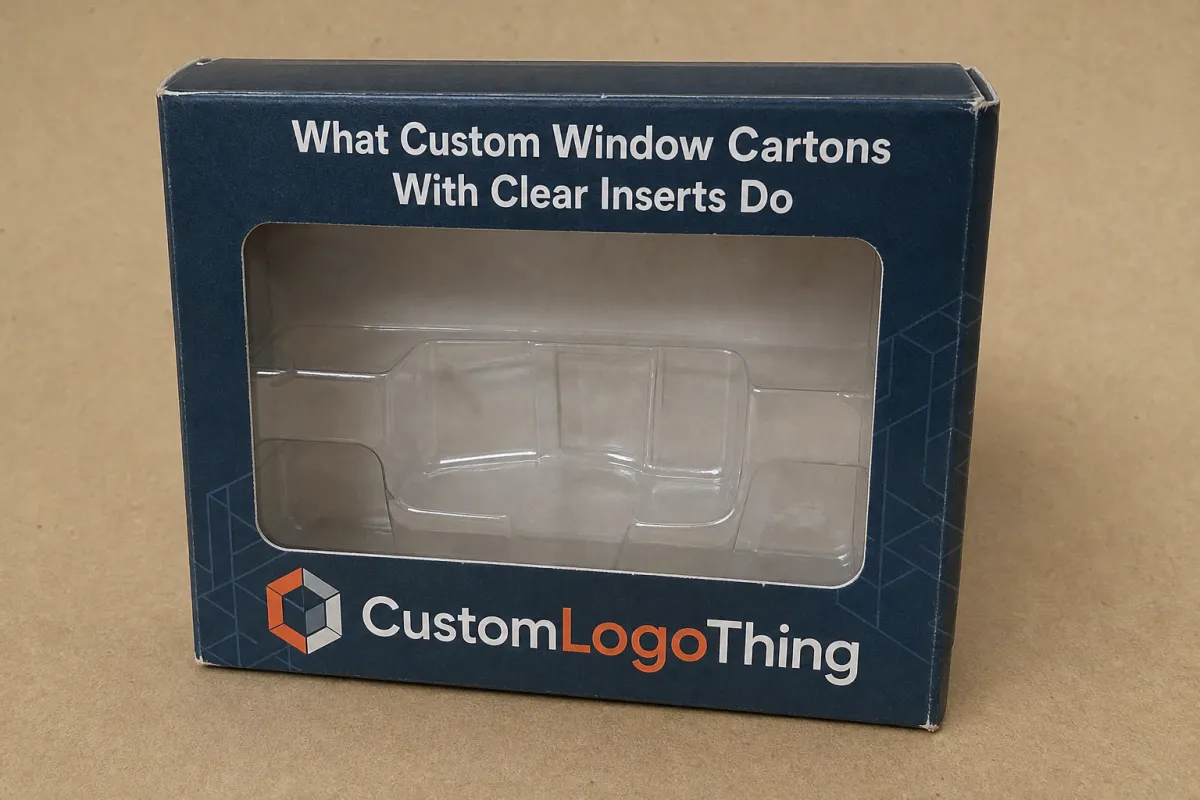
Think of custom window cartons with clear inserts as a controlled reveal. The outer carton carries structure, print, and brand story. The clear insert offers a view of the product without opening the pack or exposing the entire item. That middle ground works well for product packaging that needs shelf appeal without giving up protection.
Shoppers use the window to check color, shape, count, texture, or finish quickly. That small act can change buying behavior more than many brands expect. A crowded aisle does not reward long explanations. It rewards confidence. A candle with a distinctive wax color, a bakery item with visible decoration, or a cosmetic set with polished components can benefit immediately from a window that removes doubt.
The branding effect is easy to miss. Once the product is visible, the carton no longer has to imitate the product. That can improve the whole design system. Space does not get wasted on oversized illustrations. Typography can breathe. Hierarchy becomes clearer. The package can look more disciplined, and good packaging design often does. Windowed packs frequently reveal that restraint feels more premium than decoration.
Custom window cartons with clear inserts fit especially well in categories where the item itself has visual value: cosmetics, confectionery, bakery items, gift sets, small electronics, candles, and specialty consumer goods. They also suit Custom Printed Boxes used in seasonal retail programs, where visibility and giftability have to coexist. In those cases, the window is not decoration. It is a sales tool with a measurable job.
The insert does more than display the product. It affects placement, closure, movement in transit, and how quickly the pack can be assembled. A weak insert can make a carton look excellent in a render and awkward on the production floor. That kind of mismatch costs time, labor, and trust. Packaging programs run on repeatability, not just appeal.
"If the product is the hero, the window should frame it, not fight it."
That sentence sounds simple because the logic is simple. Custom window cartons with clear inserts can lift perceived value, support premium positioning, and make a mid-priced item feel more considered. The difference between a plain carton and a windowed carton is often small in material terms. The difference in how a shopper reads the pack can be large.
How Custom Window Cartons With Clear Inserts Work
The structure is usually straightforward, though the details carry the weight. The outer carton provides rigidity, print surface, and tamper resistance. The clear insert creates a view of the product while helping keep it in place. When custom window cartons with clear inserts are engineered properly, the two layers support each other instead of competing for space.
Insert material is the first major decision. PET is often selected for clarity and stiffness. PVC can still show up in production, although sustainability concerns push many buyers toward alternatives. Acetate offers good visibility in some applications. In certain builds, a coated paperboard insert or cutaway structure is enough, especially when the goal is partial reveal rather than a full transparent display. Each option changes cost, recyclability, stiffness, and the final look of the pack.
Window size shapes perception in subtle ways. A smaller opening can feel selective and premium because it reveals only the hero detail. A larger one shows more of the item and can build trust faster, but it can also weaken the board if the cutout becomes too aggressive. Custom window cartons with clear inserts usually perform best when the opening is sized around the product's selling point rather than a designer's instinct to show everything.
The insert works like traffic control inside the carton. It can center the product, keep components from drifting, and reduce scuffing or dust exposure. That becomes especially useful for custom window cartons with clear inserts used on items with glossy finishes, fragile details, or assembled parts that should not move during shipping. Clarity makes flaws easier to see, which is another reason fit has to be exact.
Assembly matters just as much as structure. A typical line prints and die-cuts the carton, forms or supplies the insert, loads the product, and closes the pack. For high-volume product packaging, pack-out speed can matter as much as shelf appearance. A structure that adds a few seconds per unit can cost more in labor than it saves in retail appeal. Those seconds add up quickly.
Experienced buyers spot the trade-offs early. Too stiff, and loading becomes awkward. Too soft, and the product shifts. Too large a window and board strength drops. Too small and the shelf story weakens. Custom window cartons with clear inserts sit inside those tensions, which is why structural testing usually beats visual guessing every time.
Retailers and distributors also benefit from consistency. A product that sits in the same position every time presents better on shelf and in transit cartons. That may not sound glamorous, yet it matters. In retail packaging, controlled repeatability often outperforms flash. The pack looks calmer, easier to read, and more trustworthy.
Key Factors That Shape Fit, Look, and Shelf Impact
Fit begins with the product, not the carton. That point seems obvious until a project starts with a box size and then forces the product into it. For custom window cartons with clear inserts, internal clearance has to be tight enough for stability but not so tight that loading becomes a struggle. A few millimeters can change the presentation more than most teams expect.
Visual priority comes next. The question is simple: what should the shopper see first? Maybe it is the color of a lotion bottle, the layered texture of a dessert, the shape of a candle tin, or the premium finish on a gift set. Custom window cartons with clear inserts work best when the opening exposes the feature that closes the sale. If the wrong side faces forward, the carton may still look expensive without working as hard as it could.
Board grade and finishing choices shape how the window reads. Thicker paperboard usually improves rigidity. Matte coatings reduce glare, while gloss can make print colors pop and still reflect too much light around the opening. Foil, embossing, and soft-touch lamination can raise perceived value, yet each one changes the relationship between the carton face and the transparent insert. Real retail lighting exposes those interactions fast.
Sustainability expectations belong in the brief from the start. Buyers increasingly ask for FSC-certified board, lower plastic content, or easier separation between carton and insert. FSC guidance remains a useful reference point for responsibly sourced paper materials, and the current standards are available directly at FSC. Custom window cartons with clear inserts can support those priorities, but insert material and adhesive choice need to be defined early.
Shelf behavior is where good packaging design either proves itself or falls apart. Bright retail lights can make clear film shine too much. A restrained window carton can look more premium than louder competitors sitting nearby. In stacked displays, the carton needs enough compression resistance to keep its shape. Custom window cartons with clear inserts should be tested in context, not only as a flat proof on a screen.
One comparison helps make the trade-offs easier to see:
| Build option | Typical use | Approx. unit cost at 5,000 pcs | Strength | Visual impact |
|---|---|---|---|---|
| Simple board carton with die-cut window | Low-complexity retail packaging | $0.18-$0.28 | Moderate | Clean, basic reveal |
| Custom window cartons with clear inserts using PET | Most beauty, food, and gift packs | $0.24-$0.42 | Good | High clarity and controlled display |
| Premium carton with formed insert, foil, and soft-touch finish | Higher-end branded packaging | $0.40-$0.75+ | Very good | Strong premium shelf presence |
Those figures are not fixed. Carton size, print coverage, production location, and the exact insert specification all move the numbers. Even so, the trend is consistent: custom window cartons with clear inserts become more expensive as the insert gets clearer, the finish gets richer, and the engineering gets more precise.
Another strategic question matters here. If the item depends on visual proof to sell, a window can be powerful. If the product is light-sensitive, tamper-sensitive, or better supported by graphics and messaging, the window may not be the right call. Good product packaging starts with the product's needs and builds outward from there.
Production Process, Timeline, and Lead Time
The most efficient custom window cartons with clear inserts projects usually follow a predictable path: brief, dieline, structural approval, artwork setup, sample or prototype, quote confirmation, then full production. Miss one stage and the job stretches. Skip the sample and the risk rises faster. Structural packs need more than graphic approval.
Time tends to disappear in the same places. Measurements are incomplete or inconsistent. Artwork keeps changing after the die line is locked. The insert gets revised after the carton has already been approved. Delays often come from decision churn, not from printing itself. A clean brief does more for schedule control than a flashy mockup ever will.
A physical sample is one of the best forms of risk control. It shows whether the product loads correctly, whether the window catches glare, whether the insert scratches the item, and whether the opening lands on the right feature. For custom window cartons with clear inserts, a sample often exposes problems a PDF cannot. That is why experienced buyers ask for a prototype before committing to a full run.
Lead times vary by supplier and spec, but a common range for custom window cartons with clear inserts is about 12-15 business days after proof approval for straightforward jobs, with more time needed for complex structures, specialty finishes, or custom-formed inserts. Rush production is possible in some cases, though it often narrows finishing choices and raises the price in a way that shows up immediately.
If shipping standards matter, ask about transit testing at the start. Many teams use ISTA methods to evaluate package performance under drop, vibration, and compression conditions. The broader framework is documented by ISTA, and that matters because a pack that looks strong on the bench can behave differently in mixed freight. Custom window cartons with clear inserts should survive shelf handling and the shipping lane.
Standards become useful at this stage, not abstract. Some projects call for compression checks modeled on ASTM-style methods, while others need a simpler validation pass. The point is not to test everything endlessly. The point is to make sure the carton, insert, and closure method match the route the product will actually take. That is the difference between a sample that looks nice and a program that works.
For teams ordering custom window cartons with clear inserts across broader product lines, it helps to coordinate the box structure with other Custom Packaging Products so the brand family feels consistent. A carton that lines up with tray, mailer, or display box dimensions can lower design friction and create a cleaner shelf story across the range.
Cost, Pricing, MOQ, and Quote Factors
Cost is where custom window cartons with clear inserts become concrete. The main levers are carton size, board grade, print coverage, window complexity, insert material, and finish level. Change one part and the quote can move more than expected. Buyers should never compare carton pricing without comparing the full build specification.
MOQ behavior is usually predictable. Lower quantities carry higher unit prices because setup, die cutting, and labor are spread across fewer cartons. As volume rises, those fixed costs dilute. Custom window cartons with clear inserts can become far more economical at mid-volume than at pilot runs. The unit cost curve often drops sharply between the first small order and the first real production run.
Supplier quotes can mislead if they are not broken out clearly. The board may be priced separately from the insert. Printing may be bundled with finishing. Tooling, proofing, and freight may sit in different lines. For custom window cartons with clear inserts, ask the quote to show each major element. That makes comparison easier and prevents surprises later when an added insert or upgraded coating changes the total.
The best way to understand value is to compare scenarios. A simple one-color carton with a standard window may look inexpensive, but a premium carton with heavy coverage, foil, and a custom insert can improve shelf conversion enough to justify the extra cost. That trade-off is why packaging design should be judged against margin and shelf role, not material cost alone. Good product packaging earns its place in the channel it serves.
Requesting a quote in a structured way helps:
- Low volume: pilot run for fit and shelf testing, usually the highest unit price.
- Mid volume: often the strongest balance for custom window cartons with clear inserts because setup costs start to spread.
- High volume: best for recurring retail packaging programs where the structure is already proven.
Buyers comparing options should price custom window cartons with clear inserts against other visible formats as well. Sometimes a plain carton with premium print effects comes close on shelf impact. Sometimes the window version wins because it reduces the need for extra graphics. There is no automatic answer. The right choice depends on category, retail channel, and how much of the product needs to be seen.
Final price can also shift because of logistics. Flat-packed board ships efficiently, but custom-formed inserts may add handling or space requirements. If the supply chain passes through multiple steps, ask whether the insert is sourced separately or produced in the same facility as the carton. That detail can influence lead time and freight more than buyers expect.
For a quote that is actually useful, ask for three versions at once: one at MOQ, one at a mid-run quantity, and one at a higher run quantity. Compare unit cost, tooling amortization, and finish options side by side. That is usually the fastest way to see where custom window cartons with clear inserts stop being a packaging expense and start becoming a branding asset.
Common Mistakes and Expert Tips for Better Results
The first mistake is designing the window before the product fit is locked. A beautiful opening can still fail if it exposes the wrong side of the item or weakens the structure. With custom window cartons with clear inserts, the reveal should follow the product, not the other way around. It is a simple rule, and it gets broken often.
The second mistake is ignoring glare, fingerprints, and visual noise. Clear materials are not always visually neutral. Under strong retail lighting, a reflective insert can make the product seem cheaper or harder to read. Custom window cartons with clear inserts need viewing tests under conditions that resemble the shelf, not just under soft office light.
The third mistake is overbranding the area around the opening. Too much copy, too many badges, or too much decoration can crowd the field and weaken the window effect. In branded packaging, restraint often looks more premium than trying to explain every benefit at once. If the product is visible, let it do some of the work.
Prototype with the actual product. Not a substitute. Not a placeholder. The real item. Weight, texture, surface friction, and even minor shape changes affect how the insert behaves. Custom window cartons with clear inserts that fit a sample bottle perfectly may behave differently once a heavier production item is loaded. Real inputs reveal real problems.
Specify handling and transit tests early. Ask whether the carton should survive a drop profile, a stacking load, or a longer distribution route. That is where an ISTA-style test plan earns its value. The pack should look good on shelf and still survive the journey there. If it fails one of those jobs, the structure needs another round.
Think about how the product will be packed at scale. A structure that takes 20 seconds to assemble may be acceptable for luxury gift packs, but not for a fast-moving retail run. Custom window cartons with clear inserts should be judged against pack-out speed, labor availability, and any line constraints. Efficiency is part of quality, not separate from it.
The window should support the category story, not repeat it. If the item sells through freshness, craftsmanship, or premium materials, the clear insert can prove that story in seconds. That logic works well for custom printed boxes in food, beauty, and gifting, where visual proof and brand narrative have to sit side by side without crowding each other.
Keep the sustainability conversation honest. A paperboard carton with a plastic insert is not the same as a fully fiber-based pack. That does not make it wrong. It means the sustainability claim has to match the material mix. Custom window cartons with clear inserts can still fit a responsible packaging program, but only if the structure, adhesive, and end-of-life guidance are considered from the start.
Companies managing multiple SKUs often benefit from aligning this format with other Custom Packaging Products so the shelf architecture feels coherent. One SKU with a window and another without can work, but the family should still look planned. Consistency is easy to underestimate. Retail buyers notice it immediately.
One practical habit helps more than most teams expect: review the pack in three states, not one. Flat art board. Loaded sample. Stacked on a shelf. A carton that looks elegant in the first stage can look crowded in the third. Custom window cartons with clear inserts reveal those differences quickly, which is exactly why they deserve more than a design-only review.
Actionable Next Steps Before You Order
Start with measurements that reflect reality. Measure the product, the display position, and the limits of the shipping carton. Then record internal dimensions, not just external ones. Custom window cartons with clear inserts need exact information because even small dimensional drift can change the window placement, the insert fit, and the final look.
Next, decide what the window should reveal. A full product view is not always best. Sometimes a smaller reveal that shows one hero face or one premium detail feels stronger. Other times, the customer needs to see the whole item to trust it. For custom window cartons with clear inserts, that choice should come from category buying behavior, not from what looks dramatic in a render.
Request three things together: a prototype, a structural dieline, and a written quote. Getting those in parallel saves time and makes comparison much easier. It also shows whether the supplier understands the difference between a graphic box and a functional retail structure. That difference matters, because the strongest custom window cartons with clear inserts are part packaging and part engineering.
Review the proof like a buyer and a logistics manager at the same time. Check readability, alignment, closure points, and stack strength. Look for scuffs, glare, and any awkward offset between the product and the window. If the carton will sit in a chain retailer, a boutique, or a subscription set, confirm how it behaves in each environment before approval.
Before production gets the green light, ask one final question: does the pack still meet shelf, shipping, and sustainability goals after the artwork and insert are finalized? That is where many teams lose control. A pack can drift from its original brief when design changes pile up. Custom window cartons with clear inserts should still do the same three jobs they were meant to do on day one: sell, protect, and pack efficiently.
If you are working through a broader packaging refresh, compare this format against your other retail packaging choices and the rest of your branded packaging system. The goal is not to make every box identical. The goal is to make every pack feel intentional.
Final Takeaway
Custom window cartons with clear inserts are not just attractive cartons with a cutout. They are a practical format that can raise perceived value, improve product visibility, and reduce the burden on print to explain what the shopper is already seeing. That combination is powerful in categories where appearance shapes conversion quickly.
What separates a good result from an average one is discipline. The best custom window cartons with clear inserts are built around the product's dimensions, the retail environment, the packing line, and the shipping route. If those pieces are aligned, the pack looks cleaner, performs better, and usually tells the brand story with less effort. If they are not aligned, the carton may still look good in a mockup and disappoint everywhere else.
For brands that want a packaging format with visibility, control, and strong shelf presence, custom window cartons with clear inserts remain one of the most useful tools available. The practical next step is not to chase a bigger window or a fancier finish. It is to lock the product measurements, define the viewing angle, and validate the structure under real lighting and real handling. That is how custom window cartons with clear inserts turn from a packaging idea into a repeatable retail asset.
Are custom window cartons with clear inserts recyclable?
It depends on the material mix. Paperboard cartons are often widely recyclable, but the insert can change the recovery path. If recyclability is a priority, ask for a structure that uses minimal plastic, separates easily, or follows the recycling rules in your target market. The answer is not always the same for every region.
What products work best in custom window cartons with clear inserts?
Products that benefit from visual proof usually perform best: bakery items, cosmetics, candles, gift sets, specialty food, and small consumer goods. Items with distinctive color, texture, count, or finish gain the most. If the product needs heavy tamper protection or full light blocking, another structure may be a better fit.
How do I reduce the unit cost of custom window cartons with clear inserts?
Simplify the print setup, reduce special finishes, and keep the window shape straightforward. Increase order volume when possible, because setup and tooling costs spread more efficiently across the run. Comparing insert materials also helps; a small change in film type or window size can move pricing more than many buyers expect.
How long does it take to produce custom window cartons with clear inserts?
Lead time usually depends on sampling, artwork approval, insert sourcing, and production queue length. A clean brief with final dimensions and artwork can shorten the process significantly. Rush orders may be possible, but they often raise cost and limit finishing options.
What should I ask for in a quote for custom window cartons with clear inserts?
Ask for board grade, insert material, print method, finishing, MOQ, tooling, and freight to be listed clearly. Request pricing at multiple quantities so you can see where the unit cost improves. Also confirm whether sampling, structural changes, and reprints are included or billed separately.
Do custom window cartons with clear inserts help with premium positioning?
Yes, often they do. The visible product can signal authenticity, craftsmanship, or higher quality faster than graphics alone. The effect is strongest when the product itself looks refined and the packaging design keeps the window clean, balanced, and well framed. For custom window cartons with clear inserts, that premium cue is strongest when the item and the structure work as one.

