custom woven label Beanies Bulk Order requests usually start with a simple need: the buyer wants a hat that looks finished, not generic. A woven label does that job well. It keeps the branding readable, avoids the bulky feel of heavy embroidery on fine knit, and still fits a bulk budget for retail, team kits, or seasonal merch.
The real challenge is not making one good sample. It is keeping the same look across 250, 500, or 1,000 pieces without the label drifting, the color shifting, or the beanie body changing shape from one run to the next. That means the buying decision has to go beyond the mockup. Materials, knit gauge, label style, placement, MOQ, packaging, and lead time all affect the final result.
These orders fit store merch, company gifts, event uniforms, and resale programs. They also fit packaging-heavy launches, where the beanie has to arrive folded cleanly with hang tags, insert cards, or retail bagging. The goal here is practical: what woven labels do well, which specs matter, what prices usually look like, and how to avoid the usual production delays.
Why custom woven label beanies bulk order runs outperform blank hats
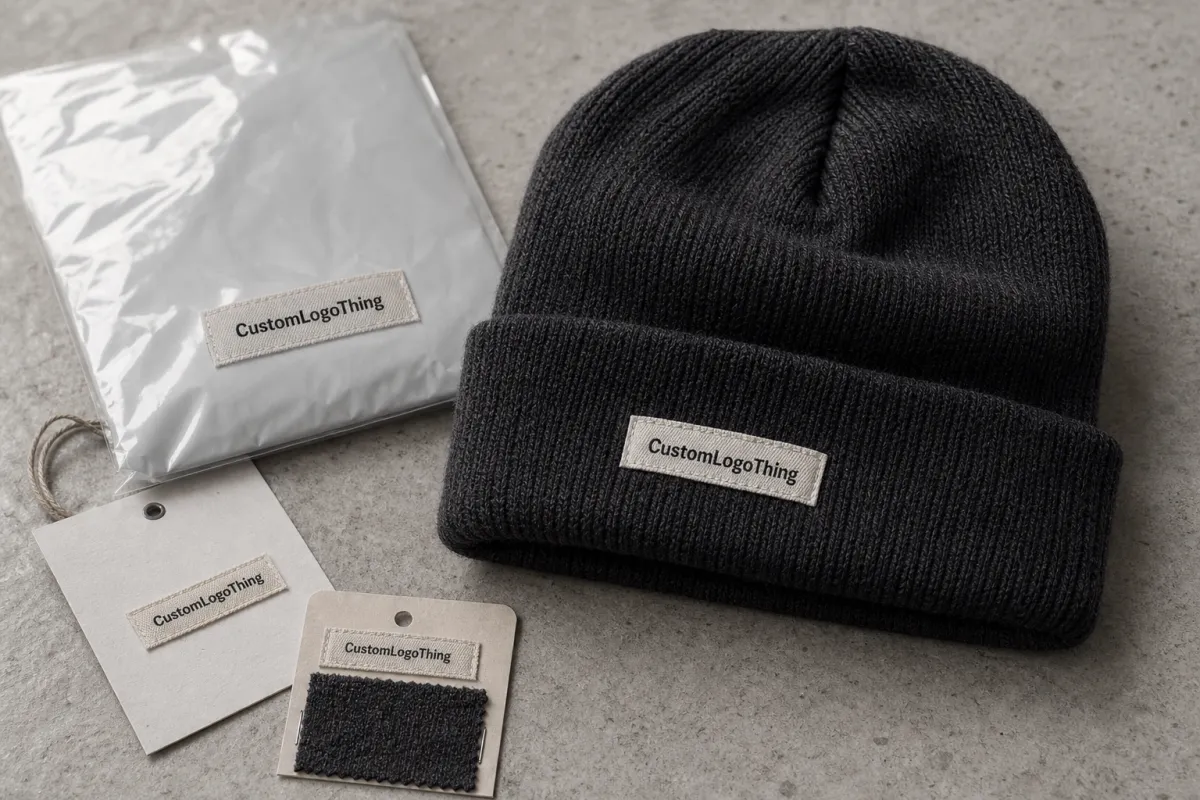
A blank beanie can work for internal use, but it often feels unfinished once it hits a shelf or a gift box. A woven label adds a branded face without changing the hand feel much. That matters on soft acrylic, recycled acrylic, and blended yarns that do not love heavy decoration. For a lot of buyers, that is the main reason custom Woven Label Beanies bulk order programs beat plain hats in retail and promotional settings.
Woven labels are also better at holding small text and fine linework. Embroidery can look premium, but on a tight rib knit or fine cuff, thick stitching can distort the surface and blur narrow lettering. A woven label keeps the logo cleaner and sits flatter on the cuff or seam. That matters more than people expect once the hats are boxed and stacked.
A good woven label can carry more shelf appeal than a larger decoration that fights the knit structure. You usually notice that the moment the beanies are folded in a case pack.
These runs are common in a few situations:
- Store merch: The hat has to look saleable from a display table.
- Company gifts: The brand wants something practical that still feels considered.
- Event uniforms: Staff need fast brand recognition without a loud decoration.
- Resale programs: The first run and the reorder need to match closely.
Repeatability is the piece buyers often underestimate. The first sample is only a sample. The value shows up when the same label size, stitch count, and placement can be reproduced later without rebuilding the spec from scratch. If the same brand family extends across other items, it helps to keep the label style aligned with Custom Labels & Tags so the visual system stays consistent.
Woven label styles, fold options, and placement details
Not all woven labels behave the same. Weave density, yarn type, edge finish, and fold style change how the logo reads once it is sewn to a beanie. For a Custom Woven Label Beanies bulk order, the label spec is part of the product, not an afterthought.
| Label type | Typical look | Best use | Buyer note |
|---|---|---|---|
| Damask woven label | Fine detail, smooth face, sharp text | Small logos and typography-heavy marks | Usually the best balance of clarity and cost |
| Satin woven label | Softer sheen, slightly more reflective | Giftable or fashion-forward headwear | Works well when the brand wants a softer finish |
| High-density weave | Tight detail with compact stitching | Mini logos and fine lines | Useful when the artwork is detailed but the label must stay small |
| Printed satin label | Ink-based, very smooth surface | Simple art or variable information | Not woven, but sometimes chosen when price matters more than texture |
Fold options that change the finish
Fold style changes both the look and the sewing method. A straight-cut flat label is simple, but the raw edge has to be handled carefully so it does not curl. End fold and center fold labels are more common on apparel because the folded edge looks tidy and gives the sewing operator a clean attachment point. A loop fold works for a side seam tab. A miter fold can look neat on a larger label if the brand wants a more finished corner.
Size matters too. A label around 20 x 50 mm may suit a small logo on a cuff. A label around 25 x 60 mm gives more room for a wordmark and a second line of text. Go much larger and the label starts to feel patch-like on a soft knit. That is a common mistake on first orders: the artwork is approved on screen, then the real hat looks crowded once the label is sewn.
Placement details that affect legibility
Front cuff placement is the most visible and usually the most retail-friendly. Side seam placement is quieter and works for brands that want a more restrained look. Patch-style placement can work when the beanie has enough surface area to support a larger branded panel, but it should be checked on the actual knit so the label does not warp when the hat stretches.
Before production starts, approve four things: edge finish, background color, thread contrast, and exact placement. Light-on-dark, dark-on-light, and tonal labels behave differently once they sit on textured yarn. A label that looks fine in a flat proof can disappear on the finished knit if the contrast is too soft.
Many buyers keep a simple spec sheet for that reason. If the order later moves into a new vendor relationship or a Custom Packaging Products bundle, the label size and placement travel with the product instead of living in an email thread nobody wants to search later.
Beanie materials, knit gauge, and decoration specs buyers should confirm
The beanie body drives more of the finished look than many buyers expect. A soft acrylic rib knit, a recycled acrylic blend, a wool blend, and a polyester blend all wear differently, hold color differently, and stretch differently under a label. For a custom woven label beanies bulk order, the body fabric and knit construction need to be decided early because they affect both price and presentation.
Acrylic is the workhorse. It is cost-effective, easy to dye, and stable in bulk runs. Recycled acrylic is a good middle ground when the brand wants a more sustainability-aware story without jumping into a much higher price bracket. Wool blends feel warmer and usually read more premium, but they raise the unit cost and need more care in washing. Polyester blends can be useful when durability and color hold are priorities.
Then there is the style. A cuff beanie gives the label a natural landing zone and keeps branding visible even when the hat is folded. A slouch beanie drapes more, so the label can sit lower or off to the side without looking awkward. A fisherman-style beanie sits shorter on the head and usually needs a smaller, quieter label so the proportions stay balanced.
Knit gauge matters too. A finer gauge gives a smoother surface and can make a woven label look sharper, but it also means the hat may stretch less. A looser gauge feels more casual, yet the texture can fight with small text. Stretch recovery matters. If the knit sags after wear, a centered label can start to look off-line even when the sewing was clean.
These are the details worth locking into the quote request:
- Beanie length: Short, standard, or oversized slouch.
- Cuff height: Important for label visibility and balance.
- Label dimensions: Width, height, and whether a fold is needed.
- Thread colors: Pantone references reduce guesswork.
- Beanie color: One solid color is simpler than mixed colorways.
- Packaging format: Retail bag, hang tag, insert card, or gift-ready wrap.
Packaging can change perceived value fast. A beanie packed loose in a carton looks like inventory. The same beanie folded with a tag, bagged cleanly, and stacked in a labeled case starts to feel retail-ready. If the order will ship with paper inserts or branded sleeves, ask early about paper sourcing and whether FSC-certified stock matters for the job. That question affects both cost and lead time.
The best spec sheets are plain. They do not need marketing copy. They need the exact body material, knit style, label size, label location, and packaging requirement so the factory can quote the same thing it will actually build.
Pricing, MOQ, and unit cost for woven-label beanie orders
MOQ is usually driven less by the total quantity and more by the setup behind the order: how many beanie colors are involved, how many label versions need to be made, and whether the artwork stays fixed across the run. A single-color run with one label style is much easier to plan than a mixed-color order with several placements and different packaging inserts.
For a custom woven label beanies bulk order, the per-piece price usually improves as the run gets larger because setup, sampling, and labor are spread over more units. Exact numbers move with yarn type, knit density, and finishing choices, but these ranges are useful for planning:
| Run size | Typical unit cost range | What usually drives the price |
|---|---|---|
| 100 units | $5.50-$9.50 | Higher setup burden, sample risk, smaller labor spread |
| 250 units | $4.50-$7.50 | Better production efficiency, still some setup pressure |
| 500 units | $3.80-$6.80 | Good balance of quantity and cost control |
| 1,000 units | $3.20-$5.90 | Best pricing efficiency if the spec stays simple |
Those figures can move quickly once the order includes extras. Sample fees may apply if a physical sew-out is needed. Setup charges can appear for new label artwork. Revisions matter too, because each round of changes adds time and sometimes a small cost. If the order needs individual polybags, custom hang tags, barcode stickers, or premium retail packaging, that can add a meaningful amount to the landed cost.
The biggest quote movers are usually rush production, mixed color runs, and packaging upgrades. A buyer asking for 500 beanies in two body colors, with two label versions and tagged retail packing, is not buying the same production job as a buyer asking for 500 pieces in one color with one label. That is why a tiered quote is useful. Ask for 100, 250, 500, and 1,000 unit pricing side by side, and the economics become much easier to read.
If the program needs a broader wholesale structure, it helps to ask about Wholesale Programs at the same time. That makes repeat runs, seasonal replenishment, or mixed-product orders easier to compare under one buying framework instead of as isolated quotes.
The cheapest quote is not always the best one. If a lower price comes from loose color tolerances, vague mockups, or weak packaging controls, the landed cost can rise after replacements or rework. A clear spec and a realistic MOQ usually save more money than trying to shave the first quote by a few cents.
Production steps, proofing, and lead time from artwork to packed cartons
A good production flow should be easy to follow. For a custom woven label beanies bulk order, the job usually moves through artwork intake, digital mockup, approval, knitting or decoration, quality control, and packing. If the supplier cannot explain those steps clearly, the order is already at risk.
- Artwork intake: The buyer sends a logo file, label size, and placement note.
- Digital proof: The supplier shows the beanie style, label dimensions, and color placement.
- Approval: The buyer signs off on the proof or requests a targeted revision.
- Production: The beanies are knitted, labeled, or both, depending on the spec.
- QC and packing: The order is checked, folded, bagged if needed, and carton labeled.
Most buyers can approve a digital mockup quickly, and that is often enough when the label is straightforward. A physical sample is worth the extra time when the logo has fine text, the knit gauge is unusual, or the brand is sensitive to color balance. If the first order is a launch piece or a retail test, the sample stage is cheap insurance.
Lead time varies, but a realistic framework helps. A simple proof may take 1-3 business days. A sample, if needed, may add 5-7 business days. Production after approval often lands around 10-18 business days for standard runs, while peak-season demand, yarn sourcing, or several revision rounds can push that longer. If the order depends on a rare color or a more complex finish, allow extra time before promising a ship date to a retailer or event team.
Clean files cut delays more than almost anything else. Vector artwork in AI, EPS, or PDF format gives the label maker a better path to precise edges and crisp type. Confirming Pantone references early also helps, especially when one beanie color must stay consistent across several production lots. If there are multiple label versions, ask the supplier to show each one on the same proof set so nobody is guessing later.
Cartons and outer packs matter more than buyers think. Boxes should be sturdy enough to keep the hats from crushing, overfilled cartons should be avoided, and the labels on the case should be easy to read at a warehouse glance. If the order will move through distribution centers or store backrooms, the carton approach should respect basic transit requirements supported by ISTA guidance. That does not mean overbuilding the pack. It means choosing a box and case count that protect the product without wasting space.
Final packing details are where orders often get vague, but they should not be. Ask who labels the cartons, how many pieces go in each case, whether each carton gets a style code, and what shipping method will be used. That is the point where the order stops being a design file and becomes a shipment.
How to compare suppliers for repeat orders and color consistency
The best supplier is not always the one with the prettiest first proof. It is the one that can repeat the order six months later without forcing the buyer to rebuild the spec. That matters a lot for a custom woven label beanies bulk order, because repeatability is where the real operational value shows up.
Start by comparing sample accuracy, color consistency, and communication quality. Did the sample match the artwork? Did the label sit where the proof showed it? Did the vendor explain the tradeoffs clearly, or did every answer feel like a guess? Those questions tell you more than a generic promise of quality.
Keep the approved files on record. Save the thread codes, Pantone references, placement measurements, packaging notes, and carton instructions in one place. That habit makes reorders faster and reduces the risk of small drift, which is how brands end up with a second run that looks close but not quite right.
The quality checks that matter most are simple:
- Symmetry: The label should sit straight and level.
- Placement: The label should land in the approved location on the cuff or seam.
- Stitch quality: Attachment should be secure without puckering the knit.
- Color match: Yarn and label colors should stay inside the agreed tolerance.
- Packaging consistency: Pieces should be folded and case packed the same way across the run.
Ask about tolerance policy before the order starts. No supplier can promise absolute perfection on every piece, but the better ones can explain what counts as acceptable variation, how replacement handling works, and whether production photos are available before shipment. That kind of transparency matters most when the buyer is ordering for a retail launch, seasonal reorder, or customer-facing event.
A dependable vendor should also make the next order easier. If the first run went well, the second should not require a fresh explanation of the label family, size, or packing format. A real wholesale partner treats the approved spec like a working record, not a one-time file.
Next steps to place a bulk order without delays
If the goal is to move quickly and avoid back-and-forth, gather the core information first: quantity, beanie color, label artwork, target date, and shipping destination. That five-part snapshot gives a factory enough context to quote the order honestly and spot issues before they turn into delays.
Then ask for a proof that shows the label size and placement on the exact beanie style you want. A generic mockup is useful, but an approved proof tied to the actual cuff shape is better. It lets the buyer judge how the branding reads in real proportions, not just in a flat graphic.
At the quote stage, confirm packaging, carton labeling, and freight method. If the hats need individual polybags, shelf-ready folding, or custom inserts, that should be known before production starts. Those details affect labor, cost, and ship timing, and they are much easier to settle early than after the goods are already in motion.
A simple action list keeps the process moving:
- Send the logo file and target quantity.
- Confirm the beanie style and color.
- Approve the woven label size and placement.
- Check the MOQ and tiered pricing.
- Lock the production schedule and packing spec.
If you are comparing programs across several product lines, a supplier that handles Custom Labels & Tags and broader branded packaging can usually keep the artwork family aligned more cleanly. That matters when the beanie order is one part of a larger merch launch or seasonal plan.
Move the job with clear specs, not assumptions. The cleaner the brief, the faster the proof, the fewer the revisions, and the better the final carton count will match the launch plan.
What is the minimum order for custom woven label beanies?
MOQ usually depends on the beanie color, label setup, and whether one artwork version or multiple versions are being produced. A single colorway may qualify for a lower minimum than a mixed-color order because the run is easier to plan and package. Ask for a tiered quote so you can see how the minimum changes at 100, 250, 500, and 1,000 units.
How much does a custom woven label beanie bulk order usually cost?
Unit cost changes with quantity, yarn type, label complexity, and whether the order includes packaging or hang tags. Higher quantities normally reduce the per-piece price because setup and labor are spread across more units. The most accurate quote comes from a full spec sheet with beanie style, color, label size, and delivery deadline.
Can I choose where the woven label goes on the beanie?
Yes, common placements include the front cuff, side seam, or a patch-style position depending on the beanie shape. Placement should be approved on a mockup so the label sits flat and stays visible once the hat is worn. The label location can affect both the look and the production method, so it should be confirmed before sampling.
How long does production take for woven label beanie orders?
Lead time depends on artwork approval, material availability, order size, and whether a sample is required first. A clean file and a fast proof approval usually shorten the schedule more than almost any other step. Ask for the timeline in stages so you know the proof date, production start, packing date, and ship date.
What artwork do you need for a custom woven label beanie quote?
A vector file such as AI, EPS, or PDF is best because it keeps the label edges and text sharp. Include any Pantone references, logo colors, and size notes so the quote reflects the real production setup. If you do not have finished artwork, send the logo and desired label size so the team can build a production-ready proof.

