Buyer Fit Snapshot
| Best fit | Eco Friendly Rigid Boxes Manufacturer projects where brand print, material claims, artwork control, MOQ, and repeat-order consistency need to be specified before quoting. |
|---|---|
| Quote inputs | Share finished size, material target, print colors, finish, packing count, annual reorder estimate, ship-to region, and any compliance wording. |
| Proofing check | Approve dieline scale, logo placement, barcode or warning zones, color tolerance, closure strength, and carton packing before bulk production. |
| Main risk | Vague material claims, crowded artwork, missing packing details, or unclear freight terms can make a low unit price expensive after revisions. |
Fast answer: Eco Friendly Rigid Boxes Manufacturer: Board, Finish, Dieline, and Unit Cost should be specified like a repeatable production item. The safest quote records material, print method, finish, artwork proof, packing count, and reorder notes in one written spec.
Production checks before approval
Compare the actual filled-product size with the drawing, then confirm tolerance on folds, seals, hang holes, label areas, and retail display edges. Reserve space for logos, QR codes, warning copy, and material claims before decorative graphics fill the panel.
Quote comparison points
Review material grade, print process, finish, sampling route, tooling charges, carton quantity, and freight assumptions side by side. A quote is only useful when the supplier can repeat the same color, closure quality, and packing count on the next order.
Eco Friendly Rigid Boxes Manufacturer: What to Know
A rigid box can lift the perceived value of a product in seconds, and it can also carry more board, more adhesive, more print chemistry, and more freight weight than many buyers expect. That is the balancing act every eco friendly rigid boxes manufacturer has to manage: premium presentation on one side, material discipline on the other, with no room for vague claims that sound nice but fall apart under inspection.
For brands comparing options with About Custom Logo Things and reviewing Custom Packaging Products, the real question is not whether the box looks green in a mockup. The useful test is whether the structure protects the product, photographs cleanly, and still leaves the customer with a disposal path that makes sense once the unboxing moment is over. In practice, that means you are gonna want a supplier who can explain the build in plain language, not just hand over a polished rendering.
A serious eco friendly rigid boxes manufacturer will talk first about board caliper, wrap paper, adhesive, and insert design before moving to decorative extras. That order matters because sustainability is not just recycled content. It is also fewer layers, smarter construction, cleaner print choices, and documentation that can stand up when a procurement team or a retail partner asks for proof. I have seen beautiful packaging programs get held up on exactly that point, where the box looked right but the paperwork and material story were fuzzy.
What an Eco Friendly Rigid Boxes Manufacturer Really Delivers
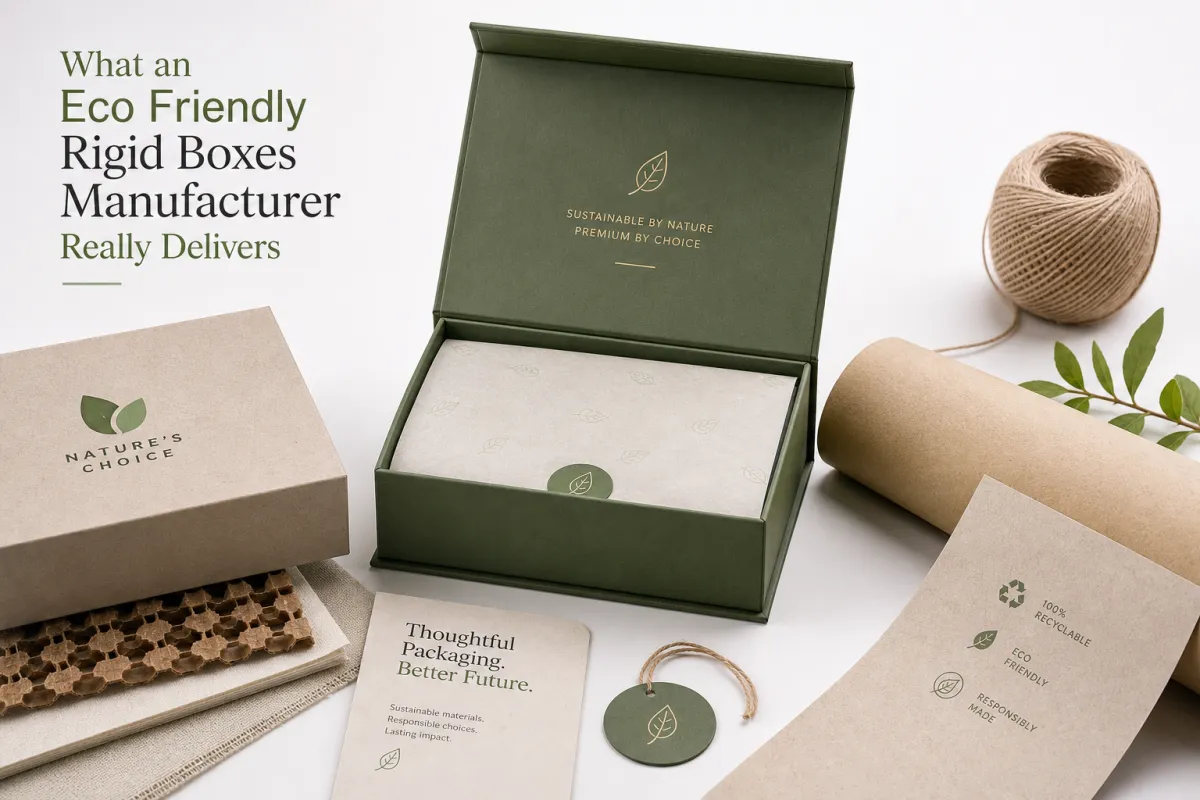
An eco friendly rigid boxes manufacturer is more than a print shop with a recycled badge in the footer. It is a packaging partner that thinks through the box from the inside out: the board core, the outer wrap, the adhesive system, the insert, and the end-of-life path. In practice, that means a box can still feel premium without being overbuilt, and it can still be practical without looking stripped down or unfinished.
Most rigid boxes begin with a paperboard or greyboard core, often around 1.5 mm to 2.0 mm for standard premium packs, with thicker builds reserved for products that truly need more crush resistance. The wrap paper may be FSC-certified, recycled-content paper, kraft stock, or another paper-first material that supports the brand story without adding unnecessary plastic film. A thoughtful eco friendly rigid boxes manufacturer will choose the lightest structure that still passes the product test, because excess board only adds weight once the structural need has already been met.
Decoration is where many buyers get nudged off course. A box can look natural on the shelf and still carry plastic lamination, a heavy foil layer, or a magnet that complicates recycling. None of those choices are automatically wrong, but each one should be chosen with open eyes and a clear reason. If the box uses three materials to impress one person, it is probably using more material than the brief really asked for.
Premium does not have to mean overbuilt. In packaging, restraint usually looks more deliberate than excess.
The difference between a standard rigid box supplier and an eco friendly rigid boxes manufacturer shows up in the details. A standard supplier may sell a beautiful outer shell and stop there. An eco-focused partner will ask whether a 2.5 mm board is truly needed, whether the insert can be paper-based instead of foam, and whether the finish can be achieved with blind embossing or an aqueous coating rather than a film layer that blocks recycling.
Certification visibility matters too. If the box is meant to use FSC-certified paper, the supplier should be able to explain chain-of-custody status without hedging. If recycled content is claimed, there should be documentation behind it. If a brand wants to describe the pack as recyclable, the supplier should be ready to explain which parts are recyclable and which parts may need to be separated first. That level of clarity is not a bonus; it is part of the deliverable.
That is the real output from an eco friendly rigid boxes manufacturer. Not just a box, but a packaging choice that can support the product, the freight budget, and the brand story at the same time without asking the customer to guess how it was made.
How an Eco Friendly Rigid Boxes Manufacturer Makes Boxes Sustainable
The sustainability question begins with structure. A rigid box is usually built in layers, and each layer gives a manufacturer a chance to improve or worsen the footprint. The core board, the wrap paper, the adhesive, the insert, and the finish all affect weight, recyclability, and how much material is consumed per unit. A capable eco friendly rigid boxes manufacturer knows the box is a system, not a single material, and the weakest choice in the stack usually decides how the pack performs in the real world.
On the core side, recycled chipboard is often the most practical option because it uses recovered fiber and still delivers the stiffness expected from rigid packaging. Many buyers also prefer FSC-certified wrap papers because they help document responsible sourcing. If the product is premium, the surface can still look refined with a tight wrap, crisp corners, and precise print. Sustainability does not require a rough finish, and a clean-looking box can still be built with responsible inputs.
Adhesives matter more than many teams expect. Water-based PVA and other low-VOC systems are commonly preferred where the build allows, because they keep the bond strong without leaning too heavily on solvent-heavy chemistry. In a similar way, soy-based or vegetable-based inks can reduce reliance on harsher formulations, although the actual environmental value depends on the full print recipe, not on the headline claim alone. The chemistry has to be read as part of the entire build, not as a marketing line cut loose from the rest of the spec.
- Paper-based inserts: molded pulp, paperboard trays, or die-cut kraft inserts usually recycle more easily than foam.
- Wrap papers: FSC-certified or recycled-content papers keep the outer layer paper-first.
- Finishes: blind emboss, deboss, and restrained spot varnish often support a premium look without adding plastic film.
- Coatings: aqueous coatings are often more recycling-friendly than full soft-touch lamination.
The tradeoffs are not abstract. Recycled board can sometimes have a slightly different surface profile than virgin board, which matters for print sharpness and color consistency. Virgin board may offer a whiter, more uniform appearance, but it usually carries a higher resource burden. Likewise, Molded Pulp Inserts can be excellent for protection and end-of-life handling, while foam may be better for shock absorption in some very fragile programs. A strong eco friendly rigid boxes manufacturer will explain those tradeoffs rather than hiding them behind a polished brochure.
There is also a premium-versus-impact balance that deserves real attention. A glossy film can make colors pop, but it often creates mixed-material packaging that is harder to recycle. An uncoated wrap with precise typography, a clean dieline, and a well-planned emboss can look more intentional than a box loaded with effects. For many brands, that cleaner look is the stronger visual choice anyway because it signals confidence rather than overstatement.
If a supplier claims FSC-certified paper, ask for the chain-of-custody details and verify the certification at FSC. The point is not paperwork for its own sake. The point is that a credible eco friendly rigid boxes manufacturer can connect every visible claim to a real material choice, and that connection should be easy to trace from the sample to the invoice.
Key Factors to Compare Before You Shortlist a Supplier
Shortlisting should begin with facts, not with the prettiest mockup. A strong eco friendly rigid boxes manufacturer should be able to show you the exact materials, the structural logic, and the proof behind its sustainability claims. If the quote says "eco friendly" but leaves the board, wrap, and finish vague, treat that as a warning sign. That kind of wording often hides more than it reveals.
Here is a practical scorecard that helps buyers compare suppliers without getting tangled in sales language:
- Material specification: Ask for board thickness, wrap paper gsm, insert material, and adhesive type. "Rigid box" alone is not enough detail.
- Certification proof: Request FSC documentation, recycled-content support, or any other certification that matters to your brief.
- Print capability: Confirm whether the plant can handle the decoration you want without defaulting to plastic lamination or excessive foil.
- Structural engineering: The supplier should know how to reduce board where possible, improve fit, and keep the product from shifting during transit.
- Insert options: Paperboard, molded pulp, and corrugated inserts are usually easier to defend than foam when sustainability is a priority.
- End-of-life clarity: Ask what the customer can realistically recycle, reuse, or separate after opening the box.
MOQ deserves more careful reading than it usually gets. A small minimum order quantity sounds attractive, but it does not automatically deliver the best overall value. If the supplier quotes a lower MOQ yet the unit price is significantly higher, or the build is heavier than necessary, the program can become expensive quickly. That is especially true for teams that have to store finished boxes for months. A slightly higher MOQ from a competent eco friendly rigid boxes manufacturer may still be the better decision if the box is lighter, easier to pack, and more consistent across the run.
Claims about "compostable" or "fully recyclable" deserve extra scrutiny. Rigid boxes are paper-based in many cases, but a paper-based box is not automatically compostable. Adhesives, coatings, magnets, ribbons, and film wraps can change the disposal story entirely. If the manufacturer uses language like "recyclable with special handling," ask what that means in plain terms. Most brands need a disposal statement that a customer can understand in ten seconds, not a claim that only makes sense in a lab report.
One more useful filter: ask for a sample that you can dissect. Peel back the wrap. Check the corners. Look at the insert. Confirm whether the finish adds a film barrier or stays paper-first. A credible eco friendly rigid boxes manufacturer should welcome that conversation because the sample tells the truth faster than the brochure does, and the build quality usually answers questions before the sales deck gets a chance.
For teams that want broader packaging context before they request samples, the structure ideas on Custom Packaging Products can help narrow the field before the first quote lands.
Eco Friendly Rigid Boxes Manufacturer Process, Timeline, and Lead Time
The production timeline is usually more predictable than buyers expect, as long as the brief is clear. A good eco friendly rigid boxes manufacturer will usually move through briefing, structural sampling, artwork approval, production, finishing, assembly, and final packing in a disciplined sequence. Delays tend to come from revisions, not from the machinery itself, and the earlier the team settles the structure, the less time gets burned in avoidable back-and-forth.
- Brief and dimensions: The manufacturer needs exact product size, weight, insert requirements, closure style, and any sustainability priorities before drawing the dieline.
- Structural sample: The first build checks fit, opening feel, and protective strength. This is where bad assumptions get caught early.
- Artwork proof: The team confirms color, bleed, barcode placement, legal copy, and finish details.
- Pre-production sample: A refined sample tests the actual materials and decoration that will be used in the final run.
- Mass production: The core board is cut, wrapped, assembled, and finished at scale.
- Final packing and inspection: Boxes are counted, bundled, and prepared for shipping with the least damage possible.
Where time gets lost is usually the same set of choices: unclear dimensions, last-minute artwork changes, insert revisions, and finish approvals. If a team changes the product after the structure has already been approved, every downstream step slows down. An efficient eco friendly rigid boxes manufacturer will push for a frozen spec before mass production starts because that protects both the schedule and the waste stream, and it also reduces the chance of paying twice for the same mistake.
Typical timing ranges are practical, not magical. A straightforward sample often takes about 5 to 10 business days, depending on dieline changes and how many components need to be checked. Full production commonly lands in the 12 to 20 business day range once the final proof is approved. Complex finishes, imported raw materials, or a large order can extend that window. Freight should be added separately, especially if the boxes are shipping overseas or moving through multiple distribution points.
Testing is a useful sign of maturity. For e-commerce or distribution-heavy programs, ask whether the supplier can test the pack against a recognized transport standard such as ISTA procedures or ASTM-based methods like D4169. The exact test protocol depends on the product, but the principle is simple: if the box cannot survive real handling, the environmental conversation is missing the biggest source of waste, which is damage, replacement, and return freight.
The fastest way to miss a launch date is to approve structure late and artwork later.
A trustworthy eco friendly rigid boxes manufacturer should be able to tell you where the clock may slip and what can be done to protect the launch. That level of transparency is usually worth more than a slightly lower quote, especially when the calendar is tight and the packaging has to arrive ready for production, not just ready for another revision cycle.
Eco Friendly Rigid Boxes Manufacturer Cost, Pricing, and MOQ
Pricing is driven by more than recycled content. The biggest cost drivers are still size, board caliper, wrap paper, print coverage, insert type, finish complexity, assembly labor, and freight weight. A modest-looking box can be expensive if it needs heavy handwork or layered decoration. A well-specified eco friendly rigid boxes manufacturer will usually break those elements out so you can see what is truly moving the number, which makes comparison much easier and keeps the conversation grounded in the actual build.
MOQ affects the Price Per Unit because setup costs get spread across fewer boxes. That is why a 1,000-piece run often costs more per box than a 5,000-piece run, even if the design is identical. In many cases, the difference is not just paper and labor; it is also inspection time, packaging setup, and the efficiency of the assembly line. If the order is small, every minute has to work harder, and the unit economics reflect that pressure immediately.
| Build | Typical unit cost at 2,000 pcs | Typical unit cost at 5,000 pcs | Best use case | Sustainability note |
|---|---|---|---|---|
| Recycled chipboard, FSC wrap, no film, paper insert | $1.05-$1.90 | $0.70-$1.30 | Beauty, wellness, accessories, gifting | Usually the easiest paper-first option to explain and recycle |
| Recycled chipboard with emboss/deboss and spot UV | $1.40-$2.80 | $0.95-$1.85 | Premium retail, limited editions, seasonal sets | Still strong if film is avoided, but finish coverage adds labor |
| Magnetic closure, soft-touch film, foam insert | $2.60-$5.00 | $1.80-$3.40 | Luxury sets, high-touch presentation boxes | Premium appearance, but mixed materials complicate disposal |
Those ranges are directional, not universal. A small jewelry box and a large candle set do not price the same way, even if both are called rigid boxes. Freight can matter as much as the box itself, especially when the board is thick or the project includes many nested pieces. A careful eco friendly rigid boxes manufacturer will quote the box, the insert, the assembly, and the shipping assumptions separately so there are no surprises later, and that breakdown is often the fastest way to spot where unnecessary cost has crept in.
When you compare quotes, ask for the exact board thickness, wrap gsm, finish type, adhesive spec, and whether sample charges or tooling charges are included. Also ask whether the sustainability claim assumes a certain region's recycling rules. If a quote sounds lower because it quietly excludes freight or hand assembly, it is not really a lower quote. It is a delayed one.
The budget rule I trust most is simple: choose the lightest structure that still protects the product. A 4 oz candle does not need the same box build as a ceramic accessory set. Overbuilding may feel safe, but it often adds cost, freight weight, and waste without improving protection in a meaningful way. That is exactly the kind of decision an eco friendly rigid boxes manufacturer should help you avoid by pointing to structure instead of padding the spec.
Common Mistakes That Undercut Sustainability and Brand Value
The biggest mistake is the one that looks eco friendly but behaves like a mixed-material puzzle. A box with plastic lamination, magnetic closures, foam inserts, ribbon pulls, and decorative sleeves may photograph beautifully, yet it creates more disposal friction than many teams expect. A seasoned eco friendly rigid boxes manufacturer will call out those tradeoffs before they become a brand problem, because the real cost often shows up after the customer has already opened the box.
Over-designing is another easy trap. The more decorative parts you add, the more the box starts to carry weight that has nothing to do with protecting the product. That extra weight matters in freight. It also matters in the customer experience, because people can usually tell when packaging is trying too hard. A cleaner build often feels more premium because it is more disciplined, and the product has room to lead instead of competing with the carton.
Vague sustainability language is a trust issue. "Eco friendly" means very little unless the supplier can explain what is actually in the box. Is the wrap paper recycled, FSC-certified, or just paper-colored? Is the insert molded pulp or foam? Is the finish an aqueous coating or a film? If a quote cannot answer those questions, it is not ready for a buyer who needs to make a defensible claim, and it is not ready for a brand that plans to publish that claim on a product page.
Fit problems are expensive in every sense. If the product shifts inside the rigid box, you may get scuffed surfaces, broken corners, or return freight. That damage can erase the benefit of a lighter box very quickly. In practical terms, one poorly fitting box that generates a return can undo the environmental win from making the structure slightly leaner. The best eco friendly rigid boxes manufacturer will test the fit before it ever talks about bulk production, because a box that fails in transit is not sustainable just because the board is recycled.
If the buyer needs three instructions to throw the box away, the design probably needs simplifying.
There is also a branding mistake that is easy to miss: some teams use eco cues so heavily that the pack stops feeling premium. A kraft wrap and sparse typography can look elegant, but only if the proportions, print alignment, and opening experience are tight. Otherwise the box reads as budget, not intentional. Sustainable packaging should not look apologetic. It should look deliberate, well ordered, and comfortable in its own materials.
That is why the strongest programs usually keep the design language calm and the material story clear. A simple structure, a precise insert, and a paper-first finish often do more for brand value than a pile of decorative extras ever will. That lesson shows up again and again when an eco friendly rigid boxes manufacturer is allowed to optimize the build instead of just filling out a spec sheet.
Expert Tips for Choosing the Right Eco Friendly Rigid Boxes Manufacturer
Start with a one-page spec sheet. It sounds basic, but it saves time and trims a surprising amount of back-and-forth. Include box dimensions, product weight, insert needs, finish preferences, target quantity, and the sustainability priorities that matter most. When a buyer does that, the eco friendly rigid boxes manufacturer can spend time engineering the pack instead of guessing at the brief, and the first round of samples is usually far closer to the target.
Ask for two sample builds if the project matters. One should be optimized for the lowest practical material use. The other should be optimized for shelf impact. Seeing both side by side is revealing. The leaner version often turns out to be more elegant than expected, and the more decorative version often exposes where the material load becomes unnecessary. That side-by-side view usually makes the tradeoff obvious long before the full order is placed.
- Request material evidence: Ask for the exact board, wrap, adhesive, and insert specs, plus any certification documents.
- Check the finish language: "Soft-touch" and "premium coating" are not enough. Ask what the finish is made of and whether it changes recyclability.
- Review the sample closely: Corners, seams, and insert fit tell you more than a sales deck.
- Compare total landed cost: Include freight, sample fees, tooling, and expected waste, not just the unit price.
- Clarify disposal guidance: The manufacturer should be able to say what the end user should remove, recycle, or separate.
It also helps to ask how the factory thinks about line efficiency. A supplier that can reduce waste at the die-cutting stage, improve nesting on the board sheet, and keep assembly straightforward is usually a better long-term partner than one that sells a heavily decorated box and calls it sustainable. The best eco friendly rigid boxes manufacturer should be able to explain both the visual impact and the material logic in plain language, because a good packaging decision should make sense to operations as well as to marketing.
For brands that want to compare packaging directions before placing a bigger run, the structure examples on Custom Packaging Products can help frame the conversation. The goal is not to settle for less. The goal is to remove avoidable material while keeping the product protected and the presentation sharp. That is the point where a premium pack starts to earn its footprint instead of merely occupying it.
If you want a practical shorthand, use this: choose the box that still feels intentional after you remove the decorative noise. An eco friendly rigid boxes manufacturer that gets that balance right will leave you with a box that looks calm, costs less to move, and says more about the brand than a louder design ever could.
Frequently Asked Questions
What should I ask an eco friendly rigid boxes manufacturer about materials?
Ask for the exact board type, wrap paper, adhesive, ink, and insert material rather than a broad sustainability claim. If recycled content or FSC certification matters to your brief, request the supporting documents. Also confirm whether coatings, foils, magnets, or plastic components will affect recyclability. A clear answer from an eco friendly rigid boxes manufacturer should sound specific, not vague, and it should match the sample in your hands.
Are eco friendly rigid boxes more expensive than standard rigid boxes?
They can be, especially if you use specialty papers, custom inserts, or small order quantities. The biggest price drivers are size, finish complexity, labor, and freight weight, not recycled content alone. Costs often improve when the structure is simplified and the order volume increases. In many cases, a well-run eco friendly rigid boxes manufacturer can reduce total spend by trimming unnecessary layers and removing work that does not add protection.
How long does production usually take with an eco friendly rigid boxes manufacturer?
Sampling commonly takes about 1 to 2 weeks, depending on structural revisions and artwork approvals. Full production often follows in 2 to 4 weeks after approval, though complex finishes can extend that window. Shipping time should be added separately, especially for overseas production. A responsive eco friendly rigid boxes manufacturer will tell you where the timing risk sits before the order is placed, which helps keep the launch calendar realistic.
How do I verify that a manufacturer is truly eco friendly?
Ask for material specifications, certification documents, and a plain explanation of what makes the box recyclable or reusable. Review whether the supplier uses efficient construction, low-impact inks, and minimal mixed materials. Look for consistency between the claims, the sample quality, and the written quote. If the story changes from one document to the next, the eco friendly rigid boxes manufacturer is not yet giving you a complete picture.
Can rigid boxes still look premium if they are designed to be more sustainable?
Yes. Premium feel often comes from structure, fit, and print quality rather than heavy decoration. Paper-first finishes, sharp construction, and precise inserts can create a cleaner look than foil, plastic lamination, or bulky hardware. A well-built eco friendly rigid boxes manufacturer can make a box feel restrained, precise, and still premium, which is why the best projects often look simpler, not louder. If you are comparing vendors, ask for a cut-open sample and a written material breakdown before artwork approval; that one step filters out most vague claims and gives you a practical basis for choosing the right build.