Electronics Recycled Poly Mailers Bulk Order Planning Tips
If you are handling electronics recycled poly mailers Bulk Order Planning, the real decision is not price alone. The mailer has to fit the product, survive normal handling, present the order cleanly, and make reorders predictable. A bag that saves a fraction of a cent but causes splits, print defects, or packing delays is not a bargain. It is a hidden cost with a cleaner invoice.
Why cheap mailers fail electronics shipments
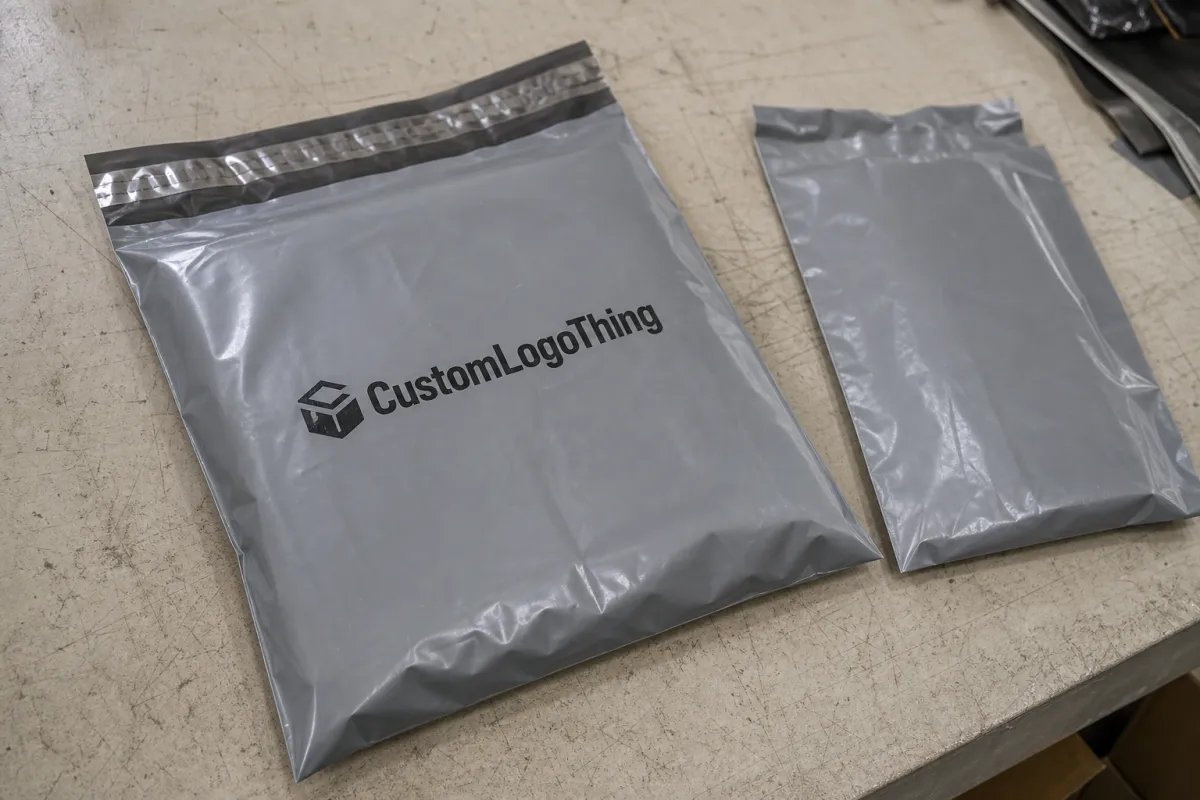
Electronics accessories are easy to underestimate. A cable kit looks light, a charger seems harmless, and a bundle of adapters appears simple enough to toss into almost any mailer. Then a corner punches through the film, a seal lifts in transit, or the package arrives with wrinkled branding and a loose fit that makes the whole shipment feel cheap. None of that is dramatic. It is just expensive.
The mistake is usually assuming every recycled poly mailer is interchangeable. They are not. Film thickness, seal integrity, opening style, and sizing all affect whether the bag handles the job or creates more work for fulfillment, returns, and customer support. For electronics sellers, the package has to do more than close. It has to close consistently, hold up under sorting, and present the product like someone cared about the order.
That is why buyers should start with the load, not the catalog photo. Measure the packed product, think through handling, and decide what the package has to protect on the way from warehouse to customer. The lowest quote is only useful if the bags arrive usable.
- Thin film can split on square edges, taped bundles, and hard corners.
- Poor seals can open under pressure or during sorting.
- Wrong sizing can leave slack that makes packing look careless.
- Weak print quality can make a clean product line look underdeveloped.
Practical rule: a mailer that saves money on paper but creates returns, repacks, or damage claims is costing more than it saves.
If your packaging mix is broader than mailers alone, it helps to review the full Custom Packaging Products range before settling on a shipping format. Some electronics lines do better in lightweight mailers, while others need a stiffer outer layer because the product edges or retail boxes are doing most of the protection work.
How recycled poly mailers fit cables, chargers, and kits
Recycled Poly Mailers are a strong fit for compact electronics because they are light, fast to pack, and easy to size around the finished bundle. They suit cable sets, charging accessories, adapters, earbuds, small peripherals, and bundled kits that do not need rigid corner protection. For many e-commerce operations, that makes them a practical alternative to cartons that are oversized for the product.
They also simplify packing. A box usually means more tape, more fillers, and more labor. A mailer can be sealed in seconds. That difference matters once the order line is busy and every extra motion slows throughput. On a thousand small shipments, a few saved seconds per pack becomes real labor capacity.
There are a few formats worth comparing before you place a bulk order:
- Flat mailers for slim accessories and single-item shipments.
- Gusseted mailers for thicker bundles and kits with more depth.
- Opaque film for privacy and a cleaner branded look.
- Tamper-evident seals for retail confidence and reduced pilfer risk.
- Printed mailers for logo placement and consistent brand presentation.
The format should follow the product, not the other way around. A soft cable bundle may travel perfectly well in a flat bag. A charger set with hard edges may need a gusset, and fragile components may still need an insert or inner cushion. That is not overpackaging. It is basic risk control.
For teams comparing shipping formats, Custom Poly Mailers are worth reviewing alongside your carton program. In several product lines, the mailer does the job at lower material cost and with less warehouse handling. The savings are often stronger than buyers expect once freight and labor are included.
Recycled content deserves precise language. Recycled does not mean compostable, and it does not remove the need to check local recycling rules or customer messaging. The U.S. EPA provides a clear reference on recycling basics at epa.gov/recycle.
Spec choices that control strength, appearance, and waste
Once the format is decided, the specification does the heavy lifting. Size, thickness, recycled content, seal style, and print coverage all affect cost and performance. If one of those is mismatched, the order becomes harder to pack, easier to damage, or more expensive than it should be.
Thickness is usually the first number buyers ask about, and for good reason. Many lightweight electronics accessory mailers fall around 2.5 to 3.0 mil. Denser kits, rougher distribution lanes, or products with sharp edges may need more. There is no universal answer. A 3 mil bag can be excessive for a soft cable pack and still too light for a dense charger bundle. The product profile decides.
Size deserves the same attention. Measure the finished packed dimensions, not the loose retail item. Teams often oversize because they are looking at the product before it is bundled, sealed, or boxed. That adds extra film, increases storage footprint, and leaves the package with too much slack. A bag that is technically large enough can still be the wrong bag if it wastes material and looks sloppy.
Print choices change both price and lead time. One-color branding is usually the most efficient option for bulk orders. It keeps setup simpler, makes alignment easier to control, and often gives the cleanest result for a shipping bag. Full-coverage graphics can look strong, but they add complexity. If the bag only needs a logo, a return prompt, or a simple message, there is no reason to buy a billboard.
Here is a practical way to compare common options:
| Option | Typical use | Typical spec | Pros | Tradeoff |
|---|---|---|---|---|
| Stock unprinted | Internal fulfillment or price-sensitive runs | 2.5-3.0 mil, standard sizes | Lowest MOQ, fastest lead time | Limited branding |
| One-color printed | Most e-commerce accessory shipments | 2.75-3.5 mil, custom logo | Good balance of cost and appearance | Artwork and setup added |
| Heavy-duty custom printed | Denser kits or rougher shipping lanes | 3.5 mil and up, stronger seal | More protection, stronger presentation | Higher unit cost |
Waste is another quiet cost. A mailer that fits well reduces material use, shipping bulk, and storage space. A slightly oversized bag may look harmless in a sample, but multiplied across a bulk order it creates plastic waste and freight drag. The smarter move is to size around the packed bundle, then test a sample before ordering at scale.
Pricing, MOQ, and landed cost
Pricing only makes sense in context. A quote is shaped by size, thickness, recycled content, print method, order quantity, freight, setup, and how much inventory the buyer is willing to carry. Ignore those pieces and the number on the page can be misleading.
Broadly, buyers can expect the lowest minimums and simplest pricing on stock, unprinted bags. Custom Printed Mailers usually raise the minimum and add setup cost. Heavier bags and special print requirements tend to push minimums upward again. That is normal. Print complexity, not just raw material, drives the order economics.
For planning purposes, a small basic run might sit around $0.08-$0.18 per bag for stock or lightly customized mailers. Printed custom runs often land closer to $0.14-$0.30 per bag, depending on size, thickness, and quantity. Larger commitments can lower the unit price, but only if freight, storage, and waste do not erase the savings. The landed number matters more than the headline number.
Buyers should ask for the pieces that often get left out of the first quote:
- Sampling or pre-production proof
- Artwork setup or plate prep
- Freight to the receiving warehouse
- Rush fees if the schedule is tight
- Reject allowance for seal or print defects
MOQ is usually lower for stock bags and higher for custom printed work, especially when the size is unusual or the color requirements are exacting. If the bag will be reordered on a regular schedule, a slightly higher minimum can be the better deal because it reduces the number of reorders and usually improves unit economics.
A useful buying habit is to request tiered pricing at several quantities. That reveals the break point where a larger buy starts to make sense. If your procurement process already compares volume bands across categories, checking Wholesale Programs can help you see how inventory tiers affect packaging families as a whole.
For electronics sellers, consistency matters as much as unit cost. Stable film, predictable seals, and repeatable print placement reduce waste later. One defective batch can erase the advantage of a lower quote. That is especially true in high-volume fulfillment, where even a small defect rate has a long tail.
Process and lead time for a clean bulk run
A reliable bulk run follows a familiar sequence. First comes the spec review. Then artwork verification. Then sample or proof approval. After that, production, inspection, and shipment. Skip one of those stages and the order usually pays for it in delay, rework, or a batch that needs correction after it is already in motion.
Lead time depends heavily on order type. Stock, unprinted bags can move faster because they do not require the same approval cycle. Custom printed orders take longer because the artwork must be checked, the print setup prepared, and the finished product inspected. For planning purposes, 10-20 business days after proof approval is a reasonable window for many custom runs, though larger or more complex orders can take longer.
The approval step is where schedules often slip. A file that sits for several days waiting on internal sign-off is no longer a standard order. It has become a deadline problem. Build backward from the receiving date, not the PO date. If the product has a launch window or a seasonal peak, work from that date first.
Freight deserves its own line in the plan. A bag can be produced on time and still arrive late if shipping was never pinned down. Transit time depends on service level, destination, and warehouse receiving rules. If your fulfillment center needs cartons on a specific day, say so early and get the shipping method in writing.
Three written checkpoints reduce most surprises:
- A dated production schedule.
- The shipping method and transit estimate.
- The sample or proof approval deadline.
That is the kind of basic control that keeps electronics bulk mailer planning from turning into a rushed scramble.
If your team uses package testing or performance standards as part of procurement, ISTA has useful reference material at ista.org. You do not need to turn packaging buying into a lab exercise, but you should know whether the bag can survive ordinary handling without adding avoidable damage claims.
What a dependable bulk supplier should prove before production
Not every supplier that can print a logo can support a repeatable electronics program. The difference shows up in batch consistency. A dependable partner can keep film thickness stable, sizing repeatable, seals consistent, and print quality aligned from one run to the next.
That sounds obvious until it fails. Buyers notice the problems only after the reorder arrives and the new shipment looks different from the last one. Maybe the color shifted. Maybe the artwork was saved incorrectly. Maybe the package was manufactured from a different material lot without clear notice. None of that helps a fulfillment team trying to keep orders moving.
A serious supplier should be able to show:
- Pre-production samples or proofs before the run begins.
- Saved artwork files with clear version control.
- Incoming material checks for recycled content and film consistency.
- Final inspection photos or sign-off before shipment.
- Reorder history so repeat jobs do not start from scratch.
Communication matters here as much as the manufacturing process. If the ship date changes, if the label area needs to move, or if the mailer size needs to shift for a new accessory bundle, the supplier should answer directly. Vague promises do not help anyone. Clear answers protect the budget.
It also helps when the supplier asks practical questions instead of talking only about price. What is the packed weight? Are there sharp edges? Is the item boxed already? Is the order one SKU or several? Those questions are not busywork. They are the difference between a mailer that works and one that looks fine until the first thousand units are in circulation.
How to lock artwork, sample, and ship date
The cleanest way to buy is to send the spec before asking for the quote. Include the packed dimensions, target quantity, print file, recycled content preference, and required arrival date. That gives the supplier enough information to quote the right bag rather than guessing from a retail box size that may not reflect the finished bundle.
Then ask for two or three comparable options. One should usually be the lowest-cost version. One should be the balanced option. A third can be the heavier or more premium build. That spread makes the tradeoffs visible. In bulk planning, visibility beats assumptions every time.
A simple internal checklist prevents the common mistakes:
- Confirm budget and quantity band.
- Approve artwork dimensions and logo placement.
- Verify carton counts and warehouse receiving rules.
- Check seal style and opening direction.
- Request a sample or pre-production proof.
If the product has sharp edges, mixed accessories, or a finish that scratches easily, do not skip the sample. A mailer can be the right format and still be the wrong spec. Measure, sample, confirm, then place the bulk order.
One more practical point: keep the reorder file clean. Save the final art, the approved size, the film thickness, and the quantity tier together. A good reorder file prevents drift, and drift is where many packaging programs lose consistency.
What size should I choose for electronics recycled poly mailers in bulk?
Start with the packed bundle, not the loose product. Measure the finished dimensions after any internal packaging, inserts, or retail boxes are included. If the bundle has depth or an uneven shape, compare flat and gusseted options before you commit.
What affects pricing most for recycled poly mailer bulk orders?
Size, thickness, recycled content, print complexity, and total quantity drive most of the cost. Freight, setup, and proofing can shift the landed price more than buyers expect, especially on smaller runs. Tiered quotes make the break points easier to see.
What MOQ is normal for custom printed electronics poly mailers?
Stock, unprinted bags usually have the lowest minimums. Custom printed orders tend to require higher MOQs because of setup and production scheduling. If the order will repeat, a slightly higher MOQ can improve the long-term unit cost.
How long does lead time usually take for bulk mailer production?
Lead time depends on whether the order is stock or custom printed, plus the time needed for proof approval and shipping. Many custom runs take about 10-20 business days after proof approval, though larger jobs can take longer. Freight and warehouse receiving rules can add time.
Are recycled poly mailers strong enough for electronics accessories?
Yes for cables, chargers, adapters, and similar compact accessories when the film thickness matches the load. Heavier kits or products with sharp edges may need thicker film or inner protection. Fragile hardware should still be tested in sample form before bulk production.


