For coffee roasters, winter merch has to do two jobs at once: sell well and survive real use. A ribbed beanie handles both better than most seasonal items because it is visible, practical, and worn in public long after the first cold snap. That is why coffee roaster ribbed winter beanies Bulk Order Planning deserves more than a quick merch decision. It affects inventory, margins, staff presentation, and how consistently the brand shows up across counters, retail shelves, and wholesale boxes.
The strongest orders usually start with constraints, not design mood boards. Quantity, decoration method, color, and in-hand date shape the entire project. If those four items are set early, the quote is more accurate, the sample review is more useful, and the final run is less likely to drift into expensive revisions. A good beanie order is planned like a small production line, not treated like a last-minute accessory buy.
A winter beanie is one of the few merch items that can move from employee uniform to retail product to customer gift without changing form. That versatility is what makes it valuable.
Coffee Roaster Ribbed Winter Beanies Bulk Order Planning
Bulk planning begins with the use case. A roaster outfitting ten staff members is not buying the same thing as a roaster stocking a retail wall, shipping holiday bundles, and supporting wholesale partner gifts. The product can be identical, but the order structure should not be. Separate those quantities before requesting pricing. A single run might include 30 staff units, 100 retail units, and 25 reserve units, but each portion serves a different purpose and may need a different cost assumption.
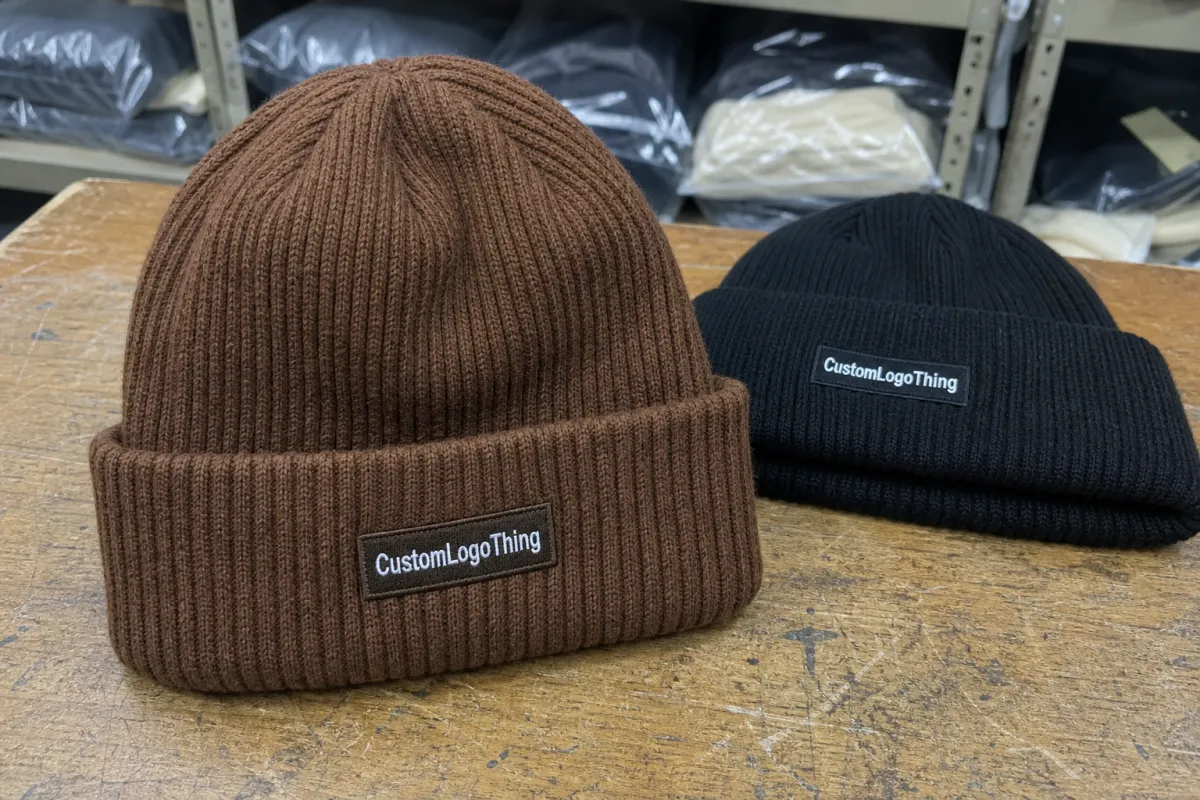
Ribbed beanies work because the fabric does some of the branding work for you. The texture gives the hat shape, the cuff gives the logo a stage, and the knit reads as winter-appropriate even before the mark is added. Compared with flat knit or novelty headwear, ribbed construction holds up better in everyday wear and tends to look more finished on a display hook. That matters for coffee brands, where the merch table often sits beside bags, mugs, and tote bags competing for attention.
Color choice deserves more attention than it usually gets. Black, heather gray, oatmeal, navy, and forest green are common because they pair easily with printed bags and packaging. They also age better in retail photos. Bright seasonal colors can work for a short campaign, but they narrow the audience and can make reorders harder if the lot runs out. For a program meant to last beyond one holiday season, restrained colors usually produce better sell-through.
It helps to think in terms of inventory lanes:
- Staff wear: practical quantity, usually the simplest decoration and fastest turnover.
- Retail stock: units meant to sit on a shelf or ship through e-commerce.
- Promotional reserve: replacements, wholesale gifts, event giveaways, and seasonal reorders.
That split affects more than pricing. It changes how much packaging is needed, whether the decoration should be subtle or retail-ready, and how much buffer should be built into the schedule. For example, a 200-piece run with 140 retail units and 60 staff units may need different carton labeling or packing notes than a pure apparel run. Planning those details up front prevents small operational annoyances from turning into delays.
There is also a timing reality that many first-time buyers underestimate. Winter merch is seasonal, which means the useful selling window is short. If the hats are supposed to arrive for a first-frost launch, a November trade show, or a December counter display, the order should be built backward from that date. Leave time for proofing, sample review, production, and shipping. A rushed order almost always costs more, and the extra expense usually shows up in freight or shortened QC rather than in the beanie itself.
If your merch program includes recurring seasonal goods, it is easier to align the hat order with a broader wholesale rhythm. Our Wholesale Programs page is a practical starting point for understanding quantity tiers and reorder planning.
Ribbed Winter Beanie Details That Affect Fit and Wear
Ribbed construction is not just a visual choice. It changes stretch, recovery, and how the hat sits after repeated wear. A ribbed knit generally returns to shape better than a looser plain knit, especially around the cuff where logos usually live. That recovery matters because a beanie that looks sharp on arrival can still become slouchy or misshapen after a few wears if the yarn is too soft or the knit is too shallow.
Material selection is the next major decision. Acrylic is the most common wholesale option because it is cost-effective, warm enough for most climates, and easier to produce in a wide color range. Wool blends usually feel more premium and retain warmth well, but they can add cost and require more careful finishing. Recycled yarns have grown in popularity, especially for brands with sustainability messaging, though performance depends on the actual fiber mix and density rather than the marketing label.
| Material | Typical Use | Buyer Benefit | Watchout |
|---|---|---|---|
| Acrylic | Staff wear, larger retail runs | Lower cost, broad color selection, straightforward decoration | Can feel thin if knit density is low |
| Wool blend | Premium merch and resale | Warmer feel, stronger retail perception | Higher price and more care sensitivity |
| Recycled yarn | Sustainability-led programs | Supports environmental positioning and retail storytelling | Color and texture can vary slightly by lot |
Fit is the detail that gets noticed after delivery. A beanie that sits too shallow exposes ears and looks undersized. One that runs too deep can collapse and feel bulky under a hood. The sweet spot is usually a cuff and crown that work across a wide range of head sizes without stretching out after one afternoon. For buyers, that means asking for finished dimensions rather than relying on vague descriptors like “standard fit.”
Cuff height also affects the decoration area. A taller cuff creates more room for a logo or patch, but it can visually shorten the crown if the proportions are off. A shorter cuff can look cleaner and more modern, though it leaves less space for branding. The best choice depends on the size and complexity of the artwork. A simple one-color mark often performs better at a smaller size than a detailed logo forced into a large patch area.
Seam finish deserves attention too. Inside seams are rarely seen on a product page, but they matter in daily wear. Rough finishing can irritate skin, twist the hat on the head, or make the item feel cheaper than it should. If the beanies are meant for retail, that inside feel matters. People touch winter hats before they buy them. A quick palm test often reveals what the marketing copy cannot.
Packaging and transit can influence the final presentation more than expected. Hats that are folded too tightly may show a permanent crease in the cuff. Labels can curl if the carton is too compressed. If paper inserts or hang cards are included, the carton spec should protect them so the beanie arrives shelf-ready rather than needing to be reworked. Industry groups like the International Safe Transit Association provide useful standards for shipment testing, especially when multiple components are packed together.
Specs to Lock Before You Approve Samples
The sample stage only helps if the specification is complete. Approving a hat before the yarn, gauge, dimensions, and decoration plan are fixed tends to create more revision cycles later. Start by locking the fiber composition, knit weight, finished measurements, cuff depth, and color target. If the order uses Pantone matching, send the reference early. If it relies on stock colors, confirm the exact shade and ask whether the lot is current or backordered.
Artwork should be cleaned up before quoting, not after. Small type, thin lines, and crowded details do not hold up well on ribbed fabric. Embroidery can work beautifully on a strong, simple logo, but it gets messy fast when the art has too many color changes or tight corners. In those cases, a woven patch or leather patch may preserve the design better. That is not a style preference; it is a production decision. Ribbed fabric shifts under stitch tension, and the decoration method needs to account for that movement.
Before approving a sample, check the following:
- Does the beanie fit comfortably across a range of head sizes?
- Does the cuff sit flat enough for the logo to read clearly?
- Does the knit recover after being stretched and folded?
- Does the color look right under indoor light and daylight?
Decoration size matters more than many buyers expect. A logo that looks clean at 2.25 inches wide may start to fray visually at 4 inches if the knit is too soft or the artwork too detailed. The same is true for patch placement. A patch placed too low can disappear under the cuff fold, while one placed too high can make the hat feel top-heavy. The goal is not maximum logo size. It is readable branding that still looks like a wearable winter item.
Ask about decoration limits before the proof is approved. Some suppliers can handle more stitch density than others, and some blanks support a patch better than direct embroidery. A buyer who understands those constraints early usually gets a cleaner result. That is especially true for coffee roaster ribbed winter beanies Bulk Order Planning, where the same item may need to work for staff uniforms, retail shelves, and partner gifts without changing design language.
For packaging components like hang tags, inserts, or mailers, paper certifications can matter if your brand is making sustainability claims. The FSC standard is worth knowing for any paper-based piece in the order. It does not affect the knit itself, but it can shape how the full package is perceived.
Cost, Pricing, and MOQ for Wholesale Beanie Orders
Quote comparisons are easy to misread if they focus only on unit price. For a winter beanie order, the more useful number is landed cost: blank hat, decoration, proofing, packaging, sample shipping, freight, and any reserve for replacements. A quote that looks lower can end up higher once extras are added. Buyers usually discover this after the first sample round, when the shipping line item arrives and the “cheap” option stops looking cheap.
The biggest price drivers are consistent across most runs. Thicker knits cost more than lightweight blanks. One-color embroidery is usually less expensive than multi-color decoration. Woven patches, custom labels, and individual polybagging add labor. Rush freight can move the final total more than the decoration choice itself. A difference of $1.50 per unit may sound small on paper, but across 300 units it is real money. Across 1,000 units, it becomes a budget line worth managing carefully.
Typical wholesale ranges for custom Ribbed Winter Beanies often fall here:
- Basic acrylic blank: about $3.50-$5.50 per unit at larger quantities.
- Decorated acrylic version: about $5.50-$9.50 per unit depending on stitch count and finish.
- Premium wool blend or recycled yarn style: often $7.50-$12.00 per unit before freight.
MOQ should be treated as a planning variable, not just a hurdle. Lower minimums are useful for testing a new design or seasonal color, but setup costs are spread over fewer hats, which raises the per-piece price. Larger runs tend to improve efficiency because digitizing, proofing, machine setup, and packing labor are used across more units. That is why a 150-piece order can look very different from a 500-piece order even when the hat design is unchanged.
There is usually value in budgeting a small replacement allowance. A 3% to 5% buffer is often enough for transit damage, sizing oddities, or reserve stock. That reserve is especially helpful for winter merch because the best-selling sizes and colors can disappear quickly once the weather turns. Running out mid-season creates a merchandising gap that costs more than the spare units would have.
Process and Timeline: From Quote to Delivery
Most delays happen before production begins. The clean sequence is request, quote, proof, sample if required, approval, production, quality check, and shipping. Each stage can stall for a different reason. Quotes slow down when the quantity split is unclear. Proofs stall when logo files are incomplete. Production slips when internal approvers keep changing the brief after the order has already been queued.
A realistic timeline depends on stock availability and decoration complexity. A straightforward single-color ribbed beanie can move faster than a mixed-color or mixed-decoration run. If the blank color is in stock and the logo is simple, a job may finish in roughly 12 to 15 business days after proof approval. Add more time for customs, holiday congestion, or special packaging. If the hats need to arrive by a fixed launch date, the safest move is to finalize artwork and quantities early enough that production is not fighting the calendar.
Shipping method is part of the timeline, not an afterthought. Ground freight is usually cheaper and more predictable for domestic routes. Air freight compresses the schedule, but the cost can rise quickly, especially on heavy cartons. Buyers sometimes plan the decoration lead time carefully and then undercount transit. That mistake is common, and it is avoidable. A product that finishes on time but arrives late still misses the launch window.
Internal approval discipline matters more than many teams expect. If multiple people need to review artwork, assign one owner to consolidate edits. Set a hard deadline for mockup sign-off, quantity confirmation, and shipping addresses. Suppliers cannot proceed while a note thread is still open, and every day of indecision pushes the schedule into a more expensive lane. In practice, slow internal approvals are one of the most frequent reasons winter merch misses the season.
Quality control should be specific, not vague. Check stitch tension, patch adhesion, cuff fold, decoration placement, color batch consistency, and carton count. If the order includes tags or inserts, verify those against the packing list before the shipment leaves. A missing ten-card insert or a mislabeled carton seems minor until it lands on a retail shelf. QC is less about perfectionism than protecting margin and avoiding repacking labor later.
Why Custom Beanies Outperform Off-the-Shelf Winter Merch
Off-the-shelf blanks are useful for emergency replenishment. They are not as strong when the beanie needs to represent a brand consistently across multiple touchpoints. Custom production gives control over color, fit, decoration size, packaging, and repeatability. That consistency matters for coffee roasters because the merch usually sits beside a highly recognizable visual system already. If the hat feels random, it weakens the overall presentation.
There is also an operational advantage. Staff can wear the same item across locations without awkward color mismatches. Retail teams can reorder the same style without redesigning the product each season. Wholesale partners can receive a branded item that looks deliberate inside a gift bundle instead of improvised. That predictability is especially useful for small teams that do not have time to rework inventory every winter.
Custom hats also photograph better. A ribbed beanie that holds its cuff and logo position reads clearly in product shots, in store displays, and on social media. The product does not need to be flashy to be effective. It needs to be coherent. Clean branding on a well-shaped hat tends to outperform a louder design with poor structure because customers trust items that look considered.
Another practical advantage is resale value. A retail customer is more likely to pay for a hat that feels like part of the brand system rather than a generic blank with a logo added at the last minute. The difference usually comes down to proportions, texture, and finish. Those details are measurable, and they are the reason a custom order can support a higher margin than an off-the-shelf alternative.
For coffee brands, the point is not novelty. It is visibility through winter. Staff wear the hats. Guests notice them. Wholesale partners see them in bundled orders. That repetition creates familiarity without needing a separate campaign for every channel.
Next Steps to Place a Bulk Order Without Delays
Start with a demand audit. Count staff units, estimate retail demand, list giveaway needs, and add a replacement buffer for lost or damaged stock. That gives you a quantity range before quoting starts. If the order includes multiple uses, decide whether each use needs the same color and decoration or whether the staff version can stay simpler than the retail version. Those small decisions can change MOQ, pricing, and lead time.
Then gather the assets that move the order forward: logo files, preferred colors, quantity breakdowns, packaging notes, and the target in-hand date. If multiple decoration methods are under consideration, ask for pricing on each one in the same quote. Comparing a patch version to embroidery is only useful if freight, proofing, and setup are included in the same calculation.
Keep the approval path short. One person should own final sign-off. If three people are revising the mockup independently, the timeline gets softer and the price usually gets worse. Winter merch is not forgiving of delay. By the time the weather turns, suppliers are already moving through a crowded calendar.
The clean sequence is simple:
- Request a quote with exact quantity splits and decoration details.
- Review the proof for size, placement, and color accuracy.
- Approve the sample only after checking fit, stretch, and logo visibility.
- Confirm the production schedule and shipping plan before the run begins.
If the goal is a dependable seasonal item that supports the brand without creating operational noise, ribbed beanies are a strong fit. The best orders are the ones that define the spec early, keep the decoration clean, and allow enough time for proofing and transit. That approach makes coffee roaster ribbed winter Beanies Bulk Order Planning feel less like a scramble and more like a controlled part of the merch calendar.
How many coffee roaster ribbed winter beanies should we order for a first run?
Base the first run on staff count, expected retail sell-through, and any planned giveaways or wholesale bundles. Add a small reserve for replacements and size preference. For a new design, a conservative order is usually safer than overbuying, especially if the brand has not sold winter headwear before.
What decoration method works best for ribbed winter beanies in a coffee roaster order?
Embroidery works well for simple logos, while woven patches or leather patches are better for designs that need sharper edges or stronger contrast. Ribbed fabric moves under tension, so the decoration method should match the knit and the artwork. If the logo is detailed, a patch often produces a cleaner result than forcing too much into direct stitching.
Can we mix colors or logo placements in one bulk beanie order?
Often yes, but mixed colors can affect MOQ, unit price, and production timing depending on blank availability. Multiple logo placements usually make the run harder to manage, so keep the variations limited if speed matters. Ask for the cost impact before approving a split order.
What drives the unit cost of custom ribbed winter beanies?
Material choice, stitch density, decoration method, packaging, and freight are the biggest drivers. Larger quantities usually lower the per-unit cost because setup expenses spread across more hats. Rush timing and air shipping can increase the final number quickly, so always estimate landed cost rather than blank price alone.
How far ahead should we plan coffee roaster beanie production?
Build enough time for quoting, proof approval, production, and shipping before the desired launch date. A simple in-stock run can move fairly quickly, while custom materials or mixed decoration add more lead time. For winter launches, early planning is usually the difference between a shelf-ready arrival and a missed season.